

Need to clean my washing machine
I have a front loader LG. I recently washed several rag rugs that had lots of hair on them from the cats, so after they were done I cleaned out the lint trap, but I noticed that there seemed to be quite a bit of hard crusty build-up in the place the lint trap pulls out of and some on the trap itself. We have very hard water here, so I'm betting that along with maybe some detergent residue has caused this.
I want to run a cleaning cycle, but I want to add something that will help "eat" away this crusty build-up. I know many recommend vinegar and I use that in most rinse cycles, so I'm thinking I may need something stronger. In the past I think I remember reading that you could use a citric acid based product, even lemon flavored Kool-Aid. If anyone can give me advice on a simple product like that and amount to use, I would really appreciate it. I need it to be an easily found product, as there aren't many resources near by to find other types of products.
Comments (58)
 11 years ago
If you have a wonky Tub Clean cycle that dumps the water after only a few minutes instead of vigorously throwing it around - use the hottest and longest cycle possible, such as Sanitary. Normal is typically made to achieve the lowest energy consumption, which means as little hot water as possible.
i_dig_it
Original Author11 years agoI wonder if I could use Tub Clean to fill it with hot water, then turn it off and restart it at a different wash cycle. Or would it empty out? I don't have a sanitary cycle. How would I know which cycle uses the most hot water?
Related Professionals
Hopkinsville Kitchen & Bathroom Designers · Virginia Beach Kitchen & Bathroom Designers · Morgantown Kitchen & Bathroom Designers · Yuma Kitchen & Bathroom Designers · Augusta Bathroom Remodelers · Jacksonville Bathroom Remodelers · Oklahoma City Bathroom Remodelers · Moline Bathroom Remodelers · Wausau Bathroom Remodelers · Cheyenne Bathroom Remodelers · Tampa Cabinets & Cabinetry · Rocky Mount Cabinets & Cabinetry · Tyler Cabinets & Cabinetry · Harrisonburg Cabinets & Cabinetry · Superior Cabinets & Cabinetryi_dig_it
Original Author11 years agoMy machine is an LG model WM2016CW. The cycles it has are Cotton/Towels, Normal, Perm Press, Delicates and Hand Wash. I normally use the Perm Press cycle because I've found it seems to use a little more water. I looked through the manual, but could find no where that stated which cycle would use the most hot water.
- 11 years ago
With the small amount of water going into front loader without heater, it probably won't matter much because the water will end up cold very quickly. You could either start and cancel a few hot Cotton/Towels cycles after a few minutes each to preheat the drum and tub before running the actual cleaning cycle - or, after the washer has finished filling, pour a pot of boiling water in the drum.
Have you checked to see whether the Tub Clean indeed dispenses the cleaner in the first fill without ever spinning the solution around during the cycle? i_dig_it
Original Author11 years agoAs per the instructions on the LemiShine, I poured the packet of cleaner directly in the tub, so it was in the tub, didn't go through the dispenser. When I do hot loads, I run the hot water in my laundry sink, which is right next to the washer, to ensure the water is already hot when the machine starts to fill. I know the drum is still cold, but at least the water is already hot when it starts filling.
I might try filling the machine with the Tub Clean cycle, then cancel and restart it on the Cotton/Towels cycle, just to see if it will empty out or not before I even use the LemiShine again.
One good thing is that there is no odor or nasty gunk inside the machine. The rubber gasket is still clean and supple. I always dry it off and leave the door open. I learned that much through making the mistake of not doing so with my old Maytag Neptune.
I mainly want to make sure there isn't any hard water deposits building up in places unseen, since I noticed some on the lint trap. I wonder if it could also be detergent residue. I try to be very careful about not over dosing with the detergent. I use powder detergents, no softener, sometimes vinegar in the softener dispenser. 11 years ago
If you are adventurous, another option would be to access the QC Test Mode as instructed by the Service Manual for the LG WM2016CW (page 15). It looks like you can activate the hot water fill, then make the tub rotate clockwise and counterclockwise, and get a reading of the water temperature. If nothing else, this may let you fill the machine with hot water straight up, get out of the test mode, then start a standard wash program.
Here is an inspiring video of a self-made cleaning cycle (credit to whirlpool_trainee).
i_dig_it
Original Author11 years agoI found this "recipe" for cleaning front loading machines.
- 2 cups vinegar
- 1/4 cup baking soda
- 1/4 cup water
- Mix the water and baking soda together and put in the detergent dispenser. Pour the vinegar directly in the drum. Start a long cycle with the hottest water setting. Supposed to break up mineral deposits, clean mold and freshen machine. Use once a month.
 11 years agolast modified: 11 years ago
Baking soda and vinegar neutralize one another, use baking soda in the wash cycle and vinegar in the rinse cycle. You can substitute citric acid for vinegar, I prefer citric acid because it doesn't stink.
- 11 years ago
Bumping because I need advice on cleaning a really grody washer.
My parents' tenant just moved out and I went over there to do a walk through on the house. Everything is clean except the washer. It's a newish f/l samsung model that doesnt do well with liquid detergent, at least with hard water. She left her cleaning stuff behind so I know she was using liquid, (even though she was told it needed powder), and from the looks of it she was overdosing the detergent and not doing hot washes or running the tub clean cycle. There is a thick coating of scale and soap scum all over the drum, the gasket drain holes were clogged with soap scum and hair, and I'm assuming the outer tub is equally nasty.
I told my mom I'd make a start on cleaning it since they can't get over there until next week. I have a feeling it's going to take more than just the hot wash with citric acid that I use to clean my machine to deal with all the gunk.
I have citric acid, vinegar, tsp, oxiclean, chlorine bleach and dish detergent on hand. My tentative plan of attack is to clean out the detergent dispenser and drain trap, remove the hairball from the gasket and run the tub clean cycle with citric acid. If that doesn't get rid of most of the buildup, repeat or switch to tsp to attack soap buildup. I know that you aren't really supposed to use TSP in a washer, but I don't have any stpp and I doubt a one time shock treatment would be a problem. Once the drum is clean, I'll run an empty cycle with bleach to make sure everything is disinfected.
Thoughts?
- 11 years agolast modified: 11 years ago
I would use the Cascade Powder and use a cup full and see if that will help. I posted a while back where a tech was talking about the dish detergent was the best thing there is to clean FL machines but that it may take more than one time. Also make sure the machine has filled for the clean portion. Some of them on clean fill for a brief time then drain. If you put powder cleaner in, the first rinse gets rid of it before the long full water clean portion. You dont have to use Cascade brand, just as long as it is powder.
Also, go to Techno fresh.net then when you are on the site click on Homemade super shock and read that. You might want to try that. It makes a lot of sense and seems to be worth a try, you may even have the stuff for it already.
 11 years ago
Agree with Sparky. Dishwasher powder to get rid of the gunk. Run a clean clycle with the DW detergent, clean out the trap. You may have to run this a few times if there's a lot of buildup. If there's also hard water buildup run the citric acid seperately. My Whites cycle is longer and hotter than the clean clycle on my washer so I use that with no spin.
- 11 years ago
Please educate me on this...isn't automatic D/W detergent loaded with sodium carbonate? What exactly is in the stuff to clean a washer? Because uf someone has hard water wouldn't the sodium carbonate make build up worse? I'm truely confused about this. I know in the past auto D/W detergent was recommended to clean washers because of the phosphates..but that's not the case now, so I'm confused because hard water+ sodium carbonate will cause build up..so confused here lol
- 11 years ago
The dishwasher detergent will eat off any bio crud that has formed and work on the liquid detergent buildup. If it doesn't leave residue in your dishwasher it won't in your washing machine.
- 11 years ago
Thanks guys ;)
so what I'm dealing with is an evil mix of limescale and detergent residue coating everything. I'm over there running a tub clean cycle with citric acid (thanks for the heads up to wait to add it until it starts the main cycle) and it is suds city!
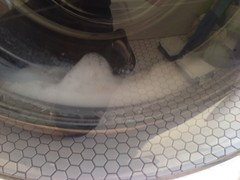
I was generous with the citric acid to compensate for the alkaline detergent residue, but after seeing how much foam there was I have the feeling I should have used more. I could have really used some litmus paper ;)
I have cascade powder and my next step is to run another tub clean cycle with that and a little tsp, followed by another shorter cycle with citric acid or vinegar (Samsungs website says vinegar is ok), but that will have to wait for tomorrow night.
- 11 years ago
Did you go to Techno Fresh and read the home made shock recipe? It uses salt (table) Cascade and 2 gallons of vinegar and a load of old rags. Long hot cycle, not clean cycle. All that goes into one load. Good read I thought.
- 11 years ago
What is the Salt for? In some older detergent's... it was used as a filler, but... nowadays most companies just replace it with Sodium Carbonate or Sodium Sulfate (Not Sodium Lauryl Sulfate) but just.. a form of Sodium Salt.
- 11 years ago
1/4 cup Cascade powder, 1/4 cup table salt and 1-2 gallons of white vinegar. I'd use 2 for bad build up. Run large load of rags/old towels with this on the hottest longest wash possible. Pour the vinegar on top of the towels, then start washer.
Says the salt adds ions to help lift off scum. Worth a try if you ask me.
- 11 years ago
TSP - I had a bag of it in the garage and figured it would be okay to use as a one time thing to help strip the detergent buildup. I decided to leave the tub clean cycle with the cascade and TSP running while I went home for dinner. There were suds, as would be expected with the DW detergent, but not the crazy bubble bath that was happening with the first cycle.
The drum looks about 50% better at this point and smells a h*ll of a lot better. I ran an express cycle with just water afterwards and there were no suds, so I think the bulk of the detergent residue is gone and it's mostly limescale (calcium carbonate and calcium sulfate) at this point.
I did read the shock treatment instructions, and I may try it at some point, but I have to pick up some more vinegar first.
- 11 years agolast modified: 11 years ago
The Vinegar would completely neutralize the Cascade. Think of Baking Soda (Alki) + Vinegar (Acid) when combined, they kill each other... causing the fizzing. Cascade is a Alki in this case.
With that much Vinegar... the Cascade would be neutralized in seconds. Additionally... some Gel's contain Chlorine Bleach, which is a deadly combination with Vinegar.
I just don't understand... why someone would give out that advice. It lacks any... sense, chemically wise. - 11 years agolast modified: 11 years ago
@Fishcow... those, would be neutralized by the Vinegar. This... whole recipe would honestly be better, if someone just used the Vinegar by itself.
Who knows. Some of the homemade "laundry" recipes, are even more scary... and people love them. - 11 years ago
The enzymes won't be "neutralized" by the vinegar. They might be denatured by the pH of the solution, but that would depend on the range of pH tolerance of those specific enzymes.
- 11 years ago
It says Cascade adds ions too like the salt.
This is called Super shock recipe. I made the mistake of saying home made.
Mitch: You should go to Techno Fresh and read it yourself instead of wanting to change it before it is even tried. They also have a powder you can buy that cleans the washer, dishwasher and clothing if the towels etc are stinking.
- 11 years ago
@Sparky... I'm not a firm believer in "Natural Selection". The recipe you posted, advocates mixing... *ANY* Dishwasher Detergent (including GEL) with Vinegar. Almost any Gel/Liquid Dishwasher Detergent that will be found in anyone's home will contain Chlorine.
Reason Being... they are all practicality made with Chlorine. Excluding Seventh Generation (Not a hot seller) & Cascade Complete Gel (Not as popular as regular Cascade).
When you mix Chlorine with Vinegar, it produces a Toxic Gas. That can be FATAL if inhaled.
That's really scary stuff.
It's one thing, to use Vinegar as a rinse for Chlorine Washed Fabrics, when all the Chlorine is mostly down the drain. But... to use them willingly in the same solution is downright dangerous. - 11 years agolast modified: 11 years ago
The amount of chlorine gas that could be produced by the amount of bleach in a couple ounces of dish detergent dissolved in 15 or so gallons of water is not going to be a problem. So throwing some liquid dish detergent in there might not be a useful idea but no one is going to win a Darwin Award from it.
No offense Mitch, but have you taken a college chemistry course? It seems like you are really into researching laundry detergents and ingredients and a basic chemistry class would help you understand some of the technical details a lot better.
So I actually did calculate the theoretical pH, not factoring in residual detergent or buffering from any other ingredient, and it would be between about 3.1 to 3.5, which would probably inactivate any enzymes intended for an alkaline cleaning product. There may be some surfactants and things that aren't greatly affected by pH - I don't know. It may be just to clean the tubing between the detergent dispenser and the tub.
By adding the salt he's trying help drive the equilibrium of the precipitation reactions that created the limescale and detergent scum in the other direction. I understand the theory but I don't know whether it is likely to have any practical effect.
- 11 years ago
I did see it says you can use the liquid detergent (Cascade) but IF I was doing it I would use powder. The other tech that goes by Appliance Doctor said to use 1 cup of Cascade powder, hot water and that would get the gunk out better than anything? I am just passing on what I have read.
Maytag told me to use vinegar with cold water, and made sure they specified cold water. Best I remember was the cold and vinegar would cause the gunk to peel off in pieces and flush out better than if you used Hot. It could let gunked up detergent/softener dissolve in the hot water and just recoat the parts/tub. Now where that is how that works, I don't know but it is sure what they said. But that has been 15 years ago, I know that has changed too by now.
- 11 years agolast modified: 11 years ago
@Fishcow. I had no idea you were a chemist. By all means, feel free to correct me.
2oz... In my world, that would be four tablespoons. That's 1/4 Cup. If Cascade Gel... still contains 3% Sodium Hypochlorite, then... we could potentially have *laundry grade* bleach on our hands.
(Quite a few Bleaches, do.. contain 3 or 4%. Only "Regular" & Disinfecting Grade contain amounts in the 6 & 8% Range.)
Okay 1/4 a cup of near pure Chlorine Bleach, not to mention the Sodium Hydroxide (Let's just call it DRANO) content... oh, and some other agents, like Sodium Silicate. We should have a strong Alki.
Now... as for mixing, 1/4 a cup of Chlorine Bleach with an Acid. Is it going to kill you? Well... who knows. I've seen CPSC & Corner Report's... where fumes have emitted so quickly, that consumers were overcome by fumes, and collapsed to the floor. Some never did wake back up again....
Is that a common theme? Perhaps not. Some people *do* notice, a bad chemical reaction, and respond well by leaving the room, and moving to fresh air.
And some people... may not notice anything at all, if they somehow have a front-loader that fills up with a considerable amount of water. But... I think the theme behind this recipe, is targeting those utilizing front loading machines, which average 4-7 Gallons of water, max... per fill.
Once again. I'm no chemist. But... I do understand, quite a bit about Chemistry. I'm not saying everyone needs to understand it... but, I do get quite concerned seeing "Witch Brews" like the one posted above.
I've mentioned this once or twice before. The best way to remove residue from a front loading machine, is to use something like Descaler (Sodium Citrate, a la Lemishine) or... a strong Alki like Sodium Carbonate & Lots of Oxygen Bleach on a long, hot cycle. This is also, exactly how most "washing machine cleaner" tab's and powders are formulated.
Hydrogen Peroxide is a disinfectant, and will break down & kill Mold.
The thing is... if someone is washing properly, and following basic machine maintenance, I find that the problem doesn't seem to occur in the first place. Just... simple things like leaving your washer door open, and avoiding Liquid Laundry Detergent's will solve most issues. You don't even have to leave the "Cold"... most powders will still dissolve and activate just fine in colder temperatures.
- 11 years ago
@i_dig_it, O M G. Not sure if your still around, but I can totally give you advice for this model.
Behind your machine, is the incoming water spicket. Try turning off the Cold Line, and turn the machine onto "Tub Clean" (In the Options Menu on the side)... Let it Slowly Fill, and when it's done. Press the Power Button, and let it turn off.
The Door Won't Unlock. This is okay. Press the Power Button Again, and turn the Dial to "Permanent Press" and on the right side, hit "Stain Cycle" and select Heavy Soil and Hot/Cold, along with Spin Speed "High" and Extra Rinse & Water Plus.
What you'll end up with is... a almost two hour hot water cycle, with the water almost 1/3 of the way up the door. ;) - 11 years ago
Will also try to post this quickly. Citric Acid will to some extent clean away mold. Just not as adequately as the Hydrogen Peroxide content in Oxygen Bleach.
Dishwasher Powder was *actually* recommended by Fisher & Paykel for cleaning out machines, due to its Phosphate Content. I believe they even said... Look for a Dishwasher Powder containing 8.7% Phosphorus. Not sure what they recommend now... post-ban.
Miele I think feels very different about this. Although they also tell people not to use Vinegar either, so... I somewhat take their advice with a grain of salt. - 11 years agolast modified: 11 years ago
Reading up on posts. sodium carbonate (aq) + citric acid (aq) —-> sodium citrate (aq) + water (l) + carbon dioxide (g. My chemistry is a tad rusty but this is basically it. So, combining a washing soda based detergent with citric acid gives you sodium citrate which is more effective than either citric acid or washing soda. I'm assuming a ratio of 4 parts washing soda to 1 part citric acid.
Salt is a disinfectant and has some water softening properties because it binds with the ions. Salt was never a filler in detergents but would kill the enzymes.
- 11 years agolast modified: 11 years ago
Dishwasher detergent used to be recommended to clean a washer because of the phosphates, I have ask this before, what use is it now to clean a washer now that the phosphates have been removed..the answer I normally get is because of the sodium carbonate in it..yet it's in powder washing machine detergent also and in fact is one of the causes of detergent residue building up in a washer...someone please tell me how throwing more at it is going to clean it? I am truely not understanding this..
- 11 years agolast modified: 11 years ago
Cleaning the washer is different than cleaning clothes. DW detergent is a hard surface cleaner and is good at getting rid of any bio crud or detergent buildup. It is more alkaline than laundry products. Water chemistry is everything that's missing in the sodium carbonate arguments. Some water naturally contains bi carbs. Some water is naturally acidic. Some soft water contains a lot of iron or other minerals.
If your problem is odd smells and mold use dishwasher detergent. If you just have limescale, delime it. Vinegar and citric acid are both weak acids. If your washer is seriously gunked up with bio goo and hard water deposits clean it with dishwasher detergent then run an acid through it to get rid of deposits. Iron Out would be much more effective than vinegar or citric acid.
Reality is though that most times we don't need to bring a gun to a knife fight. If the water was atrociously hard the pipes and everything else would suffer. Usually DW detergent alone will handle it. When we had crazy weird water I added citric acid to vinegar and used that as a rinse aid and in place of the fabric softener.
In a pinch 4 parts washing soda to 1 part citric acid makes a decent enzyme free dishwasher detergent. Detergents, soaps - they are all useful for how they react to water. Everything changes once disolved in water. That's why pure water is the universal solvent. Looking at the properties of one ingredient doesn't work.
- 11 years agolast modified: 11 years ago
Pink: According to the "Appliance Doc" the enzymes in the Cascade is what cleans up the machine. I thought you read that(the article or video Appl. Dr. had) a few months ago when I posted it? Maybe not, but I know some people did.
- 11 years ago
Mama, what you're having trouble with is that the sodium carbonate doesn't remain sodium carbonate. It forms new compounds with the other chemicals in the laundry and water mix. It is used as a precipitating water softner and to boost alkalinity. The enzymes in your laundry detergent and DW detergent are the same enzymes available in many probiotic supplements but they're modified to handle the conditions in the formula. Think of DW detergent enzymes as being more aggresive and laundry detergent enzymes as being more laid back :).
The idea of sodium carbonate never rinsing out of fiber is strange to me because it doesn't exist at the end of the wash cycle.
- 11 years ago
@sandy1616... a Really good example of Washing Soda, would be to boil a pot of hot water on your stove, and add some baking soda. Any small drip on the counter, or stove top... leaves a nasty, dusty hard to remove residue.
It's not so much, that washing soda is hard to remove. It's just Carbonates are hard to rinse, especially from porous fabrics. Zeolites aren't much better. But... if you've ever wondered why, people say things washed in Liquids feel better, it's because of the Citrates used.
STPP... can grab onto calcium & magnesium, like a magnet and prevent much of this residue from occurring in the first place. It can also strip carbonates out of clothes, removing some of the greying caused from hard water deposits.
Personally... I wish, Detergent's we're still Phosphated. I mean... they we're designed for a reason with the ingredients. I guess it doesn't matter much anymore though... :( - 11 years agolast modified: 11 years ago
I want to make it clear though... there's nothing wrong with Precipitating water softeners. They do soften hard water, and allow detergent to function instead of being wasted trying to fight the calcium & magnesium.
But.. they can be very harsh on Textiles, and leave nasty deposits behind... especially in harder water.
This is the reason.. glasses & dishes looked cloudy for a while after the Phosphate Ban. When you switch from a Non-Precipitating Water Softener, to a Precipitating Softener... you don't exactly get a spotless china cabinet... you get Calcium Carbonate residue sticking all over everything. Detergent manufacturers really struggled to find surfactants & petroleum cocktails for a while to cover & rinse away the gunk.
Of Course... you can't really hold your clothes up to the light, and notice the Calcium Carbonate, can you? Blacks/Darks *may* look faded, and in some cases... Whites may gray. But for the most part... most people don't realize it.
- 11 years agolast modified: 11 years ago
Mitch you missed my point. Sodium carbonate isn't sodium carbonate by the end of the wash cycle. Your example only works if you wash your clothes in only baking soda. Sodium carbonate and sodium bicarbonate are different things and react differently in the mix. Drop the same amount of washing soda in the boiling water instead and drip :).
Ever consider that the ingredients used to maintain viscosity and prevent rancidity are responsible for softer fabrics? Those are polymers. Liquid detergents have many.
Sodium citrate is used to keep minerals away so the surfactant can do it's thing.
- 11 years ago
@sandy1616, the reason... I mentioned Baking Soda, is a lot of people here probably don't have Washing Soda on hand. The residue is much, much worse though. I should know... I've boiled up a solution, for a project.
- 11 years agolast modified: 11 years ago
@sandy1616... Next time you're out, check a few boxes of Detergents on the shelf. I know Trend, Purex and... Fab, all contain Sodium Chloride, or Table Salt.
P&G Powders also used to contain Sodium Chloride, I think listed as a "Processing Aid" until... they we're compacted in the Early 90's. I also remember... Electrasol & some store brand detergents also used to/still do contain table salt, which can cause rusting overtime on stainless steel knives.
Purex Crystals "92% Natural" is just a keyword for 92% Salt. I think it's also in A&H's Scent Booster.
Table Salt.. is a water softener, but... it's a very, very weak one. I mean... even if you poured 3/4 a cup in your machine, you still wouldn't have the effect of two tablespoons of Sodium Carbonate.
It's not so much.. that I'm trying to question your post. I just... want to tell you what.. I understand. Your right.. that's it's been mostly moved away from. And... Salt doesn't exactly dissolve well, in Cold or Lukewarm Water. This can cause a "powdery residue" to be left behind on darks, that people sometimes talk about.
- 11 years ago
Salt is any chemical compound formed from the reaction of an acid with a base, with all or part of the hydrogen of the acid replaced by a metal or other cation.
- 11 years ago
The HClO <--> Cl2 reaction is strongly dependent on pH, and I'm pretty confident that that shock treatment cocktail thrown in a washer is not going to end up with a low enough pH to cause problems with that amount of bleach. I wouldn't do it, personally, but I wouldn't freak out about it.
Mitch, I'm not a chemist but my undergrad degree is biochem so I have a pretty good foundation.
It seems like you know a lot of facts about chemistry but from things you have said on this thread and others I get the impression that your understanding of some fundamental concepts is not as good, such as acid base chemistry. That's why I was suggesting a college class. There are a ton of free open access online classes in pretty much any subject you want now, either through Coursera and other open access platforms or directly from the universities' websites.
BTW, "alki" isn't a word. The term is alkali or base.
- 11 years ago
So to reiterate, it's not my washer, it's in my parents' rental. The tenant was apparently kind of clueless when it came to appliances.
Mold and mildew fortunately doesn't seem to a problem, it's a combo of a year's worth of limescale from the very hard water, massive buildup from overdosed liquid detergent and fabric softener, and I'm sure a lovely biofilm as well.
I believe the bulk of the detergent residue is gone at this point, so it's mostly a matter of getting the scale off the drum, which may take a couple of washes. The scum on the boot and outer edge of the casket will also need to be cleaned off manually, but I think I'm going to let my parents deal with that parent ;)
@Sparky, that's interesting about them recommending cold water with the vinegar wash, and it does make a certain amount of sense. I know citric acid has to be used hot, but that's because calcium citrate isn't very soluble at lower temperatures. In my own experience vinegar isn't the best at dealing with scale, but it's great at taking off hard water soap scum. We always just pour it straight into the tub or wherever, without any hot water, let it sit for a while and the soap scum usually comes off in flakes when you scrub it.












ArliVie