Software
Houzz Logo Print
gardengeek63

Little Gem magnolia seedling question

11 years ago

Hi everyone,

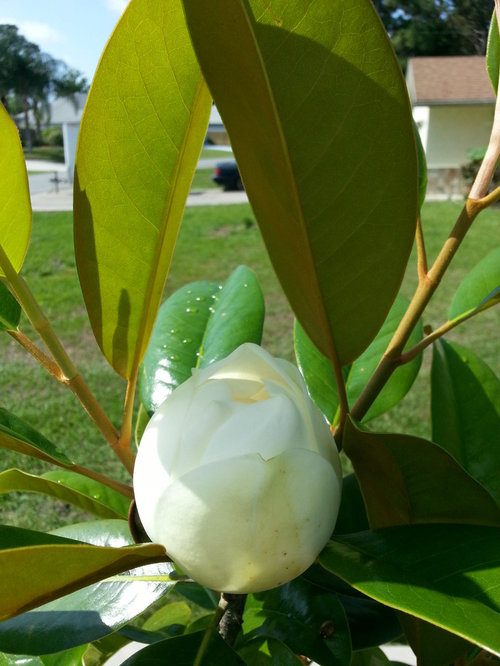
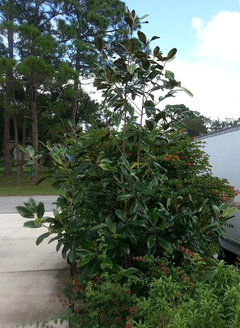
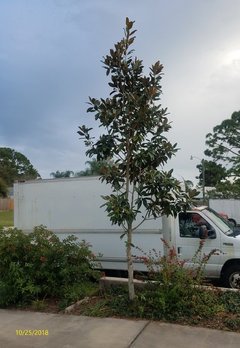
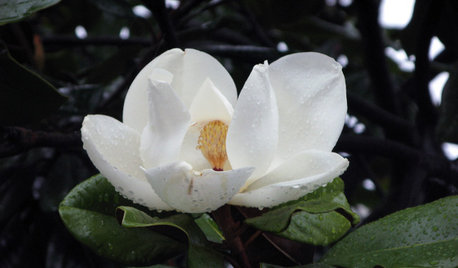
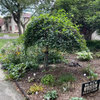
I have a Little Gem magnolia seedling (volunteer seedling) that's 4-5 years old and is starting to bloom. It's a nice looking little tree, standing about 5 feet tall with nice branching in a pyramidal form.

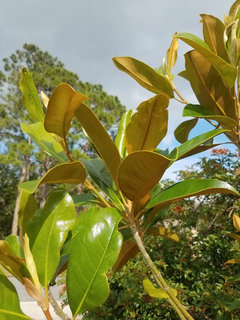
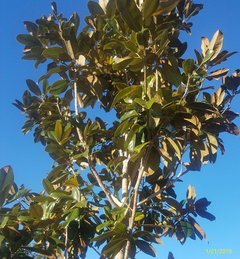
My question is, how can I tell if it reverted back to the parent? I don't have the space for a Grandiflora in my small yard. Everything I've read said that the seedlings usually revert back to the parent, but I also read that Little Gems start blooming earlier so I'm hoping that's a good sign. The blooms haven't opened yet, should in a couple of days, so I don't have a measurement on them yet. Based on the bud size, they don't look they they're going to be very large. The leaves are on the med-small side, are a medium light green, and have a light dusting of brown on their undersides.

Anyone know of any definitive ways of telling if it reverted back and will be a southern giant? I'd rather not wait another 5 years to find out :-)


By the way, how can Houzz say that my old user name is being used by someone else, but yet it's connected to my 'new' profile?

Thanks for your time,

Annette


Comments (44)

  • 11 years ago
    last modified: 11 years ago

    Looks comparatively petite and the very young blooming age implies a smaller habit. But it can be seen from its foliage that it is not a duplication of 'Little Gem' - as would be expected as it is a seedling and not a clone. Reverting back is something named variants do by throwing out typical branches and so forth; this is the result of a genetic mutation within the specimen and not a sexual process. A common and clearly discernible example here is normal Black Hills spruce growth popping out of the tops of dwarf Alberta spruces.

    By the way I have seen 'Little Gem' near Los Angeles about 42' tall. The leaves and flowers of this cultivar are small and the tree is smaller than most typical southern magnolias but nurseries calling it "dwarf magnolia" are stretching it a bit. The most distinctive thing about the crown shape is its narrowness and not its height - I remember reading about and seeing a picture of the original seedling in the Magnolia Society journal many years ago and it was pretty dramatic. Propagules here many be shrubby for years but the characteristic shape can often be seen starting to develop later.

  • 11 years ago

    Embothrium,

    Thank you for the reply, very informative.

    I was hoping that the early blooming age would be a good sign. Plus, it's always exciting to see something grow from seed that actually turns out to be a keeper. I'll keep hoping for the smaller habit and enjoy the fragrant blooms.


  • 11 years ago

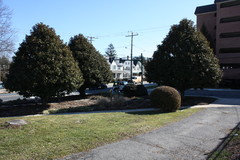
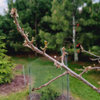
    gg63, your magnolia does not have the traits of 'little gem'. Notice the amount of new growth, the long internodes and leaf size. You have a nice tree but it will not be like LG. All is not lost, if you want to go to the trouble you could always trim it like these trees. It is alot of work, using pole pruners. One negative though, the flowering will be reduced.

    Now please explain to me how you have Lion's Ear blooming the same time as magnolia? I am posting from the east coast and our Lion's Ear doesn't bloom 'till October.

  • 11 years ago

    sam_md,

    Your trees are very nice, but that's way too much work for me :-) I think I'll enjoy the blooms this year and then give the tree away. If I had space for a big tree I would plant another fruit tree!

    About the lion's ear, it's probably because we had a mild winter and an early spring (more like summer temps) so I think it's confused!

  • 11 years ago

    a SEEDLING... is a cross between a mother and a father ...

    technically.. there is no one being.. to revert to ... so i dont understand.. how you could have read such ...

    its genetics dictate everything ... size and vigor being two of those variables ... i just dont see.. what there would be.. to revert to ...??? .. even if both are dwarf parents ....

    a seedling ... may or may not have the variable you wish ... but it is.. what it is ...

    the base question might be.... how are the dwarf ones propagated ... if they are grafted.. or rooted ... aka cloned .... then that most likely answers the issue of what seeds from them will do .. on a predictability basis ...

    anything possible ... but odds are long .. that you have a dwarf ...

    ken


  • 11 years ago

    Ken, magnolias are monoecious - a single tree is both mother and father. Named forms, like Little Gem, are propagated from cuttings to ensure they display the exact characteristics of that specific cultivar. Seedlings will be variable at best and the 'reversion' would be to display characteristics more common to the straight species than the named form. So no guarantees at all that this seedling will be dwarf in habit.

    IME, M. grandiflora 'Southern Charm' (trade name Teddy Bear) is a more compact grower than Little Gem, with a similar pyramidal form although with a wider spread.


  • 11 years ago

    "Ken, magnolias are monoecious - a single tree is both mother and father."

    Gardengal, did you read what you wrote? I'm not sure what you were trying to say, but hopefully not what was actually written.

  • 11 years ago
    last modified: 11 years ago

    'Little Gem' isn't inherently pyramidal, when the shrubbiness of some propagules is left behind the resulting trees are almost columnar - as was the original seedling. The ~42' one in California was many times taller than wide. A much smaller one that I was tasked with "repairing" after it broke in half in a Seattle snowfall was similarly slender, I have seen many other such examples including young specimens in nursery pots. Presumably the broader-growing ones are rooted side branches or scions taken from side branches.

  • 11 years ago

    Monoecious - having pistillate and staminate flowers on the same plant.

    If the tree is unisexual with perfect flowers (as is the case with magnolias) or with both separate male AND female flowers, then it is (or can be) mother AND father to any seedlings.

    So what exactly are you having difficulty with?


  • 11 years ago

    As your later comment illustrate, it's a jump to assume that both parents are Little Gem. Then, I don't understand how your comment addresses Ken's statement. But the biggest reason I said something is because it sounded as if you were defining monoecious as having a single parent.


  • 11 years ago

    The condition of magnolia flowers is perfect and thereby cannot be monoecious unless someone changed the botanical definitions without consulting me ☺

  • 11 years ago
    last modified: 11 years ago

    That was another thing...but just a minor detail that didn't change the other concerns.

    And, nope, the definition wasn't changed. If we do decide to change it, Sam, I will be sure to let you know. LOL

  • 11 years ago

    That is a very slow grower. Why do you have it staked up?

    Just keep it for a few more years and see how it turns out.

  • 11 years ago

    What do you mean by perfect flowers? Is that a matter of opinion or does it have a scientific definition? IMHO, I think all flowers are perfect in their own way...LOL!

    Ken, I guess 'revert' was the wrong word to use, sorry for the confusion. I meant that it would take on the characteristics of the parent(s) of LG since it's not a clone of LG. Just thought input from the experts on my tree's characteristics (at this point in time) could enlighten me on the likelihood of it getting huge.

    tlbean2004, It isn't tied to the stakes anymore, I used them to hold a light for a Halloween grave and never removed them. About its growth rate, I thought it was pretty fast! I mean, compared to the Brazilian grape tree that I have, its growing at the speed of light!

    Thanks everyone for your input. The knowledge on this forum never ceases to amaze me :-)

    Have a great week,

    A

  • 11 years ago

    gg63, you're forcing me to go waaaaaaaaaaay to 9th grade biology class and Miss Riemenschneider. She had a large model of a perfect flower. The lady parts were in the center, the pistil had the stigma, style & ovary. The man parts surrounded these and were called the stamens with the anthers on the ends of them. If both male & female are in the same flower, it is perfect. Surely you had a class similar to this? (think manual typewriters)

  • 11 years ago

    Oh, like a daylily. And yes there were electric typewriters around, just not in school :-)

  • 11 years ago

    For the self-elected botany terminology police: "Monoecious - In the commoner narrow sense of the term, it refers to plants with unisexual flowers which occur on the same individual.In the broad sense of the term, it also includes plants with bisexual flowers."

    The Kew Plant Glossary

  • 11 years ago
    last modified: 11 years ago

    Well, the fact that your plant is blooming early is a very good trait. And keep in mind that the now popular Mag. cultivar ‘Kay Parris’ was discovered as a Little Gem seedling. It had great characteristics. I love to read stories about he origins of our garden plants.

    I'd sure let it grow and see what it wants to become. But if you don't have enough space, then get rid of it.

    You look to be in zone 9 and have a LOT of great evergreen trees you could grow. So it's entirely up to you!

    Read about the discovery of 'Kay Parris'.

  • 11 years ago

    I am never too quick to discount the possible attributes of seedlings, even those off known cultivars. One of the best apple trees on my property was sown via a bird or rodent and saved when we bush-hogged a field. It's nearing its thirtieth year now, of course it's a standard, but is old faithful for producing decent sauce and pie apples. Ditto the progeny of a lovely red buckeye we obtained from an arboretum. I've grown, planted and given away dozens of the seedlings over the years. Yes, they have some variation, but all are presentable. Same goes for one of the maple hybrids I found produces best for sugaring. It was a chance seedling, and does present as a hybrid.

  • 11 years ago

    Dave, I enjoyed the article on Kay Parris. Thanks for sharing it.

    Calliope, I love to read replies from people that grow things that I can't here in Florida. I am grateful to be able to grow the things that I can (like citrus), but the grass always does seem greener...!

    I am going to be patient for one more year to see how she does. If she looks like she's going to be a big tree I'll transplant her to a spot where she'll have more room (a spot that I have a 7 year old crepe myrtle seedling growing that I'm not too happy with). I have a banana (Double) that would fit nicely in her current location.

  • 10 years ago

    Update 10/2/16

    A year and a half later and the tree has doubled in size. I just measured, she's now 10'4" tall with the longest leaf measuring 8 inches.

    She is going thru a gangley stage, not sure if I should prune or just let her keep going. I read somewhere that they don't like their bottom branches trimmed so I've let them grow naturally.

    Can't wait to see her bloom this year.

  • 10 years ago

    Gonna be big one!

  • 10 years ago

    Yes, I'm afraid so!

  • 9 years ago

    Keep us updated this year!

  • 9 years ago

    tlbean2004,

    Unfortunately, not much change since the last update, but I guess it's only been six months :-) Thanks for asking!

    She is now 10'8" and only had a couple of blooms this year. I wonder if I should give her a chelated iron drench? I'm worried that I planted too close to the driveway now that I see she's going to be a big 'un!

    She is in no way similar to Little Gem. Her leaves are much lighter and the undersides are a light brown / tan color.

    I'm not sure I like her form. She has a big gap (no branches) in the center of her form. I haven't pruned at all, maybe I should...


  • 9 years ago

    I would add a little slow release fertilizer. Maybe the gap will fill in in a few more growing seasons.

    Skyway Gardens thanked tlbean2004
  • 9 years ago

    Thanks. I usually apply a fertilizer for azaleas so maybe it's time again.

  • 7 years ago

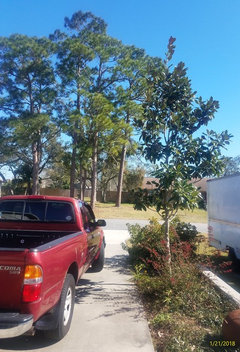
    My brother was visiting this weekend and he asked what the skinny tree was on the side of my driveway. He didn't believe that it was a Magnolia. Anyway, the discussion reminded me to make another update to this thread...


    Late 2018 / early 2019 update:

    The tree is too tall for me to measure so I'm guesstimating about 13-15 ft based on the roof line of my house and my husband's new truck cover.

    The longer leaves are still around 8 inches long, however most leaves are smaller. The upper & lower leaf color is closer to a Southern Magnolia, nowhere near as dark as Little Gem.

    My husband trimmed a branch on the driveway side of the tree (north side) because it was getting too close to his truck's mirror so the tree looks lopsided. Regardless, the tree does have a narrow canopy.


  • 7 years ago

    I don't understand your posting. "Little Gem" IS a cultivar of Southern Magnolia (Magnolia grandiflora).

  • 7 years ago

    Thanks for the update.

    tj

  • 7 years ago

    Subtropix, Sorry for the confusion. When I think Southern Magnolia the natives we have around here come to mind. Not the cultivars.

  • 7 years ago
    last modified: 7 years ago

    Okay, don't mean to beat a dead horse, but I am still confused.

    Aren't "cultivars" equally as "native". For example, in the North (where genetic control of the species is even more important due to the harsher Winter climate), one the widespread "cultivars" in (Zones 6-7) is 'Edith Bogue' which IS a M. grandiflora, native to Florida (not some kind of hybrid). Isn't Little Gem likewise, equally as "native"?

  • 7 years ago

    So they're all natives?


  • 7 years ago

    Pretty much :-) Generally, it is only the naturally occurring species that is considered to be the true native - in this case, Magnolia grandiflora. But as long as no hybridization (other species DNA) has occurred, cultivated or named forms - aka, nativars - can also be considered natives. In many cases, these cultivars are just sports found from the species but more typically, they are bred specifically to encourage some particular feature that was found to be present in one or more of the native plants. In the case of 'Little Gem', a more compact and narrow growing form of the species that will bloom precociously.

    Skyway Gardens thanked gardengal48 (PNW Z8/9)
  • 7 years ago

    Interesting...and confusing! How do they know no hybridization occurred? Is it because they have a perfect flower?

  • 7 years ago

    Most trees do not hybridize that readily or easily on their own (oaks maybe the major exception).....most require some sort of human intervention. But sports, witch's brooms or unique seedlings (each within the same species) are relatively common and focused breeding programs of these result in new cultivar development. You see this consistently with various conifers and with trees like Japanese maples, which have literally 100's of named cultivars, many of which have a very different appearance than the parent species!

    But the characteristics that make each new cultivar unique from another or from the parent species itself can ony be accurately and consistently replicated if the cultivar is then propagated asexually - by cuttings, air layering, grafting, tissue culture, etc. - not by seed. A seedling produced by a named cultivar may or may not possess any of the particular characteristics that made that cultivar unique or special, they cannot legally be called by that cultivar name and are just considered species seedlings.

    So your 'Little Gem' seedling is not technically a 'Little Gem' at all but just a Magnolia grandiflora!

    Skyway Gardens thanked gardengal48 (PNW Z8/9)
  • 7 years ago

    Thank you so much gardengal48! Very good explanation for me. Are you a teacher?


  • 7 years ago

    Now and again :-) I am a consulting horticulturist and do give a lot of classes and seminars. And I used to teach at a local horticultural school before I moved out to the boonies!

    Skyway Gardens thanked gardengal48 (PNW Z8/9)
  • 7 years ago
    last modified: 7 years ago

    I grew up a dozen or so seedlings from my 'Teddy Bear' and NONE of the seedlings displayed any of the compact characteristics of the mother plant. But you never know until you grow them. Maybe if I'd grown a hundred, I might find a good one?

  • 7 years ago

    A couple of things stick out to me in what GG wrote. None of them may be particularly relevant in this situation, but I still think it's important to keep these in mind for general knowledge.

    Typically, woody plant cultivars are propagated vegetatively (as GG said), but that is not universally true with other types of plants. I'm sure almost everyone here has planted flower seeds or vegetable seeds that produced a certain cultivar. While rare, there are even tree cultivars that are sexually reproduced. There are actually multiple ways of propagation for cultivars, and it depends on how the differentiating characteristics are derived for a particular type of plant. 'Little Gem' is a vegetatively propagated cultivar.

    I do think it's very important to reserve cultivar names only for individuals that truly are members of that cultivar, BUT I don't know of any legal requirements to do so. Nurseries may be required to accurately identify plants (and boy is that a can of worms), but, as much as I wish there were, there's no legal protection that I know of for a cultivar name.

    For anyone interested in more information about cultivars and cultivar conventions, check out the International Code of Nomenclature for Cultivated Plants (ICNCP) here:

    ICNCP 9th edition

  • 7 years ago

    Perhaps 'unethical' is a better term than 'illegal'.....although illegality will still come into play with any patented cultivars even if it is highly unlikely the plant police will come knocking on your door :-) The issue is that with most woody plants - and my previous comments were directed only at these - named cultivars seldom (like hardly ever) come true from seed. Even if they look identical to the parent there is no guaratee that they are or will remain looking so throughout their lifespan.

    Assigning the cultivar name to seedlings of that cultivar - rather than those that have been vegetatively propagated - and introducing them into commerce just distorts and dilutes the validity of that cultivar. We see this all the time with seed grown "cultivars" of Japanese maples, 'Bloodgood' being at the top of the list. As much as they may look like Bloodgoods, they are a just a red leafed version of Acer palmatum.

    Nothing wrong with seed grown JM's.......or Magnolia grandiflora or any of countless other named cultivars of most other tree species. This is often where new cultivars arise.....a random seedling that offers some unique attributes. But it is never valid/appropriate/ethical (and in the case of a patented plant, legal) to call these seedlings by the parent cultivar name.

  • 7 years ago
    last modified: 7 years ago

    Actually, there's not a thing in the patent law about cultivar name accuracy. I know of no legal reason you couldn't call a patented plant by a completely different name. It might be ethically wrong (in our opinion) and it's surely not a good idea, but it's not legally wrong. There are legal requirements regarding trade names, but that's a whole different matter.

  • 7 years ago