

Trouble-shooting a just bought Fiddleleaf-immediate care tips please!
Hello!
I have been looking for a Fiddleleaf Fig for years but have had no luck where I am in the Mid-Atlantic US - in independent nurseries nor big box stores - and I had all but given up, but yesterday I finally found one (the only one) at my local home depot! I am usually very careful about the plants I choose to buy from big box stores, but in this case, given my lack of luck in finding a fiddleleaf I bought it without a second thought.
However, I recognize that I probably bought a less than healthy tree since it already has brown spots/areas on the leaves. After reading some of the fiddleleaf care info in these forums, I realize that whatever caused the spots has probably been going on for a while, but since I just acquired the plant yesterday, I have no idea how it's been cared for.
Following is some basic info about my plant as well as some pictures of the plant.
Tree is 5.5 feet with one branch coming off of the main one at about 1.5 feet from the top of the soil.
There are brown spots on the leaves - mostly on the lower leaves, but there are smaller brown spots on the upper leaves as well. The following is a picture of the worst-looking leaf and you can see some of the smaller spots on the leaves above it.

There was also a tag on the plant saying it had been treated for pests with neonicotinoids. I see some remnants of a web or webbing on one part of the tree on both the stem and on parts of the leaves. Tried to get a picture but it's hard to see in the photo.
The following is a close-up photo of what the top of the soil looks like.

I recognize that the damage to the plant is probably due to a previously ongoing problem and that it'll probably take some time to fully diagnose, and I'm worried about the plant getting worse in the mean time. So I'm hoping for some advice or a plan of care that I can implement immediately in to minimize damage to the plant and to further increase the likelihood for a happy healthy plant. Basically, what's the best/most important thing I can do right now to minimize further damage and ensure a healthy recovery?
Thanks in advance for your time everyone!
Jen
Comments (24)
 10 years ago
Hi, Jen. Just read your message this AM - sorry for the delay, but my Houzz mail backs up from time to time if I don't stay on it.
I'll offer suggestions from the perspective of what I would do if it was my tree. Because I have at least 50 ficus in various stages of development, it's much easier for me to look at trees in terms of them being a long term project rather than something that can be transformed into a healthy specimen immediately - especially given the time of year.
It would be nice to know what happened in the past, but the trees future depends on what happens from the time you acquired it. So the broader plan would be to give the plant the best cultural conditions you can from now forward. That doesn't mean you should do anything that subjects the tree to unnecessary stress today, but it does mean you should make a plan that utilizes the plants strengths and avoids adding stress when the plant is in the part of the growth cycle when it's weakest. That translates to 'no serious work between mid-Aug - Father's Day or the Summer Solstice where you live.
Almost undoubtedly, the neo-nicotinoids referred to on the tag was some form of imidicloprid - a systemic insecticide produced by Bayer. It's effective against almost all insects with sucking/rasping mouth parts except mites, so if you do have mites, keep them under control by spritzing regularly with a 50/50 mix of 70% (as opposed to 90%) rubbing alcohol - every 4 days should have them under control within 2 weeks, then spritz weekly, making sure to cover the entire plant, including leaf undersides and axils (crotches).
I wouldn't repot or pot up at this point. The plant tolerates being root bound better than most. Being root bound will reduce vitality somewhat, and slow growth in relation to how badly root bound it actually is, but I don't look at the fact that it's root bound as reason enough to subject to being repotted; and because it's growing soo slowly now, potting up carries with it the possibility that the new soil that's uncolonized by roots might tend to stay wet for a looong time. It's more important to avoid that than to try to provide the plant with a little more growth potential you'll be planning to fix in a few months anyway (about 5 months - Summer Solstice).
ASAP, I would flush the soil thoroughly by slowly running at least 10x the pots volume of water through the soil. After it stops draining, I would fertilize it with 1/4 tsp of Foliage-Pro 9-3-6 in a quart of water, then depot the plant and set it on newspapers for a couple of hours to 'pull' excess water from the soil. I'd also consider buying some sort of cache pot for it so I could put a block on the bottom of the cache and under the nursery can the plant is in so water that drains from the actual pot can't get back into the soil. I'd keep it warm and in very bright light away from drafts & heat vents. You'll see growth start to pick up after the vernal equinox, which means the plant will be able to start storing the energy it will rely on to repair itself after you do the full repot in Jun, which will include root pruning.
Between now and repot time, I'd do some more research about what type of soil you should use. Your soil choice is extremely important and determines whether you'll have control over your plants vitality or if you'll be in a never-ending battle with your soil choice for control. A good soil allows you to take control over all the things you want to have control over (nutrition, root health, appearance, growth rate, o/a health). No matter how hard I try, I could never put enough emphasis on how much influence soil choice has over how much you'll be able to take from your growing experience. By Mid August, '16, your plant should be turned around completely and looking like a happy plant should look.
Questions?
Al
Related Professionals
West Palm Beach Landscape Architects & Landscape Designers · Somerset Landscape Architects & Landscape Designers · Taunton Landscape Architects & Landscape Designers · Worcester Landscape Architects & Landscape Designers · Spokane Landscape Architects & Landscape Designers · Somerset Landscape Contractors · Natchitoches Landscape Contractors · Elkton Landscape Contractors · Asheville Landscape Contractors · Columbia Landscape Contractors · Potsdam Landscape Contractors · Daytona Beach Interior Designers & Decorators · Bloomington Interior Designers & Decorators · Hilton Head Island Interior Designers & Decorators · Grand Rapids Interior Designers & Decorators
jenniferck05
Original Author10 years agoThank you both for taking the time to comment! I've had mite infected plants before, so I'm familiar with what they look like as well as their webbing, and at least right now, it doesn't look like there are any, but I will definitely use the solution you suggested to keep them at bay. I will also flush the soil and fertilize as you suggested and plan to repot this summer. As Mentha suggested, I've already found your soil recipes, so I'll plan to follow those when I repot.
Thanks so much again for taking the time to reply and recommend a plan of action. I feel better having one now. I will keep you updated on how my "little tree" is doing. Thanks so much again!
jenniferck05
Original Author10 years agoActually, I do have a question...after fertilizing this time, on what schedule should I continue to fertilize?
jenniferck05
Original Author10 years agoI mean, is there a modified schedule I should follow until repotting or do I follow the "normal" schedule you've mentioned in other discussion threads?
 10 years ago
Jennifer, Al gives very good advice. The one suggestion I'd make if you're contemplating trying a gritty mix as outlined in so many of his posts, is to try it on several low-value plants first for at least a full year. Grit isn't as easy as one might think from reading posts here. It can be very tricky to figure out, and isn't at all like the soils most people are used to. You'll want to get familiar with it before you trust your more precious plants to it.
Also, not all mites spin silk. The only pest I've ever had in my plants, ever, was a microscopic mite that didn't spin. It did a fantastic amount of damage in a very short time. Bayer Advantage 3-in-1 took care of the infection. It has imidacloprid, plus a mitacide and a fungicide or something for disease.- 10 years ago
J - what fertilizer strategy works best depends on your choice of soil and watering habits. If you use a soil that allows you to water to beyond saturation w/o incurring the plant's wrath, i.e. until at least 15-20% of the total volume of water applied exits the pot after the soil is fully saturated, you can fertilize every other week, weekly, or every time you water ..... if you take into account the concentration of the fertigation solution you're using. If you use a soil that DOESN'T allow you to water to beyond saturation w/o the plant pitching a fit, your options and ability to keep control of your nutritional supplementation are limited. In the later case, it's much better to include a regular and thorough flushing of the soil in your maintenance plan to prevent both salt build-up and the badly skewed fertilizer ratios that inevitably accompany the combination of poor soils and watering in sips.
Al
jenniferck05
Original Author10 years agoI see, thanks again for taking the time to address my question. I'll keep you updated!
 10 years ago
kwie2011:
Grit isn't as easy as one might think from reading posts here. It can be very tricky to figure out, and isn't at all like the soils most people are used to. You'll want to get familiar with it before you trust your more precious plants to it.
Could you expand on its trickiness? I'm planning to repot my FLF in gritty mix this summer, so I'd like to be prepared, but I don't have any low value plants to try it out on. What's more difficult about it?
- 10 years ago
This is by no means a comprehensive list, but here are some of the issues I've encountered with grit (not in order of importance):
1. It's about impossible to tell if a failing plant is getting too much or too little water- even with Al's help (too little is very common).
2. In dry or hot weather, it can be extremely difficult to provide enough water. Until the entire pot is colonized with roots, you might need to water daily, or even more often.
3. Grit doesn't anchor a plant until the entire pot is filled with roots, so tall plants topple over, and hanging plants fall out. At least until the roots have filled the entire pot, you need to devise something to anchor your plants in their pots: bungee cords, tape, chicken wire, zip ties, etc.
4. Special watering devices and methods are needed for some plants. Unlike soil that absorbs and spreads water, grit lets it run directly through, so you must water the entire surface of the grit, or dip the entire pot in water to wet it through. you can't water a plant from a corner, or around the edges. I have to use a laboratory squeeze bottle to water several of my plants because I need to direct a narrow stream of water between dense leaves that completely cover the surface of the pot. It's a pain, but my other choice is to submerge the pots, which means I have to carry them and a bucket of water around several times a week, which increases the risk of them being dropped or spilled.
5. It is easy to overwater with soil, but it's even easier to underwater in grit. There is little margin for error. If a plant wilts one day, it'll likely be dead 24 hours later if it's not watered. You can't put it off to the next day.
6. You end up a slave to watering schedules. You can't really have a friend or neighbor water your plants when you go out of town for a week. Every plant ends up on a different schedule, and you can't just stick a finger in to see if it's damp. It's too complicated and confusing to most people.
7. Grit is extremely heavy and clumsy. A five-gallon potted tree that you might've easily moved outside during the day, and back in each night becomes a chore that needs to be set on wheels.
8. It wastes a lot of water (and expensive fertilizer). I have to go around dumping drip trays after every watering. In a dry climate, of if you have heat on indoors to dry the air, it might not be an issue, but we're right around 100% humidity indoors and out here.
9. Self-watering pots and devices won't work with grit.if you do a Google search under domain:gardenweb, with search terms like "problems with gritty mix" youll come up with dozens of threads started by people who have had trouble with grit. Most eventually stop posting so we never know if they've sorted things out. I suspect not. There are many people here who use grit, but I think there are equal numbers who get frustrated and leave. It just isn't for everyone.
- 10 years ago
I find almost none of these issues to be much of a hindrance, and many to be nonexistent or significantly exaggerated. I think have a better than average understanding of what makes soils tick, and the resources at my disposal (for making soils) is virtually unlimited, yet I still choose to use those mixes I've found to out-perform anything else I've used or put together, even after more than 25 years of fairly serious tinkering/ experimentation. If they didn't offer tremendous potential, I'd be using and sharing information about something that did.
Also, 'recipes' aren't the important part. What IS important is an understanding of how water behaves in soils and how to manipulate the concept soils like the 5:1:1 and gritty mix are based on. With that understanding, you should be able to devise very productive media from a wide variety of materials. One thing to keep in mind is, what suits the grower perfectly may not suit the plant well at all.
Al
- 10 years agolast modified: 10 years ago
This isn't a competition, Al. I'm not trying to steel your sale. I'm sorry if my opinion offends you.
You've actually made my point for me: you've been using these mixes for 25 years, so you're accustomed to them. They take time to get used to. Meanwhile, there are adjustments. That's why I suggested starting with a plant that isn't too precious.
You reminded me of one more irritation with grit: "adjusting" a mix means first finding that the plant isn't doing well, and then trying to work out what needs to be changed in the mix to make it work better. That means de-potting and re-potting.
I got Al's advice, read everything I could, and did my own water retention tests before potting a bunch of plants in grit. All were doing quite well before grit, but I had high hopes of them meeting some greater potential. I was sold on the science. It certainly seems logical. I've been growing plants about 35 years. Friends call my apartment the Black Forest. I'm not a beginner, yet I haven't found any benefit so far with grit, and I've had several plants do very poorly in it. That's why I advise caution.
When I had trouble with it, I did many Google searches of the forums looking for answers in the posts of other people who'd also had problems. That's how I found that my experiences were not unique.
I'm not saying not to use grit, I'm only suggesting you approach it with caution. I'm sorry anyone who voices an opinion that isn't in 100% agreement with Al's must defend it. I think now you can see why many people who aren't successful with grit don't return to the site- or at the very least, they don't talk about it.
- 10 years ago
I definitely want to hear all opinions and experiences! Nothing is one size fits all, whether it's plants or people. ;) Everyone's input is very appreciated so I can try these things with eyes open. Thank you both!
- 10 years ago
No one asked you or forced you to defend your opinion, or even put you in a position where you should have felt it necessary to defend your observations. I simply stated that my experience differs significantly from yours; and in my experience, many of the issues you state as potentially problematic are exaggerations. I don't WANT to, but if you like, I can go through your list and, w/o the mean spiritedness, offer an alternate POV and explain why I differ with most of your offering.
Al
- 10 years ago
Al, I know my own experience, and I shared it with someone who asked for it.
This happens anytime anyone posts something that doesn't agree with your opinion on grit. You get bent out of shape just because someone points out some drawbacks to it. Instead of educating people about grit, you pitch it like you're trying to make a sale.
You're too emotionally invested, and whether or not you recognize or accept it, you become mean-spirited when someone expresses a different experience or opinion from yours. I think anyone but you would recognize that your previous post is, indeed, mean-spirited. This is why grit has become such a contentious topic on this site.
If I wanted to argue with you, or convince people not to use grit, I'd do so in any of the dozens of "Container soils, water movement and retention" posts you've begun. But, I don't. - 10 years ago
Actually - no one but you ever mentioned grit, the gritty mix, or any other particular soil in this thread. So where's the basis for the beef? I spoke in very general terms and didn't try to SELL anything other than the idea that soils that are well aerated and drain thoroughly are much easier to grow in. A quick perusal of the thread will confirm that fact. There is a LOT to disagree with in what you offered, and I elected to disagree in general terms. I don't think it's the gritty mix that is so contentious; rather, it's the tactics, distortions, and exaggerations a few people use when they have an axe to grind that causes the contention. When someone avails themselves of those tactics, it's very difficult for a conversation not to become contentious as one person tries to keep things real and another tries to pull the conversation in the opposite direction.
The closest I've come to sinning in my comments is in saying there are exaggerations in your offerings; there are and I can point to them if you like. On the other hand, you've used much baser comments to impeach me a number of times while pointing at me as being mean spirited. I'll let the OP decide if she thinks my saying you exaggerated is in keeping with my efforts to ensure she gets reliable information. I feel that pointing out the exaggeration is probably the most polite response other than no response, and leaving the OP to believe all you offered wouldn't be fair to her.
Essentially, what you did was take several things that are different about the gritty mix (NOW we're talking about the gritty mix) and exaggerate them to the point where the mix sounds virtually unusable to the OP. All of these topics have been discussed to the nth degree, and everyone understands going in that making your own soils and using a soil that holds less water than mud is going to require a greater measure of effort. Many thousands of growers use a minor variation of the gritty mix or the original formula and love it - you've read the threads. Not everyone likes it; you don't - that's fine - I get it.
Sorry about the crosstalk, Jennifer. I hope you fare well.
Al
- 10 years agolast modified: 10 years ago
Read it again, Al. Do you post a lot of recipes for soils that aren't grit mixes?
My comments about my experience were to Mar9en, who asked for them, not the original OP.
So, your argument is that if there are people who disagree with my experience, then I have no right to share it? Preposterous.
Maybe you should point out to people some of the drawbacks yourself. You only ever extol its virtues. That is in itself, exaggeration. The only drawback you ever hint at is when you say that what's best for a plant isn't always what's easiest for a grower, but you'll always choose what's best for for the plant over your own convenience. The implication being that youre somebow better than someone who doesn't choose grit.
I posted MY experience, MY frustrations. You're the one that makes things contentious by accusing anyone who points out drawbacks to grit. Here, your accusation is exaggerstion, but in other threads you make others. One is that most people who don't like grit have never used it.
I'm tired of arguing with you, Al. I have my point of view, and I shared it. I will continue doing that. My opinion is legitimate, and you'll not intimidate me out of expressing it. People have a right to information that you don't approve of.
Yes, apologies to the OP for the argument. I stick by my suggestion of trying grit before committing a special plant to it. If I can find the thread, I'll post a link about an...umbrella tree maybe...money tree...ficus...I don't recall, in which a heavy root-trimming combined with moving the plant to grit spelled disaster for the grower. She was very disheartened when her tree dropped all its leaves and apparently died. Al didn't think it was a big deal, that it happens often after such rough handling, but the poster never posted again to even say whether it ever came back. These are the threads that lead me to advise caution. What might be no big deal to Al, and not even worth warning a grower about, might be a very big deal to someone else. That grower could've used a warning. Al didn't give it to her. I wish I could've.
- 10 years ago
My POV based on my experiences and years of interacting with innumerable growers on the topic of container media:
1. It's about impossible to tell if a failing plant is getting too much or too little water- even with Al's help (too little is very common). If a failing plant is in a well-made gritty mix and is collapsing due to a watering issue, it's almost certainly due to not watering frequently enough. You actually have to work quite hard to over-water plants in a medium that holds little or no perched water. There are some plants that can be overwatered because their nature is to not tolerate much water in the soil at ALL (cacti, quiescent mesembs, .....), but for the overwhelming majority of plants discussed on this forum, it would be difficult to over-water. Any plant will fail if you don't water it, regardless of the medium it's in. It's a fact that plants in the gritty mix will need to be watered more often than plants in Miracle Grow and others similar. If someone doesn't want to water more often than these soils require watering, don't use the gritty mix - simple.
2. In dry or hot weather, it can be extremely difficult to provide enough water. Until the entire pot is colonized with roots, you might need to water daily, or even more often. Many of the plants I grow would be considered large houseplants in very small pots, so my plant mass to soil volume requires much closer attention to watering than someone growing in larger pots that would hold 2-4 times the amount of soil relative to plant mass. I pretty much use the 1:1:1 ratio for all those plants normally grown indoors. In winter, under lights I have no problem keeping plants hydrated for 4 or 5 days, and in summer when houseplants are outdoors, I water daily or every other day, depending on the weather (primarily sun, temps, and wind).
When a plant is newly planted in the gritty mix, it's necessary to retain a mental image of where the roots are and make sure you water frequently enough that the medium surrounding the roots doesn't grow dry. Generally speaking, these newly repotted plants should be in shade and out of wind to minimize transpirational water loss. I can't remember the last time I lost a plant due to the roots drying out after a repot. If you don't feel as though you want to nurse your plants through the just repotted stage - don't use the gritty mix - simple.
3. Grit doesn't anchor a plant until the entire pot is filled with roots, so tall plants topple over, and hanging plants fall out. At least until the roots have filled the entire pot, you need to devise something to anchor your plants in their pots: bungee cords, tape, chicken wire, zip ties, etc. All else equal, the gritty mix provides more shear strength than peat-based mediums. So, while a recently root pruned plant potted in the gritty mix might need support, the need for supporting the same plant in soils like MG would actually be greater. Whenever we root prune or bare root, especially top-heavy plants like trees, no matter what the medium used - they should be supported. This is not an issue unique to the gritty mix by any means.
4. Special watering devices and methods are needed for some plants. Unlike soil that absorbs and spreads water, grit lets it run directly through, so you must water the entire surface of the grit, or dip the entire pot in water to wet it through. you can't water a plant from a corner, or around the edges. I have to use a laboratory squeeze bottle to water several of my plants because I need to direct a narrow stream of water between dense leaves that completely cover the surface of the pot. It's a pain, but my other choice is to submerge the pots, which means I have to carry them and a bucket of water around several times a week, which increases the risk of them being dropped or spilled. I think that if a person chooses to submerge the pots when they can envision so many potential catastrophes associated with that method, another method is probably a good idea. It is true that water quickly runs through the gritty mix, so you need to try to wet the entire surface of the soil as you water. This is also not a problem unique to the gritty mix. The gritty mix won't become hydrophobic, like peat based soils, unless you have a lot of dry algae growing on the soil surface (but then you have a larger problem), VERY often, problems arise when peat-based soils dry down to their hydrophobic stage, at which point only a tiny fraction of the water applied is absorbed, while all the rest runs down between the soil mass & pot wall. At least if you cover the entire surface of the gritty mix with water until it flows out of the drain hole, you can be pretty certain you're wetting the soil mass & not just throwing water at it.
I use some very sophisticated watering tools:
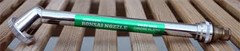
The tool above is a very simple water brake. You can buy one for the hose end for a couple of bucks. That's ALL you'll need to water anything in the gritty mix outdoors. I use it in combination with a hose-end shut-off that allows me to control flow volume.The sophisticated tool below is what I use to water all my indoor plants during the winter. I have 2 growing tables in the basement that are 4ft by 8 ft. I have about 100 plants packed onto the two tables, so the plants in the middle are 2 ft from the edge. I water ALL of those plants with this watering can and never once empty a drainage saucer (I use white plastic plates to catch the water that runs through, and it evaporates in a day or 2) or move a plant.

I took the rose (nozzle) it came with off and slipped a nozzle from a tube of caulking over the spout. It gives me pinpoint accuracy so I can cover the entire soil surface - simple.5. It is easy to overwater with soil, but it's even easier to underwater in grit. There is little margin for error. If a plant wilts one day, it'll likely be dead 24 hours later if it's not watered. You can't put it off to the next day. It's easy to underwater in any medium if the grower doesn't hold up his half of the bargain. Under-watering is another issue not unique to the gritty mix, and to say there is little margin for error is deceiving. Any plant that is wilting in any mix is likely to be just as dead next day in whatever medium it's in. The gritty mix does require more frequent waterings, but that doesn't mean the chance of under-watering is increased. One either waters on time or doesn't. The consequences are the same regardless of the medium used. Where fast draining soils shine is in the area that produces the most problems - OVER-watering. As already mentioned, you'd have to work hard at over-watering media like the gritty mix, while excess water retention is an inherent problem in almost all peat-based media.
6. You end up a slave to watering schedules. You can't really have a friend or neighbor water your plants when you go out of town for a week. Every plant ends up on a different schedule, and you can't just stick a finger in to see if it's damp. It's too complicated and confusing to most people. A slave? Different schedules for every plant? In summer, I make the watering rounds daily, but my situation is a little unique. I have lots of bonsai in very small soil volumes, some of which DO require watering daily. Those plants I'm growing pots the same size others might use are watered every 3-4 days, 2-3 days when it's really hot. I water almost EVERYTHING (other than bonsai) on the same schedule. In the winter, every plant except 1 large Fockea edulis and about 4 very small bonsai gets watered every 4 days. The F edulis gets watered every 8 days & the tiny bonsai every 2 days - not hard at all to keep track of. In summer, I have a number of bonsai that get watered daily. The rest of the plants get watered every 2-3 days, depending on weather. Soils that hold little to no perched water ALLOW you to water on a schedule, which is MUCH easier than trying to figure out when 200 plants in a peat mix might or might not need water - nothing complicated or confusing about it - simple.
7. Grit is extremely heavy and clumsy. A five-gallon potted tree that you might've easily moved outside during the day, and back in each night becomes a chore that needs to be set on wheels. Because the pot's depth plays into how much water it holds in relation to the soil volume, there is no way to be exactly precise in measuring the weight of the gritty mix vs a peat mix. In 1-3 gallon containers, the gritty mix weights about 2-3 times what a peat-based mixture weighs when both are dry. When both are saturated in the same size container, the gritty mix weighs about 25-33% more than the peat-based soils. I grow some pretty big plants, and don't think twice about the weight. The term clumsy to describe a soil wouldn't have crossed my mind. When spring temps are erratic and my numerous plants need to be moved in and out to avoid chill-related injury. I put them on nursery carts and move 50 plants in and out in 5 minutes - simple.
8. It wastes a lot of water (and expensive fertilizer). I have to go around dumping drip trays after every watering. In a dry climate, of if you have heat on indoors to dry the air, it might not be an issue, but we're right around 100% humidity indoors and out here. As noted, I've never dumped a drip tray - they do evaporate indoors long before the next watering is required. Outdoors, it's a non-issue for me. Again - not an issue unique to the gritty mix. If you're watering correctly and flushing the soil when you water, you have water in the collection saucer. If you don't, you're promoting salt build-up in the soil, which comes with its own set of problems.
9. Self-watering pots and devices won't work with grit. Completely true ...... by design. The gritty mix is purposely designed so it doesn't support the perched water SWCs depend on to supply water to the plant. Even the 5:1:1 mix isn't suited well to SWCs. Most growers that prefer bark-based media and the convenience of SWCs add additional peat to the 5:1:1 mix so they end up with something like a 5:3:1 mixed of bark:peat:perlite
Growing is all about compromise. Growers that want the convenience of week-long intervals between waterings aren't going to get it w/o sacrificing a measure of their plants' potential. When we depend on water-filled pores between soil particles to extend watering intervals, we also accept the fact that roots occupying the saturated portion of the media are functioning very poorly and dying from a lack of oxygen. This is very expensive in terms of energy outlay, and robs the plant of energy that might have been applied to something other than regenerating lost rootage. It's up to the individual to decide what best allows them to order their priorities as they choose.
Blaming failures on the mix w/o some feel for what else might have gone wrong is very unfair. Very often, we discover that in their haste to 'get the mix made', it was made with ingredients that shouldn't have been used (too large). Often, too, growers go forward with root pruning that's poorly timed and before the undertaking is well-understood before repotting into the gritty mix. When a plant is doomed before the repotting session is completed, it's hardly reasonable to blame the medium.
I repeat over and over that I'm not selling recipes, I'm selling a concept and encouraging people to understand what drives the concept so they can make use of it to avoid the issues that bring 90% of the growers to this forum seeking remedial advice for problems ultimately related to poor root health. This thread is a perfect example. I extolled the virtues of fast draining soils and never mentioned a recipe or any particular soil until the topic was broached in a fashion biased enough that I felt an alternate view would be appropriate.
YMMV - just trying to keep it real.
Al
- 10 years ago
Yeah, I feel that you need to be a slave to gritty mix in the summer time. Constantly watering. Have regular soil is not that complicated. Just let a plant dry out a big before you water. Even adding perlite to the soil will help with drainage. I would also wait until the plants starts growing in the spring or early summer before you attempt to repot it. Ficus are also very drought tolerant. In the mix they are sold in they can go a while between waterings without any ill affects in my experience. I will be getting a fiddle leaf soon from HD also and i do not plant on changing out the soil.
- 10 years ago
#1. Even you couldn't tell whether my Aeonium was under- or over-watered. If I recall, you suggested that watering it every 3-4 days might be too much. I eventually moved it back into soil, and it improved so much that I recently pruned it back to them stem,
#2 yep, that's a lot of watering, IMO.
#3 my experience is different. For example, that same Aonium was fine in soil (although it had toppled in the soggy growers pot while at the nursery). I moved it in and out almost daily and it was fine. Once it was in grit, I had to hold it upright with bungees because every time the pot tilted as I moved it in and out daily, the Aeonium toppled over. Eventually I dropped the pot moving it in and out, and everything came out, which is how I discovered the root loss.#4 a water brake only works with plants that can have their foliage soaked every day or two, in a climate in which standing water evaporates quickly and won't cause rot. Not everyone lives in such a climate. My Aloes here in Oregon didn't tolerate wet rosettes, neither do most of my rosette succulents in this climate. Standing water and cool tamps cause dropped leaves.
#5 yep, I think if you tend to over-water, grit is a good choice.
#6 you might be able to keep track of that watering schedule, but I was talking about having a friend or neighbor water plants. Most people would be more willing and able to water a neighbor's plants just once during a two week trip than they are to come around daily, or water on 3 different schedules.
#7 grit is clumsy because if you tilt a pot full of grit, it comes out. Soil tends to hold together and stay in the pot until it's tilted excessively.- you live in a climate in which you don't have to dump drip trays. I do not. This place is about 100% humidity indoors and out most of the year. If the water in drip trays evaporates, it condenses elsewhere.
The alternative to filling drip trays each time you water soil is to leach the soil once or twice a year, which I prefer, especially in a cool, humid climate where indoor heating is rarely used.
I'm glad you posted those things, Al. I think it would be helpful to people if you included those points in your regular Water Movement sermons. Your recipes inevitably come up in every one of them, but I suspect any grit will have the same issue. I haven't tried your 1:1:1 mix. I'd probably like it better than grit because it holds more water, is easier to test for dampness (there's another beef I have with grit), and holds together better. I'd have to try it first to know for sure. In any case, I don't disagree with much of what you've said- it's just many small adjustments, which is all I was trying to point out to Mar9en to begin with. I don't think the drawbacks of grit should be kept from new users. They should be as easy to find as your recipes and Water Movement posts.
TLBean, I also amend soils with perlite, and quite like the results. It doesn't actually increase drainage though; it just replaces some of the soil with a non-absorbent medium so a pot doesn't soak up as much water to begin with, and thus dries faster. But that is extremely helpful for plants that like drier soils or are in larger pots.
I think many of the same people who might not like grit, would do well to simply amend their soil. There are many options. Miracle Grow and grit aren't the only ways to go.  10 years ago
I'm going to try the happy medium here. This is not a position I usually take very often, so bear with me. Al's mix taught me a lot about watering. When I had the time and gumption to water every third day it saved a lot of m plants. It is a very good mix for those who have a heavy hand at watering. Now that I have 300 or so houseplants it's not feasible for me to water them all twice a week so I have fallen back to a 60/40 perlite/potting soil mix and it works just as well for me. Although now that I am back in Tennessee where it rains a lot during the summer and I love c&S so much I may go back to the gritty mix just so I don't have to shield my plants from the rain all the time.
My point is both mixes are good mixes, but it's not one size fits all. There are some times where one would be better than the other. It all depends on personal convictions and preferences though. I think we can all agree that potting soil straight out of the bag is not the best thing for most plants. How you ammend the soil is your own preference. This is just my experience.
- 10 years ago
K -
You confuse me, and make me think you might be confused (I'm not saying that in a snarky way). No one I know of , especially not me and especially in this post, ever suggested or defended "grit" as an appropriate stand alone medium, though I'm sure there are isolated cases where it might be if nutritional needs are met. If your argument is against using grit as a medium, you're tilting at windmills - I have no dog in that fight.
Actually, I regularly/openly discuss all the issues you brought up when they come up about the gritty mix (1:1:1 pine or fir bark:screenerd Turface: grit). I have to discuss them because of the tremendous amount of disinformation disseminated by a very few members who feel bashing the gritty mix is almost as much fun as bashing me (I'm not referring to you or making that insinuation - I'd rather keep any conversation I'm in producing light instead of heat.)
I'm not invested in twisting peoples arms in order to convince them they should use any particular mix, I could actually care less. I'm much more interested in seeing they get reliable information so they can take more control over their growing experience and make informed decisions that aren't tainted by extreme bias, and that includes addressing anything that might be considered an issue with ANY medium - not just the 2 basic recipes I post as good starting points, but those are included. I don't avoid the conversations or try to cover anything up - ever, and I'm not emotionally invested in what people choose to use. I work hard to help people, and people have a very high rate of success when they follow the things I suggest because they are always aimed at identifying and eliminating limitations. I try very hard to qualify everything I say so there is no chance of it being misunderstood to the detriment of someone's plants, but while I take responsibility for everything I say, I can't be responsible for how people interpret what I say or everything everyone does. Still, I do feel bad when anyone making an honest effort meets with misfortune. At that point, I can either offer platitudes or dig a little deeper until I get to the issue most likely responsible for the bad luck. How I proceed depends on my perception of what would be most productive for that person in that particular case and how they might take a post crisis constructive critique.
Enjoy what's left of your evening.
Al
- 10 years ago
"Grit" just shorthand for any inorganic medium roughly similar to your "gritty mix." There are many variations on the theme. There's another unsifted recipe called Mississippi River Bottom or something similar. "Grit" doesn't single out your recipe. That's all.
Why wouldn't you use Turface by itself? I've asked you this several times before, but you've never really answered. Since we're on a similar subject... - 10 years agolast modified: 10 years ago
I don't remember anyone asking that question. Turface isn't grit. In discussions about soil amendments or ingredients, grit would be a nonporous particle with an irregular surface and close to chemically inert under growing conditions. Crushed granite or cherrystone are the two types of grit most commonly discussed as appropriate ingredients for soils like the gritty mix, but materials like Haydite or Bonsai block (expanded shales), and others can be utilized in place of grit with an appropriate adjustment in the ratio between the Turface and grit. Grit is combined with Turface in varying ratios to adjust water retention. When someone says that the gritty mix doesn't hold enough water, I know they are following a recipe and not utilizing a working knowledge of the concept that spawned the gritty mix and the 5:1:1 mix. I say that because the level of water retention of the gritty mix can be increased significantly by simply changing the ratio of Turface:grit in the mix.
E.g.:
3 bark
4 grit
2 Turface
offers substantially less water retention than the basic 1:1:1 (3:3:3) mix, while
3 screened bark
4 screened Turface
2 screened grit
offers a LOT more water retention than the 1:1:1 (or 3:3:3) basic recipe, and it offers the added water retention w/o a notable change in aeration, which can't be said of soils that trap water between soil particles (that would serve the plant better if filled with air) instead of inside soil particles, like the gritty mix. Of course, it also holds moisture on the surface of particles in a microscopically thin film and at the interface where particles contact each other - as all media does.
I have used only Turface as a medium in a few cases and mostly in earlier years, but I generally don't these days because even when screened over insect screen, Turface is a little on the fine side and holds more water than I prefer (due to the smaller than ideal particle size when used alone), which is why I add the grit and bark to purposely reduce water retention. I actually WANT my plantings to need water more frequently because it's much healthier for the plants than long intervals between waterings. To me, 4 days is as long as I would ever want a plant to go between waterings, and even at 4 days I realize I'm leaving SOME potential on the table due to too much water retention.
Soils that require more frequent watering generally offer plants much better opportunity to realize more of their genetic potential because by holding less water they eliminate a large part of the limitation imposed by lack of oxygen when soils are saturated. Also, the benefits extend beyond root health. Actually maintaining control over your nutritional supplementation is very difficult in heavy soils - monkey easy in soils you can water to beyond saturation w/o plant backlash. If you think you disagree with that idea, let me explain before you actually do.
Al










Mentha (East TN, Zone 6B-7A)