Software
Houzz Logo Print
smartdesigner

Bamboo near Drainage Area and Forest Preserve. Need Help.

9 years ago
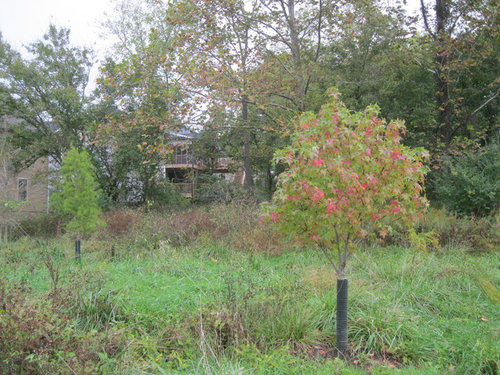
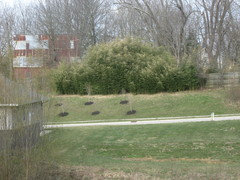
Bamboo planted behind my Bald Cypress and in front of the yellow house (owner of the bamboo).

Recently a neighbor planted bamboo in a flood control space/retention area shared by 8 houses (everyone owns a part of it). He planted the bamboo on his own part of the retention area, 4 feet from my property line. Because it's a flood control area, I can never create a barrier to prevent the bamboo from invading the part of the space that I own. I can't poison the bamboo shoots that invade my area because when it rains, the water moves from that area towards my planted bald cypress trees. Also, the area has somewhat tall grasses and vegetation so mowing the invading bamboo would be very difficult. Finding young bamboo shoots among the tall grasses would be difficult too.

Furthermore, this retention area is next to a protected forest preserve (see mature trees). This is my other concern. I am afraid that the bamboo will invade and ruin the protected forest area.

I am sure my neighbor meant for the bamboo to provide a privacy cover, so most likely he planted the spreading type. He put in at least 6 plants and one is already 15 feet tall. He did not put in any type of barrier, but he isn't allowed to anyway in this space. The area gets plenty of nutrients and moisture so I suspect that it will grow quickly and really spread.

This is a fairly new neighbor and someone who impressed me as being a bit of a "bully" which could make this difficult. I don't think that he's that knowledgeable about plantings, but he is enthusiastic about putting in a number of trees in his part of the retention area. I actually appreciate this and wasn't concerned until the bamboo went in.

Advice? Everyone is allowed to plant things in the area, but we can't build or place permanent structures in the shared area, nor can anyone redirect the flow of water in the area.

Email CommentBookmarkLike

Comments (11)

  • 9 years ago

    Kudzu, I agree with you that "poison" is not the solution. I don't even use weedkiller on my lawn. Right now I'm debating about talking to the neighbor. Between the two of us there's a healthy lot of new trees that would eventually provide added privacy between us without the bamboo. Although, in the winter...not so much and it will take some time with young trees. Talking to him though, could make him angry. That's my perception of this person, but I can't be sure.

    My second option that I'm looking at is contacting the city. It's doubtful, but I could argue that the bamboo falls under the city regulation of a "nuisance" particularly because there's little I can do to control it moving into my space. Also, there is a regulation in that area against anyone changing the flow of the water. There's a dry stream near his bamboo that flows when it rains. It may also eventually fill in much of the water retention area, thus we lose some protection against flooding. Also, it would eventually invade the preserved forest area. I know the city is trying to rid invasive species, which I think in this situation the bamboo would qualify considering that the owner is doing nothing to control it.

  • 9 years ago

    smartdesigner-

    I generally have a negative reaction when people want to classify bamboo as a nuisance based on their fear it will get out of control and devour the neighborhood. However, your situation is exceptional. If you are not allowed to use the normal, effective bamboo controls, then I think that approaching the city with the position that this could become a nuisance situation is a good strategy and kind of puts the ball in their court. They would have to either say that you aren't allowed to control it and worry about the consequences if it moves out and compromises the area, or they can decide that a modest barrier is going to do more good than harm. Or they could decide to get your neighbor to remove it. He might still get annoyed, but you wouldn't be the sole target.

    Installing barrier means trenching down maybe 24 inches, which means groundwater would still be able to move, and if the barrier was kept an inch or two above ground level, surface water could move over it when the area gets a lot of water. I understand that they don't want to have people building diversionary dams, but I would argue to them that bamboo barrier doesn't constitute that level of habitat alteration. (Between you and me -- and something you don't need to share with the city -- is that, although bamboo do like water, they do not like too much water. Bamboo will typically not move through a stream bed, and they begin to suffer and die when their root systems are continuously subject to standing water for several weeks. So it's hard to know in your situation what bamboo will do in this environment.) However, approaching the city with your concerns is wise as this shouldn't have to fall all on you.

    Good luck and post back when you have more to share.

  • 9 years ago

    Kudzu, thank you for some very good advise. Applied correctly I actually like bamboo, but you are correct that this is an exceptional situation. I'll post back when I get some response from the city.


  • 9 years ago

    Bamboo update:

    The city has been slow to respond. In the meantime I found out from another neighbor that he had taken this bamboo from across the road and transplanted it into his yard. I saw him put it in. This stand of bamboo is literally the size of a house and you can see how tall it is against the barn. That is an old farm house inside the city. From research, I understand that the bamboo will love where it was transplanted to.

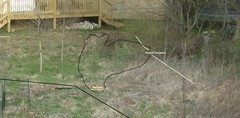
    In this photo you see my property line and two weeping willow trees that he planted to the left, followed by the bamboo circled, and then the forest preserve on the right. Size is deceptive in the photo. I think the bamboo is about 15-20 feet tall now. A stream flows in front of the bamboo when it rains, then drys up within a day. I'm guessing his deck is about 30 feet from the bamboo.

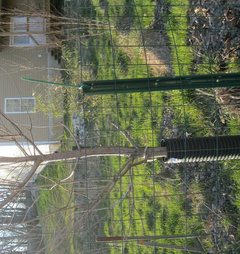
    Excuse the sideways picture. In the middle you can see another grouping of bamboo (my own Bald Cypress-bamboo- neighbor's river birch) about 5 feet from my property line. I don't have a photo of a third grouping of bamboo that is on the side of his house by another neighbor. The stem of the bamboo is yellow and green.The person who gave away the bamboo had moved there less than a year ago and never had a yard before. No barrier was used when it was transplanted even though the person he got it from told him that a barrier should be used.

  • 9 years ago
    last modified: 9 years ago

    Does the yellow and green bamboo look like this?: Phyllostachys aureosulcata Also known as Yellow Groove, it is possibly the most common running bamboo in the U.S.

    Good luck with the city. They probably don't know quite what to do about the problem, but keep on them...

  • 9 years ago

    Yes. I think that you are correct that it's Yellow Groove bamboo. The stem is yellow. I'm going to try to find a way to email the city so I have official documentation of my concern. In my case I'm going to argue that it falls under their city law of "nuisance" considering its location which makes it nearly impossible to control.


  • 9 years ago

    Documentation, politeness, and persistence are always good in dealing with a city department... :-)

  • 9 years ago

    I have not seen any action from the city to address my concern. It has been 3 weeks since I spoke with the person responsible for issues related to vegetation in the city. I also sent them an email just a week ago confirming that "running" bamboo was the type that had been planted. I will attempt contact again with the city mid-week if I don't hear anything from them.

    I have since learned from the Invasive Bamboo Society that this bamboo can grow 25 feet in a year once established, it's rhizomes can break and spread in this flood area downstream to other neighborhoods, and bamboo barriers are very expensive, so I'm going to be persistent about taking action.

    I like the look of bamboo, but this is the wrong place for it considering the particularly difficulty of controlling it's spread in the area.


  • 9 years ago

    I encourage you to keep after the city and document things. However, I also want to caution you about the "Invasive Bamboo Society": in my experience this so-called society is simply a small group of people with an extreme hatred of bamboo and are prone to exaggerate, so they're not a particularly reliable source of information. What you should know about bamboo growth is that a plant will put up new shoots in the spring and these will grow into culms reaching their full height in several weeks, maybe 4 to 6. if the plant is young, these culms will be short; if the plant is mature, these culms will be tall. But the reality is that these plants will just get incrementally taller each year until they max out at the full height for that species, and none of the culms will ever grow taller than they got the first year they shot up. Those bamboo you showed pictures of previously are not going to magically shoot up to 25 feet. I have had yellow groove for over 10 years where I live, and it's about 12 or 13 feet tall right now. Where I lived previously I had a grove that was already planted when I bought the house, and 30 years later it was definitely getting to be about 20+ feet. You could start having a problem with invasive growth in perhaps three to five years, but don't let the Invasive Bamboo Society make you think that it's going to eat your house tomorrow. :-)

  • 9 years ago

    I will keep after the city. You're probably right about this "Society" being overly aggressive about their statements (: Although, they do have some very strong cases of problems evidenced through photos taken year to to year. There his probably good reason that some cities and states have placed restrictions on running bamboo.

    Factually, I can say that the bamboo stand from which it came has caused problems. The neighbor with the established bamboo is constantly fighting bamboo culms that work their way down the hill and they have had a very difficult time getting rid of at least part of the stand. They decided that since the neighbor next to them had bamboo there too, it wasn't worth the expense to rid all of it.

    Much of my concern is that the neighbor put it in an area that is immensely difficult to take care of once it spreads to my property and others.


Sponsored