Software
Houzz Logo Print
dissonance79

Companion plants for strawberry tree (Arbutus unedo) Zone 8

9 years ago

Hello I have a corner with a newly planted strawberry tree and I am looking for companion plants. I will be removing the arborvitae on the right so there will be equal room on both sides. There's about 11 feet from the trunk of the tree to the edge of the art. Does anyone have any suggestions for foundation plants and then I can fill in with some perennial flowers? I was thinking perhaps a frost hardy Gardenia on each side. But I'm not sure.

You probably can't tell from the picture but from the trunk of the strawberry tree to the corner of the fence is 12 feet so I have some room back there to find something to compliment the tree. I eventually plan to trim up the strawberry tree to showcase the limbs/bark.

Comments (12)

  • 9 years ago

    where are you ... location matters ...


    anything can go under it.. its really up to personal choice ...


    i would go with some height behind.. and lower in front ...


    if your looking for perennial suggestions ... you might want to try that forum ..


    i dont know why you need perfect balance in the yard.. so i dont know why you would remove the right arb ... but again.. thats a personal decision ...


    you might also want to think of clematis or morning glory on the fence itself ... a cut down type of plant for future maintenance on the wood fence ...


    ken

  • 9 years ago

    If you want something that has roughly the same water requirements, a garden-hardy manzanita such as 'Howard McMinn' would work. They would also eventually give you very attractive bark and they can be pruned and opened to showcase it. They are slow-growing and can easily be kept lower than the heights cited. Otherwise almost any shrubby plant would work - some of the Nandina cultivars, especially those with lots of red like Sienna Sunrise ('Monfar') would compliment the berry colors of the Arbutus, Coprosma if its hardy in zone 8, Yuccas such as 'Color Guard' if you want color (they form attractive clumps) or really whatever shrubs you like. You could also use dwarf conifers to bridge between the Arbutus and the Thugas. I tend to go for evergreens but because your existing plantings are all evergreen, you could certainly choose something deciduous.

  • 9 years ago
    last modified: 9 years ago

    Anything with reddish bark in that spot is going to disappear visually in front of the fence unless it is painted a different color. Other broad-leaved evergreen shrubs with the same deep to medium green, glossy mature leaves, bronze or coppery new growth and preference for sunny locations with average moisture as Arbutus unedo include:

    Abelia x grandiflora

    Camellia sasanqua

    Erica carnea

    Ilex cornuta

    Osmanthus heterophyllus

    Gaultheria mucronata

    Pyracantha

    Rhododendron augustinii

    Some deciduous shrubs in this same group are

    Deciduous azaleas

    Chaenomeles

    Punica granatum (dies back during coldest winters in this region)

    Viburnum x burkwoodii

    And some herbaceous perennials of this same nature are

    Delphinium

    Helenium

    Paeonia

    Rudbeckia

    Dan thanked Embothrium
  • 9 years ago

    Thanks guys. This gives me a lot to research!

    I do understand the fence is the wrong color to accentuate the strawberry tree bark. As the strawberry tree grows, I do want to accentuate that feature so I have considered placing plants behind to try and provide the contrast that the fence doesn't offer. I looked at some fargesia robusta (clumping bamboo) although I'm not sure if that would look right there. Eventually that fence will need to be replaced and I might go with a more natural lighter stain.

    I ended up getting two Gardenia 'Frostproof' 5 gallon plants to try on the far left and right sides. I have some perennial flowers dianthus, grosso lavender, geum, sun daisy, black eyed susan) to fill in the spots, although I'm not totally sure what to do with the far back to block the fence and to get that contrast with the bark.

  • 9 years ago
    last modified: 9 years ago

    Bark of that particular Arbutus not very red, gives a generally brown impression. It is other kinds like manzanitas that will look too similar to the fence to show well.

    The bamboo would have been compatible, most of those others not so much. I tried that same gardenia cultivar near the sunny west side of my house and it froze out after a few years. I haven't seen any successful gardenias in this area that weren't low and dwarf in habit, with single flowers. Really off the top of my head I can think of only a single property in a hot, valley bottom location inside Seattle having ones that seemed to be working out, in this case the 'Kleim's Hardy'. A planting site with a south exposure, walls and paving nearby, and not the same amount of ventilation as up on a ridge or other location where the wind gets in easily. In other words a heat trap.

  • 9 years ago

    Bummer to hear about your Frostproof gardenias. They show good down to zone 7. I think I'll give them a shot and hope for the best.

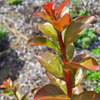
    The new growth on my strawberry tree is very red. I was hoping the older wood would keep some of that.

  • 9 years ago
    last modified: 9 years ago

    No it does not have red bark, as far as I am concerned this species is basically a zero for bark effect. At least in comparison to 'Marina', which is amazing in coastal Southern California, and Arbutus menziesii.

    Plants on the market come with optimistic zonal designations all the time. The Zone 7 determination for the gardenia could perfectly well be due to erroneous conclusions having been reached. To begin with many people don't seem to understand the USDA zoning system at all.

  • 9 years ago
    Sara was talking about the Howard McMinn Manzanita and I saw one at my local nursery and couldn't resist and got one. I don't think I'll put it near the strawberry tree since they are so similar. I do have this sunny spot out front that may work if I remove an azalea or heavenly bamboo. My house has probably 6 or 7 azaleas out front so it's a bit much.
  • 9 years ago

    Sure it would work there. The more that I look at your original photo, the more I like the idea of Hydrangea quercifolia. Great contrast of textures since it has large leaves, nice flowers and fabulous fall color. Easy to prune to size, although the smaller cultivars wouldn't need it.

    Your 'Howard McMinn' will grow very densely and you can eventually trim out the dead twigs and foliage on the inside and have an extremely sculptural shrub.

  • 9 years ago
    last modified: 9 years ago

    People who have tested a whole bunch on the east coast have found 'Grif's Select' to be one of the hardiest Gardenias. In the cooler summer PNW, YMMV.

  • 9 years ago
    last modified: 9 years ago

    There's too many azaleas only if you want one or two plants of each kind in the entire planting. Otherwise, since the azaleas are small-leaved if anything the planting could stand to use more of them, to balance the leaf sizes of the nandinas and in particular the palm. (Also I would stop clipping them so they stand apart from one anther like tombstones, would instead allow them to merge and form a drift).

    Windmill palm, heavenly bamboo and evergreen azalea all want more moisture than manzanita. And look the part. So if you stick a manzanita among these others there will be a conflict of naturalistic character.

    'Howard McMinn' is good looking and has made some nice specimens visible from Seattle streets. And elsewhere, including at the Rhododendron Species Botanical Garden in Federal Way. However it also has a tendency to develop leaf galls here, and for whatever reason the still recently good looking example at the Rhododendron Garden had suddenly gone south the last time I looked, been basically lost - perhaps to crowding and shading.

    If you start planting types like manzanitas you are dealing with dry-land species that have little tolerance for shade and dampness or heaviness of the soil, at least in the case of the last two them occurring in combination with one another. Think coastal California and Mexico, the Mediterranean etc. Whereas what you have planted in that driveway bed now is E Asian monsoon climate species, from places where it rains buckets all summer most years.

    If you now want to focus on dry climate plants instead I would take out the palm etc. and probably replace the soil in the bed with a coarse one prone to excessive drainage. One time I bought pit run sand and dumped it on top of the existing soil in front of my house, made berms which supported an assortment of plants that all did well (although few of them were actual dry-land kinds, I am sure it would have worked for those. And I wouldn't have felt the need to water them in summer). Also at the Jungle Fever Exotics nursery in Tacoma there is a berm between the sidewalk and the sales yard planted with things not usually expected to grow here, consisting visibly of some kind of freely draining or otherwise "different" soil that is making it possible for these plants to persist.

    Bing Images - Jungle Fever Exotics Nursery

    http://www.bing.com/images/search?q=jungle+fever+exotics+nursery&qpvt=jungle+fever+exotics+nursery&qpvt=jungle+fever+exotics+nursery&qpvt=jungle+fever+exotics+nursery&FORM=IGRE

    Dan thanked Embothrium