Software
Houzz Logo Print
woodyoak

Nepeta (prob. Walker’s Low) killing lawn...? Plus new project for 2019

Yesterday we were walking around the front garden trying to decide what to do to deal with several issues that have been bugging me - particularly metal edging becoming exposed. DH was able to drive some of the edging that had heaved back into the ground using the heavy metal tamper tool applied on top of a 2x4 laid on top of the lifted edging. The ground is wet and soft enough to let the edging go back down without too much trouble. But still too much edging remains exposed and we concluded that the grass paths along the edge of the beds have compacted, sunk, and become uneven making walking on them difficult for me. So we concluded the best thing to do was rip out the grass, add more soil to raise the level a bit which should cover the rest of the exposed edging, and re-lay new sod. DH called several contractors yesterday and we will be meeting the first one here tomorrow to discuss the work so they can give us a quote. So some spring clean-up work may get delayed depending on the timing of the grass work if we can get it done soon.


The other big, related issue is a large patch of dead grass at the back of the main bed. I have noticed over the past couple of years that it looks like some Nepeta has seeded into the grass and the grass has died in that area. Has anyone else had a problem with this? The death of the grass has left the ground lumpy and uneven. I had a bad fall there late last summer and almost fell yesterday too. So the Nepeta will get evicted from the garden here and I wondered if this plant caused anyone else problems...?

Comments (23)

  • 7 years ago

    Nepeta in the lawn hasn't been a problem for me because it is apparently one of the many plants that can't handle being 3" tall. I have one plant that kills lawn because it is too close to a bed edge and shade out the adjacent grass.

    woodyoak zone 5 southern Ont., Canada thanked mad_gallica (z5 Eastern NY)
  • 7 years ago

    How do you know the nepeta is what killed the grass? Could be simply a coincidence and something else is going on (e.g. grubs, herbicide spray drift, etc). Grass is pretty hard to kill after it's well established, so I have a hard time believing some nepeta seedlings did it in.

  • 7 years ago

    mxk3 - I don't know for sure that it is the nepeta but there is lots of what I assume to be nepeta (lots of blue flowers that match what's in the bed in the area close to where the grass died - the nepeta in the bed will be removed during spring clean-up!) I use no chemicals (they are banned here anyway....) I haven't found any grubs there. The reason I posted here is to see how likely nepeta is to be the cause - i.e. has anyone else experienced this with their nepetas...? It appears that the answer may be 'no' so I will keep looking for an alternate explanation.... (and hope the grass doesn't die there again after we replace the lawn!)

  • 7 years ago

    Pictures? Could you be talking about creeping Charlie? It is a common lawn weed that is related to nepeta. It doesn't kill lawn, necessarily, but can quickly take over if something happens to the grass.

    woodyoak zone 5 southern Ont., Canada thanked mad_gallica (z5 Eastern NY)
  • 7 years ago

    I'm staying well away from that area to avoid falling! It's also still a brown and wet mess in midst of spring thaw :-) It's not creeping Charlie though.

  • 7 years ago

    I really think pictures would help in this case.

  • 7 years ago

    I’m beginning to think maybe it is grubs that we just didn’t find last year. We don’t have much grass left in the front yard and this is the only place where there is dead grass in the remaining grassed areas. There is definitely seedlings that have spread out from what is in the bed nearby. But grubs wouldn’t likely eat their roots as they do the grass roots, making it look like it’s the nepeta (or whatever....) that is making the grass die. Tomorrow someone is coming to look at the front to give us a quote on replacing the grass etc. Maybe I’ll try to get some pictures then. Both plants and grass are still dormant here though so there’s not much to see other than patchy dead stuff.

  • 7 years ago

    Maybe your DH can oblige with a photo. I do have grass killed by Nepeta, not by seedlings, but as Mad gallica mentioned, by the entire plant spilling over onto the lawn when planted too close to the edge and either smothering or shading out the grass. So maybe the Nepeta seedling are because the grass was killed by the parent plant rather than because the seedlings themselves killed the grass.

  • 7 years ago

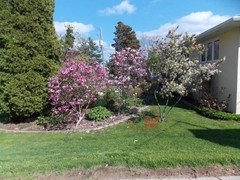
    I will see what I can do tomorrow re getting a picture. In the meantime, I looked at old pictures to try to find one where I can roughly mark where the dead spot is - see below for a 5 year old picture showing roughly where the problem area is. The original nepeta is barely visible - it was planted at the base of the 'Randy' magnolia and never did well - sprawling on the ground and obviously not liking the area (too much shade as the tree grew and probably too much root competition). That plant never got big enough to shade out grass on the lawn. The grass in the area closest to the bed has always been odd - very narrow, thin stems and dense roots - hard to cut into with just a trowel. There is a similar patch of that grass on the other side of the bed. That grass hasn't died. Where the grass has died, the space has been filled with seedlings that look like, flower like, and have the scented foliage of the plant that is supposed to be nepeta under the magnolia. As this discussion has continued, I am increasingly suspecting grubs or some other pest in the soil - maybe grubs particularly liked the dense roots of that odd grass (although I'd expect them to then also like the grass on the other side of the bed too but it is fine....) The problem started small a couple of years ago and has gradually moved outward from the bed, towards the serviceberry tree (and probably covers more than just the space I tried to mark on the photo - when I was looking at it the other day, I was looking out from a path in the bed, not the view in this picture.)


  • 7 years ago

    Magnolias can kill grass with their exceptional dense and shallow root system.

    woodyoak zone 5 southern Ont., Canada thanked whaas_5a
  • 7 years ago

    Maybe it's because of all the suckering from the serviceberry. They sucker a lot no lie!

  • 7 years ago

    Jay - I keep the serviceberry to the three stems in the picture - all other suckers are remove as soon as they appear! (Some of the serviceberries in the backyard though are not de-suckered often enough....)

  • 7 years ago

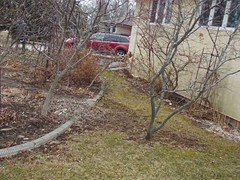
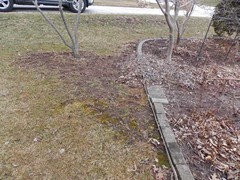
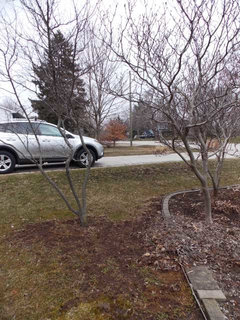
    OK - i got some pictures of it this morning..... I'm totally baffled by this! The area is bigger than I thought and seems to have enlarged over the winter. The problem became noticeable the summer before last (i.e. summer 2017). From the pictures below you can see that it seems to be spreading outward from the bed, starting near the magnolia, but it it also spreading along the bed edging. It almost looks like damage from a spill of something except we don't use any chemicals. There doesn't seem to be any similar damage near the other magnolia. I've also looked at pictures I've taken of other magnolias in the neighborhood that are planted in lawns and don't see any grass damage with those, so I'm doubtful that the problem is magnolia roots. Any other ideas...?


    This picture clearly shows the extent and pattern of the problem:


    This picture shows a closer view of the base of the 'Randy' magnolia with the mess of dead foliage that is the nepeta at this point:


    In this picture I was trying to show the extent of the magnolia canopy:

    I have no idea what is going on! We will dig around a bit when it gets warmer and drier to see if we can find anything obvious in the soil.... Any other suggestions....?

  • 7 years ago
    last modified: 7 years ago

    I don’t know direction and how sun and shade fall here, but might it be a combination of shade and root competition from the two trees?

  • 7 years ago

    North (and a bit to the east) is at the top (where the neighbour's car is) of the picture above; the garage wall is to the west. The area gets shade from the garage by late afternoon but there is lots of sun for that area before that. So shade is a bit of an issue but not much for that specific dead area. When we dig around there in a few weeks when it's drier, we'll pay attention to how dense the roots are in that area....

  • 7 years ago

    I have an area that looks similar to that woody. It is up by my house over the septic bed and in my case it appears to be mice or moles making shallow runways under the snow. They are not active there in the summer but the grass/soil is a little churned up right now. There is a core area then little runways off of it. Almost like a meeting place.

    Especially in the last two pics it looks like little runways on the bottom left of your pic. I agree that the Nepeta is not the issue.

  • 7 years ago

    peren.all - hopefully the problem is not little rodents! So far, the top contenders for cause seem to be one or both of root competition or too much shade when the trees leaf out (although I wonder then why the dead patch is not more circular to match the shape of the canopy....?) I'm now trying to think of strategies to address such issues and keep replacement sod alive. At this point I'm thinking keep the trees limbed-up to maximize light reaching the ground and add in a couple of those tree spike fertilizer things to provide more nutrients for the trees. (The guy who came on Saturday to look at the garden to get information needed to give us a quote for sod replacement said the moss in the dead area says to him that the area is nutrient deficient - so that probably supports the root competition theory.) I'd like to avoid removing one of the trees if possible. If there is no option but to do that, it would be the serviceberry that goes.

  • 7 years ago

    Use a broadcast granular fertilizer rather than tree spikes which concentrate fertilizer in a tiny area.

    woodyoak zone 5 southern Ont., Canada thanked NHBabs z4b-5a NH
  • 7 years ago

    If you need to fertilize the trees, don't use spikes!! Tree roots (and most other plant roots for that matter) spread out in a roughly circular radius from the base of the tree. Concentrating any nutrients to one or two very localized areas is of marginal benefit to the tree and the majority of the product is wasted. It is much better to use a granular product sprinkled all the way around the dripline or canopy edge. If you already have the spikes, just grind or crumble them up finely and use them in this manner.

    woodyoak zone 5 southern Ont., Canada thanked gardengal48 (PNW Z8/9)
  • 7 years ago
    From what I understand, Walkers Low produces sterile seeds.
  • 7 years ago

    OK no spikes...:-). (I was trying to think simple and easy...). Any particular recommendation for NPK ratio appropriate for these trees...?

    I keep looking at the last picture above.... I think I WILL remove the serviceberry as that will make movement through the area easier and might help with the grass problem. I had wanted a single-trunked tree when I planted that one years ago but didn’t find one. We will soon be removing a wayfaring tree (shrub) that is not too far away in the bed where the magnolias are. If I can find a single-trunked serviceberry I may try to find a place for it somewhere in this area but not so close.....

  • 7 years ago

    Fertilizer spikes are indeed simple and easy.....for the gardener :-) Not so much for the best benefit of the plants. Trees are generally most limited by insufficient nitrogen so something with a 2-1-1 or 3-1-1 ratio is ideal but any granular all purpose fertilizer should suffice.

    woodyoak zone 5 southern Ont., Canada thanked gardengal48 (PNW Z8/9)