

Are downdraft ventilation units better in 2024? Honest reviews please
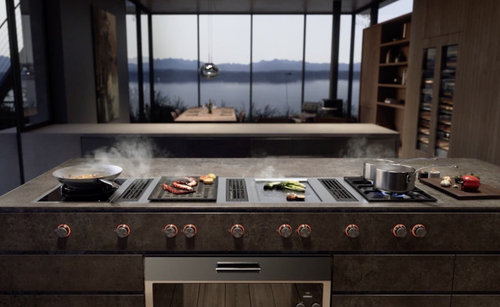
Our architect designed us a single-story, Minimalist contemporary 2 bedroom home and specified the new 2022 Gaggenau Vario 400 Series downdraft ventilation induction cooktop, with a recirculation system in the cabinet below. It's supposedly the "best technology" downdrafts have seen to date.
I know many of you will throw a fit, but we had some major design limitations and wanted to give priority to our sink and prep area facing the view, so that's how we arrived at a downdraft.
We are also very light cooks - soups, steamed veggies, pastas, rice. In fact, our current home has no exterior ventilation at all, and it's never been a concern due to our cooking style. We have an outdoor grill for the occasional heavy cooking.
Most of you will say downdrafts are useless but there's a small percentage of us who just have no reason for an overhead hood. New downdrafts are coming onto the market and I'm curious about their effectiveness. For example, our friend in Germany has the new Two-In-One Miele integrated induction downdraft induction. She says it's incredible.
So, are downdraft units getting better in 2024? Are the telescoping downdrafts better than integrated ones?
Or, should we forget about indoor ventilation completely, given the relative ineffectiveness and the fact we're one of the few people who don't really "need" one to begin with?
NOTE: Other threads about downdrafts seem to have turned into a space to argue for why people should be installing hoods instead. I'd like to request that we avoid repeating that here, and accept that some people want or need to use downdraft ventilation units.
Comments (58)

Pi_pumkin_sol3
Original Author2 years agolast modified: 2 years agoI was told the reason for recirculating instead of venting directly outside is because the cooktop is on an interior wall and venting outside would mean channeling a vent through the concrete slab.
He said that could create a lot of potential damage that's uneasy to access and at least with recirculating you have direct access to anything if it needs repair without having to break open a slab.
Can anybody speak to this? 2 years agolast modified: 2 years ago
"....if you just can't skip the awful anti science dysfunctional downdraft idea."
Don't you think OP already knows that the downdraft is not ideal? They certainly aren't making an argument for its effectiveness.
What they seem to be asking if it's worth having a downdraft at all or if newer technologies have made them a bit more worthwhile. Or if they should just skip venting all together as they have done so in their current setup. Could be a lot of hassle and extra expense if it's only going to make a 5% improvement.
But who says the newer units only create a 5% improvement? What's to say they aren't closer to 50% by now in 2024?Related Professionals
Memphis Architects & Building Designers · Bridgeport Architects & Building Designers · San Francisco Architects & Building Designers · Potsdam Design-Build Firms · Portland Design-Build Firms · Salina Home Builders · Wausau Kitchen & Bathroom Designers · Huntsville Bathroom Remodelers · Hagerstown Bathroom Remodelers · Jackson Bathroom Remodelers · Tyler Kitchen Remodelers · Cheyenne Kitchen & Bathroom Designers · Rocky Mount Kitchen Remodelers · Fredericksburg Custom Countertops · Middletown Custom Countertops- 2 years ago
Gaggenau Vario 400 Series Downdraft System
You know it's special because the video's narrator ain't some rube from flyover country.
-----
You can import an induction cooktop with recirculating downdraft.
Pi_pumkin_sol3
Original Author2 years agoSo what's better ?
Downdraft exterior vent through the slab (would be a 15' straight line under the slab to reach outside) or Downdraft recirculating system directly under the induction?
Pi_pumkin_sol3
Original Author2 years agocpartist, my mind is made up on the fact I don't want an overhead hood. But my mind is not made up whether I should install a downdraft or just go completely ventless, given the complaints on this website about downdrafts being "mostly useless."
I see you vote for having a downdraft over nothing at all.
People seem to like Best Cattura Downdraft for light low-oil cooking.
Do you think a telescoping downdraft could be more effective than even the "highest-quality" integrated downdrafts coming out of Europe today? 2 years agolast modified: 2 years ago
I would not go completely vent less. We have radiant heat in the ceilings in this 1955 MCM (so no whole house fan or air moving) and a stove on interior wall. It's a JennAir with downdraft. It's not wonderful but its better than nothing....as it is, there are certain things I cook that I can smell approaching my kitchen the next morning. Pot roast with garlic comes to mind. No slab, the downdraft is vented into the floor, goes under the kitchen and with a fan system blows with enough force outside the house at sidewalk level it will move leaves on plants in the flower bed other side of the sidewalk there. Still, some lingering cooking odors. Outside in my backyard when that downdraft is on? Yes, I can smell my dinner cooking :) Window glass on the opposite wall might still steam up if cooking a large pot of pasta - the kitchen is not small.
My former house had a heat pump with whole house air cleaner attached. That may have been a better situation for a downdraft and the range had a normal hood!
Other note: I had a warranty service person here for another reason and we were discussing the stoves. He told me 'next year' (which would be this one although it was just about 6 weeks ago he was here) there were potentially a couple of more efficient downdrafts that would be presented, he'd seen them and said 'better'. He mentioned JennAir specifically but there is no Miele service close so he wouldn't have experience with those....few locals install Miele in anything with authorized service being 125 miles away....'prompt' service doesn't exist for us.
- 2 years agolast modified: 2 years ago
“Downdraft exterior vent through the slab (would be a 15' straight line under the slab to reach outside) or Downdraft recirculating system directly under the induction?”
Running various types of ductwork through the slab was fairly popular about thirty years ago. For the most part, it didn’t turn out well. Lots of mold and other problems.
“Do you think a telescoping downdraft could be more effective than even the "highest-quality" integrated downdrafts coming out of Europe today?”Yes. Most everything you need to capture is going to flow up. Catching as much as you can on the way up seems a lot easier than trying to get it to fall in the right spot.
Pi_pumkin_sol3
Original Author2 years ago"Lots of mold and other problems."
More-so than wall/ceiling venting? What would cause a difference in the amount of ductwork mold under the slab verses ductwork mold in the wall and through the attic, if the both are exposed to the same outdoor elements at the end?
I'm curious about what other problems could arise as well. We are in Florida.
If slab ductwork is so horrible and not an option, what other solutions could I have? Besides a recirculating system like the Architect originally proposed? 2 years ago
How high is the ceiling? They have a ceiling vent that is flat against the ceiling
- 2 years ago
also if the cooktop is on an interior wall, why no hood? it seems like there must be other options.
Pi_pumkin_sol3
Original Author2 years agolast modified: 2 years agocpartist, the ceiling is 13' tall, so a ceiling vent won't work.
harpie, cooktop is on an interior wall and we chose no hood because we don't cook in a way that really needs one ... rice, dumplings, soups, rice noodles, slow-roasted meats, stews, steamed veggies, baked chicken, crockpot .... I can't even tell you the last time we stir-fried or seared something inside the house ... maybe 4 or 5 years ago? Neither of us feel the need to vent out rice or noodle steam, and in all these years, we've never seen grease or oils buildup on our furnishings or walls, as people said would happen.
The aesthetic for the new house is open and minimal, so with a 14' ceiling, it just made sense to forgo a hood completely. Otherwise, it would be very long up the wall and through the attic. The architect said great things about Gaggenau downdraft so that's what led us here to ask the kitchen pros.- 2 years agolast modified: 2 years ago
I really want to throw a fit at your architect.
My vote is no ventilation at all for you.
My concern is that this house will outlive you and your cooking style. Someone who doesn't cook or cooks with your style will buy the house but it will have a limited buyer pool. I have walked away from many houses without a hood.
There is a great value in custom houses but creating a design that works for few people is a really bad idea from a societal standpoint.
Of course, I would also probably walk away from a 13 or 14 ft ceiling in a kitchen.
To be clear, I would walk away from a house with a downdraft vented cooktop even if it was a Gaggenau.
- 2 years agolast modified: 2 years ago
I have never seen a buyer walk away from an otherwise acceptable home because of kitchen ventilation. It is cool that it is so important to you, but I strongly suspect that you are an outlier.
An astounding number of higher end homes in my area have recirculating microwave hoods. Kitchen exhaust has to be one of the lowest ROI’s when flipping houses, you are going to spend a couple of thousand dollars fixing something that almost noone cares about.
- 2 years ago
“What would cause a difference in the amount of ductwork mold under the slab verses ductwork mold in the wall and through the attic, if the both are exposed to the same outdoor elements at the end?”
Why does it matter? I suspect it has alot to do with the temperature difference and water infiltration of a pipe under the slab versus inside the building envelope. However, it really doesn’t matter. It was quite popular in the 80’s snd 90’s and by the early 2000’s people were removing them (filling them) because they were a constant problem.
Pi_pumkin_sol3
Original Author2 years agoDavid, have you actually owned or experienced any of the newer downdrafts? Which models did you have and how did they perform? What kind of problems did they have?
Again, I understand downdrafts are not the best, but my objective here is to hear from folks who have used them, especially the newer models that are wildly popular in Europe.
I'd like to find out if they're worth having if the only other option is no ventilation at all.
Which by the way, 2 homes sold next to us for $2.3 and $2.7 million, and neither had ventilation. One had a gas cooktop on an island and the other had an induction range up against a window. I think most buyers don't care, it's something that can be installed if need be.- 2 years ago
Slabs get a 10mil plastic vapor barrier these days to stop moisture from coming up through the slab. 8" Schedule 40 PVC pipe is commonly used underground.
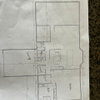
How about posting your floorplan. Maybe there's another way. - 2 years ago
One thing is certain, if all meals involving fats or oils are catered, kitchen ventilation requirements are modest.
- 2 years ago
Insufficient venting of cooking is a health hazard. https://ww2.arb.ca.gov/sites/default/files/2020-03/cookingstudy_0.pdf
 2 years ago
^^ ^^ That link attributes mostly to the risk of Gas cooking. Carbon monoxide, nitrogen dioxide, formaldehyde, gases, things like that - Induction cooking will eliminate all of that.
It also depends on what you're cooking. It comes down to oils and grease on high heat and the chemical reactions that take place when heating fats. If you're steaming or making soups there's 0 concern.
But even WITH a heightened risk of smelling fried foods, I personally think there's a lot of fear mongering going on.- 2 years ago
I say get a downdraft to help with some of the moisture or smells.
We put a downdraft in front of our induction in front of a window and it has been the best decision. Much better than facing a loud, bulky, expensive, filth-accumulating, overhyped machine above our heads. Pi_pumkin_sol3
Original Author2 years agoI hate to repeat myself but I posted here to get feedback about high end downdrafts. Perhaps from those who own them or have used them.
I did not post here to find out if downdrafts inferior to range hoods. I already know they are.
"So, are downdraft units getting better in 2024?"- 2 years ago
The fundamental science is the same, no matter what year it is. So, no, there is no possible way for them to improve. Cooking byproducts rise upwards in a V shape. That is science. It is scientifically impossible to redirect the upwardly rising vapors downward with any current or future design of a kitchen downdraft. Flow dynamics prohibits anti science from happening.
Doing so would require a super high CFM fan, 3000 CFM to start, plus an extremely large filtered aperture, at least 5000 sq inches. Your entire counter surrounding the cooking zone would essentially need to become the filtered aperture. It would need a commercial level conditioned make up air system that could output 3000 CFM of heated or cooled air Such a system would be very windy, loud, and would remove all the air out of your home in about 2 minutes. Pi_pumkin_sol3
Original Author2 years agoThanks guys. So then it's just German false advertising magic at work?
I suspect many people who own sleek and minimalist Euro kitchens don't really cook. Or they have a butler's kitchen behind them.
- 2 years agolast modified: 2 years ago
People will believe all kinds of myths created by marketing. ”Veggie burgers are healthy” “Diamonds are required for engagement rings”. “Drinking alcohol warms you up in winter” “Brown eggs are more nutritious than white.” Downdrafts really do get rid of all the cooking odors, grease, steam, and smoke.” “Minimalist and modern doesn't need a hood.”. “I’m a brilliant architect who doesn't need to consider the ventilation part of hvac or hvac at all”.
- 2 years ago
"Much better than facing a loud, bulky, expensive, filth-accumulating, overhyped machine above our heads." Cost of these pop-up down-draft units, along with blower, ducting, and exterior cap is not significantly less than a proper hood. The only thing making a down-draft less "filthy" than a canopy hood is lack of capture and containment.
"Such a system would be very windy, loud, and would remove all the air out of your home in about 2 minutes." Replace, not remove. Unless one were using a Rootes positive displacement blower, the high flow rate blower would be gagged to a low flow rate unless there were adequate MUA to replace what it removed.
'Myth: “Brown eggs are more nutritious than white.” ' Shhhh. I'd like to keep the price differential, thank you. :)
- 2 years agolast modified: 2 years ago
^^ ^^ It was almost a few thousand dollars less back when we were exploring. And truthfully, we don't even use our downdraft often because we aren't frying.
Fun fact, 95% of residential hoods lack adequate containment area, so yes, 95% people's range hoods ARE filthy, loud, bulky, and overhyped.
In fact the "best" residential hoods can only remove around 50% of effluent on a good day. The Prestige High-Capacity Series hood comes closest to being "okay." Look at the commercial hoods such as Accurex and compare to residential hoods. They require 25%-45% less CFM and are much, much less noisy as a result.
https://bamasotan.us/range-exhaust-hood-faq/
If you really need to cook fried foods often, then I think you're better off cooking outdoors, opening the windows for full circulation, or getting a commercial hood. Only commercial hoods have the best chance at sufficiently removing adequate levels of cooking byproducts.
Otherwise, you're walking yourself into a false sense of security. 95% of range hoods aren't doing what people like to THINK they're doing. It's a multi-million dollar $$$ industry, and it's working. Some architects know the hype and don't bother including hoods into their design. Many top chefs don't have big range hoods in their homes, either. Or if they do, they don't bother turning it on. I follow many chef's social media accounts and livestreams. In the consumer world, probably half the people don't even know how to use their range hood properly, as you're supposed to have it running long before you even place your first pan on the burner.
But hey, whatever helps you sleep at night. And what ever makes the most money. Add that to your list of "myths created by marketing." ;)
But please don't remind people that brown eggs aren't more nutritious than white. I rather enjoy the cheaper prices on white eggs. ;) - 2 years ago
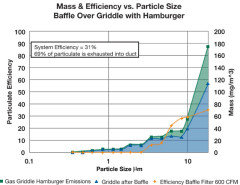
"In fact the "best" residential hoods can only remove around 50% of effluent on a good day." One has to understand what this is actually referring to. One can capture and contain almost all of the plume effluent given adequate overlap and air flow rate with a residential hood -- a topic we endlessly address here. That doesn't mean that the hood system collects all of the content of the effluent, only that it removes it from the residence.
And that is also true of commercial hoods, properly sized. The baffles only remove a portion of the larger end of the grease particle spectrum. (see plot) Ideally, grease not collected by the baffles is ejected outdoors. In reality, some grease condenses in the ducting. The commercial hood system goal is to not turn the duct into a fire hazard, and this is why commercial hood system ducting is required to be inspected and cleaned yearly. With typical residential cooking rates, over time the thin coating of condensed grease "rancidifies" into a varnish and fire hazard is minimal.
Obviously, it is possible for a residence to cook at rates that approach those of some commercial enterprises, and, where applicable, added effort to minimize hazard may be appropriate.
- 2 years ago
"Fun fact, 95% of residential hoods lack adequate containment area, so yes, 95% people's range hoods ARE filthy, loud, bulky, and overhyped."
I see no correlating physics between lack of containment area (actually volume) and filthiness. Take a look up into a commercial hood subject to greasy cooking and see that it just has a larger surface area for grease condensation than residential hoods have. There is a reason commercial hoods have water plumbed to them for fire suppression.
Commercial hood systems, exclusive of perforated ceilings, are more bulky than residential hoods in nearly every case I can imagine. It should be obvious that adding a lot more containment volume (reservoir volume) will add bulk.
Fortunately, for the no-hood faction, modern interior paints are good at bonding to imperfectly cleaned surfaces.
- 2 years agolast modified: 2 years ago
^^ ^^ Filthy meaning that 95% residential hoods are sized much too small and greasy smoke will travel outside of the hood.
You're lucky if you can find a home with a nice 36" depth hood, let a lone 30" or 27". Heck, even a 24" deep hood a lot of the time. People (who even have external hoods to begin with) will have a 16-18" depth hood and use their front burners by default.
And this is BEFORE sufficient containment volume is even evaluated (remember, 95% of consumer hoods severely lack adequate containment volume), so quite honestly, almost everybody is set up to fail what they're hoping to achieve (and will come brag about on this website).
That is what I mean by filthy.That is what I mean by false sense of security.
That is what I mean by overpriced and overhyped.
Again, this entire concept only REALLY matters if you're cooking oily greasy foods on high heat inside your house.
Nonetheless, while I recognize that inhaling this stuff COULD lead to a SMALL RISK in illness, it's my opinion that it's fear-mongering & marketing.
Go live in Italy or Japan or Mexico for a few years - very few people using these things or worrying about "their health" from smelling their food. At all.
Funny how there's so much rigmarole to avoid inhaling oily foods before there is to putting oily food into your body.
Eh, humans.  2 years ago
Yes I think they are getting better. Anecdotal experience but my mom had one in her kitchen for over 20 years. It didn’t do all that much in my opinion. They renovated and put in a new one and indefinitely noticed improvement in venting. They do also have quite a large space.
- 2 years ago
"And this is BEFORE sufficient containment volume is even evaluated (remember, 95% of consumer hoods severely lack adequate containment volume)"
I think you are misapplying the value of containment volume. What it does is allow a given plume to expand over the extent of the baffle area. This reduces the required CFM so long as the total CFM of the plumes is less than the hood CFM.
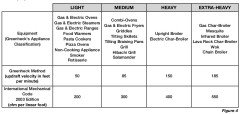
However, for residential hoods that must fit into residential kitchens, high containment volume is not easily achieved. So the change needed for containment is a high enough velocity at the hood entry aperture to ensure entrainment of the plume into the baffle flow. (Reflections get entrained before they escape capture.) It seems that this can be achieved for most residential cooking, even for transient plumes, if the average capture area up-take velocity equals the peak plume velocity times the fraction of hood baffle area that is open (slot area). So if the plume velocity is 3 ft/s = 180 ft/min, and the baffle slot area fraction is 50%, then 90 ft/min should do. (90 ft/min == 90 CFM/sq. ft. of hood entry area.) Hence, I usually suggest 90 ft/min for residential purposes.
If you look at Fig. 4 from the Greenheck guide (see below), you will notice that for commercial hoods (namely theirs) the suggested flow rates for typical cooking purposes that might also be residential ("LIGHT" column), are lower than 90 ft/min for the very reason of my first paragraph above.
https://www.tagengineering.ca/wp-content/uploads/2015/02/KVSApplDesign_catalog.pdf
The added noise of the higher CFM needed for residential hoods can be mostly ameliorated by using a remote blower and intermediate silencer where one can be fitted.
 PRO2 years agolast modified: 2 years ago
She's going to be alive, long past when the rest are dead from frying, sauteing, spattering, searing.........
IN a country where a gigantic portion of kitchens vent thru an over the cook micro, and the food prepared might be considered worth a trip to a cardiologist, or is 90% use of the micro above cook in processed chicken bites , pizza rolls and whatever?
She said......lol
"cooktop is on an interior wall and we chose no hood because we don't cook in a way that really needs one ... rice, dumplings, soups, rice noodles, slow-roasted meats, stews, steamed veggies, baked chicken, crock pot .... I can't even tell you the last time we stir-fried or seared something inside the house ... maybe 4 or 5 years ago? Neither of us feel the need to vent out rice or noodle steam, and in all these years, we've never seen grease or oils buildup on our furnishings or walls, as people said would happen."
If ......it makes you feel better to have a down draft? Do it. If not? Don't wring a hand.
Walk a mall in the USA.....anywhere.There is a whole lot more of this

Than this..........
Sure ! Go ahead....beat me up. : ) and apologies for the veer, but steam doesn't kill us, any more than the scent of chocolate chip cookies in your oven.- 2 years agolast modified: 2 years ago
The "need" for ventilation for kitchen smells and moisture is overhyped. That's my opinion. You will not die and you will not get sick. Eating fried foods could make you sick long before simply smelling it.
But if you decide to start frying turkeys, or go into the catering business, or open a stir-fry restaurant out of your own home, then yes, you may need to rethink your kitchen ventilation.
As I said, most people's venting setup offers a false sense of security. Having 2 or more windows open to allow stable air pressure (for the air to enter AND exit, pulling the smoke outward) tends to work better than MOST people's setups.
Then again, if it's really a concern, you could explore going back to the old days when many American kitchens were in separate buildings. Much of the world still does it.
Vietnam, Ecuador, Panama, Malaysia, and around the world will do their cooking in a separate, open-air structure.
Americans have snowy temperatures for half the year so this isn't our reality.
- 2 years agolast modified: 2 years ago
"Much better than facing a loud, bulky, expensive, filth-accumulating, overhyped machine above our heads."
@Sally S. - with a downdraft, please tell me where the grease that is pulled by the downdraft goes? And wherever it goes and ends up, how do you clean it?
I've asked that question before, and the majority of the replies are that either they don't know, or that it goes to "a duct somewhere underneath", i.e. not seen and not cleaned. How is that not filth-accumulating?
The laws of physics say that smoke and grease rise, regardless if the energy source is induction. Consequently, it is physically impossible for a downdraft to be as effective as an overhead hood.
As to the video above that @dan1888 has posted for the hundredth time, it's a bit of a bamboozle for people who aren't as sophisticated about kitchen design as this forum is. While that downdraft appears on the video to be powerful and dramatic, it's only pulling steam from boiling water, so it's not much of an achievement exhaust-wise.
- 2 years ago
We pretty much live off of soups and steamed foods. Meats get baked in the oven or CSO. We don't fry oils on high heat.
I agree with you that the ducts can get gross.
We got a downdraft to help with vapor but to be honest, we barely ever turn it on. - 2 years ago
TY. I don’t think this thread has been very useful to OP, but it has been super helpful to me! I’m team induction/downdraft! If we’re gonna fry(rarely), we do it outside anyway
 2 years ago
My exprerience: we bought a house with the cooktop on the isand, with a 6" telescoping downdraft vented outside. Gas. We replaced with a 18 inch telescoping downdraft. Its better.
- 2 years agolast modified: 2 years ago
My experience:
- 2 week rental with telescoping downdraft (tall one, I don't know the exact height, but it was definitely taller than 6") -- absolutely useless! Did nothing other than to interfere with the flames on the back burner (gas). You could see the steam, etc., "ignoring" the downdraft. It was supposedly a good one (Dacor, as I recall).
- Growing up with no hood -- Walls & cabinets had to be cleaned all the time b/c otherwise grease & gunk built up. (Guess who had to wash the walls & cabinets -- we kids, one of our weekly chores!)
- Old Kitchen/cheap builder-grade shallow hood (~18"D) -- only worked for back burners. Did OK for back burners but did nothing for the front burners.
- Our current Kitchen with Vent-A-Hood (24"D) & induction -- odors, etc., are not an issue. I don't smell last night's dinner the next morning (or even while cooking). We clean the hood regularly and no issues. I'd rather have the grease caught by the hood than have it land on my cabinets, walls, etc.! Sure, if you don't clean it regularly, it will get dirty -- same as anything. BTW...it does prove that it's working.
Seriously -- where do you think the "filth" is going if it's not going out the vent? Into your home (& lungs)! Downdrafts, if they're any good, will have exactly the same "filth" as an overhead vent. But, since most are no good, I suspect most are sending the FOGSS (fumes, odors, grease, smoke, steam) into and throughout your home. - 2 years ago
Of course they are not better. But people have become less educated in science, don't own tools, and don’t understand how anything works anymore.
- 2 years agolast modified: 2 years ago
I've had downdraft and it was the older Jenn-Air and vented outside. I have a similar cooking style and had no issues with it. Actually didn't have issues with it when using the Jenn-Air grill feature either. I didn't choose this as it came with the house we bought. It is not as effective as a hood, but I think it would work fine if you could just vent it outside as recirculating reduces effectiveness as well. That said you can route the venting inside the interior wall and straight out the roof instead of the recirculation. You just need the right dimensions and have a rectangular or oval one to fit the wall. Yes again not as efficient as a hood, but better than recirculating and fits your aesthetics.
BTW I stayed away as you asked to, but although it was adequate I would prefer a hood.  2 years ago
We installed a telescoping downdraft. I can literally see it sucking the steam from the pots. So far I have not had obvious "smoke", but I figure it will suck that, too. We have it vented under the crawlspace, and out the side of the house, so no concrete to contend with. I do have to admit, however, that it probably works so well because the motor is powerful. When it starts up, it sounds like my house it about to achieve lift-off.
- last year
What brand/model of downdraft did you purchase? Gas, electric or induction cooktop? Do you still feel ok about it a year later? Thanks! Needing to make the same decision soon with a kitchen remodel project.
 last yearlast modified: last year
I understand that people who do only very limited cooking and prioritize aesthetics might not want a big hood hanging over their island cooktop.
(I'd wonder if one does so little cooking, why place the cooktop in the island at all? The whole "cooking for an audience" thing seems pointless, the audience is not going to be captivated by the host steaming a carrot.)
Anyway, for people who have island cooktops and don't want range hoods, I wonder if a large ceiling vent wouldn't be an alternative to downdraft.
Supposing a 36" cooktop, maybe a 60" perforated ceiling panel leading to suitable duct and blower. Probably less expensive than a motorized downdraft unit, and maybe more effective for all but the mildest cooking.
If you really want to get the best possible capture without a hood, you could have motorized panels on all sides of the perforated panel, that normally sit flush with the ceiling but drop down to form the sides of a "hood" when the blower is turned to "high". PROlast year
The entire ceiling over the island would need to be a restaurant type vent. They do that in hoity toity "open kitchen" restaurants, where the chefs are the floor show. It's impractical from a logistics and financial setup for most average non Emeril cooks. The majority of professional chef's home kitchen have their ranges on the walls, with a professional level hood.
 last year
@Pi_pumkin_sol3 Did you get the Gaggenau Vario downdraft? Their demo videos sure were mesmerizing and impressive. I'm actually planning on a 54-60" Vent-a-hood insert, but for my island, I was looking at Gaggenau 400's invisible induction for hot pot and stumbled on their downdraft. I had the same question as you and found your thread (have Gaggenau engineers figured some stuff out about downdraft?).
I certainly hope you got a downdraft vs nothing, as some ventilation is better than nothing. (Just because people don't drop dead from combustion products and smoke doesn't mean they aren't causing meaningful harm to physical or mental health.)
It was intriguing to see how people answer the question they hear (is downdraft as good as an overhead) rather than the question you asked (has downdraft gotten better?).
- PROlast year
Physics is not an emotion based, non empirical, pseudoscience. It's actual real science. People feel a shole lot of ways about downdrafts, based on their internal biases. The science does not lie though.
- last year
@Minardi Physics may not change, but engineering can overcome "impossible" hurdles. It was once thought we would never be able to create a flying machine, or a submarine, or a rocket ship, or an AI that could defeat a human chess grandmaster, then a human go champion. I'm not saying engineers HAVE solved the downdraft problem, but after years have passed, it's valid to wonder if advances have been made.
 PROlast year
Stronger CFM downward creates issues. Especially with gas flames. There is no way around that.
- last year
@Simon Templeton & Associates That makes sense, luckily OP is specifying induction. And I wandered onto this thread but have no horse in this race, as I am specifying an overhead Vent-a-Hood. My opinion based on what I've gathered so far is with induction, downdraft is better than nothing, and with gas, overhead is the only acceptable way to capture most of the combustion products.




Sally S.