Software
Houzz Logo Print
westes

Creating a Cheap Mortar From Clay Soil and Sand

15 days ago
last modified: 14 days ago
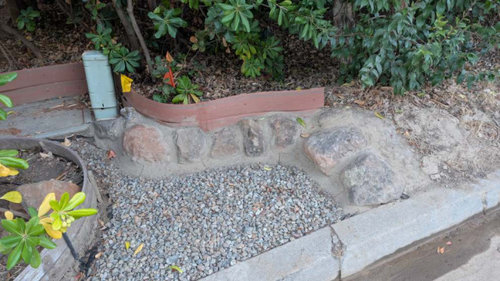
A common misconception is that adding sand to clay soil will make it more friable and result in a soil closer to sandy loam. In reality, you only get a sandy loam when the sand fraction of the soil mix is around 70%. If you mix a smaller percentage, the result is an extremely dense and hard mix that hardens with water to a rock-hard consistency.

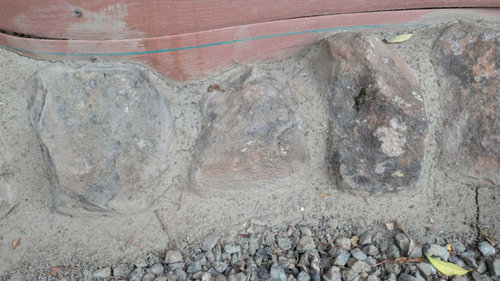
As a useful demonstration of this, I made a mud mortar and used it to build a simple stone wall to reinforce a bender board that keeps organic material out of a crushed rock bed. My formula for this was 50% clay loam and 50% concrete sand (C33 or Olympus sand #2; both work). I added water to this mix to reach a mud-like consistency, then placed it between rocks to create the stone wall shown in these photos.

It's worth noting that "concrete sand" doesn't mean it contains concrete. Concrete sand is sand whose particle sizes are optimized to form a hard substrate when mixed with other materials. Other materials could be a concrete mix or a simple clay loam soil, which is my case.

Give this a try sometime, both to learn something about soil science and to learn how to make a cheap and easy mortar for building low raised beds with boulders.


Comments (13)

  • 14 days ago

    I am curious if @tapla (mid-Michigan, USDA z5b-6a) has tried something like this.

  • 14 days ago

    Interesting. My lake's bottom is mostly rock and stone, but it has areas of clay. Lately when I've anchored at a certain place, my anchor comes up with about 20 pounds of solid, clean, gray clay attached, which I usually remove with hard dunking of the anchor. The last two times out, I brought the clay home and chucked it into my garden, thinking to enrich my soil. The hunks of clay are unchanged through two rains, albeit weak ones.

    Your idea intrigues me. I poured a small concrete pad about 15 years ago, intending to build an outdoor fireplace on it with dry laid stones. Maybe I'll build it next summer using lake clay as mortar.


    Unfortunately, I took my boat out three weeks early because we were supposed to get a Nor'easter.

    westes Zone 9b California SF Bay thanked annpat
  • 13 days ago

    @annpat Be careful: concrete and mortar are different materials and serve different purposes. Concrete is designed to handle high compressive loads. That's why it is used for building foundations or for footings of vertical posts.

    Mortar is best understood to be "rock glue". It's a substrate that glues to rocks and helps to hold them together. That's why you see stone masons use mortar on the facades of walls, to glue the stone facade to concrete block or wall. Mortar won't handle a compressive load. It would immediately crack and fail under that load. What I designed is a mortar mud, so it works well for gluing informal boulder walls and holding them in place against lateral movement, not vertical compression.

    Can you take a photo of your base and describe how that area will be used? Talk about the kind of stone you want on top.

  • 13 days ago

    My sandy soil will not make a mortar when mixed with more sand. We did fire some clay pots we made with the clay soil we had previously, but they were fired in a wood-burning stove, and we had no idea of the heat required to make pottery or what heat the coals were.

    westes Zone 9b California SF Bay thanked Sigrid
  • 13 days ago

    My plan was to build the small fieldstone fireplace without mortar or concrete. I was hoping to get a nice puzzle type fit using gravity to keep it together.

    I thought it would be interesting to try using the clay, but I forgot I actually gave up the whole idea after I poured the small pad (25"x40") a few years ago. Am I going to go hang out by my little fireplace? No. Is it a safe spot, under the firs, to have a fireplace? No.


    Did it work, Sigrid? The woodstove pottery?

    westes Zone 9b California SF Bay thanked annpat
  • 13 days ago

    @Sigrid Your sandy loam has at least 70% sand. Adding more sand makes it an even sandier loam. To make mud mortar, you will need a source of soil with a higher clay or at least silt content

  • 13 days ago

    @annpat If you want a decorative stone or flagstone on top of your concrete pad, I would use a real Type S mortar mix to glue it on.

  • 13 days ago

    Initially my plan was to build a small, mortarless, outdoor fireplace with a chimney and a keystone design above the front opening. Mainly just to see if I could---and to replace one from my childhood. But it's 20' from the lake, and it probably was illegal to pour the pad, so after thinking about it, I gave up the whole idea. I have a beautiful pad out there---shiny and smooth, not a crack in it, that, since it's there, I should utilize, but, I, who have enough unfinished chores to last two more lifetimes, should not be entertaining new projects. I might use the clay to build berms in my garden, though. Built on a slope, I have a (very) slight erosion problem.

    westes Zone 9b California SF Bay thanked annpat
  • 11 days ago

    I don't have much to add in the way of pottery and brick making other than some clay works better than some.

    My reason for commenting has to do with this. In reality, you only get a sandy loam when the sand fraction of the soil mix is around 70%. If you mix a smaller percentage, the result is an extremely dense and hard mix that hardens with water to a rock-hard consistency.

    Maority of people on this site are interested in raising crops and "sandy loam" is the gold standard for that. We usually talk about sand and clay content but should include silt because it's required to bridge a dap between sand and clay. %s can vary but 50% sand is more realestic than 70% for agriculture purpouses. The balance is aproximatly,30% silt and 20% clay. How do I know what the composition of my soil is? Search for "Jar test" to see how the average gardener can tell what they have and if admendments can help. But what about organic matter,isn't that required? Yes, very muchly so and some will be mixxed with clay while some remains flaoting when doing jar test. Many experts suggest 5% organic matter, and that might be fine if we were talking about perfect soil with right %,ph and nutrents which rarly happpens. Compost is the simplest way to make do with poor soil and that usually requires more than 5%.


    I realize I'm preaching to the choir but lurkers might think 70% sand will cure their unproductive soil.


    I'm wore out, will y'all shake this jar and pull weeds while I go take a nap?

    westes Zone 9b California SF Bay thanked klem1
  • 9 days ago

    Are klem1 and westes the same person?

    westes Zone 9b California SF Bay thanked robert567
  • 8 days ago

    Are klem1 and westes the same person?

    No.


    westes Zone 9b California SF Bay thanked gardengal48 (PNW Z8/9)
  • 6 days ago

    @robert567 He definitely is not me, and what about this conversation ever made you say that? We don't sound alike and don't even apparently share the same concerns about this topic.