
Search results for "Cognitive biases" in Home Design Ideas
 Smart-Solutiions
The Science of Light and Learning
To understand the relationship between lighting and learning, it’s critical to grasp the concept of correlated colour temperature (CCT). CCT refers to the warmth or coolness of light, measured in Kelvin (K). Lower CCTs (around 3000K) provide a warm, cosy atmosphere, while higher CCTs (5000K or above) emit a cool, daylight-like glow. Studies have shown that cool white light, which mimics natural daylight, can increase alertness and mood, contributing to improved cognitive performance. LED lighting, with its ability to produce this desired CCT, makes an ideal choice for educational settings.
LED Lighting: Brightening the Future of Education
Energy Efficiency and Cost Effectiveness
One of the main advantages of LED lighting is its energy efficiency. Traditional lighting solutions like fluorescent and incandescent bulbs consume much more energy to produce the same amount of light as LEDs, which is not only environmentally harmful but also financially costly. Switching to LED lights can result in substantial cost savings for schools, enabling them to redirect funds to other critical areas of education.
Durability and Longevity
LED lights are renowned for their durability and longevity. They have a significantly longer lifespan compared to conventional lights, which means less frequent replacement and reduced maintenance costs. This durability also minimises disruptions caused by light failure, providing a consistent, well-lit learning environment.
Improved Visibility and Reduced Eye Strain
With their superior colour rendering index (CRI), LED lights render colours more accurately, leading to improved visibility. This is particularly beneficial in educational settings, where activities often require distinguishing fine details and colours. LED lights also emit less glare than traditional lighting solutions, reducing eye strain and fatigue. This can lead to better concentration and increased comfort for both students and teachers.
Incorporating LED Lighting in Classrooms: Practical Considerations
When transitioning to LED lighting in classrooms, a few key factors need to be taken into account. Firstly, the lighting design should ensure an even distribution of light, preventing shadowy or overly bright spots that could distract or discomfort students. Secondly, the integration of dimming capabilities can provide flexibility, allowing educators to adjust the lighting level based on the task at hand. Finally, lighting controls can be used to take advantage of natural light, automatically dimming or turning off the LEDs when sufficient daylight is present.
Conclusion: The Bright Promise of LED Lighting in Education
As education systems continue to evolve, it’s imperative to keep sight of the physical factors that significantly impact learning, one of which is lighting. LED technology, with its myriad benefits, offers an innovative and effective way to enhance the quality of lighting in classrooms. By prioritising investments in such improvements, we can take a significant step towards creating an optimised learning environment that nurtures the educational success of future generations.
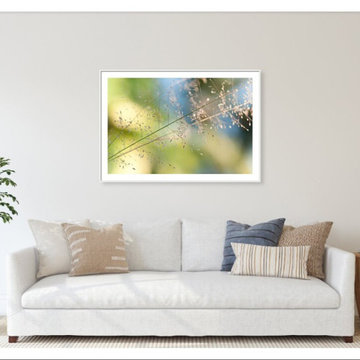
 Evgeniya Vlasova_Healing Art for Healthcare Spaces
"The Beauty of the Earth. Natural Watercolor"
Healing Art for Healthcare project.
Offering as ready metal, wood, acrylic, or farmed prints or canva in a different sizes. Also available as image licensing for your own local printing.
Worldwide delivery.
I seem to have lost track of countless times this grass photo has sold, as prints or as digital licenses to interior design and art advisors companies for healthcare projects. Just couple of months ago this image license was sold once again for wall art project in one of USA clinic.
The reasons why it will be suitable almost for any wall art solution for healthcare spaces:
- It immediately meets strict hospital Evidence-Based Design (EBD) criteria, which require realistic, non-threatening nature imagery.
- Zero Cognitive Fatigue. The composition lacks complex abstract shapes
- Flawless Color Compatibility. The natural green and blue undertones perfectly match standard healthcare finish palettes.
Research from The Center for Health Design shows that a balanced green-blue palette operates as a natural visual sedative, lowering acute environmental tension.
- Soft Fascination. For an image to restore mental energy, it must possess "soft fascination", visual properties that catch the eye gently without requiring active cognitive processing.
- Macro Minimalism. The viewer's eyes easily rest on central, glowing blades of grass, shifting the nervous system from a sympathetic state to a parasympathetic (rest-and-recover) state.
- Sunlight and Hope. Neurologically, sunlight signals a brand-new day, triggering the release of serotonin and offsetting the sterile, windowless spaces.
Find the right local pro for your project


1