
Search results for "Survival ability" in Home Design Ideas
 Pennsylvania Landscape & Nursery Association
u2014 ALE: Wayne Rain Garden
Pennsylvania Landscape & Nursery Association
u2014 ALE: Wayne Rain Garden
Terren Landscapes http://www.terrenlandscapes.com
2014 PLNA Awards for Landscape Excellence winner
Category: Residential Up to $15,000
Award Level: Gold
Project Description:
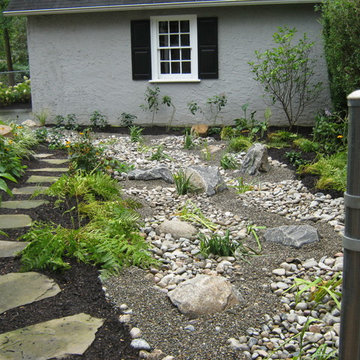
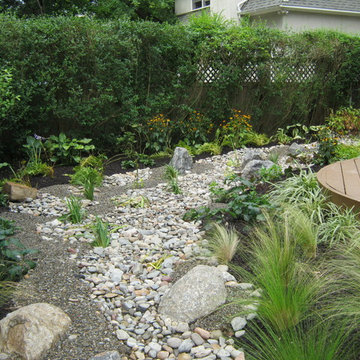
Our company was contracted by the client to provide a creative solution to an ongoing drainage problem. Their property is located within 30 feet of a local stream that collects storm water from the surrounding area. The nearby stream and high water table caused the lawn area at the side of their home to flood and to remain waterlogged for a few days after each storm. The client not only had difficulty growing plants in the existing conditions, but also had a problem with mosquitoes due to standing water.
Our goal was to design a self-contained, naturalistic rain garden that slowed storm water runoff, allowed for percolation, and promoted infiltration while permitting excess clean water to enter the nearby stream with diminished force. As designed, the rain garden allows the earth to slowly and more naturally
absorb excess storm water while filtering out toxins such as excess nitrogen and phosphorous which are frequently found in the landscape, therefore reducing the contaminants entering the stream.
A percolation test was conducted with criteria of absorbing a one-inch rainstorm within four hours without overflow. The one-inch storm calculation included an existing downspout from the home, which would be piped into the rain garden to reduce roof runoff. The first test failed due to a deep layer of high clay-content soil. Excavation continued until a layer of sandy loam was reached, the percolation test was repeated, and a successful test result was achieved. Next, the entire rain garden basin was excavated to the sandy loam layer and the soil amended with compost and sand to create a highly porous planting media.
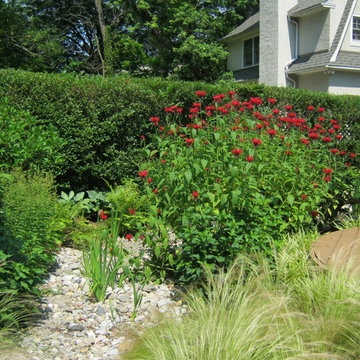
Geotextile fabric was placed to help reduce migration of the surface stone into the soil and allow for minimal maintenance. Gravel, river stone and small boulders were carefully placed to achieve the look of a natural streambed.
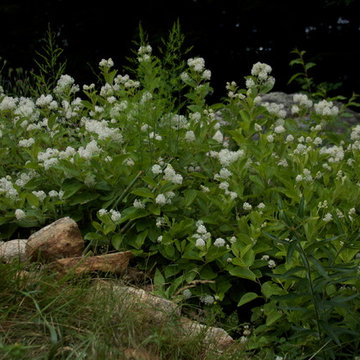
A palette of mostly native plants with a few non-invasive ornamentals were chosen for their ability to survive in extreme conditions ranging from floods to drought and were placed according to their specific preferences.
Wetland plants were chosen for the lowest portion of the rain garden as that area remains saturated for longer periods of time, with a Chionanthus virginicus as a focal point surrounded by irises and ferns at the lowest depth.
Plants tolerant of drier conditions were chosen for the upper edges of the garden. The beautiful colors of Monarda, Ligularia, Eupatorium, Solidago, Chelone, and Rudbeckia were scattered within the upper edge, while movement and softness were incorporated by use of the graceful Nassella that lines the border. Finally, winter interest was provided with a backdrop of Cornus sericea.
As built, this small rain garden creates tremendous impact by decreasing the amount of storm water runoff not only on our client's property, but also in the neighboring stream. It serves as a means of slowing the water and providing an area for infiltration back into the earth. The plants provide a habitat for birds, butterflies, and insects, working in harmony with nature and providing beautiful visual interest year-round.
Photo Credit:
Lisa C. Falls
 Horn & Co. (Previously JHLA)
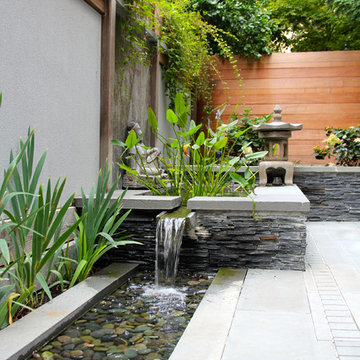
Our clients on this project were inspired by their travels to Asia and wanted to mimic this aesthetic at their DC property. We designed a water feature that effectively masks adjacent traffic noise and maintains a small footprint.
 Wesley Stout Associates
Stepping Stones, Garden
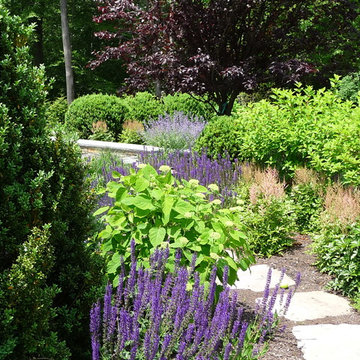
Photo of a small traditional full sun backyard stone formal garden in New York for summer.
Photo of a small traditional full sun backyard stone formal garden in New York for summer.
Find the right local pro for your project


 Cool Designs for Landscapes
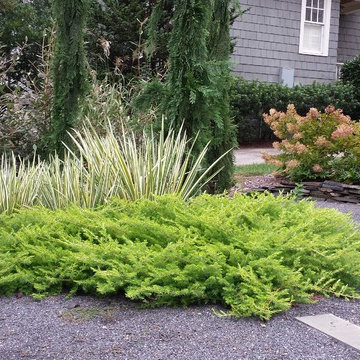
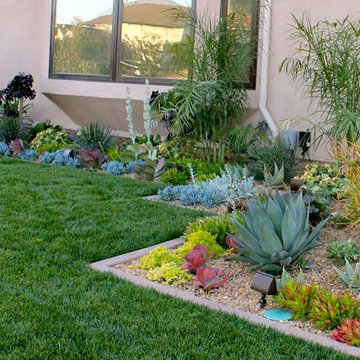
Photo of a mid-sized transitional drought-tolerant and partial sun front yard gravel landscaping in Orange County.

 Pennsylvania Landscape & Nursery Association
u2014 ALE: Wayne Rain Garden
Pennsylvania Landscape & Nursery Association
u2014 ALE: Wayne Rain Garden
Terren Landscapes http://www.terrenlandscapes.com
2014 PLNA Awards for Landscape Excellence winner
Category: Residential Up to $15,000
Award Level: Gold
Project Description:
Our company was contracted by the client to provide a creative solution to an ongoing drainage problem. Their property is located within 30 feet of a local stream that collects storm water from the surrounding area. The nearby stream and high water table caused the lawn area at the side of their home to flood and to remain waterlogged for a few days after each storm. The client not only had difficulty growing plants in the existing conditions, but also had a problem with mosquitoes due to standing water.
Our goal was to design a self-contained, naturalistic rain garden that slowed storm water runoff, allowed for percolation, and promoted infiltration while permitting excess clean water to enter the nearby stream with diminished force. As designed, the rain garden allows the earth to slowly and more naturally
absorb excess storm water while filtering out toxins such as excess nitrogen and phosphorous which are frequently found in the landscape, therefore reducing the contaminants entering the stream.
A percolation test was conducted with criteria of absorbing a one-inch rainstorm within four hours without overflow. The one-inch storm calculation included an existing downspout from the home, which would be piped into the rain garden to reduce roof runoff. The first test failed due to a deep layer of high clay-content soil. Excavation continued until a layer of sandy loam was reached, the percolation test was repeated, and a successful test result was achieved. Next, the entire rain garden basin was excavated to the sandy loam layer and the soil amended with compost and sand to create a highly porous planting media.
Geotextile fabric was placed to help reduce migration of the surface stone into the soil and allow for minimal maintenance. Gravel, river stone and small boulders were carefully placed to achieve the look of a natural streambed.
A palette of mostly native plants with a few non-invasive ornamentals were chosen for their ability to survive in extreme conditions ranging from floods to drought and were placed according to their specific preferences.
Wetland plants were chosen for the lowest portion of the rain garden as that area remains saturated for longer periods of time, with a Chionanthus virginicus as a focal point surrounded by irises and ferns at the lowest depth.
Plants tolerant of drier conditions were chosen for the upper edges of the garden. The beautiful colors of Monarda, Ligularia, Eupatorium, Solidago, Chelone, and Rudbeckia were scattered within the upper edge, while movement and softness were incorporated by use of the graceful Nassella that lines the border. Finally, winter interest was provided with a backdrop of Cornus sericea.
As built, this small rain garden creates tremendous impact by decreasing the amount of storm water runoff not only on our client's property, but also in the neighboring stream. It serves as a means of slowing the water and providing an area for infiltration back into the earth. The plants provide a habitat for birds, butterflies, and insects, working in harmony with nature and providing beautiful visual interest year-round.
Photo Credit:
Lisa C. Falls
 Pennsylvania Landscape & Nursery Association
u2014 ALE: Wayne Rain Garden
Pennsylvania Landscape & Nursery Association
u2014 ALE: Wayne Rain Garden
Terren Landscapes http://www.terrenlandscapes.com
2014 PLNA Awards for Landscape Excellence winner
Category: Residential Up to $15,000
Award Level: Gold
Project Description:
Our company was contracted by the client to provide a creative solution to an ongoing drainage problem. Their property is located within 30 feet of a local stream that collects storm water from the surrounding area. The nearby stream and high water table caused the lawn area at the side of their home to flood and to remain waterlogged for a few days after each storm. The client not only had difficulty growing plants in the existing conditions, but also had a problem with mosquitoes due to standing water.
Our goal was to design a self-contained, naturalistic rain garden that slowed storm water runoff, allowed for percolation, and promoted infiltration while permitting excess clean water to enter the nearby stream with diminished force. As designed, the rain garden allows the earth to slowly and more naturally
absorb excess storm water while filtering out toxins such as excess nitrogen and phosphorous which are frequently found in the landscape, therefore reducing the contaminants entering the stream.
A percolation test was conducted with criteria of absorbing a one-inch rainstorm within four hours without overflow. The one-inch storm calculation included an existing downspout from the home, which would be piped into the rain garden to reduce roof runoff. The first test failed due to a deep layer of high clay-content soil. Excavation continued until a layer of sandy loam was reached, the percolation test was repeated, and a successful test result was achieved. Next, the entire rain garden basin was excavated to the sandy loam layer and the soil amended with compost and sand to create a highly porous planting media.
Geotextile fabric was placed to help reduce migration of the surface stone into the soil and allow for minimal maintenance. Gravel, river stone and small boulders were carefully placed to achieve the look of a natural streambed.
A palette of mostly native plants with a few non-invasive ornamentals were chosen for their ability to survive in extreme conditions ranging from floods to drought and were placed according to their specific preferences.
Wetland plants were chosen for the lowest portion of the rain garden as that area remains saturated for longer periods of time, with a Chionanthus virginicus as a focal point surrounded by irises and ferns at the lowest depth.
Plants tolerant of drier conditions were chosen for the upper edges of the garden. The beautiful colors of Monarda, Ligularia, Eupatorium, Solidago, Chelone, and Rudbeckia were scattered within the upper edge, while movement and softness were incorporated by use of the graceful Nassella that lines the border. Finally, winter interest was provided with a backdrop of Cornus sericea.
As built, this small rain garden creates tremendous impact by decreasing the amount of storm water runoff not only on our client's property, but also in the neighboring stream. It serves as a means of slowing the water and providing an area for infiltration back into the earth. The plants provide a habitat for birds, butterflies, and insects, working in harmony with nature and providing beautiful visual interest year-round.
Photo Credit:
Lisa C. Falls
 Langhorne Carpet Company
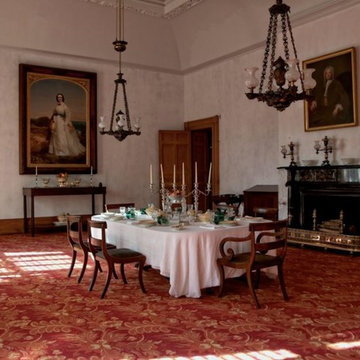
Langhorne Carpet Company proudly announces its latest collaboration with Vermont Custom Rug Company’s David Hunt on an elegant reproduction of the early 19th century worsted wool carpet for the dining room of historic Hyde Hall.
A National Historic Landmark and New York State Historic Site in Springfield, NY, eight miles north of Cooperstown, Hyde Hall is considered “one of the finest examples of the neoclassical country houses in the United States.” The agricultural estate was the project and prize of wealthy British-born landowner George Clarke (1768-1835). Clarke owned 120,000 acres in New York’s Leatherstocking Region and designed Hyde Hall on the bank of Otsego Lake with Albany architect Philip Hooker. The mansion, the estate’s centerpiece, was constructed from 1817 to 1835. Today, Hyde Hall resides within Glimmerglass State Park.
Recent years have brought Hyde Hall a meticulous, history-driven, artisan-fueled restoration to recreate Clarke’s precise original vision.
David Hunt chose Langhorne Carpet Company to recreate the Brussels looped pile carpet for the property’s dining room. Made from the finest worsted wool, a yarn used today almost exclusively in apparel, Brussels carpets were a 19th-century status symbol among America’s wealthiest citizens, including presidents and major landowners. According to Clarke’s scrupulously kept ledgers, in 1831 he purchased “122 linear yards of Brussels body carpet, along with 24 yards of Brussels border carpet from the showroom of Lowe & Connah in New York City for the sum of $308.00. A hefty amount for the period,” said Hunt.
The carpet—which, Hunt said, may well be one of the first examples Wilton carpet woven in the United States—remained in the dining room through the end of the 19th century. As for the two tuffets? They not only survive—they also remain covered in the original textile.
This existence of these original tuffets for nearly two centuries, said Hunt, is both incredibly rare and fortuitous. “Having a documented portion of the original carpet, intact 186 years after manufacture, is, for the textile historian, a gold mine of information. Although the border portion of the design remains most visible, having the ability to document and verify the yarn quality, sett (pattern) of the weave and most importantly the original colors is huge.”
Hunt “dissected” the tuffets to reveal the yarn that, like in all Wilton weaves, is buried beneath the textile’s back, unexposed to sunlight, air, or cleaning agents. When he did, he found the carpet’s original colors and pattern. From there, he and Langhorne used a black-and-white photograph of the original carpet to create a botanical pattern for the field that would, he said, “honor the style of the border.”
He then turned over the work to Langhorne, to create the patterns, match the dye colors, and weave the carpets on narrow looms much like the ones used 200 years ago. Langhorne, he added, is the only mill in the United States—and one of very few in the entire world—capable of doing such a job.
“Langhorne has this wonderful capability to do all sorts of different things. I don’t think a lot of people understand that option is out there, and it’s a lot easier than you think to do it,” he said. What’s more, “They’re real people, working people—the folks on the loom, the weavers, the folks in the office: Except for the clothing, they’re the same type of people you would have found in a mill 200 years ago. It takes special people to do this, and that’s Langhorne.”
 Valor Home
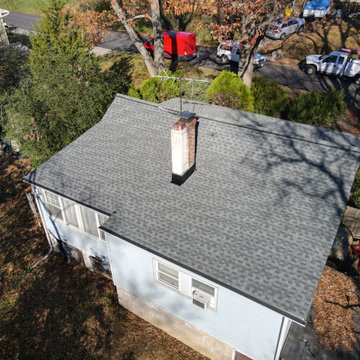
As part of Valor Roofing’s Raise the Roof program, US Army Veteran, SGT George Welch received a free roof on his home in Edgewater, MD. SGT Welch is 73 years old and was an Army Military Policeman (31B), as well as a Gunner on a Helicopter Gunship. His platoon was involved in the Battle of Saigon in which they were trapped in an alleyway. Unfortunately, a few of his platoon members did not survive.
“When we consider a Veteran for the Raise the Roof Program, it is important to not only establish a need, but to ensure we recognize the Veteran for their dedication to our country,” said Al Kincaid, Founder of Raise the Roof.“ SGT Welch exemplifies the bravery and heroism we have come to expect from our servicemen and women. Furthermore, SGT Welch deserves a roof that is sturdy and safe. His current home desperately needs something that we can provide. It is our duty as grateful Americans to do our part.”
Living in Edgewater, Maryland for the last 41 years has been a blessing for SGT Welch, but more importantly, for the community that surrounds him. SGT Welch is a cancer survivor, but that doesn’t limit his ability to walk his beloved dogs and get his daily exercise in. This is wonderful news for the neighboring K-9’s, as they all have grown accustom to sneaking a dog treat from his pockets — purposefully — full of delicious snacks.
“SGT Welch was flabbergasted when we arrived. Most Veterans are very humble and do not believe they deserve recognition for their service,” said Will Fisher, Program and Brand Manager at Valor, “After we saw his reaction, we took a moment to show respect. The last thing we wanted was to overwhelm him even more. That is just the type of guy he is; humble and prideful.”
The Raise the Roof program was created by Valor Roofing to give back to service disabled veterans in need, especially Veterans of Foreign Wars such as WW2, Korean War and Vietnam War. Veteran recipients are nominated by their community through Valor Roofing’s radio partners 93.1 WPOC, 98.7 WMZQ, 105.7 The Fan, and 100.7 The Bay. With hundreds of applications to choose from, Valor Roofing selects four veterans a year, one per quarter, to receive a new roof. In less than three years, the program has donated 11 roofs, a value of $132,000. Through their partnership with Operation Second Chance and Flags of Valor (FOV), each recipient also receives a custom wooden flag, hand-built by veterans.
 Basile Landscaping & Lawn Care
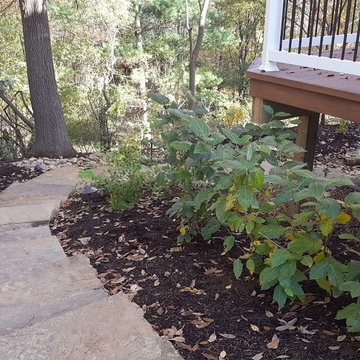
The natural stone steps curve around the deck supports to bring you to the lower patio. Along the path are Carolina Allspice, Japanese Kierra and a Dogwood. Using the native plants such as the Allspice and Dogwood will help the ecology of the micro-climate and also ensure that the plants are hardy enough to survive our strange weather patterns.
We had originally planted 3 Carolina Allspice that had not yet come out of dormancy. We were skeptical of it's ability to transplant well. They were very slow to emerge and one didn't make it. So we swapped them out with new shrubs from a local nursery that caters to home gardeners and landscapers alike. They were beautiful and blooming! The newly transplanted ones bloomed for much longer than anticipated. The customer was much happier with the result.
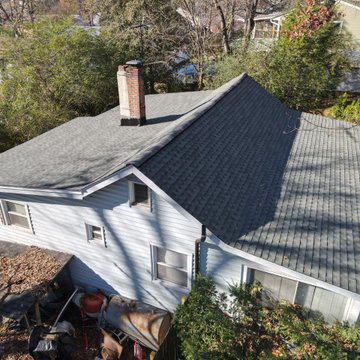 Valor Home
As part of Valor Roofing’s Raise the Roof program, US Army Veteran, SGT George Welch received a free roof on his home in Edgewater, MD. SGT Welch is 73 years old and was an Army Military Policeman (31B), as well as a Gunner on a Helicopter Gunship. His platoon was involved in the Battle of Saigon in which they were trapped in an alleyway. Unfortunately, a few of his platoon members did not survive.
“When we consider a Veteran for the Raise the Roof Program, it is important to not only establish a need, but to ensure we recognize the Veteran for their dedication to our country,” said Al Kincaid, Founder of Raise the Roof.“ SGT Welch exemplifies the bravery and heroism we have come to expect from our servicemen and women. Furthermore, SGT Welch deserves a roof that is sturdy and safe. His current home desperately needs something that we can provide. It is our duty as grateful Americans to do our part.”
Living in Edgewater, Maryland for the last 41 years has been a blessing for SGT Welch, but more importantly, for the community that surrounds him. SGT Welch is a cancer survivor, but that doesn’t limit his ability to walk his beloved dogs and get his daily exercise in. This is wonderful news for the neighboring K-9’s, as they all have grown accustom to sneaking a dog treat from his pockets — purposefully — full of delicious snacks.
“SGT Welch was flabbergasted when we arrived. Most Veterans are very humble and do not believe they deserve recognition for their service,” said Will Fisher, Program and Brand Manager at Valor, “After we saw his reaction, we took a moment to show respect. The last thing we wanted was to overwhelm him even more. That is just the type of guy he is; humble and prideful.”
The Raise the Roof program was created by Valor Roofing to give back to service disabled veterans in need, especially Veterans of Foreign Wars such as WW2, Korean War and Vietnam War. Veteran recipients are nominated by their community through Valor Roofing’s radio partners 93.1 WPOC, 98.7 WMZQ, 105.7 The Fan, and 100.7 The Bay. With hundreds of applications to choose from, Valor Roofing selects four veterans a year, one per quarter, to receive a new roof. In less than three years, the program has donated 11 roofs, a value of $132,000. Through their partnership with Operation Second Chance and Flags of Valor (FOV), each recipient also receives a custom wooden flag, hand-built by veterans.
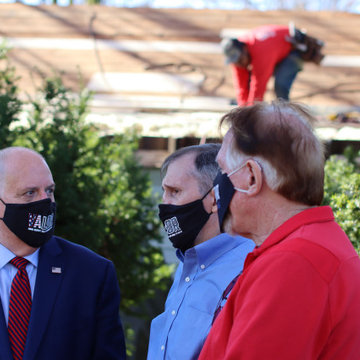 Valor Home
As part of Valor Roofing’s Raise the Roof program, US Army Veteran, SGT George Welch received a free roof on his home in Edgewater, MD. SGT Welch is 73 years old and was an Army Military Policeman (31B), as well as a Gunner on a Helicopter Gunship. His platoon was involved in the Battle of Saigon in which they were trapped in an alleyway. Unfortunately, a few of his platoon members did not survive.
“When we consider a Veteran for the Raise the Roof Program, it is important to not only establish a need, but to ensure we recognize the Veteran for their dedication to our country,” said Al Kincaid, Founder of Raise the Roof.“ SGT Welch exemplifies the bravery and heroism we have come to expect from our servicemen and women. Furthermore, SGT Welch deserves a roof that is sturdy and safe. His current home desperately needs something that we can provide. It is our duty as grateful Americans to do our part.”
Living in Edgewater, Maryland for the last 41 years has been a blessing for SGT Welch, but more importantly, for the community that surrounds him. SGT Welch is a cancer survivor, but that doesn’t limit his ability to walk his beloved dogs and get his daily exercise in. This is wonderful news for the neighboring K-9’s, as they all have grown accustom to sneaking a dog treat from his pockets — purposefully — full of delicious snacks.
“SGT Welch was flabbergasted when we arrived. Most Veterans are very humble and do not believe they deserve recognition for their service,” said Will Fisher, Program and Brand Manager at Valor, “After we saw his reaction, we took a moment to show respect. The last thing we wanted was to overwhelm him even more. That is just the type of guy he is; humble and prideful.”
The Raise the Roof program was created by Valor Roofing to give back to service disabled veterans in need, especially Veterans of Foreign Wars such as WW2, Korean War and Vietnam War. Veteran recipients are nominated by their community through Valor Roofing’s radio partners 93.1 WPOC, 98.7 WMZQ, 105.7 The Fan, and 100.7 The Bay. With hundreds of applications to choose from, Valor Roofing selects four veterans a year, one per quarter, to receive a new roof. In less than three years, the program has donated 11 roofs, a value of $132,000. Through their partnership with Operation Second Chance and Flags of Valor (FOV), each recipient also receives a custom wooden flag, hand-built by veterans.
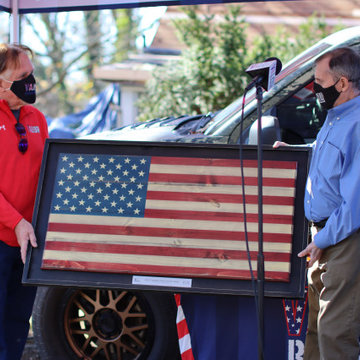 Valor Home
As part of Valor Roofing’s Raise the Roof program, US Army Veteran, SGT George Welch received a free roof on his home in Edgewater, MD. SGT Welch is 73 years old and was an Army Military Policeman (31B), as well as a Gunner on a Helicopter Gunship. His platoon was involved in the Battle of Saigon in which they were trapped in an alleyway. Unfortunately, a few of his platoon members did not survive.
“When we consider a Veteran for the Raise the Roof Program, it is important to not only establish a need, but to ensure we recognize the Veteran for their dedication to our country,” said Al Kincaid, Founder of Raise the Roof.“ SGT Welch exemplifies the bravery and heroism we have come to expect from our servicemen and women. Furthermore, SGT Welch deserves a roof that is sturdy and safe. His current home desperately needs something that we can provide. It is our duty as grateful Americans to do our part.”
Living in Edgewater, Maryland for the last 41 years has been a blessing for SGT Welch, but more importantly, for the community that surrounds him. SGT Welch is a cancer survivor, but that doesn’t limit his ability to walk his beloved dogs and get his daily exercise in. This is wonderful news for the neighboring K-9’s, as they all have grown accustom to sneaking a dog treat from his pockets — purposefully — full of delicious snacks.
“SGT Welch was flabbergasted when we arrived. Most Veterans are very humble and do not believe they deserve recognition for their service,” said Will Fisher, Program and Brand Manager at Valor, “After we saw his reaction, we took a moment to show respect. The last thing we wanted was to overwhelm him even more. That is just the type of guy he is; humble and prideful.”
The Raise the Roof program was created by Valor Roofing to give back to service disabled veterans in need, especially Veterans of Foreign Wars such as WW2, Korean War and Vietnam War. Veteran recipients are nominated by their community through Valor Roofing’s radio partners 93.1 WPOC, 98.7 WMZQ, 105.7 The Fan, and 100.7 The Bay. With hundreds of applications to choose from, Valor Roofing selects four veterans a year, one per quarter, to receive a new roof. In less than three years, the program has donated 11 roofs, a value of $132,000. Through their partnership with Operation Second Chance and Flags of Valor (FOV), each recipient also receives a custom wooden flag, hand-built by veterans.
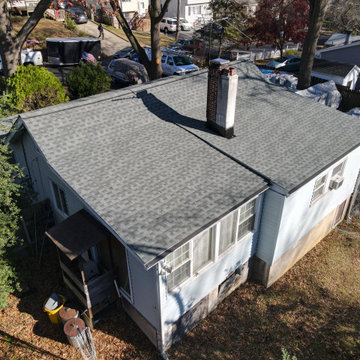 Valor Home
As part of Valor Roofing’s Raise the Roof program, US Army Veteran, SGT George Welch received a free roof on his home in Edgewater, MD. SGT Welch is 73 years old and was an Army Military Policeman (31B), as well as a Gunner on a Helicopter Gunship. His platoon was involved in the Battle of Saigon in which they were trapped in an alleyway. Unfortunately, a few of his platoon members did not survive.
“When we consider a Veteran for the Raise the Roof Program, it is important to not only establish a need, but to ensure we recognize the Veteran for their dedication to our country,” said Al Kincaid, Founder of Raise the Roof.“ SGT Welch exemplifies the bravery and heroism we have come to expect from our servicemen and women. Furthermore, SGT Welch deserves a roof that is sturdy and safe. His current home desperately needs something that we can provide. It is our duty as grateful Americans to do our part.”
Living in Edgewater, Maryland for the last 41 years has been a blessing for SGT Welch, but more importantly, for the community that surrounds him. SGT Welch is a cancer survivor, but that doesn’t limit his ability to walk his beloved dogs and get his daily exercise in. This is wonderful news for the neighboring K-9’s, as they all have grown accustom to sneaking a dog treat from his pockets — purposefully — full of delicious snacks.
“SGT Welch was flabbergasted when we arrived. Most Veterans are very humble and do not believe they deserve recognition for their service,” said Will Fisher, Program and Brand Manager at Valor, “After we saw his reaction, we took a moment to show respect. The last thing we wanted was to overwhelm him even more. That is just the type of guy he is; humble and prideful.”
The Raise the Roof program was created by Valor Roofing to give back to service disabled veterans in need, especially Veterans of Foreign Wars such as WW2, Korean War and Vietnam War. Veteran recipients are nominated by their community through Valor Roofing’s radio partners 93.1 WPOC, 98.7 WMZQ, 105.7 The Fan, and 100.7 The Bay. With hundreds of applications to choose from, Valor Roofing selects four veterans a year, one per quarter, to receive a new roof. In less than three years, the program has donated 11 roofs, a value of $132,000. Through their partnership with Operation Second Chance and Flags of Valor (FOV), each recipient also receives a custom wooden flag, hand-built by veterans.
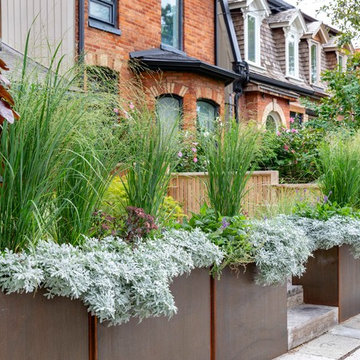

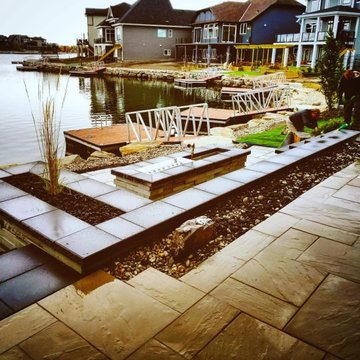
 Terra Bella Signature Landscaping LLC
The Landscape Designer Job Description
Though landscape designer jobs and landscape architect jobs are often tossed around as meaning the same thing, there are a few differences. The landscape designer job description includes:
Using creativity and the beauty of nature to create a harmonious, aesthetically pleasing and functional area. Areas may include personal lawns, parks, highways, walkways, and more.
Planning the finished product, tying in new features with current ones, by sketching it to scale. These drawings will be very detailed, down to the window and door placement on the buildings.
Performing site analyses that include the assessment of current plants, soil conditions, lighting, the view, and architecture style of the house.
The ability to communicate well both with clients and other types of workers (contractors, supervisors, etc) on the landscaping team.
Researching topics such as plants and their ability to survive in an area, guidelines and codes.
Make public presentations when necessary to discuss the project, complete with charts, sketches, and so forth.
Reviewing plans, proposed changes, and any other necessary documents.
Oversees progression of the project to ensure that it is going as planned.
Keeping records, including everything from correspondence to reports.
 Five Star Tree Care
A tree has many parts, all of which contribute to its overall health. Just like the human body, each part of the tree works together to ensure the tree’s survival. There are a few important elements that trees and other plants need to live; these include carbon dioxide, water, sunlight, and food. A tree that has been planted in a nourishing environment and that has quality soil for its roots will grow tall, strong, and healthy. Trees that are planted in an urban environment such as on someone’s personal property need regular maintenance to thrive.
The arborists here at Five Star Tree Services are happy to provide residential and commercial tree care services, including pruning and removal. We help trees stay healthy by getting rid of dead branches, trimming overgrown leaves to prevent them from infringing on power lines and much more. Aside from regular care, homeowners should pay particular attention to the roots of the tree, and here’s why.
Why Trees Have Roots
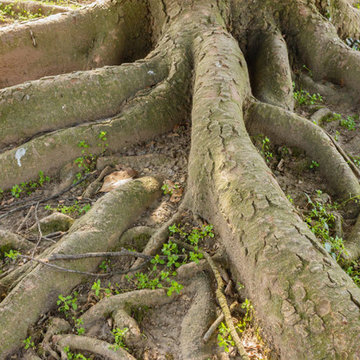
The roots are what hold the tree in place as well as used to absorb essential nutrients from the surrounding soil. Furthermore, water is also absorbed by the roots, which is critical for the tree’s survival. The majority of the roots of a tree are located between six inches and one foot underground. While they may be shallow going down, they extend very far horizontally, even surpassing the canopy of the tree. If a tree didn’t have roots, then it would not be able to stand or withstand harsh weather.
Allow The Roots to Breathe
The roots of your tree need to be protected, but they also need plenty of oxygen in order for your tree to thrive. Drying out the soil under your tree will allow oxygen to reach the area. Instead of watering your tree on a daily basis, choose a schedule that keeps the tree hydrated but allows the soil to rest. Packing the soil around the tree too tight will also limit the airflow which may suffocate surface roots.
Watering
Trees constantly require water regardless of their age. Trees need to be watered on a regular schedule, especially during dry seasons or drought. Ample watering will boost tree growth and maintain tree health.
Don’t Cut Them
Cutting the roots of a tree not only limits its ability to nourish itself, but it can also leave it open to attacks. Bacteria, insects, and viruses are more prone to strike a tree with a weak root system than one with a sturdy one. Cutting will also place stress on the tree which may stunt its growth for several years. Depending on the severity of the cut, severed roots may even cause the death of your tree.
Invest in Mulch
Mulch is a material placed around the bottom of a tree. It is fully organic and is intended to give the roots extra protection while also providing nutrients for your tree. Mulch should be placed around the base of a tree in the spring in order to promote new growth. An additional layer should be added in the winter to provide a buffer from the cold.
Tree Care by Five Star Tree Services
If you are worried about the health of your tree Five Star Tree Services is here to help. We offer Toronto Tree Care Services, storm damage, regular maintenance, affordable tree removal, pruning and planting services all over the metro area. If you are interested in boosting the aesthetic value of your property, or just maintaining your tree’s health, give us a call at (416) 990-3355 today.
 Five Star Tree Care
Oak trees have been a symbol of strength for a long time. They are also known to live for a very long time, given the right conditions. The reason they became a symbol of strength is because they themselves are very strong and are able to survive some of the harshest storms, when healthy. The wood it produces is undoubtedly very strong as well and is commonly used in the making of furniture, homes, and boats.
Oak trees are not only used for their strong wood, but also for their beauty. There are even certain species that produce distinctive lobed leaves, allowing them to stand out. Then, when fall comes around, they become even more majestic when their leaves turn bright and brilliant colours that add texture and a unique spectacle to the changing environment.
The beauty is so amazing that you might even want one for your own yard. Our team here at Five Star Tree Services is going to go over a few different types of oak trees that might be perfect for your landscape! These are guaranteed to have spectacular fall colours, great shade, and amazing texture.
Different Types of Oaks
You might be interested to know that oaks are one of the oldest trees in the world. Archeologists have been able to date them back to around 65 million years ago. A healthy oak can even live to about 200-300 years old. But do you know where these big trees come from? Little tiny acorns. A single oak tree is able to produce roughly 10 million acorns over the course of its lifetime.
Not only are oak trees beneficial to people but they are also great for animals. They are able to support more than 500 moth and butterfly species, which is more than other native trees can do. Insects also like to find homes in oak trees, which helps to feed the birds. Not to mention that small animals like squirrels also can utilize them for things like food, shade, and shelter. They also help larger animals, such as the white-tailed deer, who eats the acorns during the fall and winter season, which is about 75% of their diets.
Around the world, you can find more than 600 species of oak trees. Let’s go over a small handful of our favourites that are great for providing dazzling colourful displays during the fall months, when the leaves change colours. These are going to range from bronzes, to golds, to reds, and everything in between.
Black Oak
It might be apparent that the name comes from the outward appearance from the almost black bark that you see, along with the deep orange or yellow inner bark of the tree. Being quite a statement tree, you can enjoy the green glossy leaves in the summer and then enjoy them again then they turn orange and red in the fall. This tree has a tendency to look very similar to a red oak, but one of the major differences is that black oaks are a little smaller and are able to tolerate drier soil conditions.
Specifications:
-Growing Zones: 3-9
-Sun Tolerance: Full sun, which can equate to 6 hours of uninterrupted sunlight each day
-Soil: Needs slightly acidic, well-drained, and rich soil
-Growing height: 50-60 feet
White Oak
This oak tree is great for shade and can easily be spotted by the light colour of its bark. During the spring, it comes out with pinkish leaves that later on turn to dark green. The leaves of this tree are 4-9 inches long, have 7-9 lobes, and turn reddish-brown in the fall.
Specifications:
-Growing Zone: 3-9
-Sun Tolerance: Full sun, which can equate to 6 hours of uninterrupted sunlight each day
-Soil: Needs to be planted in well drained and slightly acidic soil
-Growing Height: 80 feet
Red Oak
This oak doesn’t have its name for nothing. It offers the brightest red leaves out of all the oak trees. In the fall, the leaves turn a beautiful deep red. During the summer, it has glossy green leaves and an open canopy. This is a widely adaptable tree and it also grows much faster than other oaks.
Specifications:
-Growing Zone: 3-9
-Sun Tolerance: Full sun, which can equate to 6 hours of uninterrupted sunlight each day
-Soil: Needs to be plated in slightly acidic, moist, but well-drained soil
-Growing Height: 50-75 feet
Bur Oak
One of the defining features of this tree is that it has unique acorns. They are larger than other trees and are fringed. It grows in a round shape that is dense with leaves, offering lovely shade and is able to tolerate heat stress and pollution. In the fall the leaves of this oak tree can turn either yellow/green, muted yellow, or yellow/brown.
Specifications:
-Growing Zones: 3-8
-Sun Tolerance: Full sun, which can equate to 6 hours of uninterrupted sunlight each day
-Soil: Needs neutral to alkaline soil
-Growing Height: 60-80 feet
Pin Oak
Typically found along rivers in eastern and central US, this oak tree’s unique feature is its distinctive branching pattern. It has large leaves that are pointed with sweeping U-shaped spaces between lobes. The leaves in the fall turn a scarlet red and eventually become bronze later in the fall.
Specifications:
-Growing Zone: 4-8
-Sun Tolerance: Full sun, which can equate to 6 hours of uninterrupted sunlight each day
-Soil: Needs slightly acidic soil. Can tolerate wet and heavy clay soils
-Growing Height: 60-70 feet
Live Oak
These are not usually super tall but they do have winding and spiraling branches which have the ability to grow into a massive diameter, larger than other oak trees, and this helps to provide a large area of shade. Another special thing about this particular type of tree is that it is the only evergreen, not a deciduous tree like the rest. This specific oak tree is one of the strongest and was used in colonial times for making ships in the US Navy. The glossy leathery leaves on this tree are 1-3 inches long and are dark green with lighter green underneath, which lasts during the entire winter.
Specifications:
-Growing Zone: 8-11
-Sun Tolerance: Full sun, which can equate to 6 hours of uninterrupted sunlight each day
-Soil: Needs to be planted in slightly acidic soil
-Growing Height: 40-80 feet
How Five Star Tree Services Can Help
Whether you are looking for the best oak tree for your yard or any other tree, our professionals here at Five Star Tree Services can help! With our wide variety of services, we can help you with all your tree care services in Richmond Hill! Give us a call today at (416) 990-3355!
1