

Rave for zinnia!
I bought some "Purple Prince" seeds to try, planted them in an out-of-view area, figured if I didn't like them no big deal.
They're beautiful! Color is a rich darker lavender color - or maybe could better be described as a rich pinkish-purple, something along those lines. Foliage is healthy thus far. Will definitely be growing next year!
Comments (24)
 16 years ago
Love Zinnias!!!!!!! Wish you had some pics to share. I've been growing the over the counter ones the last few yrs. This year I ordered 3 different reds and Wow I'm really pleased. MT
 16 years ago
Were you the one who asked about that color back in the winter, mxk? My neighbor planted a big mix this year and I have been watching them. You are so right. The purple is beautiful. I'd call it a deep red-violet. I am going to be watching for seeds in that exclusive color myself next year. I love the magenta ones too. They hold up well in our searing heat.
Related Professionals
Greenville Landscape Architects & Landscape Designers · Trenton Landscape Architects & Landscape Designers · Kalispell Landscape Architects & Landscape Designers · Sioux City Landscape Contractors · Waterloo Landscape Contractors · Evanston Landscape Contractors · Jackson Landscape Contractors · Albany Architects & Building Designers · Oklahoma City Architects & Building Designers · Florence Architects & Building Designers · Plainfield Architects & Building Designers · Stamford Architects & Building Designers · Bloomington Architects & Building Designers · Alexandria Architects & Building Designers · Bozeman Architects & Building Designers 16 years ago
Are Zinnias easy to grow from seed? I've always bought the plants from the nursery and they're beautiful and thrive here, but I also have some seeds I'd like to use next Spring.
I think people are afraid to plant Zinnias because they look hard to grow because of their beauty.
I want to do seeds because where I live I only had a choice of one color. Orange. My least favorite color. lol
Last year I grew the smaller zinnias full of different colors and they were gorgeous!
- 16 years ago
OakleyOK,
Zinnias are generally thought of as easy to grow, as indicated in this article, Easy Growing Zinnias and in this blog, Zany for Zinnias. I like to grow zinnias, and I breed them as a hobby (purely as an amateur). This is one of my current "breeders", which I think of as a "Pink Shaggy Dog".
{{gwi:11166}}
Eventually I hope to get a "shaggy dog" strain of zinnias in many colors. Just by saving seeds from your favorite zinnias, you can get some nicer ones for next year.ZM
- 16 years ago
Oh, I don't want to save the seeds from this year's zinnias, like I said, they're my most hated color in the garden. lol.
But growing them from seed instead of buying the plants is pretty easy?
Love your pink Zinnia!
 16 years ago
I really love Benary's Giant and Magellan.
The Ivory Magellan is especially lovely planted with the yellow and salvia 'Victoria Blue'. I am growing these around my sundial.
Benary's Giant Wine is fabulous with purple fountain grass, coneflowers and agastache 'Salmon & Pink'. The deep wine color is so rich.
I also love my combination of Benary's Giant Salmon, Lime and White.
Cameron
Here is a link that might be useful: flowers surround the sundial
porkchop_z5b_MI
Original Author16 years agoCameron - very pretty!
Zinnas are *really* easy to grow from seed.
- 16 years ago
OakleyOK,
"But growing them from seed instead of buying the plants is pretty easy?"
Yes. Zinnias are easy from seed. Plant them in the ground after the danger of frost is past, and keep them moist until they germinate (usually somewhere from 2 to 10 days).
The advantage of growing zinnias from plants is that you can get an earlier start, so that they come into bloom several weeks earlier. I usually start a few dozen zinnia plants inside under fluorescent lights for that reason. But most of my zinnias are sowed as seeds directly into the garden.
Occasionally I will be setting out blooming plants that I started extra early. Since I am a zinnia hobbyist, I grow some zinnias indoors during the Winter. Zinnias are a year-round hobby for me.
For a good selection of zinnia seeds, ask for some seed catalogs and/or shop for zinnia seeds online. My favorite is probably Burpee, but Park's Seeds, Harris, Stokes Seeds, and Johnny's Selected Seeds are all good zinnia seed sources that I use. You can click on those links to open their web sites. I am sure there are many other good zinnia seed sources, as well. Seed racks in stores can be convenient. Zinnias are available in great variety from seeds.
ZM
(not associated with any product or vendor mentioned) - 16 years ago
Oakley, I have a few gaps in my summer perennial border, so TWO days ago, I sowed eight seeds (all I had left in the pack from spring) of the tall zinnias in four one gallon pots on my deck, under the benches for afternoon shade, watering them well at sowing and once daily. All eight are up now, even in this dreadful heatwave. I will let them grow on until they have 3 sets of leaves, watering daily with my other pots. Then I will cut them back by half and let them start back out. By mid September, I will set them in the ground to bloom until frost in November. Very few flowers are easier than zinnias. (I grow them in pots first because the newly germinated plants are slug bait in my garden.)
- 16 years ago
Donna,
"Then I will cut them back by half and let them start back out."
That will make them branch, but it might be sufficient to just pinch out the top growing tip. That way the base of each leaf can potentially provide a growing point for a new branch, and you could get more side branches that way, because you won't remove any of the leaves you already have. You could repeat that pinch on the side branches for an even branchier plant.
I don't follow my own advice, because I am so eager to see what the flower from that top bud will look like. If it is good, I will cross pollinate it. If it isn't good, I will pull the plant and discard it, to make more room for the good ones. I would have nicer looking plants if I pinched them. But I am impatient. If I weren't trying to breed my zinnias, and in such a hurry, I would have a much nicer looking zinnia garden.
ZM
- 16 years ago
zenman, please clarify. What is the difference between what you said and what I said? Do you mean, pinch just the growing tip as soon as the first set of true leaves appear? I do want bushy plants, and especially, plants that don't need staking, so am determined to be more attentive to pinching.
- 16 years ago
Donna,
"What is the difference between what you said and what I said?"
About half of the zinnia plant. You said, "cut them back by half" and I am saying, don't "cut them back" at all. Just pinch that tiny bud when it starts to form.
ZM
- 16 years ago
wakechick,
"...that is a lovely shaggy dog! love the color, where did you get it?"
I breed zinnias as a hobby, and crossed various types, including cactus flowered, Burpee's Burpeeanas, Burpee Hybrids, Whirligigs, and Scabiosa Flowered zinnias. I save seeds from my crosses, grow those hybrids, and then intercross the hybrids. After only a few years, it becomes a "crazy mixed up" zinnia patch. That shaggy dog zinnia appeared in my zinnia patch, with very complex ancestry, including probably a few mutants. One of its ancestors was a suspected mutant that I referred to as a "dinosaur zinnia".
{{gwi:18602}}
The "dinosaur zinnia" was well over seven inches in diameter, and had enormous stigmas--about three times the regular size. The shaggy dog zinnia may, itself, be a mutant. Breeding zinnias is fun.ZM
- 9 years ago
Hi four,
" Is their winter flowering behavior same as in other seasons? "
Wow, that is quite a jump in time from the previous post. The answer to your question depends on what you mean by "same as in other seasons?" The plants are grown indoors under fluorescent lights on shelves in pots, like in this picture.
The zinnia flowers are essentially the same, they put out pollen and can be pollenized by hand. The day length is set by a timer, and does not change from day-to-day as it does outdoors. I usually set my timers for 8 hours of darkness and 16 hours of light. That causes the zinnia plants to bloom a bit sooner than they usually do outdoors. Outdoors it can from 6 to 8 weeks from seed, while indoors I have had blooms opening in as soon as 5 weeks from seed. Because I don't have interference from bees and weather and such, my indoors zinnia cross pollinations have a much higher success rate, and my number of viable seeds per flower head is much higher.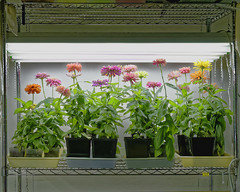
Is that the type of information you wanted to know?
ZM
- 9 years ago
Excellent. Thanks.
I did not think to ask about temperatures, so, now I ask.
- 9 years agolast modified: 9 years ago
Hi four,
The basement utility room contains the central heat/air conditioning system, but has no outlet from either, so its temperature is not under strict control by our thermostat. However, there is a large double-door entrance to the finished part of the basement, and a second standard sized always-open doorway, so the temperature stays a few degrees cooler than the thermostat set-point temperature during the Fall, Winter, and Spring.
The T8 fluorescent fixtures add a little warmth to the room. I have an exhaust fan in one of the basement windows, which I can use to keep the air fresh. So the temperature is close to 70F most of the time. It cools to about 68F in the dark period of the lighting timer. I do have heating mats that I use to provide bottom heat to germinating seedlings, but they are not in use most of the time. I will be starting some zinnia seeds indoors in the next few days, so the heating mats will come into use for them.
It has always been quite comfortable to work with the indoor project in the utility room. And the bright lighting is nice, too. The zinnias would grow much faster if the temperature were 100F (zinnias thrive in heat), but they grow fast enough at temperatures that are comfortable for me.
ZM
- 9 years ago
Very fine design and implementation.
Through your continous outdoor+indoor approach,
what is the longest time that a zinnia plant has gone before it
stopped being productive (flowering) ? - 9 years agolast modified: 9 years ago
Hi four,
The outdoor zinnias have their flowering terminated by the first killing frost in the Fall, and some of those have been flowering for 6 months. The indoor zinnias have their flowering terminated by the shutdown of my indoor project, so their productive flowering is stopped after 5 months.
A few years ago, when I was experimenting with growing zinnias from cuttings, I had one scabious zinnia which had been transitioned from outdoors to indoors back to outdoors the next year, and then indoors again, by simply taking cuttings from the cuttings grown plants and repeating that, and that process produced two years of productive flowering. before I terminated the experiment. In the second outdoors year that zinnia had become a whole bed of identical specimens. Zinnias, like coleus and many other plants, are potentially immortal when grown asexually from cuttings.
If zinnias are a "true annual", and I am not certain that is the case, but it might be, then presumably at some point a zinnia plant will undergo a genetically pre-programmed death. So far I have not seen that in a zinnia. But the possibility remains.
ZM
- 9 years ago
I had in mind the conventional meaning of individual plant, in distinction from
"plant" used in any categorical sense, and of one unregenerated lifespan.Until your most recent posting, I imagined that your "year-round" included
keeping some individual plants going, by moving them.The statement : "many... plants, potentially immortal when grown asexually"
twanged my interest, because I frequently remember the related (contradictory)
information that I read, which was that plants contain less growth hormone in
each successive generation, thus are destined to eventual decline. - 9 years agolast modified: 9 years ago
Hi Four,
" ...which was that plants contain less growth hormone in each successive generation, thus are destined to eventual decline. "
Actually, I don't know of any case in which such a decline occurs. Many ornamentals have been propagated asexually for decades or even centuries with no signs of eventual decline.
" Until your most recent posting, I imagined that your "year-round" included
keeping some individual plants going, by moving them. "In my very first year of hobby zinnia breeding, I did transplant some of my outdoor breeders into big pots and bring them inside to continue growing under fluorescent lights. That turned out to be catastrophic. An aphid population exploded indoors, as did a lady bug population to feed on the aphids. Eventually the zinnias succumbed to the aphids and the ladybugs went into hibernation.
In the following years, I tried bringing in cuttings instead of transplants, only to be wiped out by one or more of aphids, thrips, spider mites, and fungus flies. Eventually the use of systemic insecticides and fungicides made it possible to grow my zinnias indoors, including cuttings. But cuttings usually bring in at least one pest from outdoors, so I currently content myself with bringing in seeds. Even then, I am vigilant for any possibly seed-borne problem.
ZM
 9 years agolast modified: 9 years ago
Cool thread!
Grew these larger Zinnias a couple years ago. Bought seeds at Park seed...
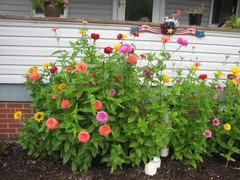
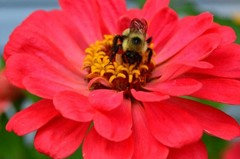

four (9B near 9A)