Software
Houzz Logo Print
rachel2412

Diseased impatiens

16 years ago

Hi everyone! I'm a first time home buyer and am having lots of fun with the landscaping around my house... i've used these forums a lot for advice but this is my first post!

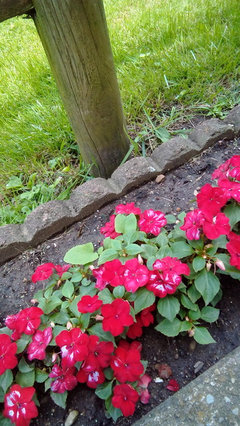
My problem is - I planted two rows of magenta pink impatiens lining the walk to my house (mostly shady area with maybe 1-2 hours of sun per day). On one side of the walk, the impatiens are doing beautifully. On the other side, they look terrible! The plants themselves are doing fine (not wilting or anything) and the green leaves on the plant are doing great as well... the pink flowers have LARGE white blotches on them. I don't think it is my watering schedule, since the other side of my walk is on the same schedule and is doing fine. I found some references to powdery mildew online but all pictures show the mildew affecting the leaves as well, and I only have white blotches on the flowers (not the leaves). Any ideas on what they might be or how to diagnose? I have pictures but am not able to post here. Your help is much much much appreciated!! Thank you!

Comments (14)

  • 16 years ago

    Link below. Your impatiens are not diseased, Rachel. That is what impatien blooms look like when the flower has lived it's life and is spent and ready to be shed. They simply haven't fallen off yet.

    Here is a link that might be useful: {{gwi:22189}}

  • 16 years ago

    I don't think they are diseased either but I also don't think it is just old flowers. Powdery Mildew would affect the leaves too. I have grown Impatiens for years and none have ever turned white. I think it is sun scald.

    Rachel--When do you water? Is it perhaps when the side that isn't affected is in shade but the one that is affected is in sun. Sun on wet flowers will burn Especially the hot sun of California. Try waiting to water until all the flowers are in shade. Or do it in early morning when the sun is not so strong.

  • 16 years ago

    Thanks both of you - to my self professed untrained eye, they definitely dont look like dead blooms... my other impatiens look nothing like that. I checked the sprinkler schedule and they are watered twice per day, once in the early morning and once mid morning. I will change the schedule to only water early morning and see if that clears things up!

    Thanks so much!!!!

  • 16 years ago

    It isn't sunscald. Those are simply flowers at the end of their bloom but they've been held too moist to fall off. I suspect improper watering techniques. This is typical of impatiens going into the night wet and you could be setting yourself up for botrytis to start up on the otherwise healthy foliage. If you ran your hands briskly over the 'spotted' flowers they'd probably shed. And you probably should clean them off before grey mold does set in. We get baskets like that in greenhouse situations when we have a run of cloudy weather with high humidity. The baskets have to be taken down and shaken smartly to get the old blooms off. The new ones coming on will be fine. I grow about 20K impatiens each spring, and I've seen this many times.

  • 16 years ago

    Thanks Calliope! I will remove all the dead blooms and change the watering schedule... i'm very excited that theyre not diseased (yet at least!)! Love this forum!! Thanks again!

  • 16 years ago

    What else has been getting water twice per day, and now every day? And, out of curiosity, how many minutes per irrigation cycle? Is it just these impatiens that have been watered like this, or everything?

  • 16 years ago

    Hi Rhizo,

    We were watering twice per day (once at 5 am and once at 10 am) for 5 minutes each time. We reprogrammed to only water once a day, in the morning, for 5 minutes.

  • 9 years ago

    Here is a picture of my flowers. My husband never waters until the sun goes down

  • 9 years ago

    A 5-minute watering cycle will barely moisten the leaves and the very top few millimeters of soil. That water will evaporate quickly and never reach the roots of your plants. Watering is best done far less frequently, but for longer periods, to allow the water to soak deeply into the soil. That allows the roots to grow deeply, where they will be able to access water even when the surface of the ground is hot and dry. The best, most efficient watering systems are soaker hose that release water directly into the soil without ever wetting the leaves. The best way for you to know whether your soil needs more moisture is to dig into it with a trowel and feel the moisture with your fingers. Try it daily for a while, or just periodically to get a feel for how quickly or slowly your soil dries out. It will vary depending on the soil type and amount of sunlight, as well as the number of roots competing for the moisture, and how well the foliage shades the soil and whether you have used mulch, etc. I hope this is helpful.

    Martha

  • 9 years ago

    Good grief. This was years ago!

  • 9 years ago

    Hi Martha,

    " Good grief. This was years ago! "

    The start of this message thread was old, but that last picture from honeyray52 is labeled as recent. I'm surprised nobody has mentioned Downy Mildew, which presumably "dooms" Impatiens.

    ZM

  • 9 years ago

    I didn't mention it, ZM, because the foliage looks fine. Downy mildew of impatiens affects the leaves rapidly, making them appear stunted, curled, and off color.


  • 9 years ago

    Hi Rhizo,

    " I didn't mention it, ZM, because the foliage looks fine. "

    The foliage does look fine. But, oddly, two different users, rachel and honeyray, have the same blossom white spots on what appears to be the same blooms, years apart. Quite a coincidence. So, do you think it is a disease, or is it a nutrient deficiency? Or do impatiens just not like chlorinated/fluoridated water?

    ZM

Sponsored
Schlabach Woodworks
Average rating: 5 out of 5 stars21 Reviews
Franklin County's Reclaimed Wood Professionals