My builder uses Houzz Pro to plan the timeline and give detailed estimates and daily updates with photos of progress, and provide invoices at pre-agreed key points in the build. This made the whole experience much more efficient and stress-free.
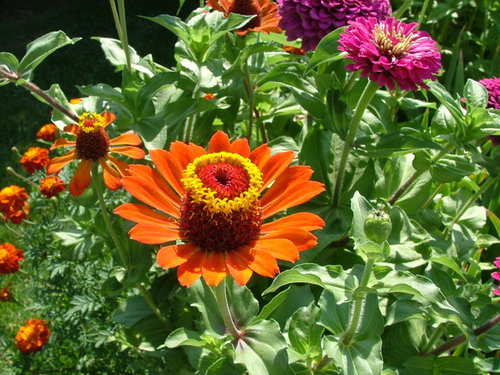
I have seen these zinnias and would like to know what kind they are since they appear to only have a single layer of petals. Also, I have never seen a zinnia that has such a raised center. Is that common or is that there because all the petals have fallen off?
As far as I know, that zinnia has no name. Every now and then a really odd zinnia shows up, and that is a unique looking single zinnia.
" I have never seen a zinnia that has such a raised center. Is that common or is that there because all the petals have fallen off?"
It is rather common to have a single zinnia appear in mixtures of doubles or semi-doubles, but that is an unusual looking single. The zinnia variety, Zowie tends to have a tall center like that, but it is semi-double. And its center slants in more.
"... is that there because all the petals have fallen off?"
No petals have fallen off, but that ring of yellow florets in the top of the bloom emerge fresh daily, and all down that central cylinder there have been florets in previous days. It is very possible that floret seeds are developing in that entire cylindrical head. That part of a zinnia is usually cone shaped (wide at the bottom and getting narrower toward the top), and that part of a zinnia is sometimes referred to as the "cone".
I am an amateur zinnia breeder, and I routinely cull out (discard) all of my single zinnias. But I have to admit, I would be tempted to save seeds from that one. I do like unusual zinnia flower forms, and that zinnia is unusual. I have currently been working on zinnias that have tubular petals, like this one.
{{gwi:23876}} I have been working on several other zinnia flowerforms, but so far none that are single. I have seen some daisy-like zinnias that were rather attractive. But I haven't seen any like the one in your picture. You might want to save seeds from it. It could be quite a novelty, especially if you developed a whole strain of them in a variety of colors, and their plants were covered in blooms. You could work toward that goal by growing a lot of seeds from it and crossing some of them with other "normal" zinnias that had different colors, and saving seeds from those crosses.
Your blog link had a picture captioned "This isnâÂÂt your typical grandmotherâÂÂs flower" that shows a nice single red zinnia and a nice red tubular petaled zinnia in the background. That kind of bowled me over, because I have been working with tubular zinnias as a relatively rare zinnia form. Maybe they aren't as rare as I thought.
However, that is consistent with my theory that tubular petaled zinnias are an unknown existing zinnia strain that survives "under the radar" in zinnia seed fields.
After I read your Sept. 14 message, ZM, I went out and studied the red background zinnia more closely. Indeed, it is a tubular, with petals folding inward.
zen_man
pupperOriginal Author
Related Professionals
Bangor Landscape Architects & Landscape Designers · Worthington Landscape Architects & Landscape Designers · Bronx Landscape Architects & Landscape Designers · Washington Landscape Contractors · Springfield Landscape Contractors · Enid Landscape Contractors · Miami Landscape Contractors · Yakima Landscape Contractors · Ottawa Landscape Contractors · Gainesville Architects & Building Designers · Bainbridge Architects & Building Designers · Chambersburg Architects & Building Designers · Clarksburg Architects & Building Designers · Kankakee Architects & Building Designers · Brooklyn Architects & Building DesignersDeb
zen_man
Deb