Software
Houzz Logo Print
dainaadele

hedge/winter interest

20 years ago

Okay, I have been lurking and learning at this web site for over a year now, and finally this newbie feels like she is beginning to "get it." :-) Here is goes:

Having lived in Nebraska 4+ years, I am begining to realize what is "missing" from my garden are the evergreens. Our summers are so short here that "winter interest" lasts longer than summer blooms. At the same time, I want a bit of sceening between me and my eastern neighbor. It doesn't need to be a full privacy screen, just something that makes my garden feel like a room and not a stage. (We are about 3 feet higher than they are with a retaining wall between us.) To top that off, due to garage and driveway behind the house, my flower garden area is only about 25 feet wide/35 feet long. So needing to keep this hedge single file and on the narrow side, I came up with this idea: emerald green arborvitae's every couple of yards (narrow with height, no need to prune), mixed with Korean Boxwoods in between (lower growing/easy to prune). So... come winter... The boxwood (according to my reasearch), has a tendancy to turn red/brown in winter, but keep its leaves, so I will have a nice varigation between the two in winter, and a nice solid bakdrop of green in summer. The area is mostly sun, and even though it gets strong winds, the arborvitae could help shelter the boxwood a bit from its drying effects. Well.... Where are the holes in m theory? Would another kind of planting work better?

~Thanks!

P.S. I am working on the other aspect of winter interest by using more sedum, and letting my daylilies, bee balm and cone flowers dry on the stalks. (I know, now someone is probably sighing over the fact that I am growing the overused daylilies and coneflowers, but I do like them.)

Comments (11)

  • 20 years ago

    I wouldn't alternate the boxwood and arbs, if that's what you mean. A planting of three arbs together so they will meet eventually, followed by a few of something else, then maybe another cluster of arbs, but arranged to it's not asymmetrically balanced.

    I might be easier and look simpler to just plant a solid hedge of anything that doesn't get too wide, if you don't have the space for a mixed shrub planting.

  • 20 years ago

    I would substitute Japanese holly instead of the boxwood. I hate the look of winter burned boxwood and it sounds like yours will be in a tough location with the wind. I also don't care for the "alternating" look. I agree about going with clumps of three.

  • 20 years ago

    Since this is in sun, there are a lot of dwarf conifers that might work. I'd be very skeptical of any broadleaf evergreen unless I had local ones to watch over a few years. Even then, they will probably need careful siting, so it's more a matter of placing a plant somebody really wants than using a plant in the landscape.

  • 20 years ago

    Thanks for the suggestions.

    I checked on the holly, can't find anything that survives past zone 5/6, and I am definitley more 4/5. That's my biggest problem. Zone 4 plants that are evergreen seem to be far and few between, unless you go with a huge conifer or arborvitae. That's why I am having a hard time with finding something to give winter height and evergreen in that small area. I have always lived in zones 6-7 before, am finding this zone 4 thing a challenge.

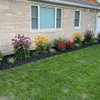
    Any more suggestions? I am open to them. I posted pics of the garden on the gallery side. Thanks!

  • 20 years ago

    A larger photo that includes a view of a larger portion of the area would be good. It's hard to tell from the photo where it is you want to make changes.

  • 20 years ago

    In addition to the arborvitae, chamaecyparis and yews are hardy to zone 4.

  • 20 years ago

    You have the sun. You can grow dwarf conifers. It also sounds like deer aren't an issue if arborvitae are a reasonable choice. There are literally thousands of juniper cultivars, and a few hundred pines and spruces that will grow in zone 4 *so long as they have sun*.

  • 20 years ago

    I seem to be wandering around the forum just agreeing with Mad and Saypoint tondight, but here goes again: ditto what they said. Mix 'em up. Upright juniper, low mugo pine, arb, chunky spruce, columnar pine, Chamea obtusa cultivar, and so on. Great book for ideas: Adrian Bloom's Gardening with Conifers. Have had my head buried in it for a month now. I kind of like winter-brown boxwood too. I would think of this less as a hedge and more as the backbone of that perennial garden you're trying to work behind - if I understand your photos correctly. That means you don't need a row of plants, but a sequence of groupings. A subtle but important difference!

  • 20 years ago

    I have noticed that one of the biggest design issues for novices is recognizing and conquering their instinct to plant a limited palette of plants in straight lines. The advice to mix up the shrubs is good. If I understand correctly that the "hedge" is at the back edge of the flower bed, I agree with Karin that you should bring some of the evergreens forward to be the backbone of the bed, so you don't just a have a single file line, but groups/clumps of evergreens interspersed with the herbaceous plants.

    I think there might be Ilex species that will survive in your zone. That Adrian Bloom book is a great resource.

    As a renter whose planting space is limited and whose landlord has already installed lines of arborvitae, I have to live vicariously when it comes to these kinds of plantings...

  • 20 years ago

    I agree but also disagree with most of the previous comments. I would be tempted to build on what you have and mix in some groups of shurbs, conifers and grasses. But then again, there is nothing inherently wrong with the idea that you propose, as long as you have evaluated how it fits in with the overall style of your garden. A straight row of evergreens would look out of place in a natural garden, but it may fit right in with your border. It would add an element of consistency that could help tie together the perennial plantings as well as provide a backdrop.

    I would say that I am not sure about the alternating plant idea. I would be more tempted to plant just the arborvitae spaced such that there was 2 to 3' between each plant.

    - Brent

  • 20 years ago

    I have boxwood is zone 5 and every year they get nasty winter burned. Not pretty reddish leaves, but dead yellow ones. Every spring (now) they need to be pruned which is a pain, I'm not happy with them. I also have yew which is a much better choice as it takes the extreme weather better and always looks good. I recommend yew.

    Also, what about other things besides evergreens for winter interest? Miscanthus grass looks great in the winter. Henry Lauder's walking stick has interest curly stems. How about great bark from flame willow? Lots of things have winter interest besides evergreens, although some evergreens are necessary because the eye craves some green in winter.