Software
Houzz Logo Print
blue_velvet_elvis

Shade garden design process

19 years ago

I'm embarking on a new gardening journey. A shade garden. All my other areas have been carefully planned out. I've researched, drawn up plans and graphs and carefully chosen plants. This seems so different to me. I've purchased a few hostas, moved a fern or three from my other property and have a climbing hydreanga and a transplanted hydreanga I got several years ago that's never bloomed and can't remember for the life of me what it is. I've kind of just plopped them in the ground.

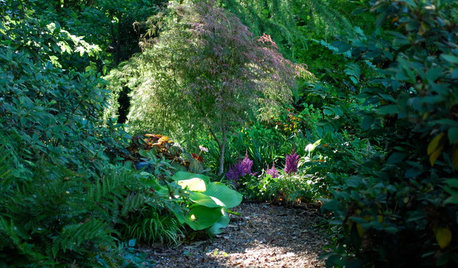
The site is dry shade, under a maple tree. It's well protected and almost totally shady all the time. There are a few peeks of sun here and there but nothing to write home about. I think I'm going for a woodland-y kind of a look.

Are design principles the same in all garden settings? I'm not sure why this so difficult for me. Normally I can "see" what I want and plan accordingly. Shade plants are new to me.

Is this something akin to writer's block? Any suggestions how to "see" what I need to see in order to make it something other than a mishmash of plants?

Comments (7)

  • 19 years ago

    Your feelings are not all that uncommon - many gardeners seem to have a block about gardening in the shade. Classes that I offer in shade gardening are always some of the best attended and most popular. Why I 'm not sure - perhaps because folks are just not as familiar with the plant selection and the specific conditions unique to shade gardening.

    But yes, the design principles are the same. IMO, foliage comes into even more play in shady conditions than it does in open sunny ones, as the bloom period for many shade plants is rather limited, so I tend to focus heavily on shapes and textures. And foliage/flower color - light colors come forward and pop out in low light situations; darker colors receed and lose distinction.

    You also have an issue with the cultural requirements. Dry shade that exists under the canopy and within the root zone of large trees is a very limiting factor and there is not a huge palette of plants that are suitable for these conditions. And they are tricky to plant and establish due to the presence of many tree roots and aggressive competition for moisture and nutrients.

    You will need to do some research on plants for dry shade that are suitable for your zone. And for inspiration, there are many great shade gardening books you can peruse for ideas - The Complete Shade Gardener by George Schenk and The Natural Shade Garden by Ken Druse are two that come to mind immediately.

  • 19 years ago

    I would encourage you to read the link below.

    It's a discussion about gardening under a maple, and it may not be as enjoyable as you hope.

    Here is a link that might be useful: Hostas under maple tree

  • 19 years ago

    Dry shade under maples is the most challenging of all garden conditions. And yes, the tree always wins. Also, gardengal is somewhat encouraging to you, but what passes as dry shade in the rainy PNW is nothing like dry shade in most of the rest of the country. I once got Liriope spicata established somewhat under a silver maple many years ago, but it never really thrived. Nothing else, however, had a ghost of a chance.

  • 19 years ago

    Luckily or not, I am somewhat obsessive about watering. Also luckily I have the best and blackest dirt in the area. It has been untouched and to my knowledge never farmed prior to a house being here 12 years ago. The tree isn't any older than that. All the original nutrients that make Iowa soil so wonderful are still in place.

    Off point but I thought if you watered a tree the roots go down, not up? I was always told that by my gardening grandmother.

    The area gets a lot of run off and isn't that dry to begin with. It's in a patch of land a good three feet down a sloping hill from the rest of the yard. Any good rain and the area is drenched.

    I'm not concerned about it being moist enough or nutrient poor. I am concerned about tree roots choking the plants. I wasn't concerned about that either until I read that about the roots growing up towards the water.

    So far, a week into the process the few plants I have down there are thriving. Hostas, the climbing hydreanga, the other hydreanga, and the transplanted lady ferns. I think I need more white plants and flowers.

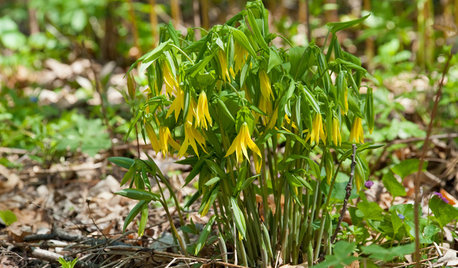
    I want it to look like the forest floor in the Sierras that I used to play in when I was a little girl but I can't quite remember what it looked like and I know that it really isn't possible with the difference in climate. I know I need some kind of lily, not sure what or where I'd get one. I don't really see those around here in garden centers.

    Maybe my issue is how to make it look natural but incorporate a design at the same time.

    Sorry, I'm rambling. I need more coffee.

  • 19 years ago

    what passes as dry shade in the rainy PNW is nothing like dry shade in most of the rest of the country

    And you know this how?? I'd venture to say that dry shade in the PNW is just as much an issue as it is anywhere else in the country, perhaps even more so. Anyone who has gardened for any length of time in the PNW or who is familiar with the area at all understands that its reputation for constant moisture is grossly overstated. The combination of only an average 36" annual rainfall (much less than many parts of the country, including West Virginia), a recurring summer drought situation (virtually NO rain for 8-12 weeks every summer) and the presence of countless large native conifers as well as our native bigleaf maple makes dry shade gardening in the northwest just as challenging as it may be elsewhere. Challenging but not impossible. It merely takes a knowledge of the plants that will thrive and flourish under these circumstances and provide them with the care they need to become well established.

    Regardless, elvis's situation doesn't sound nearly as restrictive as it could be. Both of the referenced texts should be helpful. Specific plant selection should of course be tempered by your local conditions - often native woodland plants are very suitable to include, provided they are commercially cultivated and not harvested from the wild. A number of lilies will grow in a partial (not full) shade situation but these are most often planted as bulbs and you may need to investigate mail order sources to get the best selection.

    FWIW, less frequent but slow, deep watering does indeed encourage deep root development far better than the occasional surface sprinkling. The further water penetrates down into the soil level, the further roots will travel following it. Deeper root development also means increased drought tolerance during drier periods.

    You're on the right track, elvis. I was encouraging because you should be encouraged. This is not an impossible undertaking despite what others may have experienced. Its a matter of discovering the right plant for the right place and proceeding forward. Keep going - you're getting there :-)

  • 19 years ago

    Most maples (the soft maples) have a very shallow root system. I was once told to look into the canopy of the tree, then imagine that as the root system only flattened and spread out within the top two feet of the soil. The root system of my 50+ year old silver maple extended way past the canopy. Feeder roots spread out looking for nutrients and moisture needed to support the fast growing tree.

    I couldn't grow anything under that tree. It wasn't until the tree was cut down, and I tried digging in the area to plant, that I really understood its massive, consuming root system. And that was after a stump grinder ground down the root mass in a 12' x 12' area.

    You might get other plants growing under the tree for a while, but eventually, like laceyvail stated, the tree always wins.

  • 19 years ago

    I know well how difficult the maples can be. The saving grace for me is probably the really "low" nature of our lot, lol. But maples are tough adversaries in a garden.

    Shade and partial shade were distinctions I found tough to understand and reconcile. I think the subtlty of it all depends on your regional locale. And a lot of trial and error. It all really tests your sense of humor and makes you double your ability to "observe" and write down your observations. Everyone thinks they'll remember, but they're never able to, at least with any great reliabilty.

    After nearly 17 years here I realize I'm just starting to really appreciate the oh-so-subtle light changes from day to day, week to week, month to month. (I'm OK with being "slow"; there's a lot more in my life than just gardening.).

    But shade and its variants are rapidly becoming my favorite aspect here. There is a subtlty and understated elegance to plants the "make their living" in the shade. It's about leaves, texture, relative "gloss" and the layers (mean differing heights). Bloom is definitely "there", but it's quiet, unassuming, and often early.

    Paste-y and fair-skinned, the shade has always provided an allure to me. I just appreciate it more now than I used to. And I think about it differently than I used to.