Software
Houzz Logo Print
bobbif_gw

Need help choosing material for front walkway

20 years ago

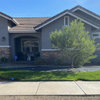
I would appreciate any input on choosing material for a new front walkway. We live in the north central Connecticut, and have a 1920s colonial house with white stucco siding, light blue trim, slate roof, and a black wrought iron fence, that faces out on a fairly busy street. The walkway is about 35 feet long, 4 feet wide. The stoop (just one step high) is concrete. The walkway is currently regular pattern bluestone that is cracked, and the stones have shifted and come up in many places. We will probably put the house on the market within a couple of years, so I'm also concerned about how it will look to prospective buyers. My landscaper thinks that the concrete pavers (I like the tumbled ones from Belgard and Unilock) would last longer than bluestone and look better to prospective buyers. I think the blue (as opposed to full color) bluestone goes best with the house, color wise, but I agree that there is a finished look of the tumbled concrete pavers that is appealing. I am increasingly confused by the many different paver colors and combinations available. One dealer told me generally to mix greys and mix tans, but never mix the two. As I drive around my neighborhood, I think that the muted walkways look better than when people have tried to bring in color, which I have considered doing to match the many-hued slate roof. But I have to say that I fell in love with a new Unilock color called Coffee Creek which looks orange in the brochure but at the dealers lookes like a mix of very muted colors much like our slate roof. Then I think I should do a mix of light and dark grey paver, or perhaps just the dark pavers. Also, should I go with the standard paver sizes or the larger ones such as Unilock stonehenge or Belgard's mega-bergerac- are those only appropriate for larger areas such as patios. As you can see, I'm lost. Any help would be appreciated. Thanks.

Comments (22)

  • 20 years ago

    Bluestone is way more eleganat than anu current manmade stuff. Is there any way you can salvage some of it, maybe get some new to replace the totally disinigrated pavers and reset it. Way way better than the new crap (sorry my opinion.) The old cracked bluestone would be a selling point for me, even if you had taken it up and stacked it behind the garage. I would use for another landscaping project in the yard. People pay big bucks for old pavers.

  • 20 years ago

    I'm enough of a fan of concrete pavers that I've used them in several applications, along with natural stone which I do like where its features can be appreciated. It sounds like your nice long walkway might actually be a setting where the latter applies. (Search this forum for words like 'concrete pavers' to get a flavour of previous discussions on the topic).

    Also, there is substantial snob appeal to natural bluestone and other forms of natural stone. So even without bias, in view of your probably impending sale I would echo Tibs' recommendation that you re-use or reinstall the stone that you have, maybe buying some new pieces to replace the cracked ones.

    I think what often appeals about concrete pavers is their extreme tidiness, which is partly a function of the clean edging and straight, tight seams between pavers, as well as the attention paid to achieving a good flat surface. A good job of installing stone, and consistent maintenance of the clean edge, can satisfy those same needs. I'm assuming from your phrase "regular pattern bluestone" that you mean square-cut pieces. If in fact your stones have some sort of irregularity or gaps, the impression can be tidied up by edging the walkway with a soldier course of bricks.

    I think a well-installed bluestone walkway will pay the most dividends upon resale with the least investment possible in new material purchase and transport, installation work, and old material disposal.

    Another key to a satisfying walkway is to make it wide enough. If your current walk is narrow, then some new bluestone or a course of soldier bricks will help in this regard as well.

  • 20 years ago

    Do you have a picture of the existing walkway and house to help with your colour question? I agree with you that the colour should be muted and not in competition with anything else around. The obvious advantage with concrete pavers is cost, material will be cheaper and, as they do not require the same level of skill to lay, so will the labour. If you can find a supplier, or if your contractor can, that will get all one size (I favour the large rectangle that is about brick size)this looks best on a walkway in my opinion. Putting your two colour idea together with karins 'soldier course' you could have the units along the edge of the walkway a darker colour than the others, which would look classy.

  • 20 years ago

    I'll echo Ink's point about the labor cost and that there are a lot more people who can lay concrete pavers well than those who can lay bluestone well.

    A lot of people get hung up on matching walkway colors or warm vs. cold tones to the house. I have seen many combinations and find this concern to be overblown.

    I recently worked on a historic house where the budget constrained us to using a concrete paver type product. It is a warm tan color along cold gray granite curbs at the driveway, a rich green lawn, a reclaimed piece of bluestone at the porch, against a green porch floor on a red and tan house. It all looks quite fine. There is a soldier course of the same color.

    I wanted to do it with clay brick, others believed it was inappropriate because there was none used on the site at all in the past. The idea of using bluestone was discussed as there was some already on site, but it was believed to be from a later renovation. Granite was priced out and rejected due to expense. The pavers were selected because of cost, tight enough joints to be ADA acceptable for handicap access, and an acceptable aesthetic. I think it worked out better than expected. I have heard no negative comments,.... ...about the walkway. ...Let's not talk about parking lots.

    [IMG]http://i9.photobucket.com/albums/a84/laag/P9130024.jpg[/IMG]

    [IMG]http://i9.photobucket.com/albums/a84/laag/P9130003.jpg[/IMG]
    The main entrance is a simple, but not easy to pull off, ADA handicap accessible entrance, by the way.

    [IMG]http://i9.photobucket.com/albums/a84/laag/P9090052.jpg[/IMG]

  • 20 years ago

    {{gwi:47833}}

    {{gwi:47834}}
    The main entrance is a simple, but not easy to pull off, ADA handicap accessible entrance, by the way.

    {{gwi:47835}}

  • 20 years ago

    Nice work Andrew, nice attention to detail, note slope both ways from front door, and completely in keeping with the house. And with that garden hose laid out to help, you got the perfect curve there (an irresistable piece of nonsense).

  • 20 years ago

    This is all enormously helpful, especially the support of the bluestone. I had one dealer tell me that no one used bluestone anymore. I am attempting to post photos here (this is the first time I have ever tried this), and would appreciate any further comments. As you can see, we are also redoing the front plantings - it's very bare now. Thanks.
    {{gwi:47836}}


    {{gwi:47837}}


    {{gwi:47838}}


    {{gwi:47839}}

  • 20 years ago

    pretty house, I'd have to vote bluestone or at least the look of it with say... Devonstone products...I think it's an EP Henry paver.

  • 20 years ago

    Nice property. What about a crushed stone/gravel/swept earth walkway and with the money you save dig up the grass and fill that whole area with a big blowsy mixture of perennials?

  • 20 years ago

    on the cottage garden, that house screams for it. Honestly, looking at the stone you have there, I would just lift them, redo the base and relay what you have warts and all. It has character. Just reset them to make the walk smoother.

  • 20 years ago

    I agree with nicethyme. Reuse what you have. Bluestone (or any natural product) is classic and timeless. You have a classic home that was obviously built with quality in mind--why cheapen it with concrete? (I personally think concrete is a fine product for most homes, but if you ALREADY have the stone, changing to concrete is a downgrade IMO).

    I found a lot of contractors tried to sway me away from bluestone toward concrete pavers because pavers are a lot easier to work with (not to mention cheaper). Bluestone of the size you have is very heavy--but it is worth it. Your cost will even out since you already have the stone. It just needs to be washed and relaid. This walkway is the first thing your potential buyers will see--why not make it the best quality you can?

    Is your blustone mortared or dry laid? This will effect ease of relaying.

  • 20 years ago

    I love the bluestone, also. Dark pavers, by the way, get very hot in the summer, and so, are hard on those of us who like to go barefoot and also hard on any plantings placed adjacent.

  • 20 years ago

    Another vote for the bluestone. I would do just enough work to make sure nobody's tripping over it. I admire the patina in the first photo.

    If I were to sink money into such a house to prep it for sale, I'd work on upgrading electrical, plumbing, and the kitchen, and add the 'big blowsy mixture of perennials' as suggested above. The appearance is already perfectly charming.

  • 20 years ago

    I think the house screams for formal, not cottage. But since it's the walkway we're talking about, how about a row of tiny boxwoods alongside the walkway, on one side, showcasing the curve? Could extend the theme into the foundation plantings and along the inside of the fence maybe. But you say you are working with a landscaper.

    Now that I see it, I can hardly believe that the walk is 4 feet wide as you said originally. Perhaps its length and the contrast to the doorway width makes it seem narrower. I think I might work on the transition between stoop and walkway; maybe adding bluestone to expand the landing pad and shape it nicely.

    I think Spunky phrases it well, to say that to remove bluestone and replace with concrete pavers is to downgrade the walkway. If you were doing it to reflect and meet your own preferences it would of course be a perfectly logical thing to do, but with a resale in view... I suspect it would be counterproductive. It sometimes isn't so clear when you compare newly laid pavers to old bluestone, which is what you're doing. But by the time the house is on the market, the pavers will be looking aged too; there will be some unevenness and dirt will have settled in the cracks and weeds or moss will be growing.

    Of course, sometimes when you want something, you want it in defiance of logic, and if you really want pavers, then there's another reason to do a soldier course of bricks on either side of the bluestone, maybe making the landing pad of these too. They could be black, to pick up the slate roof. This would be a particularly logical option if you can't get matching bluestone.

  • 20 years ago

    It does not look like he whole walk needs to be reset. There are a few stones that look like tripping hazards that should get replaced and several that could be leveled out.

    I agree with Karen about the house lending itself well to a more formal look. I would not say that other looks would be wrong, just that formal feels right to me on this house. I also believe that formal shrubs will give you a nice quick clean look that might be advantageous when it comes to selling it.

  • 20 years ago

    Thank you all so much for all your help. I also like the bluestone and it's great to see that most of you think I should reuse whatever I can. My landscaper told me that he didn't think I could reuse it - maybe I need a new landscaper. I'm guessing that if I replace some pieces that in a short time the new ones will look like they've been there a while.. I love the ideas for plantings too. The only problem is that my family is proprietary about this space which is the only area clear enough for soccer and lacrosse. However, I have been able to have a cluster of tulips there in the spring.
    Karin, I'm very interested in the idea of adding bluestone on the step (is that what you mean by landing pad) - wouldn't I have to demolish the concrete step to do it? I now recall my landscaper saying he wanted to change it from the step to a sloped sidewalk- maybe he was thinking this too. I think you're right that the walkway is not 4 feet wide - maybe 3 or 3 1/2 feet wide. Should I widen it or does it look right to you?
    Finally, Catkim, I agree about spending the money inside - but I've done that pretty continuously over the last 20 years. Confession: I'm very comfortable renovating interiors but lost with respect to the garden and the exteriors. Maybe this forum will change that for me. But anyway, right now the interior of the house is in far better condition than the exterior. Thanks again.

  • 20 years ago

    Bobbi, I actually meant I would shape the walkway's end to echo the shape of the stoop, so I wouldn't change the stoop itself nor would I remove it. Almost like making a mini-patio around the stoop. Perhaps there's a better word than "landing pad" but it won't come to me just now. You can also tile the concrete (with slate or bluestone I think), or stain it a different colour, but I don't think it looks bad at all the way it is. All depends on how much work you want to do...

    How nice that the yard lends itself to such necessary activities as soccer and lacrosse. Perhaps your landscaping should consist of a pair of tall narrow conifers at each end to mimic goalposts!

  • 20 years ago

    Beware the sloping walkway. The idea sounds nice, but this is the type of situation that needs completion of thought which is often overlooked. If the walkway rises to the stoop, the soil on either side must be added to in order to rise with it. That sounds simple enough. But that also means that the soil will be higher than the soil up against the main part of the house. This will trap water and will obviously slope back toward the house directing runoff toward it.

    The pictures that I posted above (red house) show exactly this situation as it is handicap access. As simple as it looks, this took careful planning and some major alterations to that porch design. All the framing of the porch is pressure treated wood. It is coated with a waterproof membrane and then has stone and mortar over it (on top of a poured concrete wall and blocking on a footing to support the masonry). More importantly, the porch juts out 10' from the main wall of the house. That along with the grainite curbing next to the walk, allowed the soil to slope down along the face of the porch, still have clearance between the house wood and the soils surface, to continue to slope across the face of the house, and finally continue across the side yard lawn at a 2% slope the whole way. Those conditions don't exist and can not be easily created at your front stoop.

    You could add bluestone on top of the stoop, but it will add a minimum of two inches in height. That will make your already high front step even higher, the threshold of the front door lower, and all the trim work on the porch to be redone (and possibly some flashing work as well). I don't think you'll get the return on your investment if you hire a good mason to do it. I think you will have nothing but problems if you have less than a skilled mason do it.

    Your landscaper should be able to level out a few pieces of bluestone and replace the dangerous ones, but it would not be a bad idea to get an estimate from a reputable mason who does this type of work all of the time.

  • 20 years ago

    Wow, I would drool over that walkway just as it is if I were home-shopping.

  • 20 years ago

    Thanks so much to all of you who gave me such great advice on how to handle the walkway. I followed what seemed to be the consensus, to reuse the bluestone and just reset it. I also took the advice not to make it sloping so as to eliminate the stoop. The walkway is almost done, I've added plantings, and I'm so happy with how it is looking and that I didn't make the mistakes of replacing the bluestone with pavers, sloping it, etc. This was invaluable. (And it's looking so much better that now I'm not so sure I want to sell the house yet!) If you're still checking this thread, I'll post a photo when its done.

  • 20 years ago

    Post pictures, please!

  • 20 years ago

    Although it is true most of the facade is symmetric it does have that uneven roof above so this house does not call for a formal garden layout in front. Planting should be asymmetrically balanced to go with the building front (no matching pairs of identical plants like you have now).

Sponsored
Peabody Landscape Group
Average rating: 3.5 out of 5 stars8 Reviews
Franklin County's Reliable Landscape Design & Contracting