Software
Houzz Logo Print
sujiwan_gw

Mixed shrub/flower borders

When incorporating shrubs into a perennial/annual border, how does one plan the distance between the shrub planting in the back and whatever is immediately in front of it? I'm thinking there has to be space to get in and around shrubs to prune, yet I don't want to be tromping all over compacting the soil in the process.

Is there a particular depth for perennial borders that would be recommended for larger land areas being "enclosed" by a border? I'm thinking my front yard alone must be at least 3/4 of an acre. Other than trial and error, how do you know the depth that will make a proper impact?

Comments (10)

  • 20 years ago

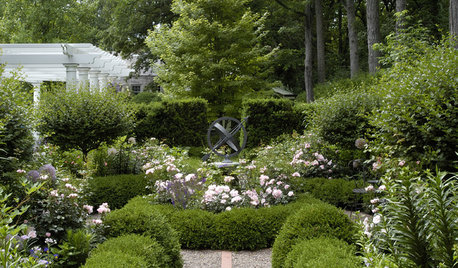
    First you design the shape and lines of the border according to the space available and your needs. Then you choose plants that fit the space and look good. All on paper first, of course. For fine examples of mixed borders (shrubs, perennials, annuals), look at photos of the Red Borders at Hidcote Manor or the mixed border at Great Dixter, both in England. They have been in many books and magazines and are online, I would guess.

    Plants first and design second never works. Create the space; then pick the plants.

  • 20 years ago

    You can use stakes or whatever you have on hand to lay out a possible border size/shape and eyeball it to see if it's in scale with the rest of the property and house. Most people make flowerbeds and borders too small. 8 feet is not too deep for a perennial border if you want to layer the plantings and have enough space to include a sufficient number of different plants to have something blooming at all times. How long you make it depends on how much gardening you want to do, as well as what other elements are already there, such as trees, walks, driveway, existing shrubs, etc.

    Perennials look best in masses rather than singly, so a planting of something that is described as 2 feet wide will be more likely to cover an area 2-3 feet x 6 feet or more if planted in a drift. Massed plants will have an impact that you can't get with one plant, unless it's a large one or a shrubby plant.

    If a border is deep, you can scatter stepping stones among the plants to access the interior for weeding, mulching, etc. A very deep border can have a path winding through it or an access path behind it, if it has a hedge or wall for a backdrop.

  • 20 years ago

    Pick up a used copy of Grant, GARDEN DESIGN ILLUSTRATED.

  • 20 years ago

    Your first question is one reason why I have an aversion to perimeter plantings where you can't get at a border from both sides. But it you must have them, and with the width of border you will end up with in a yard the size of yours (I recognized your name and searched to remind me of your earlier postings), you can easily put some stepping stones or even a median pathway along the back of the border.

    Here is a link that might be useful: Thread with arial photo

  • 20 years ago

    I guess I'm not sure I understand the question as it relates to what you are trying to accomplish with your property.

    First I will attempt a laag impersonation (sorry, Andrew) and say you wouldn't necessarily "size and shape the border to fit your needs" and then choose plants to go there; you would determine what types of trees, shrubs or plants you want where and how big they will be and how arranged with respect to one another, and then the cultivated area should be sized and shaped for that. Otherwise you will end up as I have in some places in my yard, stumped on what to finally put in a space or having the bed go "in" when the plant needs to go "out" or whatever.

    Furthermore, it isnt' clear to me that what you want or need is captured in the term or execution of a "border". With your large property, you are not necessarily trying to create some gi-normous (current expression among my local teen group) "border" but instead might be thinking of where to site trees, large shrubs and perhaps some form of "border" related to those to frame the house and to hold whatever plants serve some purpose--such as, a border of flowers for cutting, or a foundation shrub border. It could be just as important to maintain significant grassy areas between various plantings, in terms of maintenance, as to put unnecessarily large areas under cultivation as borders, which therefore require weeding, mulch, etc. On your property you might need to get your impact by siting ornamental trees stretching out from the house corners and sited outside of the confines of a "border" or foundation planting, and large trees further out to frame the house (depending on the "view" from which you would like to see the framing). Just because the property is large, you still have proportion issues related to the house itself (and people).

  • 20 years ago

    Thanks for your ideas. KarinL, I'd forgotten about those aerials. I am horrible at visualizing how to frame the house--especially since it's a fixer-upper needing a facelift right now. This place was a gift from my husband--I'd always wanted a farm(ette) in a rural area that didn't take long to drive to from our main house. It's my get away place where I have pretty much free reign to do as I would like with the house and yard. It's going to take years to get into total repair, but that's OK.

    What I'm trying to get away from is just acres of grass to mow. The lawn grows fast and thick and takes about 18 hours to mow the whole thing walking behind the DR. mower/brush cutter. Very tiring. That's why I like the idea of deep borders/plantings that take away lawn to mow and not just inserting a shrub or tree in the lawn to be mowed around and under. My husband loathes that. Also, lawn in all directions is boring. I liked the big yard around the house so I could put in flowering things and relieve the monotony.

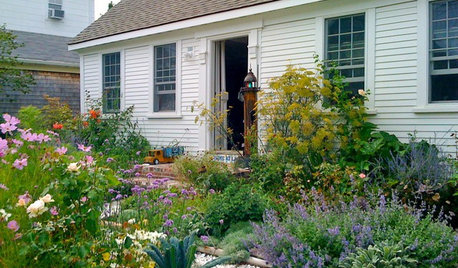
    What I have done this year is put in a butterfly/hummingbird garden in that triangle between the walkways. I am happy to say that one long section was fueled by 2 years of gardenweb swap plants that I'd saved in a kiddy pool! It has a very cottage garden-y look to it. I had no idea of the sizes or colors some plants would have, but as is--a happy profusion.
    I have also put in a large fenced vegetable garden north of the shed, a small fruits area and started putting in spring flowering shrubs (viburnums), some white crepe myrtles on the other side of the front entry walk and small magnolias in the east yard. I also plan to naturalize daffodils and daylilies along the slope of the main driveway which cuts through the ground like a streambed. I have been thinking about putting some small flowering trees along the top of the slope but remain undecided.

    One of the framing issues has to do with our ancient old ash tree--"Wogan". It has been hit by lightning and has many dead branches-BUT--it's alive and a home to multitudes of birds and mammals. Despite being decrepit, its' branching architecture is fascinating. I am loathe to take it down. Meanwhile, I have no idea where I'd site a replacement tree--it is the only shade on the south side yet I don't want to shade out the butterfly garden...

  • 20 years ago

    I understand "deep" borders from a foundation and/or decorative standpoint, but I am wondering how you will replace "acres" of lawn with beds or borders and end up with less maintenance or even be likely to maintain them.

  • 20 years ago

    Well, the acres mentioned encompass areas that aren't part of the section that I envision as a pleasure garden. That's the immediate area around the house, so I'm working with maybe 1 1/2 acres max for that--the remainder is the working garden/orchard/whatever else... I think that smaller size ought to be manageable.

    Can you explain what is meant by a foundation border? Are you talking about the area that used to be shrubbery surrounding the perimeter of a house? Or is this different? I see a visit to a bookstore/library in my immediate future so that I understand some terminology.

    The long and short of it is, I can make deep borders and put in stepping stones as suggested to get around in there. This (as well as working on the house) is a major hobby that I enjoy, not a task to dread. So, I don't at all mind a big border as far as maintenance goes. Being a romantic at heart, I've been longing to create something like an old fashioned garden to fit this 1800's house. I'm not doing any of this to appeal to anyone but myself since I'm not flipping this property and I have years to work at making it look right. I know I'll make mistakes along the way, but I'm learning. I just appreciate other experienced GWebbers ideas or reality checks.

  • 20 years ago

    Figure out what you are keeping as the grounds of the house. Keep that mowed. Figure out what is going to be orchard (and how much work an orchard truly takes) and have that bush-hogged a couple of times a year.

    Ignore the rest, unless you want to plant it with conservation trees.

    Get a copy of Thalassa Crusoe's book 'Making Things Grow Outdoors'. It's her version of doing pretty much what you are trying to do.

  • 20 years ago

    When you go to the library, see if you can find a copy of Ann Lovejoy's American Mixed Border, published mid-90's. This style uses ornamental trees, shrubs, vines and flowers in large, deep borders. It works well for gardeners who actually enjoy gardening and are interested in watching an area change and evolve over time. Since there are no isolated trees and shrubs in her gardens, it also makes life easier for the one who mows.

    Good luck with using your romantic vision to incorporate the ancient 'Wogan' into your garden.

    Annie in Austin

Sponsored
Hope Restoration & General Contracting
Average rating: 4.7 out of 5 stars35 Reviews
Columbus Design-Build, Kitchen & Bath Remodeling, Historic Renovations