Software
Houzz Logo Print
jumby_gw

ailing jade plant

14 years ago

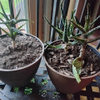
have had this jade plant a few years, office plant. was out a few weeks for shoulder surgery and it didn't get watered and started to die back. most of the stems dried up and fell off. I need to repot it but is there anything else i can do for it? it used to be just a great big bush and now it just looks sad. thanks!

{{gwi:69669}}

Comments (13)

  • 14 years ago
    last modified: 11 years ago

    It's suffering from a lack of light, for one thing.

    Secondly, when you feel the leaves, are they firm or soft or somewhere in between?

    Yellow leaves that are not shriveled usually mean too much water. What sort of soil is it in?

    I would re-pot the healthy trunks in a smaller container, and I would take cuttings, too.


    Josh

  • 14 years ago
    last modified: 11 years ago

    Jumby,

    Your Jade isn't getting enough sun. Repotting in a larger pot isn't the answer.

    It's difficult telling people to cut their plants back, but in cases such as yours, the solution would be to prune each and every trunk/stem down to the soil line.

    Unless the stems are dead, they can be rooted in soil. Jades look their best when growing one plant per shallow container.

    If you prefer a compact/bushy look, reroot stems then place in fresh soil and container. Before repotting rooted cuttings, choose a pot no larger than 2" larger than roots.

    Jades do well under-potted or given enough space to grow from spring on.

    Which direction is the window facing, what type of soil and what size pot?

    Jades look their best when grown in full sunlight. Since they're succulents, 'leaves and stems hold water,' soil needs to dry between waterings.

    Hope I was able to help. End sections where leaves are growing look okay, but stems are bare. Which is the reason I suggest cutting back, and taking cuttings. Toni

  • 14 years ago
    last modified: 11 years ago

    thanks! was mostly wondering if I could cut back to the soil line. repotting is on the agenda since it has been in the same pot for a few years and I wanted to get it into some fresh soil. I only water it about every 3 weeks. I fill the kitchen sink in the office with water and let it soak for a while then drain and place it back on my desk. it survived years like that and was very healthy. I think it is getting a decent amount of sun as it sits in a south facing window. maybe it looks leggy since the other 15 or so stems of it are gone now but once it was very full. and the leaves are nice and firm...

  • 14 years ago
    last modified: 11 years ago

    All great advice!!

    Check the stems near the soil line to make sure they aren't starting to rot. Also, cut back on watering during the winter and be sure the soil is dry before watering.

    I wouldn't repot it now, since it's already ailing. Repotting it will put it into shock, and might make it worse. I live in MN and my jade leaves dry out and drop during the winter too, this might just be part of the natural habit of the plant.

    It definitely needs to be trimmed, but I wouldn't cut it down to the soil line. I would pinch off the new growth for starters. You could also take a few cuttings like the others suggest and root those for new plants. Once you have a few rooted cuttings, then you could trim back or repot the mother plant. That way, if the mother plant dies, you still have the rooted cuttings. Good luck!

    Amy

  • 14 years ago
    last modified: 11 years ago

    Good catch, Amy - about not cutting the plant back to the ground.

    Jumby - While radically cutting back a plant that is full of energy in the long, energy-building days of summer can often be done with impunity, the picture is quite different when winter days are short and the plant strained. Since the only source of energy a plant has available to push a new flush of foliage or develop new buds is either the sun or it's own energy reserves, the future for this particular plant at this time would be bleak at best, terminal more likely, if it was to be cut back hard. I wouldn't remove ANY foliage at this time. Remember that removing your plants' foliage eliminates the plants' ability to make food (photosynthesis).

    Additionally, since the likelihood of cutting success is closely linked to the energy level of the parent material, cuttings from plants so obviously stressed will exhibit a decided reluctance to cooperate until the plant regains some vitality.

    If your plant is root bound to the degree the root/soil mass can be lifted from the pot intact, it needs repotting. It doesn't like to be under-potted or grown tight. For confirmation of that thought, we can ask ourselves if the roots of the plant grow in tight little knots where they naturally occur. When we've answered "NO", we can look into why that particular piece of advice is so often repeated. Plants hate to be under-potted ..... but they hate wet feet more. Under-potting or growing a plant tight is offered only when under the assumption that if you don't grow the plant in a modicum of soil, the soil will remain wet too long and rot roots. People ASSUME that you are using a heavy, water-retentive soil - thus the advice, offered only to save you from yourself.

    The symptoms (across the board) of the stress associated with tight roots are retarded growth, reduced branch/stem extension, small leaves (reduced photosynthesis), shedding of foliage close to the center of the plant, and reduced vitality. Those that would have you choose between the stress of tight roots or rotted roots, don't understand that by choosing an appropriate soil, you can deliver yourself from both evils at once. If you must subject your plant to the stress of tight roots in order to avoid root rot, your soil is inappropriate and you're leaving growth potential and vitality lying on the table. Free-draining, well-aerated soils that support no soggy layer of soil at the pot bottom are great for all plants, but particularly for plants that don't like wet feet. Ask, if you're interested in learning more.

    No one will attempt to support a claim that any plant appreciates stress. While in some cases we CAN employ the stress of tight roots to bend the plant to our will, it's still stress and the plant won't like it. Judiciously used (because it affects vitality), we can use tight roots to slow growth when we think it's appropriate; and in some cases, the stress of tight roots induces a more prolific bloom period, a survival strategy brought on by the stress. It's important that we understand that WE appreciate the results, the plant doesn't.

    If I were you, I would flush the soil thoroughly, let it dry down, fertilize the next time the plant needs water, keep a close watch on my watering habits, and get the plant into the better light it assuredly wants. If you decide to implement that advice, I'll be happy to provide more specific instructions.

    Al


  • 14 years ago
    last modified: 11 years ago

    Sorry - I meant to add some pictures at the end of my post. Notice how gritty the soil is.

    {{gwi:12149}}

    {{gwi:3241}}

    a cutting from the dad, above:
    {{gwi:69672}}

    you can see that plants love the soil:
    {{gwi:43055}}

    {{gwi:13090}}

    {{gwi:1295}}

    Al

  • 14 years ago
    last modified: 11 years ago

    Al, what is that large flat leafed plant on the right side of the pot? Jumby, Jades are my favorite indoor plant. They are very easy to root. I took 6-8 inch cuttings and they all rooted! Good luck !

  • 14 years ago
    last modified: 11 years ago

    That's Kalanchoe thyrsiflora.

    Al

  • 14 years ago
    last modified: 11 years ago

    If the leaves are nice and firm and displaying that yellow color, then I'm almost positive that
    the plant is overwatered (or, rather, the soil type and volume is holding too much moisture).

    I wouldn't hesitate to remove those healthy stems from the pot in order to save them.


    Josh

  • 14 years ago
    last modified: 11 years ago

    Amy, the suggestion to pinch off new growth is so that the plant's energy is not diverted?

  • 14 years ago
    last modified: 11 years ago

    It would be too encourage back-budding and to prevent "leggy" growth.

    Josh

  • 14 years ago
    last modified: 11 years ago

    Most of a plant's normal activities are ultimately controlled by photo-period ...... and it's actually the length of the dark period, as opposed to day length, that determines whether the plant will direct its energy toward growing foliage and extending branches, or storing energy in roots and cambial tissues.

    The plant also reacts in somewhat predictable ways to stimuli that upset normal operation of its systems. For instance, a sucking insect or root malfunction would stimulate a response that requires energy outlay to 'fix' the problem. Usually, the response required to fix these problems overrides normal function, so the energy diverted to 'repairs' detracts from potential growth and vitality.

    A compromised root system is a very powerful energy sink, so most of a plants energy will be diverted to trying to fix those roots. In a plant growing normally, pinching apical meristems (branch tips) simply results in a decrease in the polar flow of a growth regulator (auxin), the result of which has the effect of making another growth regulator (cytokinin) dominant. Cytokinin stimulates dormant buds in leaf axils to growth, so the net effect of pinching doesn't/wouldn't change the amount of energy the plant allocates to foliage or branch extension - it only changes the way the plant grows - and that would be bushier instead of longer after pinching. Additionally, in a plant under stress, the system will likely be 'overridden' until the stress is reduced to a level where the plant's chemical messengers signal the plant it's ok to allocate more energy to the top of the plant.

    Roots come first, making top growth very slow on plants with compromised root systems - probably a large part of the reason why some growers report in absolute terms that their plants go dormant in winter. Also, removing any foliage from plants growing under stress compromises the plant's ability to make food; so while tip pruning is usually not all that big of a deal for plants that are in good shape in the winter because they can usually easily afford the energy outlay, we need to be judicious about how much foliage we remove from declining plants and plants with low energy reserves.

    Al

  • 14 years ago
    last modified: 11 years ago

    I was called away from the puter several times while putting my last reply together and didn't get a chance to see Josh's reply. I'd like to add something interesting to it that might help some of you keep your plants looking better. In fact, I think I should have included it How to Keep Your Plants Looking Good.

    WHEN you do your pinching has a lot to do with the future appearance of your plant. For instance, if you decide to pinch your plant in the winter when there are months of low light ahead, you set yourself up for months of additional leggy growth that if left on your plants isn't going to look good.

    To illustrate, imagine a plant that branches. It's nice & bushy when you bought it, but you think it's growing out of bounds and pinch it when you bring it in in the fall, or just pinch it in the fall, even if it's been indoors all summer. All winter, it grows leggy and long. If you leave that growth on in the spring/summer months, you'll have the nice tight internodes the plant had when you acquired it, then, several months of long winter internodes that are often accompanied by abnormal branch growth due to those being thin and unable to support themselves; followed again by the next batch of tight internodes.

    This detracts from the plant's appearance considerably.

    However, if you make it a point to prune off ALL of the leggy winter growth in mid to late spring (assuming your plant is robust enough to tolerate it), then any ensuing growth (internodes) should be as tight and sturdy as the old growth, which was also produced under high light conditions.

    If you're actively maintaining your plants for appearance, WHEN you pinch and prune has a permanent impact on how your tree will look. At some point, it's reasonable to think that a reasonably accomplished grower would have reason and the will to cut the plant back hard. At that point, you may very well be depending on back-budding that originates from very widely spaced nodes, so the timing of your pinching and pruning today, can have a significant influence on what a plant looks like several years hence.

    Al