Software
Houzz Logo Print
maidinmontana

???'s about a schefflera

16 years ago

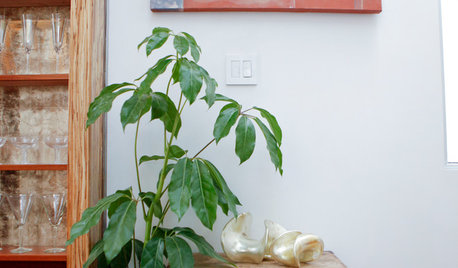
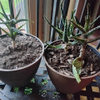
Hi, I have a fairly good sized scheff. I have read about them. It is my understanding that they like to grow on the dry side. I do grow mine dry, however. . . it never fails. When I do water it the smaller, older leaves on the very bottom of the plant turn yellow and fall off, including the stem.

As a general rule, I water all of my plants by flushing them (adding plenty of water, letting it drain out then repeat at least two more times) I WAS doing the same to this one, but since stopped and water just until I see water start to run out, then I stop.

I did re pot it when I first got it but didn't change the pot, I just swithced to my own soil mix. soil, perlite and orchid bark.

It sits to the side of an easter window, bright but not direct light.

The plant isn't dying, it's otherwise healthy, but I was wondering if there is a happy medium for watering to ensure I don't continue to loose leaves with every watering.

Thanks in advance. . .

Maid~

Comments (6)

  • 16 years ago

    When you water, are you sure you're wetting the entire root mass, or is water running along the side of the pot and out the drain hole?

    It sounds, since you're concerned about flushing the soil, like the soil might be remaining wet for extended periods. If it's not, it could be a drought response because the soil isn't getting wet - or a drought response because root function is impaired or roots are rotting due to anaerobic conditions in the rhizosphere (root zone - probably where Dori got her name);o), or a drought response because a high level of salts in the soil is preventing adequate water uptake.

    Other possibilities are mites or other insect marauders, or extremely tight roots, but because of the timing issue (occurs after you water) extra suspicion of it being a soil issue is warranted.

    You said you made your soil from 'soil/perlite/bark'. What is the 'soil' you refer to, and how large is the bark? Describe your soil? How about your fertilizing? What are you using and how much/often? Did you repot or pot up?

    Al

  • 16 years ago

    Thanks Al,
    I use Miracle Grow potting soil. I add orchid bark and perlite (1/3 of each).

    I do test the soil before I water, when it is dry as far down as my finger is long, I water it. After I water it, I lift the pot, it feels heavier, I also re test with my finger. It appears to me that the soil is getting thourghly wet.

    I use VF-11 everytime I water. It's not really a fertilizer tho, so I also use a balanced fertilizer during the spring/summer months.

    I did not change the pot size when I re-potted, I just dumped the old soil and added mine. It's in a 1 gallon black nursery pot it came in and setting in a basket.

    I re-potted about a year ago and the roots seemed fine then, not over crowded and healthy looking, so I didn't pot up.

    The yellowing of the leaves only occurs soon after I water it. The rest of the time the leaves stay green and look good.

    I've seen pics of yours, it's a beauty. May I ask how you got it to be so full? What light does it get? Do you remove new growth to stimulate more roots? I ask this b/c it is so uniform, mine grows any which way.

    Thanks for all you good advice and help. . .

    Maid~

  • 16 years ago

    I would bite the bullet & do a makeover like I described to GI in her thread about a scheff. I regularly cut mine back very hard & they respond by back-budding profusely.

    The ones I have at the office get light through east windows, and I have to say that the windows are tinted and allow only about 48% light transmission, so most plants grow rather leggy (I have lots of plants on the window sills). In addition, they are tinted blue, and reflect mainly the blue portion of the spectrum, which is a decided disadvantage for foliage plants, as they prefer that portion of the spectrum.

    I usually root-prune and cut the office scheffs back to nearly stumps and short branches every 2-3 years. When I do, I prune the branches in roughly a tepee shape, and remove crossing branches & those growing inward - standard pruning stuff. After the root work and pruning, I put the plants in shade for a week or two, then move them to full sun for the summer, then return them to shade in late Aug in preparation for moving them indoors. I often remove ALL the foliage at this time, which again causes some serious back-budding and a new flush of leaves that are adapted to shade so they aren't shed when I move the plant indoors for the winter. I use lots of tricks on all my plants to get them to grow the way I want them to. Most of them (tricks) have their roots in something I borrowed from my study of bonsai applications and procedures used to bend plants to the will of the grower. ;o)

    Is the bark you're using in your soil quite small - like 1/4" and smaller?

    Al

  • 16 years ago

    Thanks Al,

    Wow, a complete make over huh? I see the results you get by doing this, but it makes my heart pump fast to think about doing it. But then again, it was only a $9.00, if it doesn't work I can always get another one. And Lord knows if I loose a plant it's not going to be missed amoungst all the others. . . And, I would like to get it looking like yours so I may be up for an experiment. . .

    I don't put any plants outdoors tho. Well, I guess thats not entirely true, I did put a black pagoda (lipstick variety) in a tree last summer and it did well. I also planted a jade in the gound and dug it up in the fall, it more than doubled in size. I may do it again this year. . . I worry too much about bringing in bugs from the outside, so I just keep them in.

    The bark I use is bigger than 1/4". I'd say closer to 1". I soak it in warm water then run it thru my blender to make it finer and less chunky. My hoyas love it. I also recently started to switch all my plants over to coir. I've only done a handful so far, but I will get the rest switched over real soon. I plan on using it for my annuals this year too. It's cheaper than potting soil, but the real beauty of it is it doesn't dry and cake around the roots, it re wets very easily but doesn't retain water like soil can so it doesn't stay wet for a real long time. It doesn't have any nutrients in it so it's necessary to fertilize with every watering, on a very diluted basis.

    Thanks again for your help Al,

    Maid~

  • 16 years ago

    For your consideration - I wrote this as a reply on the container forum a while ago. You may find it interesting:

    Sphagnum peat and coir have nearly identical water retention curves. They both retain about 90-95% of their volume in water at saturation and release it over approximately the same curve until they both lock water up so tightly it's unavailable for plant uptake at about 30-33% saturation. Coir actually has less loft than sphagnum peat, and therefore, less aeration. Because of this propensity, coir should be used in mixes at lower %s than peat. Because of the tendency to compact, in the greenhouse industry, coir is primarily used in containers in sub-irrigation (bottom-watering) situations. Many sources produce coir that is high in soluble salts, so this can also be an issue.

    Using coir as the primary component of soils virtually eliminates lime or dolomitic lime as a Ca source because of coir's high pH (6+). Gypsum should be used as a Ca source, which eliminates coir's low S content. All coir products are very high in K, very low in Ca, and have a potentially high Mn content, which can interfere with the uptake of Fe.

    I haven't tested coir, but I have done some testing of CHCs (coconut husk chips) with some loose controls in place. After very thoroughly leaching and rinsing the chips, I made a 5:1:1 soil of pine bark:peat:perlite (which I know to be very productive) and a 5:1:1 mix of CHCs:peat:perlite. I planted 6 cuttings of snapdragon and 6 cuttings of Coleus (each from the same plant to help reduce genetic influences) in containers (same size/shape) of the different soils. I added dolomitic lime to the bark soil and gypsum to the CHC soil. After the cuttings struck, I eliminated all but the three strongest in each of the 4 containers. I watered each container with a weak solution of MG 12-4-8 with STEM added at each watering, and watered on an 'as needed basis', not on a schedule. The only difference in the fertilizer regimen was the fact that I included a small amount of MgSO4 (Epsom salts) to provide MG (the dolomitic lime in the bark soil contained the MG, while the gypsum (CaSO4) in the CHC soil did not. This difference was necessary because or the high pH of CHCs and coir.) for the CHC soil.

    The results were startling. In both cases, the cuttings grown in the CHC's exhibited only about 1/2 the biomass at summers end as the plants in the bark mix.

    I just find it very difficult for a solid case to be made (besides "It works for me") for the use of coir or CHC's. They're more expensive and more difficult to use effectively. The fact that some believe peat is in short supply (no where near true, btw) is easily offset by the effect of the carbon footprint of coir in its trek to the US from Sri Lanka or other exotic locales.

    That's the view from here.

    Al

  • 16 years ago

    Could it be chlorine in your water? Hardness? Mine is planted very similar to yours. I also grow orchids. I water all my plants with RO (reverse osmosis, and rain water because my well water is very hard. I haven't had any problems with yellow leaves.

    Maybe get a water test. This is just a guess.

    Jane