Software
Houzz Logo Print
herb_gw

Casting small window frames

21 years ago
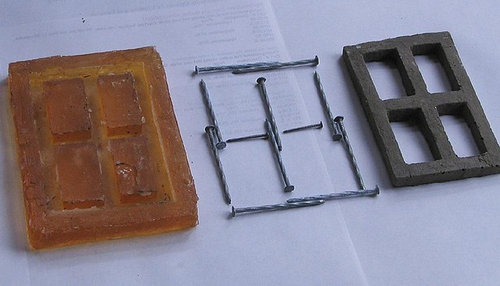
Ever since tufaenough posted a picture of a small concrete window frame for a Japanese garden lantern, I've been trying to do make a similar (though possibly smaller) one.

My first try, using a polyurethane rubber mold and a mix of Portland and Copper Slag failed. The polyurethane rubber is moderately stiff, but bendable, but the casting broke when I was demolding it.

Maybe the mix was too wet or maybe I demolded it too soon. In any case, the cross-section of the 'bars' of the window is only 3/8 inch x 3/8 inch (i.e. about as thin as my little finger) , and I don't think any concrete, even with copper slag, is much good at resisting bending force, and it took a fair amount of bending force to separate the mold from the casting..

To usual way to get concrete to resist bending forces is to reinforce it with rebar, but the only rebar I could find was way thicker than the window bars.

Then I found a box of nails - of just the right size. I filled the mold - having first sprayed it with mold release - with a mix of 1 Portland to 3 Copper Slag (making sure it wasn't sloppy) and then gently pressed several nails into it until they were submerged.

I think it was about 48 hours later when I demolded the casting - and this time it worked.

Image link:

Comments (11)

  • 21 years ago

    Good experiment Herb, this will open up the door for more projects for your yard I bet.You have such a nice asian influence garden. I had used nails in rubber gloves for reinforcement for the fingers when I made several of those. I can't wait to see what project you will make now that you have your technique down. Cindy

  • 21 years ago

    Today I found a shop that sells a plaster-like product called Hydrostone.

    When I got it home, I made another of these window frames with it. And whereas I had to wait at least 2 days for a casting made from Portland and Copper Slag to come out of the mold without breaking, this stuff came out of the mold within an hour - and I hadn't included any nails to reinforce it.

    It's claimed that after it's set, it resists water so I'm hoping that after I've painted it black, it'll stand up to being out doors, especially since the lantern's roof will keep it fairly free from rain.

    Click for a description

  • 21 years ago

    Herb, I have read about hydrostone before. I think people were using it for carving. I also thought I had heard it was expensive, what sort of cost isit compared to a concrete mix?
    I am in Nanaimo and there isn't lot's of places around that would carry it I bet, my son is in Victoria though, where did you get it? Maybe I can get him to pick me up some, or get some next time I visit.
    Thanks Cindy

  • 21 years ago

    Cindy -

    I got it from Lloyd-el Ceramics Crafts. They're at 1-933, Ellery St. in Victoria. I've lost my receipt, but it was around $25 for a 50lb bag.

    I too have read that people use it for carving, but it beats me how they can carve it. I suppose if people can carve things from granite, that they must use some similar method for carving Hydrostrone.

    It's strong too. Yesterday I was making a mold (about 1 1/2 inches deep) to cast a plain rectangle shape. I carefully taped and Vaselined the master (made of plywood) & lowered it into the newly-mixed Hydrostone. After about an hour I tried to lever the master out of the mold & couldn't.

    So, I turned the mold upside down & drilled a 1/2 inch hole through it (at least it wasn't hard enough to resist a hardened drill bit) till I got to the plywood. Then I inserted a thick, strong, nail - head downwards - into the hole till it contacted the wood, and started to hit the nail with a hammer, hoping to drive the wooden master out of the mold. Nothing happened!

    So, I got a sledgehammer. The first blow of that didn't work; the second, harder one didn't work either; it took a third, much stronger hit. That drove the master wooden rectangle from the mold - and split the mold in two. But it was a clean break and all I needed to do to use the mold was push the two parts together and bind the thing up with adhesive tape.

    That should give an idea of how strong the stuff is!

    You can also add aggregate to Hydrostone. I tried a mix of about 1 part Hydrostone and 3 parts Copper Slag to make a couple of these window frames & it worked, though I left the mix in the mold a good deal longer than needed for a Hydrostone only mix.

    Anybody wants to try this sort of material - bear in mind that there are two others - Hydrocal White and Hydrocal 105. They're probably very useful but I think Hydrostone is the strongest.

    Herb

  • 21 years ago

    Hi Herb
    Wouldn't Gardencast be a better choice for outdoors?
    I don't know much about Hydrostone other than I was going to try to make the stuff a while back.:)
    I think it's very fine silica dust, Portland cement, POP and maybe some admix.
    I didn't know it was weatherproof.
    Just for the Halibit I'm going to mix some white Portlands, fine silica sand, POP and some Acrylic admix then add water and see what I get.:)

  • 21 years ago

    Tufa Enough - I think you're right about the composition of Hydrostone - see this site - http://galerieverdun.com/artglossary-H.htm - which describes it as basically plaster of Paris (90%), Portland cement (5%) and crystalline silica (5%).

    I don't know for certain that it's weatherproof - I'm just guessing, on the basis that I've seen it described as water-resistant & because I'd assume from that that if it's also sealed with a coat of paint, and sheltered from the rain (as with a lantern's roof) I can't think of much reason why it would deteriorate?

    I haven't any opinion about Gardencast because until you mentioned it, I'd never heard of it. I'm going to start looking for it.

    Herb

  • 21 years ago

    Hi Herb
    It was my understanding that Gardencast and HydroStone were the same basic product except Gardencast was for outdoor use and Hydrostone for indoors.
    I looked this product up a few months ago but seem to have lost my link. I could be wrong.

  • 21 years ago

    Tufa Enough -

    It seems we're both hot on the trail of these products - this site (I assume it's the same Hydrostone, though the site appears to be in Australia) - http://www.armsmodelit.com.au/infogardencast.htm - confirms what you say about the composition of the two products being basically the same - indeed I can't see any difference other than that it says that for maximum durability Gardencast must be used with a sand aggregate.

    And I read somewhere that you can also add an aggregate to Hydrostone - and I did when I made the mix of 1 part Hydrostone to 3 parts Copper Slag. Maybe the castings from that will last longer than the pure Hydrostone castings......

    Herb

  • 21 years ago

    Thanks for the info Herb. It sounds like it would be more challenging for me to carve than I would want to try, but for small castings that need strength, perhaps ideal. I may be in Victoria in a week or so , the cost isn't as high as I thought it would be so may pick up some.
    Cindy

  • 21 years ago

    Thanks for the info Herb. It sounds like it would be more challenging for me to carve than I would want to try, but for small castings that need strength, perhaps ideal. I may be in Victoria in a week or so , the cost isn't as high as I thought it would be so may pick up some.
    Cindy

  • 21 years ago

    I read that gardenstone is not good for birdbath,fontain and water exposition.

    http://www.sculpt.com/catalog_98/CastingMaterials/GYPSUMS/gypsum10.htm

Sponsored
NME Builders LLC
Average rating: 5 out of 5 stars2 Reviews
Remodeling Company in New Albany, Ohio