Software
Houzz Logo Print
tootswisc

goofy pot size

18 years ago

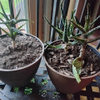
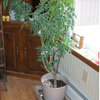
Is a tall narrow pot as good as a traditionally sized pot. I want to use a drainless antique pot for my pencil cactus that needs to be repotted. A plastic glass with a hole punched it it fits perfectly in this tall narrow pot. Is increasing a pot size by going tall and narrow the same as potting up in a "regular" pot.

Thanks from Diane who is ignoring our snow by playing with houseplants and lurking around here!

Comments (11)

  • 18 years ago

    The problem will be that the glass will constantly be sitting in water, and unless you constantly empty the big pot, your cactus will drown from water wicking back up into the soil to the roots.

  • 18 years ago

    Nope-that won't happen. I will pull the plastic glass out of the pot when I water as I do all the other plants I have in decorative outer pots. BTW, that does get to be a pain at times.

    But what do you think about my question. Is there a difference potting into a tall skinny pot. If the amount of soil is the same does the shape of the pot(within reason of course) matter?

  • 18 years ago

    Any soil made of small particles will support a perched water table (PWT), which is manifest in a saturated layer of soil, usually at the bottom of the pot, but which can also perch on top of material added to the pot as "an aid to drainage". This PWT will always be consistent in height, no matter the size/shape of the container the soil is in. With this knowledge, we can say that a soil that supports a 3" PWT, used in a 3" deep container will remain 100% saturated at container capacity. Container capacity is the state of the container soil after it has been fully saturated and is just at the point where drainage has stopped. So, a 6" deep container will have 50% saturation and a 12" deep container will have only 1/4 of the soil saturated at container capacity; therefore, it should be easy for us to draw the conclusion that taller containers are easier to grow in, based on soil saturation levels. "Skinny" or fat makes no difference, the PWT height using any given soil will remain consistent from one container to another.

    Container shape has no effect on the height of the PWT, but it can/does have an effect on the total volume of water in the PWT. The easiest way to understand this concept is by illustration. A container that tapers toward the bottom will have less soil o/a in the bottom 3" than one with vertical sides; thus, the lesser volume of soil will hold a lesser volume of perched water. Here, we can draw the conclusion that, based on soil saturation levels, containers that taper toward the bottom will be easier to grow in.

    Since the PWT height diminishes with increasing particle size, until at around a particle size of just under 1/8" the PWT disappears, there is much to be gained from using a coarse, well-aerated soil. Those that I use and suggest are designed to eliminate or nearly eliminate any perched water and associated concerns.

    Al

  • 18 years ago

    I've seen--but not usually read much of--articles claiming that plants make better root growth in deep pots like you're considering. I've always been told that most of the plants I'm primarily interested in (gesneriads and begonias) grow primarily in the leaf litter and detritus on the forest floor in nature, so shallow pots are better for them, so haven't spent much time considering it. But I think it may well be true of some plants, certainly true for many trees--and quite possibly good for your plant. Always worth experimentation!

  • 18 years ago

    Al,you are a wordy poster...I love having your soil post return to the top of the page. I saw and ad for a new plant supply store in Madison and immediately wondered if I might be able to find some of your ingredients there.

    The next time I water I am sure I will be wondering where my water is perching.

    I did repot my pencil cactus and I think it might like having deeper roots.

  • 18 years ago

    I've seen--but not usually read much of--articles claiming that plants make better root growth in deep pots like you're considering. I've always been told that most of the plants I'm primarily interested in (gesneriads and begonias) grow primarily in the leaf litter and detritus on the forest floor in nature, so shallow pots are better for them, so haven't spent much time considering it. But I think it may well be true of some plants, certainly true for many trees--and quite possibly good for your plant. Always worth experimentation!

  • 18 years ago

    You said that already! ;o)

    Plants with roots that seem to prefer to have their roots in the top inch or two of soil are telling us something. They are saying, "This is the only part of the soil I can find, where I can efficiently expend my energy to make roots. I am finding ample moisture here, and nutrients as well. Every time I try to send my roots deeper, I can't seem to find the right combination of air, water and nutrients, so I keep shedding the deeper roots to conserve energy. I am ready though, to put roots down much deeper if I ever do find that right combination."

    Put that plant in a container with a well-aerated soil and you might hear, "Hey! I really dig this stuff. It has lots of air, just the right amount of water in the soil, and whatever Toots is feeding me just makes me want to dig my feet in all the way to the bottom of this pot & grow my favorite adventitious bud off!"

    Plants that usually grow with shallow roots where they occur naturally, do so because cultural conditions are only favorable in the upper reaches of the soil. Change the soil so the same conditions occur at deeper soil depths, and the plant will happily colonize the deeper soil with roots.

    Because of the PWT effect, a shallow container with a heavy soil, like is so often used for house plants, could easily be a death sentence for any plant whose roots are normally found at the top of the soil because they demand an O2 rich environment. For these plants, shallow containers are worse, not better.

    Al

  • 18 years ago

    Al, before you repot, do you stir in bits of water to your potting medium. I feel I have to reconstitute my potting soil and at times I don't do it right.

  • 18 years ago

    I mix the bark/peat/perlite soil either 3 or 6 cu ft at a time. After I measure the peat & perlite, I add them to the bark, which will already have been piled on top of a tarp. I then add my liming material, micronutrients, and any fertilizer charge I might wish to include. I give it a quick mix by pulling on the corners of the tarp, rolling & mixing the soil. After it's lightly mixed, I add what I think is enough water to make sure the soil will be damp when I'm done, then mix thoroughly. Then, I cover the soil with the corners of the tarp and allow it to rest over night, so the water can diffuse through the soil. This prevents the hydrophobia (water repellency) associated with dry soil components (particularly peat and bark) and makes it easy for soils to absorb water after I plant in them.

    Is that what you were asking?

    Al

  • 18 years ago

    Yes. Hydrophobia is what I need to work on.

  • 18 years ago

    . . . best to stay away from doggy soils, then.

    Al