Software
Houzz Logo Print
wgreenthumb

office plants

19 years ago

I am looking at getting some plants for my new office which doesn't have windows, just typical office lighting. Are they any suggestions that would work well for me?

Comments (20)

  • 19 years ago

    Not trying to take over your thread here.....but, which of these listed plants does someone actually have experience growing in a low to no natural light office environment, as opposed to just pulling a list of low-light plants off the internet?

    For example, I know Chinese Evergreen is a low-light requirement plant, however, at least in our office, they do horribly under flourescent lights and grow very straggly very quickly.

  • 19 years ago

    Mr. Sub, sorry but I have to agree w/Daisy..All plants, other than mushrooms, need sunlight, even if it's low. Artifial lighting is fine, but plants needs natural sun too. Otherwise, plants get spindly, until they look like death-run-over. Even plants set up in malls are under sky-lights..
    And many times, ppl who work in offices toss water, (when not needed) coffee, cig ashes, (if smoking is allowed)..Sorry...
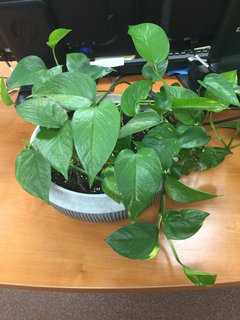
    Wgreen, you might get by w/a Pothos, but even after time, it'll lose its color..you can keep pruned for a compact look..Toni

  • 19 years ago

    I grow (or have grown) the following (from the list) under low light, all-artificial light or low artificial light:

    Aglaonema spp. (low+art.)
    Anthurium 'Cotton Candy' (short-term) (low+art.)
    Araucaria heterophylla (low)
    Aspidistra elatior 'Milky Way' (low)
    Asplenium nidus (low)
    Chlorophytum orchidantheroides 'Fire Flash' (art.)
    Cissus rhombifolia (low)
    Cordyline terminalis (art.)
    Davallia trichomanoides (low)
    Dieffenbachia 'Compacta' (low)
    Dieffenbachia 'Hilo' (low)
    Dieffenbachia maculata (art.)
    Dieffenbachia 'Tropic Snow' (low or art.)
    Dracaena deremensis ('Lemon-Lime,' not 'Janet Craig,' but still) (low)
    Dracaena fragrans ('Limelight,' not 'Massangeana') (low+art.)
    Dracaena marginata (short-term) (low)
    Epipremnum pinnatum / aureum (low+art.)
    Euphorbia tirucalli (didn't do well, but survived 2 yrs.) (low)
    Ficus binnendijkii (low)
    Ficus lyrata (short-term) (art.)
    Haworthia retusa (low)
    Philodendron 'Black Cardinal' (art.)
    Philodendron 'Moonlight' (low+art.)
    Philodendron scandens (low or art.)
    Sansevieria trifasciata 'Laurentii' (low)
    Sansevieria trifasciata 'Moonglow' (low+art.)
    Spathiphyllum 'Golden Glow' (art.)
    Spathiphyllum 'Sensation' (low+art.)
    Spathiphyllum wallisii (low+art.)
    Tillandsia cyanea (low+art.)
    Yucca elephantipes (or maybe Y. aloifolia) (short-term) (low)
    Zamioculcas zamiifolia (low or art.)

    Some of those worked out better than others, hence the leaving them off the recommendations list.

    In my experience, Aglaonema spp. grow quickly enough that they become scraggly regardless of what kind of light or how much.

  • 19 years ago

    I'll side with Mr. Sub. You'll be surprised how many plants can be grown under total fluorescent lights.

    S

  • 19 years ago

    Not trying to start an argument here, or have anyone take sides. :-)

    Since I'm looking for the same info. as the original poster I wanted to clarify--too many times I see people post what they've read as opposed to what they've experienced. Most of us have read the info. on the internet and are looking for actual experiences by asking our questions here.

    Thanks for the list!

  • 19 years ago

    Susan, just for the record, I'm not trying to debate w/anyone either :) As far as I'm concerned, Mr Sub knows quite a bit about plants..
    I agree there's a number of plants that will thrive under flourescent lighting, but usually when placed under bulb.
    Wgreen is talking ceiling lights..a long distance from a plant grown directly under lights..
    But, the only way to test is buying a plant and see how it works..I wish her/him all the luck in the world. Toni

  • 19 years ago

    Well, I didn't want to start an argument either: I hadn't seen hopefulauthor's response when I started typing mine, so I didn't mean that quite the way it looks.

    It is true that plants need both high-energy (blue) and low-energy (red) light, and that old-style fluorescent bulbs are heavy on the blue side, such that they're somewhat unsuitable for growing plants (it's still doable, though some plants may grow but not flower, grow but not thrive, etc.). The newer fluorescents, like for example most compact fluorescent bulbs, are better. (If I remember right, the really serious plant growers are into halide lights, which is something else entirely.)

    Also, sometimes even an older fluorescent can be preferable because they run cooler than sunlight or incandescent light, so you can put the plant closer. Less red being produced, but you're making more complete use of it.

    Your office may or may not have the newer lights, may or may not leave them on around the clock, may or may not change them when they burn out, may or may not have 8-foot ceilings, may or may not have co-workers who dump coffee in potted plants, etc., so there's no guarantees, but I'm confident that the *overwhelming majority* of offices have enough light in them that the *overwhelming majority* of plants in that first set of eleven could survive and grow, if very slowly. No promises beyond that.

    Here is a link that might be useful: Link about fluorescent lights

  • 19 years ago

    I'm not "really" taking sides, just a figure of speech but it did sound like you were getting a little offended there and possibly assuming he was reading from the internet.

    I happened to have a green rubber tree that is doing very well under total fluorescents and is not close to the "bulb".

    Susan

  • 19 years ago

    There are a lot of factors that come into play when you consider using artificial lights, but I believe that it is possible to grow certain plants under that type of lighting - with no natural light whatsoever. I have several of them growing under fluorescents, one of which is the Iresine Herbstii (a plant that requires high levels of light to sustain its colors). And surprisingly enough, the darn plant has never done as well in natural light as it's doing now in artificial lighting. I moved this plant from a southeast location to test my artificial lights, test their quality. Little did I know that my little plant would thrive beyond my expectations in its new home. So I've left it there.

    I also have an Anthurium, a Dieffenbachia, an African Violet, a Kalanchoe, a Pilea, a Chlorophytum (and two or three others I can't remember now) growing there. And theyÂre all doing great.

    So, yes, I believe that - with the right lighting - it can be done.

  • 18 years ago

    What size are all these plants?

    I have some desk space and the top of a shelf.

    The desk space available is 20"x 24" and there is a florescent light 19" above the desktop.

    The shelf is 15" x 30" and 12" below the cube wall (the pot must be shorter than this) and 48" below the ceiling.

    Thanks.

  • 18 years ago

    I'm rather suprised that nobody has mentioned Dracaena sanderiana, a.k.a. "Lucky Bamboo." It's supposed to be able to grow in virtually any light condition, as long as it has water.

    And for the record, I have never tried to grow this plant, but I have read time and again that it can grow pretty much anywhere....

  • 18 years ago

    "Araucaria heterophylla (low)"

    How well did this work out?

  • 18 years ago

    Ennh. It didn't really grow or die. It was a temporary deal, for a few months, while we were trying to decide whether to keep it or throw it out (it hadn't looked great to begin with, mostly because it'd been underwatered). I don't expect that the low light did it any favors, but it handled the situation better than I expected it would.

    And then we decided to throw it out.

  • 18 years ago

    Greenthumb, the long list provided might just be moot....first, you have to decide which size of plant the office crew wants to see, wants to put up with.
    Offices, usually with fluorescent light way up there on the ceiling, are not places to have expectations of plants surviving well.
    Any artificial light -- without natural light of any kind, will have to be within 6 to 8 inches of the top of the plant.
    You would be wise to think small, and to think artificial light from a lamp located on your desk, on the filing cabinet, on a nearby shelf, under a shelf, anywhere light can be made to fall within the necessary limits.
    There are different intensities of lamps expressly for growing plants. Speak to a nurseryman who sells and knows houseplants. Do not trust the sales lady over at Home Depot or Lowes, go to a nursery and get good advice about houseplants they sell. There, they can also advise on what fertilizer -- if any -- should be given the plant you choose.
    If the office has some avaialable light---and it comes from a western or southern exposure, your plant might do well if sufficient intensity reaches it.
    Otherwise, if the light coming into the room is very mimimal, then don't trust it to do anything for the plant and you would be best to trust only what artificial light you provide.

    You know, there are worst things than not having any office plant that needs care. Why not trust artificial...plant that is. Michaels and other places, have beautiful plastic plants you cant tell from the real thing.
    Best of all, they are always in full glory.
    Most large houseplants have their clone in plastic.

    For years, I was always asked to care for a spider plant my sister had while she took vacations. I always watered it faithfully. This I did for at least 5 years. I was very proud of myself in that that plant always looked great when she returned.

    Then she told me...she found water in the bottom of the pot of her artificial plant and wondered how it got there.

    Well, that's what makes the world go round...silly buggers like me.

  • 18 years ago

    Now here's something I have some experience with--artificial plants. One thing I've always wanted is a Bonsai tree, but I've never thought I'd be able to keep one alive. A few years ago, a local discount store got in a small shipment of fake Bonsais, and I got myself a couple. The only "maintenance" they require is the occasional dusting or wiping with a damp cloth, and they still look as good as they did the day I got them! I know for sure that I wouldn't be able to say that if they were real trees. Also, I don't think a real plant would survive on top of my TV for very long....

  • 8 years ago
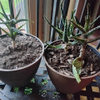
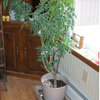
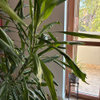
    My desk plants with fluorescent lights in 10 foot ceiling. No sun.
  • 8 years ago

    Just a heads up - as I work for an office plant company I'd be happy to advise as to what does well in offices, as it's a very different environment to most people's homes, so ask away.

    Would start by suggesting:

    Dracaenas

    Sansevierias

    Aglaonemas

    Kentias

    Ficuses

    But would avoid anything that requires humidity, e.g.

    Boston Ferns

    Calatheas

    Almost anything that flowers.

  • 8 years ago
    last modified: 8 years ago

    stewartsjon

    ''Just a heads up - as I work for an office plant company I'd be happy to advise as to what does well in offices, as it's a very different environment to most people's homes, so ask away. Would start by suggesting:...Almost anything that flowers."

    I am confused by "Almost anything that flowers."

  • 8 years ago

    Yeah, I know most things have some vestigial flower, but most indoor plants that are grown for their flowers (e.g Phalaenopsis, Anthuriums) do not like the dry air you get in most offices. Spathiphyllums are probably the notable exception.