Software
Houzz Logo Print
randy_

Branch pruning, Ficus Benjamina

13 years ago
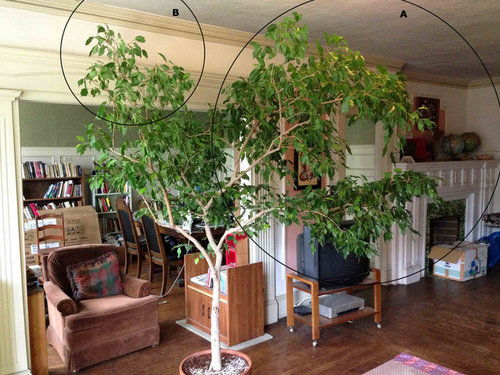
Hello all - after plenty of solid advice I'm happy to report on the good health of my ficus. Got rid of a nasty scale problem, undertook root pruning, and potted-up in Al's gritty mix. A year later, what a difference!

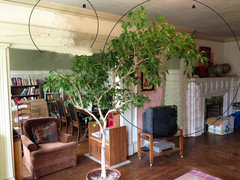
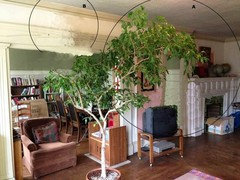
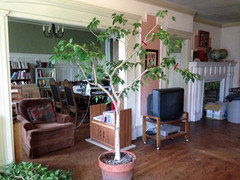
Now that the tree is healthy and happy I want to work on the shape - the previous owner must have had it close to a wall as it's narrow in depth yet wide when turned 90ú. There are a few branches in this wide area that are thick very dominant. I would like to cut these branches back hard and trim a bit from the top 1/3 to promote growth lower in the tree.

I have no idea where to cut these thick branches (marked A in photo). Seems the more I read the more confusing the matter is. I don't want to whack into the trunk at this juncture. I'm including a quote from Al (to andersons), as it seems to describe what I'm thinking of doing (esp the part about strong middle branches).

Somehow the idea of choosing a new leader is difficult to visualize, which is advice received last year. I'd just like to balance the tree better, from 2D to 3D if that makes sense. Photos included to hopefully illustrate situation. Thanks!

'I think you misunderstood about the pruning of the upper part of the tree. That part will always grow strongest, and I wasn't very clear about the 'cutting back to 2 leaves' part. I meant to remove half the branching in the upper 1/3 of the canopy, then reduce the remaining branching (in the upper 1/3 of the canopy) to 2 leaves per branch. The rest of the branches should be left as is unless there are very strong branches in the middle third, in which case you should reduce only those branches & leave the weaker branches untouched for now. If you want to remove lower branches after the tree recovers - feel free. BTW - when pruning containerized trees (as opposed to current practice for trees in the landscape), flush cuts are ok, and sealing them with waterproof wood glue or even Vaseline to keep the cambium from dying back and increasing the wound size speeds healing of major pruning cuts markedly. Also - your cuts will tend to bleed latex, but a quick spritz at the cut site with tap water half a minute after pruning will stop the oozing.

Here is a link that might be useful: Ficus album

This post was edited by Randy_ on Thu, Jul 4, 13 at 1:38

Comments (10)

  • 13 years ago

    When you have a healthy tree, it opens avenues you couldn't have otherwise traveled, so 'way to go'! Now is the best time for repotting if needed, and subsequently pruning - after the plant shows new growth as its evidence it's sufficiently recovery after the root work.

    You only want your tree to have one head. Right now, it has 2 or 3. The apex will be determined by the potting angle (of the trunk) and an imaginary vertical line from where the trunk exits the soil. The apex eventually should be near to straight above the point where the trunk exits the soil.

    Start your pruning by correcting any problem branches - those growing straight up, down, or back toward the center of the plant. Correct crossing branches by retaining the crossing component that best compliments the plants outline & eliminating branches that don't compliment it. Then, determine your apex./ That should be the tallest part of the plant. Other branches should be pruned back to a branch growing horizontal or slanting slightly downward on the lower part of the tree, and horizontal to slightly upward on the middle part of the tree, to slightly upward on the upper part of the tree.

    On the 'B' side, what you have circled should be removed by pruning it back to the lowest horizontal branch that is lowest on the trunk and moves left in the picture. There are actually 2 pruning opportunities for the 'B' foliage mass. Pick the one that looks the best. You should be mainly concerned with making sacrifices in appearance now that promise the best potential for tomorrow's appearance.

    In picture 5, the low branch moving right - the heavy nearly horizontal branch in the background should be removed back to where it joins with the smaller branch (about where it crosses the flutes in the door trim in the background. After that, you'll look for other pruning opportunities in the branches above that leave you with branches oriented as close to horizontal as possible. Roughly, you'll be trying to establish a triangular shaped profile, using the horizontal branches, and with the apex of the triangle as close as possible to directly above where the plant exits the soil.

    You can cut off a LOT right now ..... and that will really make the tree back-bud, which in turn will provide you with more and finer pruning opportunities that will REALLY help you get to the point you're working on FINE refinement instead of establishing rough structure. You really do have a tree with lots of potential to be a very attractive specimen.

    Where do you live?

    Al

  • 13 years ago

    Hi Al and thanks for such a detailed response - it's helping to start to make sense finally. I like to get the picture in my head as best I can first - this direction is just what I was looking for.

    Did a little photoshop as pre-plan to get it in my eyes and will go over your details again for sure another time or two. Think I'm gonna have to do the preliminary clean up before the top part of "A" portion becomes clear, but it seems a lot of that of will go. The key words apex, triangle, and horizontal definitely are informative. Appreciate the encouragement to be bold with it.

    I'm in Boston btw, Brookline to be precise. Again, many thanks:-)

    This post was edited by Randy_ on Thu, Jul 4, 13 at 1:33

  • 13 years ago

    If it was my tree I'd cut everything in the A and B circles off, i.e. in your photoshopped pic, I'd also lop the big branch in circle A off, you could take it back to the point a few inches inside the circle and leave the upward branching stem on, but also prune the outwards spur on that off.

    Oh sod it, here's my MS paint effort with red lines where I'd cut. A picture paints a thousand words!

  • 13 years ago

    Thanks StewartsJon, indeed it does - Happy 4th all!

    Well here's where things stand at the moment. I've stopped to assess things - getting in the ballpark, but I think a little more needs to come off and your areas of suggestion are precisely where I'm mulling about, SJ. Somehow the choices at this juncture have become decidedly less clear though. I've included another set of pics, including another photoshop of where I'm tempted to go.

    The thing hanging me up is Al's description of Apex. Is it ok that the apex of this tree is not as centered over the exit from soil as one might like?

    It looks pretty good in the first pics I think, but as you circle the tree you can see how the tallest branches jut out a bit from center. With all the Y's in the branches, there's little straight up from the trunk (which I think is interesting as heck yet vexes me as it relates to the subject at hand). Many thanks!

    Here is a link that might be useful: Results of pruning

  • 13 years ago

    It's really hard to get a clear picture of what's going on by looking at the plant in 2D. For now, the apex can remain a secondary consideration that's easily remedied as the tree grows. Remember, the plant focuses 2/3 of it's energy in the upper 3rd of the plant, so you'll either be able to guide a branch into the position of apex by tying it off or using soft wire, or more likely, you'll be able to create an apex by selective pruning - by encouraging small branches that are growing into the apex zone and removing branches that compete with the apex or don't fit well into the structural plan you have or are developing for the tree.

    As my bonsai develop, I almost always have a plan in mind when I do my selective pruning, but that doesn't mean that plan will be THE one carried to fruition. Often I change horses in the middle of the stream after some other inspiration nudges out the former idea.

    I think the important part of the exercise is that YOU are assuming control today for how your tree will look in the future. Vision, and by that I mean the ability to look at a plant and KNOW how it's going to develop and KNOW what it's going to look like in a year or two, and taking steps to avoid the potential problems you see or just increase the plant's potential for eye appeal, is a significant milestone in the journey.

    Al

  • 13 years ago

    This beginner thanks you for your insight Al, it really is appreciated:-) Easy to lose sight of the forest sometimes. Thanks again for the detail of your posting.

  • 13 years ago

    Hi Randy!
    Update pictures? I imagine that benji has gone crazy since the last pic.

    Sorry to pester but I'm a curious sort. :)

  • 13 years ago

    Me too, didn't comment here, but on the edge of my virtual seat!

    Love your beautiful old, REAL house, BTW. Man, they don't make 'em like that anymore... and if they do, it's plastic.

  • 10 years ago

    I am seeing beautiful results of the pruned ficus house plant. I should like to caution that as an outdoor plant the ficus will become a tree. A real tree. A really big tree. The root system will become an unbridled garden terrorist lifting walk paths, concrete walls, and threaten foundations. Consult a pro gardener if you are considering planting your ficus outside.

Sponsored
Hope Restoration & General Contracting
Average rating: 4.7 out of 5 stars35 Reviews
Columbus Design-Build, Kitchen & Bath Remodeling, Historic Renovations