Software
Houzz Logo Print
virginiald

Plum Canker?

18 years ago

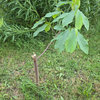
I planted this tree in 2004 (see photos) and this is the first year it is bearing. I bought two trees that were supposed to cross-pollinate, but they bloom three weeks apart so no luck until now, and still nothing on the other tree. Last year I noticed smallish cracked areas on this tree but couldn't identify them - couldn't see any holes, oozing gum or sawdust, so thought probably not borers. This year it is much worse and affects the main trunk as well as most of the branches. In spite of this, it was covered with blossoms and is loaded with fruit even after thinning. My questions are: is this canker, and if so, can I treat it? If not, can I cut the tree down below the canker and expect it to regrow? The area you are looking at is about six vertical inches.

Virginia in Virginia


{{gwi:116697}}

{{gwi:116698}}

Comments (4)

  • 18 years ago

    Virginia:

    I think you may have black knot disease there, which is fungal in origin. Canker is normally caused by a bacterial disease, and seems to produce more oozing at the site of the lesion. But it's a distinction without much difference, since both diseases produce the same result: Progressive weakening and eventual death of the tree.

    Neither of these diseases are "treatable" in the sense that the lesions can be eliminated other than by pruning them out. If there is a solution, it is only partial and preventive, and consists of rigorous dormant spraying with a strong copper compound. I use Kocide for dormant season sprays on all stone fruit trees, and have managed to keep disease at bay for quite a few years, but knock on wood. Luck may play a part too. I am a little surprised that you have such an advanced case on a relatively young tree. Some symptoms may have been evident last season and perhaps even the season before.

    Since this is your first fruit set, you may want to try to squeeze a crop of plums from the tree this season, but if the tree is to have a future you should prune all affected limbs well below the lesions. This may still not cure the black knot, and no one can guarantee you will see regrowth. But with the trees as they are now, you haven't got much to lose.

    Don Yellman, Great Falls, VA

  • 18 years ago

    The photos look like cytospora canker, another fungal disease.
    I don't see black Knot in those two pictures. Black knot forms bulbous black lesions that spread on the upper branches. Black knot needs to be pruned out and sprayed with captan fungicide. Cytospora also needs to get pruned out. For the main trunk cut out the infected bark and it should start to heal over during growing season. Folks should plant more than two trees for cross pollination.

  • 18 years ago

    So whichever it is I've got, I'm doomed, basically! If I wait until after the crop ripens and then prune the upper branches and cut out the infected bark on the main trunk, should I then spray the trunk with a copper fungicide? Is there a danger of its spreading to the other plum tree, about 60 ft away?

    Appreciate your help!

    Virginia in Virginia

  • 18 years ago

    In the growing season the tree will try to wall off a fungal canker infection. The fungus spreads when the tree is emerging from dormancy and cannot fight it. If you cut the infected bark[now] during the growing season, it will begin to heal. Next spring determine if the surgery stopped the infection. If the infection has spread, time to remove the tree.