Software
Houzz Logo Print
ronalawn82

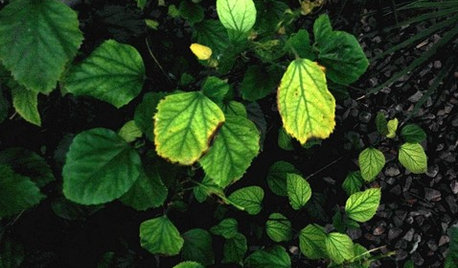
Yellowing pattern on leaves

18 years ago

I have observed a pattern of yellowing which starts at either margin of the leaf and works its way across the leaf to the other margin. My feeling is that this is significant but I cannot find out why. The plant is Aspidistra (in a bright location in a hardware store) and neither moisture nor nutrition appears to be the cause. Does anyone have an explanation of what might be happening?

Thanks in advance

Comments (17)

  • 18 years ago
    last modified: 11 years ago

    If the plant isn't horribly potbound, the problem is almost surely rooted in a moisture problem or nutrition - probably both, as they are usually inextricably entwined in problem plants.

    If the soil has collapsed (broken down into very small particles) the soil could be holding too much water and not enough air for too long. This would mean the bottom reaches of the container are staying soggy and rotting roots, making water uptake difficult.

    If you repotted recently, and an examination of the roots reveals no rot issues, you should suspect a salt build-up in the soil from watering habits and/or accumulation of fertilizer salts and the dissolved solids in irrigation water. As these salts increase in concentration, it becomes increasingly difficult for the plant to take up water, and what you describe is the result.

    I'll link you to a thread that talks a little about the reasons for necrotic leaf margins and tip burn. I hope you find something that sounds familiar there.

    Al

  • 18 years ago
    last modified: 11 years ago

    My reference book suggests that yellowing of leaves will happen when temperatures go below 50F. Unlikely in your location, but perhaps. Also, "lack of magnesium appears as broad, marginal yellowing in the older foliage," and Aspidistra has a high magnesium requirement in general.

    That said, Aspidistra slows down a lot this time of year, and needs a lot less frequent watering: if your watering habits haven't changed with the season, it really could just be overwatering. I would:

    1) Check the roots to make sure they're healthy. Basically what Al said -- replace soil if needed: especially this time of year, they need to be able to dry out quickly, so a clay pot might not be out of the question either, if it's not in one already.
    2) Flush with a lot of water at the next watering, if soil wasn't changed.
    3) Add some Epsom salt (1/2 tsp / gal) to the water during the watering after that.

  • 18 years ago
    last modified: 11 years ago

    About the Epsom salts:

    The 1/2 tsp per gallon dosage will add 547 ppm (parts per million) of dissolved solids. If we conservatively allow 100 ppm for the dissolved solids in the irrigation water, we're now up to about 650 ppm to deliver only magnesium.

    I realize we cannot measure this ourselves, but soil solutions for houseplants, in winter, should have only about 800 ppm dissolved solids, total - this level, to facilitate water uptake. Even if we do not consider the dissolved solids already accumulated in soils, Ron would only be able to afford all the other nutrients at a rate of 150 ppm (a little over 1/10 tsp/gallon) before it begins to impact plant hydration noticeably.

    Additionally, Mg and Ca must be present in soils in a favorable ratio because they are mutually antagonistic, and a surplus of one affects the uptake of the other. There should be about 4 times more Ca in soils than Mg. If you add 547 ppm of Mg, you would need to add about 2,200 ppm of Ca, and you cannot do it - it would kill the plant.

    So, the Mg dose of 1/2 tsp per gallon virtually guarantees a Ca:Mg imbalance, other nutritional deficiencies, and probably a degree of plasmolysis (difficulty taking up water) that will increase as normal doses of fertilizer are included in the supplementation program.

    Just my thoughts ....

    Al

  • 18 years ago
    last modified: 11 years ago

    Point taken, but -- most of this runs back out of the pot in the drainage water anyway, no?

  • 18 years ago
    last modified: 11 years ago

    We're talking concentration. I get it.

    Still, though: this wasn't just me making up an amount; this is how much actual growers apparently actually add every three months, according to my growers' guide. Why would that concentration be okay for growers to add and not okay for an indoor container plant?

  • 18 years ago
    last modified: 11 years ago

    The concentration of fertilizer in the soil solution that a plant can tolerate depends on several things. Light levels are key, humidity and where the plant is in the growth cycle are also very important. When transpiration levels are high, with good light, humidity, and growth rate, a plant that prefer/tolerate 2,000 ppm of dissolved solids instead of the 100-800 (actual, not solution strength) it prefers when it's resting.

    We're also not considering that in greenhouse conditions, growers are watering properly and flushing salts from soils continuously, so salt accumulation is not the problem it is in our dry homes. That humidity levels in greenhouses are normally more than twice that in homes also impacts the o/a picture (less evaporative loss means fewer dissolved solids precipitate left behind).

    Finally, you're thinking that Mg in the range of 550 ppm is ok for growers. I believe you will never find those concentrations of Mg in fertigation practice. As noted above, in order to balance the Ca:Mg ratio, you'd also have to add 2,200 ppm to balance the equation and still have to supply all the other nutrients on top of that. N alone, should be present in solution at approx 7-10 x the level of Mg. Now, to balance Mg with N, we need to add 24,000 ppm of N, which would immediately fry plants.

    You said: Add some Epsom salt (1/2 tsp / gal) to the water during the watering after that. which lead me to believe you meant at every watering; but, even if you add it every three months, you STILL need to include an appropriate amount of Ca at each watering and that sends TDS through the roof.

    If you were using 20-20-20 fertilizer at 1/4 tsp per gallon at each watering, it would yield 150 ppm + all the other nutrients + TDS in the water, or a total of around 300 ppm (of which 50 ppm would be N. This is very good, if not a little high for most winter maintenance. If Mg is added to this solution as a function of its presence in plant tissue as compared to N (how fertigation solution strengths are calculated), the Mg component of the solution should be only 5-7 ppm, which translates to less than 1/100 tsp/gallon.

    Al

  • 18 years ago
    last modified: 11 years ago

    Typo correction, 1st paragraph above: When transpiration levels are high, with good light, humidity, and growth rate, a plant could possibly tolerate, even prefer 2,000 ppm of dissolved solids instead of the 100-800 (actual, not solution strength) it prefers when it's resting.

    Sorry

    Al

  • 18 years ago
    last modified: 11 years ago

    I meant just for the one watering, after the soil was flushed: "every three months" is the recommendation from the book. The full quote is,

    "Keep the soil barely moist and irrigate conservatively, especially in winter. Feed with a teaspoon of soluble 20-20-20 and one-half teaspoon Epsom salts per gallon (3.8 L) about every three months."

    Swear to God. That's what it says right there in the book. When I posted that earlier, I thought this was from the greenhouse production part of the text, but in context, no, he means it for indoor growth. And you know how people aren't allowed to publish stuff that's not true, so.

    -

    ronalawn82: are we making the situation more confusing? Have we hijacked your thread? Should we move this to e-mail?

  • 18 years ago
    last modified: 11 years ago

    You can research your own answer by going to the production part of the text and reviewing what the most favorable fertilizer concentration is. You'll probably find it is in the 800-1,200 ppm range for most plants that are growing well under favorable conditions. 1 tsp of 20-20-20 + .5 tsp MgSO4 + 1 gallon distilled water yields a 1,146 ppm solution before you add in irrigation water dissolved solids, the other nutrients in the fertilizer, and residual salts in the soil. You should top out around 2,000 ppm, which is extremely high.

    Additionally, fertigation formulas are calculated as a % of N, and at 199 ppm N, and 547 ppm Mg, the blend will have 29 times more Mg than it can use.

    Here are the ranges in which plants use nutrients, relative to N. N, because it's the largest nutrient component, is given the value of 100. Other nutrients are listed as a weight percentage of N. Note that Mg is used at a rate of 5-15% that of N. Your blend has about 1/3 tsp N and 1/2 tsp Mg - a very large imbalance that is certain to affect water and Ca uptake. Mg should be about 1/30 tsp. Prosecution rests. ;o)

    N 100
    P 13-19
    K 45-80
    S 6-9
    Mg 5-15
    Ca 5-15
    Fe 0.7
    Mn 0.4
    B(oron) 0.2
    Zn 0.06
    Cu 0.03
    Cl 0.03
    M(olybden) 0.003

    Al

  • 18 years ago
    last modified: 11 years ago

    "Well-drained, peat-based mixes are common, as are slow-release, coated fertilizers with a 3-1-2 or similar ratio of N-P2O5-K2O."

    Which I gather would mean something like a 20-10-15 (the numbers come out 20-7-13, but close enough). Alas, Aspidistra is in the "other foliage varieties" part of the text, so that's as specific as it gets.

    I don't actually doubt you here, Al (which hopefully was clear anyway); I'm just trying to figure out a way that it makes sense that his recommendations and yours are so far removed from one another. Is the Ca:Mg balance really that critical and easily thrown off? In the Epsom salts thread, way back when, I couldn't find anything much suggesting that over-magnesiizing (to coin a word) was that harmful: I follow that soluble salts of any kind are going to alter osmotic pressure and everything, so it's a problem to have too much of anything, even something relatively harmless, but does something as soluble as MgSO4 even count? I don't know about other people, but I come pretty close to flushing all my plants every time I water anyway, just from the way I do it, so wouldn't excess magnesium wash out after one application (at least for me) anyway? 'Cause, okay, you're no fool,* but the guy who wrote the book doesn't seem to be an idiot either.

    (Maybe it's not fair to ask you to explain him, but he's not here, and you are, so you see my problem.)

    *No, really. I know this.

  • 18 years ago
    last modified: 11 years ago

    I'm just trying to figure out a way that it makes sense that his recommendations and yours are so far removed from one another.

    It's not unusual for me to run across a dozen statements or ideas in books and magazine every week that could never hold up under scrutiny. In this case, I know what the writers intent was, but what he suggests is rather foolish, based on the hard numbers.

    Production fertigation programs are based on the individual plants being fertilized, but will be devised based on tissue analysis and a chart which will fall within the range of the one above. I have a dozen texts that show a similar chart, and there is no variance in it. All mention that the most favorable Ca:Mg ratio is about 4:1.

    Plants use 7-20 more times N than Mg. If we can establish that as a given, we can also agree that when we supply Mg at rates as high as 1-1/2 the rate of N, it's a waste at best because the plant can never use it in that volume. It is simply unnecessary ions raising the TDS level and making water and nutrients harder to absorb.

    Is the Ca:Mg balance really that critical and easily thrown off?

    If you agree there is a ratio that needs to be maintained in the favorable range, then yes, of course it is easy to throw off. Adding one without the other (and in the favorable ratio) must upset the balance (unless it's added as a corrective measure), which creates a deficiency.

    ... but does something as soluble as MgSO4 even count?

    Yes, anything soluble counts. If you spilled lemonade in a container, anything soluble (sugar, citric acid, etc) would add to the number of ppm of dissolved solids. Adding MgSO4 to soil solutions yields approximately the same increase in dissolved solids as table salt.

    First, we need to determine that there is indeed a Mg deficiency. Likely, if dolomitic lime was included in the soil as a pH adjuster, there isn't. But let's say we made our own soil and left lime out. It's still foolish to add Mg to soils w/o adding Ca, so we should simply add both in the form of dolomitic lime. The only time that would not hold true, is if our media pH was already high and we had to use gypsum as a Ca source to prevent the upward movement of pH. THEN, we could add small amounts of MgSO4 on a regular basis to maintain a favorable ratio and as a source of Mg.

    In my estimation, the author you refer to failed by suggesting such a large dose, hoping the effect on plants would not do severe damage, and by not considering the fact that if a container soil needs Mg, it almost always needs Ca, because they are normally initially incorporated in container media in the way of dolomite. I cannot fathom why anyone would suggest such a large and out of balance dose unless he was unaware of how it would affect soil chemistry. More appropriate would be something like 1/16 tsp per gallon at each fertilizing if a true deficiency is known, or the plant is known to be one that uses Mg heavily.

    Three texts I rely on heavily to confirm what I'm saying on the forums are "Water, Media, and Nutrition for Greenhouse Crops", "Growing Media for Ornamental Plants and Turf", and "Plant Production in Containers II". I consulted all three texts on this subject and they all confirm my assertions.

    Al

  • 18 years ago
    last modified: 11 years ago

    Much clearer. Thank you for explaining. I've written down the book titles: I'll be trying to buy some of them, or at least get an interlibrary loan or something.

  • 18 years ago
    last modified: 11 years ago

    You may be able to get one or more of those above through Ball Publishing. I have 'Water, Media, and Nutrition for Greenhouse Crops' in front of me now, and it came from them. It's prolly the best AND the easiest read - these are all very technical texts.

    Here's the info on a few good ones in addition to above

    David Wm. Reed. 1996. Water, Media and Nutrition for Greenhouse Crops. Ball Publishing, Batavia, IL, ISBN: 1-883052-12-2.

    Paul V. Nelson. 1998. Greenhouse Operation and Management. Prentice-Hall, Inc., Upper Saddle River, NJ, ISBN: 0-13-374687-9.

    Thomas C. Weiler and Marty Sailus. 1996. Water and Nutrient Management for Greenhouses. Northeast Regional Agricultural Engineering Service, Ithaca, NY, NRAES-56.


    Al

  • 18 years ago
    last modified: 11 years ago

    mr subjunctive/talpa, confused a bit but in positive manner. I am digesting all this information in small bites.
    But to return to that Aspidistra. The plant is in a 7 gallon container which itself is set in a large planter filled with gravel. I have acquired a probe which helps me to compare the moisture content at 6" intervals inside the 7 gallon container. It is not unduly moist; indeed the soil is 'powdery dry' in the top 6" before I add any water. I would say it requires about a quart of water every 2 weeks. The plant is quite healthy otherwise. The leaves are a glossy green and all are quite erect. They do not bend or droop half way along the blade and at one time I was thinking that this itself might be a symptom of a disorder! I have since been looking at Aspidistra in the landscape and found the yellowing pattern here and there. Sometimes it is from the left margin, other times it is from the right. Incidentally, the specific indication of magnesium deficiency for me is the darker triangle near the base of the leaf. Is there another symptom, perhaps peculiar to this plant, that is more definitive?
    I am still at the section where ppm of total soluble solids was discussed and I wondered whether the soil was being ignored. Surely the soil particles would absorb, adsorb, or react with the minerals thereby removing them from the soil water and thus reducing the ppm of total soluble solids. My thoughts stem from the idea that element fixation occurs in the soil in agricultural activities. Those elements have to come from somewhere.

  • 18 years ago
    last modified: 11 years ago

    tapla, sorry for the misspelling. Could be for any or all of the following.
    I could be dyslexic.
    I confuse Los Angeles with Pennsylvania.
    I was not born in these parts.

  • 18 years ago
    last modified: 11 years ago

    Happy Thanksgiving, Ron.

    If you're using a moisture meter/probe to test moisture levels, it's not accurate. They don't measure moisture levels, they measure electrical conductivity. To test this, dip the probe in a glass of deionized (distilled) water. You'll see that it reads 'DRY' because there are, of course, no ions to conduct electricity in deionized water. ;o)

    You said: "I would say it requires about a quart of water every 2 weeks."

    I think this statement likely reveals the problem. There is no way that you can be flushing the soil when you water by adding a quart of water every other week. This means that every bit of dissolved solids from irrigation water and fertilizer salts is accumulating in the soil.

    "I am still at the section where ppm of total soluble solids was discussed and I wondered whether the soil was being ignored."

    I'll never ignore the soil in any discussion about a plant in trouble. It's always the first thing I suspect. ;o)

    In my estimation, if you cannot water copiously, so that at least 10-15% of the total volume of water supplied exits the drain hole, the soil is inappropriate and will eventually cause increasing degrees of drought stress. It's that simple, it will happen eventually in every case unless you bite the bullet & take the risk of flushing the soil thoroughly, periodically (at least once per month).

    "Surely the soil particles would absorb, adsorb, or react with the minerals thereby removing them from the soil water and thus reducing the ppm of total soluble solids."

    This is a major error in thinking. Soluble salts are just that - soluble. They are not neutralized in soil, nor are they absorbed, except to the extent that soils temporarily hold water and dissolved solids in the smaller soil openings and the 'holes' in soil particles (these are micropores) until the solution is used or the water evaporates & leaves the solids behind in the soil. Unless they are used by the plant to build tissue or create photosynthate, all nutrients, salts, and any other dissolved solids applied will accumulate in soils, or unless you and I flush them out periodically.

    You mentioned agricultural situations. They are very little like growing in containers. Just as much of what works in the garden is useless in container culture, so are agronomic practices, Farmers test the soil and chemically supplement the nutrients needed because the soil content of these nutrients varies widely, AND, they are expensive, both to buy AND apply. Most farmland is more than 98% mineral content, while the soils you grow in, in containers, is likely 90-95% organic. How can we compare them? Container culture is much closer to hydroponics than it is to growing in the earth.

    It's possible you really do have an Mg deficiency, but if you do, it's because all the limestone in the soil you're using is depleted (or was never there to begin with. If this is true (limestone is added primarily as a Ca supplement) you also (almost certainly) have a Ca deficiency because they're both supplied in the lime. To add Mg w/o Ca will exacerbate the Ca deficiency. To correct the deficiency, you should add a couple of tsp of dolomitic (garden) lime to the soil, which supplies Ca and Mg in roughly the proper proportions.

    Does this help, or raise even more questions?

    Al

  • 18 years ago
    last modified: 11 years ago

    tapla, the probe referred to is an aluminium rod with recesses at regular intevals; it is pushed into the pot, twisted a little and withdrawn. The bits of medium trapped in these little niches are checked (rolled between thumb and index finger) to judge the m.c. at different depths. Water is then applied with consideration to species, light intensity and one's own experience. The objective, I imagine, is to water enough so that the top 6" dries out and the bottom 6" is just 'damp' before water is again applied.
    But to revert to the solutes in irrigation water; you tax my memory and send vibrations into the foundations of my knowledge. Determinations like Electrical Conductivity and Cation Exchange Capacity must be relevant to the Container and Hydroponic industries as they are to commercial land preparation and crop fertilization. So now I must find out further about all of this.
    It illustrates that knowledge defies mathematics in that the more it is divided, the more it is multiplied.