

Problem with pandanus
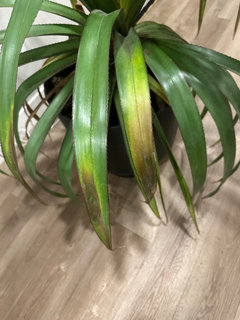
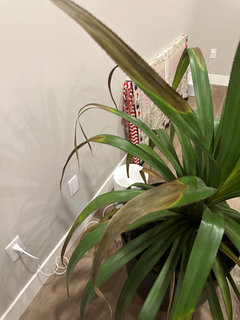
Not sure if this is the best forum to post this question, but here goes: I have a large (for a houseplant) pandanus. I have no idea what kind but perhaps Pandanus amaryllifolius? It has been going gangbusters, with occasional browning of tips here and there. But all of a sudden, I am getting significant browning/death of leaves, all over the plant. Nothing in terms of light or watering habits or anything else has changed. I will post a few pictures below. The leaves (aside from being a bit dusty ... which I'm sure doesn't help but I can't imagine is causing a problem of this severity) look perfectly normal about 1/3 to 1/2 way out. Then they shrivel and die. They're positively crisp. Any ideas what might be going on and what I can do? I inherited this plant from my daughter, who was given it a few years ago by her landlord. It has doubled in size since I've had it and has a lot of new inner "babies" ... more on the way, so it's growing....
{{gwi:112505}}
{{gwi:112506}}
{{gwi:112507}}
Comments (25)
 16 years agolast modified: 11 years ago
You mention that watering habits haven't changed, but your plants water requirements have (as light levels diminish). The symptoms are consistent with one or more of over-watering, under-watering, or a high level of salts in the soil from fertilizer and tap water. Are you convinced there is no chance that you're over-watering? If you can eliminate that as a cause, and you've been fertilizing regularly, that leaves salt levels in the soil as a likely candidate.
What have you been using for fertilizer? how often? full recommended strength?
How long since the last repot?
When you water, are you watering copiously so that you're flushing the soil every time you water?
Al

ctlady_gw
Original Author16 years agolast modified: 11 years agoWow... good questions. Most important, no, I haven't ever watered enough to flush the soil. And I usually use Miracle Gro (just diluted in the watering can, when I'm watering all the plants, which is how I've always done it -- not every watering, but probably every other time there's fertilizer),
I'll try flushing the soil well, and cutting back on the watering. I usually let this plant dry out completely between waterings -- should I? (It was repotted early last year -- about a year and a half ago -- it was in a VERY small pot when I got it, and it was suggested to repot in a larger pot, which I did. It grew a great deal after that and aside from much more evidence of a bi-colored foliage (some leaves almost totally white, others totally green, some half and half), it has looked terrific.
Should I cut the half dead leaves off at the plant base or let them wither the rest of the way naturally?
How often should I be watering this plant? It's in a northern window (one of my few windows with real sunlight) and has been for several years (same window).
Thanks so much for the leads ... beyond flushing the soil (each time I water?) and perhaps less fertilizer less often, anything else I should be doing?
Related Professionals
Alexandria Landscape Architects & Landscape Designers · Elizabeth City Landscape Architects & Landscape Designers · Virginia Beach Landscape Architects & Landscape Designers · Wausau Landscape Architects & Landscape Designers · Vincennes Landscape Contractors · Annapolis Landscape Contractors · Parkersburg Landscape Contractors · Auburn Landscape Contractors · Dubuque Landscape Contractors · Baton Rouge Interior Designers & Decorators · Toms River Interior Designers & Decorators · Davenport Interior Designers & Decorators · Oshkosh Interior Designers & Decorators · Lancaster Interior Designers & Decorators · Dodge City Interior Designers & Decorators- 16 years agolast modified: 11 years ago
I don't think you should let it dry out completely, but you should wait until the soil feels dry at the drain hole before you water.
If you're not flushing the soil every time you water, or at least periodically, you're allowing salt from fertilizers and tap water to accumulate in the soil. The salt has considerable impact on how easy it is for the plant to take up water. As the salt level increases, it gets harder and harder. Now, add in the fact that you're heating the house and transpiration is occurring at a more rapid rate (lower humidity) and you have the plant being unable to move water to the top fast enough to replace whats lost - thus, necrotic tips and margins.
I can't tell you how often to water, but I did leave a guideline above. I can say though, that plants are better watered on an 'as needed' basis, rather than on a schedule.
No harm in cutting the dead parts of the leaf off. Cutting the whole leaf will remove some photosynthesizing surface, which will slightly affect the plant's ability to make food, but it's sort of up to you if you want to look at half-leaves. ;o) It won't kill the plant if you remove them by cutting through them at the stem.
Is there any more you should know? Oh my. Sure there is. The more you know the easier growing becomes, and of course, the more proficient you become at it. If I was limited to offering you only one tip, it would be to learn about good soils. It makes more difference (except for maybe light) in your ability to grow nice plants than any other singular factor.
Al
- 16 years agolast modified: 11 years ago
Hi CTLady. In 1994, my brother gave me a cutting of his MIL's plant which happened to be the same as yours.
Since the plant came from Poland, no ID, it's coined the Polish Plant. :)To this day I wonder if it's a true Pandanus..You'll discover, once yours grows 5' and taller, it grows vine-like and needs staking.
A recent pic of my Pandanus??
{{gwi:112508}}Now here's a pic of Pandanus/Screw Pine bought at HD in 1999 as a baby..The pic was taken this past summer.
The latter Pandanus has grown top heavy, which is the reason it's leaning.
Anyway, like I said, I was unsure whether or not the plant, similar to yours, 'white leaves' is Pandanus.. Pans are succulent, whereas the one you and I have requires a lot more water, and less sun..
My brother's MIL, (the woman who had the mom plant) 20 yrs +, gave this beauty to my brother and her daughter when they married.
It sat in her kitchen corner, the nearest window 15-20', a porch in-between the plant and window..East Windows to boot..lolLast, here is a pic of my brothers plant, (the mom plant) taken last winter. Sorry, it's somewhat dark.
Cut the brown tips off, but leave about 1/8th" of the brown on..sometimes when all brown, cut into the green, it grows back..It's a good idea to use water that's been sitting out overnight.
Let soil dry between waterings, especially during winter months, but water throughly when you do.
BTW, how tall is yours? Toni ctlady_gw
Original Author16 years agolast modified: 11 years agoHi Toni,
Mine looks a LOT like your first picture -- some of the leaves are pure white, some are all green, some are part white, part green. It's about 3-4 feet tall and has already needed staking. I'm curious... what happens to those air roots when it gets bigger and begins to "vine" like yours? I was trying to keep it upright (hence the staking) because I thought it was supposed to stay "propped" above the air roots...
It is a curious plant. Not one to move around casually with those serrated leaves! I did cut the leaves back per Al's suggestion above. It looks a lot better already. I think I need to water less often and more heavily -- I'm going to try that this winter and see how it responds. Will try letting the water sit, too (does that allow minerals, salts, etc. to settle or what?) It's planted in a soil mix (which includes sand and perlite) that was recommended for it by someone on this forum last year.
I am also curious ... when I got the plant, it was all green. Not as big but all green. The white leaves have developed in the past 18 months or so, as it really began to grow. But a few of the "babies" I've pulled off and planted have been basically ALL white. What causes the coloration differences?
- 16 years agolast modified: 11 years ago
Howdy Ctlady,
Exactly..our plants look alike. Where did you hear it called Pandanus? Was it sold as Pandanus?
The reason I ask is, I've been trying to find an ID since 1994. Even here on GW.
Other than your thread I never saw our plants posted, anywhere.The last photo is a picture of my brothers' plant. The first picture is mine, a cutting taken from my brothers plant..follow me? lol.
My brothers plant has a lot of white, too, but it's hard to see..maybe because the room was dark when pic was taken.
To answer your first question. The air roots seek soil and/or something to cling to. At least that's what mine seems to do as they mature. I am curious what the plant would look like if I hadn't taken so many cuttings over the years..
Air roots will wrap around the stake or if left to grow freely, just hang or possibly fall..air roots get heavy.Yep, water thoroughly,(until water seeps from drainage holes) then let soil dry before giving another drink. Most plants 'soil' should be allowed to dry between waterings.
Leaf edges can prick skin..They catch onto clothes just walking by..lol. Be careful when carrying around..even the tips are sharp.
One thing, Pandanus or not, even though leaf edges snare, there's no comparison to other Pandanus types.
I started keeping containers of water for two reasons. One was so chlorine evaporates, and second, sitting water is room temperature.Potting in a completely soil-less mix, (depending on room temp, humidity, container material and size) makes a difference how often a plant needs watering.
Testing soil is fairly simple..insert a finger deep in the soil. If it comes out wet/moist, wait a few days and retest.. If dry, then give a drink. Simiar to testing a cake/pie, with tooth-pick..if you're into baking..lol.Coarse sand and Perlite is fine. Did you mean to say, there's house plant soil in your mix, too, or just sand and Perlite?
As for leaf color, I haven't an answer. I've experiemented over the years..full sun, medium and a light-shade..leaves had more white in less sun..too much sun and tips started browing. BTW, I'm talking about direct, 'summer' sun. In winter, mine is placed in the sunniest window. Sometimes it is summered outside, in a shady spot.
This plant adapts to various light conditions, except harsh, direct south or west summer sun.I'm still not totally convinced our plants are Pandanus..Maybe we've acquired some extremely rare species..lol.
There are several reasons I doubt our plants are Pandanus; two major reasons..One: Pandanus are semi-slow-growing..this plant grows fast. Two: It requires more water than standard Pandanus. If soil dries too much, leaf tips turn crispy brown.
How long have you had yours? What size pot was it in when you got it and what size is it in now? How much light does it get year round?
Whatever, good luck..it's really a wonderful plant..If you don't remove off-shoots, you will notice a huge differece in growth rate and looks..Toni ctlady_gw
Original Author16 years agolast modified: 11 years agoHi Toni,
Thanks for the long response! I'm pretty sure my plant is some form of Pandanus for two reasons: one, I posted a photo and description of it on ... Gardenweb! ... when I first got it, plus I'd looked it up based on its characteristics (serrated leaves, palm-like growth, air roots, etc.) But more importantly, a friend of mine was in the Peace Corps in Kiribati (Western Pacific) and she recognized it right away. The natives there (where I assume they are much bigger) use the leaves to weave mats and other things. She recognized the leaves right away, serrated edges and all (yes, they DO catch on clothes, curtains, dogs... you name it!)
So I'm pretty sure it's a pandanus, but have no idea which variety -- and there are lots. Some get reddish leaves in lots of sun (apparently), or red streaks. Mine was all green when I got it (it was a nice size, maybe 18 in - 2 ft tall but in a WAY too small pot at the time). It belonged to my daughter's landlady and when she moved out, she gave it to my daughter but said she didn't know what it was. So I had to research it. The white has developed gradually, starting with some tips, then spreading down leaves, then I started getting babies that were all white. Now all the new growth out of the top center is always white, but seems to turn green over time. Weird and weirder. It is a most unique plant and I do enjoy it.
Can't recall but I think the advice (again, from GW) when I repotted it to the pot it's now in was to use a cactus mix. So I bought that, but ended up adding more sand and perlite and some good potting soil because I didn't have enough of the cactus mix. I have no idea if that's what it should have, but I know in the Pacific, they grow in very sandy conditions.
They supposedly have fruit as well, but I've never seen anything close to that. Maybe one needs a pollinator?
The other thing I noticed as it's gotten bigger is that the little baby shoots that were popping up around the very bottom (and I was removing them and potting them up) starting coming in ABOVE the lower circles of leaves, partway up the main stem. Gives the plant a much fuller look but it's harder to remove the babies.
I wonder if we should post these questions to the tropical plants forum ... ?
- 16 years agolast modified: 11 years ago
CTL - Just a quick note. Sand mixed with potting soil is not a good choice at all for your plant. If you do use sand, it needs to be VERY coarse, much coarser than playground or builders sand and much coarser than what most people refer to sand - more like fine gravel or 1/2 BB size or larger. Most problems, including the one you pictured, can be most often be traced directly back to the soil the plant is in.
Sand, mixed with potting soil forms an extremely water-retentive mix that is very difficult to manage properly.
Al
- 10 years ago
Firefly, what you're referring to is Pandanus amaryllifolius, it's one of several hundred species of Pandanus. Most don't have a fragrance. Many of them are called Pandans, or Screw Pines. Some are called Bush Breadfruit because the fruits resemble breadfruit. I grow P. amaryllifolius plus about 7 other species of Pandanus, they're an interesting group of plants.
- 10 years ago
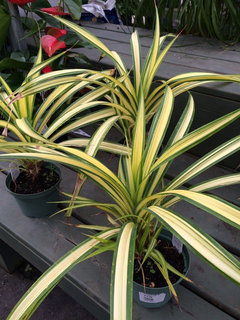
Pandanus USED to much more available in the trade. The species mostly sold was Pandanus veitchii (the one with cream variegation). That is the one in the first picture. Now, they seem virtually impossible to obtain. They are easy indoors as long as they get decent light, and well-drained soil. Also, easy to propagate from suckers. They want to eventually lift themselves out of the pot on their stilt roots (so they do get top heavy). A lot of people get degrees of dermatitis from touching the serrated leaves, and I wonder if that's why they seem to have disappeared from the market. Some species are not serrated but P. veitchii is. If anyone knows a source for that species, kindly let me know.
- 10 years ago
I found this one in a local nursery this week. It doesn't have the serrations so it's a little more friendly. I couldn't decide whether to buy it or not. Has anyone grown one like this?
- 10 years ago
I have that one. One of them grew into a clump of about a dozen plants with one of those reverting to complete green. The rest are still all variegated. I tried to find the ID and was told it was Pandanus sanderi. However, that is a synonym of Pandanus tectorius. But it's nothing like your average Pandanus tectorius which is relatively common and grows into a large all green plant along coastlines.
- 10 years ago
Thanks tropicbreeze. After giving this some thought, I think it's wise to pass on this one. I am imagining that it would take over and I would have to add a room on the house. They would be wonderful outside in a tropical climate.
- 10 years ago
I've got 2 clumps that started off as single pups given to me by a friend. They're beyond pot size now and still have a lot of growing to do.
- 8 years ago
Yesterday. It's sensitive to cold wet soils. This plant stood 33f with no protection also. Its potted and about a 2 year old cutting. Its supposed to be not hardy in my climate..but its holding up.

- 3 years agolast modified: 3 years ago
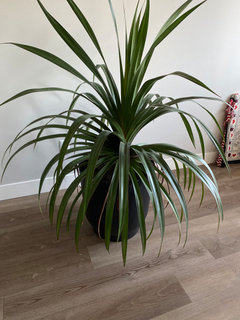
Mine has brown tips but overall it seems pretty healthy?
- 3 years ago
Usually that's lack of water in summer and in winter it's the colder temps.
- 3 years ago
Put it on a saucer or better a tray with water always in it...just not too deep. Not much else to do indoors for low humidity unless you use a humidifier.
- 3 years agolast modified: 3 years ago
Here's mine from the other day...keeping it watered in California ain't easy..
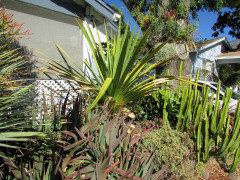
Yours Hue looks fine to me..just boost the humidity a bit.
- 3 years ago
I did an experiment several years ago to see how effective a humidity tray might be. I'll share my results and anyone considering using one can decide whether or not it's likely to be useful.
I had a small tree in a 6 x 9 pot and figured it needed more humidity. I bought a 9 x 15 humidity tray, added enough washed peastone to almost cover the bottom, then nestled 4 medicine bottle caps into the stone to position the plant on, thereby preventing a pathway through which the water in the tray could make way back into the grow medium. when I was done, there was a layer of peastone that fully covered the bottom of the pot, with enough water to cover 1/3 - 1/2 of the larger stones. I was sure to see the capillary pull of the stones was enough to ensure the stones were entirely wet, which increased the wet surface area from which water could evaporate by a factor of at least 2-3X. Once situated, I wedged a digital hygrometer in the branches. After taking readings for 2 days, the highest RH reading above ambient levels was only .4% (4/10 of 1%) greater. Since the level of RH in the room in the mid to upper 20s, the air was nowhere near the point where evaporation would be expected to be low due to air saturation, just the opposite. Also, some of that .4% increase in RH would have been due to normal transpirational water loss through foliage. Oh - we have hot water heat, not forced air, so air movement was limited to normal convective currents, which would tend to better hold any humidity gained from the tray nearer the plants. I decided that a .4% increase wasn't worth the effort and scrapped that idea.
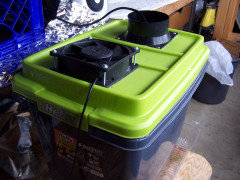
Now, if you had say 20 humidity trays, it might make some difference, but a humidifier is indeed the way to go. I make my own from a few fairly inexpensive parts and they work extremely well. A, tub for a reservoir, small static fan, and an ultrasonic fogger/ mist maker is all that's needed, though you can by devices that allow you to adjust the volume of water put into the air, fan speed, and the humidity levels/ parameters.
Al

firefly_425