Software
Houzz Logo Print
nomorenicksleft

Cherry and apple, for lumber.

18 years ago

This may be a little strange, but I'm interested in the idea of growing bother of these for what would eventually become lumber (though, not before I retire, I suppose). It wouldn't be any great quantity, I'll never be a commercial tree farmer. But if I put out 3 or 4 each of these every year, maybe my children might use the stuff.

What varieties are best for this purpose? Does anyone have any suggestions on this? I'd prefer to grow from seeds, rather than buy saplings from the nursery. Also, though I am in Atlanta at the moment, I'll probably be moving to the midwest sometime in the next couple of years, not sure where (zone 7-8ish). Think of the present as being more of a practice time.

Comments (16)

  • 18 years ago

    nickels,

    cherry and apple sure is purty wood.

    BUT

    for a lumber crop go with black walnut. not only does a huge tree provide a nice veneer on top, but a stump and root system that makes incredibly beautiful gunstocks,furniture , etc.

    thousand on top,10's of thousands below.

    mark my words !

    regards,
    wildlifeman

  • 18 years ago

    My wife and I are doing something similar to you on a piece of land we purchased. We're planting trees for our kids to harvest when the trees are of sufficient size. We're planting White Oak, Red Oak, Wild Cherry, Black Walnut, Hickory, Hybrid Chestnut(American x Chinese), Poplar and Ash. Wild cherry is the primary cherry used for lumber. Your trees will do best for timber purposes planted around other trees to make them grow up and not out. Otherwise you will have a shorter rounder tree that won't produce as much lumber. If you don't have any trees around to plant them between, plant them about 8 feet apart in the row and 12 feet between rows. As far as apple goes, I'd say get some antonovka rootstocks. It will produce a full size tree and it produces a decent yellow apple if nothing is grafted onto it. If you plant a good mix of tree varieties it will also benefit the wildlife in the area. I planted nut trees for personal and wildlife use along with other trees that worth a fair amount sawn. Poplar is fairly expensive even though it is a common wood because it can be stained to look almost exactly like cherry or walnut and it is softer than both which makes it easier to work with. I'm not sure if Sycamore grows in GA but if it does it makes the most beautiful lumber when quartersawn. It looks a lot like flamed Paulownia or curly maple. Speaking of that, Paulownia would be a quick cash crop. Trees are ready to harvest in about 15 to 18 years and sell for a pretty good chunk of change. Email me if you need any more information. I used to cruise timber for my uncle before he retired and have a decent amount of experience with tree farming.

    Paul

  • 18 years ago

    Thank you Paul and wildlifeman. I do intend to plant black walnut as well, though I believe even when we buy our new home that we'll be too far south for it to do as well as it might. But walnut's easy, 5 seconds of googling will tell you what seeds you need (just black walnut, there aren't that many varieties, and none that are native).

    White oak and red oak, again, it was fairly easy to determine what I needed there. I've also been looking at chestnut, but it seems that it hasn't done all that well in over a century... I had heard of dutch elm disease, but didn't know that a similar plague had affected chestnuts. I will be sure to look up the hybrids, chestnut is supposedly really nice for lumber, even if we only have the reclaimed stuff anymore (I don't think I've ever seen it). And the nuts would be nice as well.

    Hickory is another one... I just don't know what type might be best, seems there are alot of them. And is the lumber good for more than just axe handles and such?

    I've got a few different types of ash on my list of seeds to get, though I don't remember which types at the moment. A friend said that guitar makers tend to favor green/swamp ash, so I put that down. Think White Ash was the other. And, as for poplar, are you planting poplar proper, or "tulip" poplar? I think that's the one I put down on my list.

    I've also got some boring ones, a few pines. Oh, and cedar!

    As for the maple, wikipedia (not the best resource, I know) seems to think that sugar maple is the best of them for lumber, so that's what I was going to try... though, I've been wondering whether I might not tinker with japanese maple as well, since if I could even manage to get them a couple feet high yuppies seem to be willing to pay money for them.

    Again, thanks both of you. I appreciate the good answers.

  • 18 years ago

    As far as hickory goes I like shagbark and wild hickory. Both have beautiful wood. They are some of the best in my opinion for cabinets. Do a search for "hickory cabinets" and you'll see what I mean. It also makes nice counter tops and cutting boards.

    For poplars, I've heard common yellow poplar called "Tulip Poplar" and just plain old "poplar". Don't get the hybrid poplars. Most don't live very long and aren't good for timber.

    Chestnut hybrids are usually Chinese and American or European crosses. The Chinese chestnut adds blight resistance and the American and European varieties add the nut and wood quality. The American Chestnut Foundation doesn't sell their American hybrids yet, but they should be selling them in a few years. I'll include a link to their site. Colossal chestnut hybrids are supposed to be a good choice. I'm pretty sure they're grafted...

    Sugar maple is called hard maple here and is an excellent timber tree. Hard maple doesn't do good in clay soils if I remember correctly... Soft maple is also good for timber, but it isn't as pretty. A good example of hard maple is at your local bowling alley. Most lanes are hard maple. It is also the type of maple used for cabinet doors, maple cutting boards and hardwood floors. Soft maple is used for furniture frames (couches, etc.), cabinetry frame parts and woodworking jigs.

    Here is a link that might be useful: American Chestnut Foundation

  • 18 years ago

    It looks as if seedman.com has the antonovka seeds. (Not surprising, they have all sorts of stuff.) Thank you again, I'll be getting those for sure... and it's nice that if I can manage to grow them, they're useful as rootstock as well. I'll have to learn to graft these things here someday, I guess.

    On the cherry, wikipedia says that "wild cherry" is the european species, but that "black cherry" is sometimes referred to as "wild (black) cherry" and is an american species. I assume you're referring to the american one (prunus serontina) ? If so, looks like ebay has some.

    Again, thank you.

  • 18 years ago

    Yep. I was referring to the American species. I might be able to find you some seed. I have a couple in my yard and I think they have some dried up cherries on them. I'll take a look and get back to you.

  • 18 years ago

    any apple tree I know of will die in five or six years of San Jose Scale if you don't spray it. The fact I have cherry, apple and peach orchards has not stopped me from planting Black Locust for firewood. It grows like a weed, sends up roots and has vicious thorns but I like it. I never gave much thought to planting some trees for wood for furniture and such. Nice idea.

  • 18 years ago

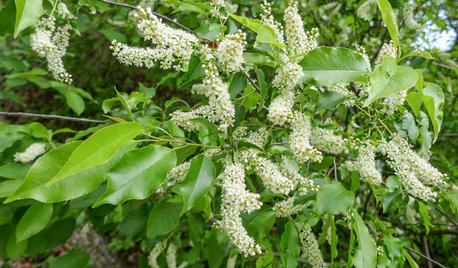
    The cherry that produces good lumber is wild Black Cherry - Prunus serotina - not the sweet cherry nor any of the other species of cherry such as bird cherry or fire cherry. Sweet cherries - the kind we grow for fruit to eat - seem to have a punky, soft wood. There are perhaps six or seven native species of cherry in the northeast US, but only one produces lumber as far as I know. The rest are smaller, fast growing, short-lived trees that are a lot more similar to the domestic sweet cherry than the black cherry is. Black cherry grows everywhere from the gulf coast into Canada in the east, but is a large component of forests mostly in the middle of the range - for example, Pennsylvania has tons of Black Cherry.

    As for poplars, the hardwood lumber sold as 'poplar' is Tulip Poplar, aka Tulip Tree, Yellow Poplar, etc. This is a tree not related to the aspen/poplar/cottonwood family. I really don't know why it is called a poplar at all. Other poplars have soft wood and are fast-growing, short-lived trees, while the Tulip tree is a very large, tall, often very straight tree of the appalacian forests. you can sometimes see Tulip Tree growing as a shade tree, and it makes a nice one. They are planted all over the US, but native to the eastern forests.

  • 18 years ago

    This is really great idea. If you read the book The Contrary Farmer by Gene Lodgson, you will find that he recommends that early in his or her career, a farmer plant just such a wood lot of highly valued trees as a retirement fund.

    Rosefolly

  • 18 years ago

    nickels,

    i should mention that if u decide on some black walnuts be aware of juglone toxicity. they don't play well with others sometimes, especially apples. do a search on gw and school yourself on the subject.

    i have some black walnuts and will be planting transplants and nuts this fall. i'm trying to isolate them in their own "groves" and along the upperside of the road on my property so as to not present a problem to my other plantings.

    price gave u some good advice. i am thinking of what i should plant to " DIVERSIFY " my retirement trees as rosefolly pointed out in her post. i believe if one plants several species he/she protects themselves against disease or bugs which may decimate 1 specie of tree but not another.

    geraldo,

    glad to hear that black locust is doing well for u. am of the same mind just to plant some on a couple or 3 acres for never-ending firewood. haven't proceeded because i am a bit worried about them spreading "too much".

    if your ever in the need for a fence post i can't think of a better 1 than locust. those ol' steel things just rust away in a couple of centuries, when after the same time u can pull up the locust and bank some coals all night. kinda like multi-tasking !

    never hurts to plant a gun stock or coffee table. if nothing else it should raise property values, at least to a savvy buyer.

    regards,

    wildlifeman

  • 18 years ago

    Yes, not only apples, chestnuts too will die of juglone. Better plant all the black walnut in a grove, surrounded by certified resistant trees such as black cherry or red oak, everything else at least 70 feet away. Even the resistant plants get stressed by juglone some, though.

    Apple wood is great firewood and excellent for smoking things. It is otherwise very difficult to work with.

  • 18 years ago

    The black walnut toxicity holds true. A few of the farms around I hutn on have small clumps of walnut trees and nothing but grass grows within the drip line of these trees the rest of the ditch and fence lines are chock full of various shrubs, bushes and trees. Its so apparent you can spot the walnut trees from a mile away.

  • 18 years ago

    Thanks for all the comments. I'll keep all this in mind.

    If we end up moving back to where my girlfriend is from (Littlefield, TX), I'm not sure that walnuts will be possible. Everything says 25 inches of rain per year minimum, and Littlefield averages 18". Maybe with irrigation, but making up 7 inches a year sounds like alot.

    I'd really like to. I doubt that they'd ever be worth alot except to me, but the idea of having a little wood working shop when I'm retired and making furniture from this stuff just sounds good. Don't think I'd ever be able to afford walnut anything otherwise.

    But in the meantime, I'll practice, so that if I do get the chance, I'll be able to grow stuff from seed.

    Kinda surprised, when I got the idea for this, I assumed that there'd only be 2 or 3 different types of wood worth attempting.

    Price, if you do have some cherry pits you can spare, I'd gladly pay shipping and a little besides. If not, I shouldn't have trouble finding it, now that I know which species to look for.

  • 18 years ago

    I looked for wild cherry seeds, but I guess the birds got them all... Don't forget about Paulownia. It's beautiful wood and worth quite a bit. My uncle and I had problems about 10 or 15 years ago with people sneaking in to places we were going to timber and cutting down all the paulownias. They're light enough that 2 people can carry a 12 foot long log that's around 16 inches DBH. It's amazing what people will do for a little money. I think Jimmy Carter has a paulownia farm in GA by the way.It might be something to look into.

    Paul

  • 18 years ago

    Wild Black Cherry typically goes for about twice what pine timber sales for. In addition it is a fast grower. Space it as mentioned above.
    Arizona Cypress should handle the 18" year and maybe Eastern Red Cedar if you move and want to plant out there. Beyond that I'd have to look as that's getting pretty dry.

  • 18 years ago

    Scot, I'm actually wondering if I could irrigate for it. Wellwater's not usually hard to come by out in that area, and additionally if I had a big cistern to catch rain not falling on the trees themselves.

    Anyway, not sure where I'll end up, necessarily. And besides, it's fun to plant seeds and see how they grow, so even if nothing comes of it, I won't feel as if it's wasted effort.