Software
Houzz Logo Print
raelynn09

Soil Questions - Charcoal?

14 years ago

Been lurking for months, and I want to first say - I'm so glad I discovered gardenweb! I've been working as a cashier at a local garden center for almost two years now, When I was hired I knew very very little about gardening (okay, that's an understatement). I'm certainly not a pro yet, but with help from my coworkers and you guys I've learned quite a bit!

One of the most helpful things I have learned is the importance of a healthy soil. I've read nearly every post tapla has made - and boy I appreciate his info!

I live in a tiny apartment with no balcony, and only three west facing windows that are mostly blocked by large trees. I thought houseplants would be impossible, but to my surprise I've been able to keep quite a few plants alive! (maybe not thriving - but alive nonetheless! :)

Anyways, I've had a few people ask about the benefits (if any) of using charcoal in a soil for houseplants. I know it's often an ingredient in commercially sold bonsai and orchid soil mixes - could other houseplants benefit from it?

And what exactly would be the differences between charcoal and activated charcoal?

Also, I've had trouble getting some ingredients, so this is what I did in a pinch- and it seems pretty good. what do you think? Is there anything I should switch up next time?

1/3 Hoffman's bonsai soil (turface, pine bark, haydite)

1/3 Orchid mix (thrown in a processor to break the bark to 1/4" pieces and smaller)

1/3 perlite

and a small handful or vermiculite- I really don't know why I added that though.

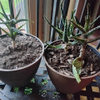
I have 3 draceanas, a jade, 2 philodendron, pothos and sansevierias planted in this mix and they seem to like it, or atleast tolerate it. I've had one draceana

My biggest problem was the salt buildup, which has drastically decreased since I repotted them from nursery soil into this mix 4 months ago. I still use mostly tap water - I don't have a vehicle and carrying jugs of purified water on the bus and then carrying 1/2 mile home every week is just not happening! :)

Aaaaanyways- I apologize for the long intro! I'll try my best to keep the rambling to a minimum next time! :)

TL;DR - How beneficial would it really be to add charcoal to your regular houseplant mix?

And has anyone ever heard of or used Sumi Balls? I'm pretty interested in them. I'll attach a link for those.

Here is a link that might be useful: Sumi Balls

Comments (8)

  • 14 years ago
    last modified: 11 years ago

    It's great that your skills are improving. You can't help but learn when you spend time here!

    I think what you'll find on the net are large numbers of hobby growers that absorb a lot of the hype that SELLERS of various types of horticultural charcoal make, then repeat it as fact. There is evidence that some types of charcoal are valued for their agricultural benefits, but you won't find much out there that offers an ovation for what it contributes to container media.

    It's easy for a charcoal producer to convince you that because charcoal holds nutrients, adds aeration to soils, increases drainage .... that it's an indispensable element necessary to bring along a healthy plant; but the fact is, that peat, pine bark, perlite, and a number of other potential soil ingredients can make the same claim.

    It doesn't reduce odors, absorb salts or toxins, or do anything in soils out of the ordinary, and it's not an anti-fungal. In fact, I looked in 4 authoritative texts on container media before I wrote this to see what they said about charcoal, and not one of them even mentioned it - even though, along with all the 'regular' ingredients we're familiar with, they give pretty good outlines of some pretty obscure potential media ingredients that most of us have never even heard of.

    Re charcoal vs activated charcoal: High temperatures and chemical processing is used to make activated charcoal, neither of which is used to make horticultural charcoal.

    Activated charcoal, because it's fired at high temps is more porous, so holds more water and less oxygen. On it own, it has no filtering effects when incorporated in container media. In fact, if it did 'filter or attract' salts or other undesirable elements, they would still be IN the soil and still available to the plant.

    Reactions of orchid growers are even mixed, with some swearing by it and others offering that high % of charcoal are counterproductive. Usually, when you do find it in tried & true commercial orchid mixes, it's found in small fractions.

    If you've been following some of my threads, you probably realize that the salt build-up is a result of watering practices, if we can exclude over-fertilizing as a possibility. I think you can incorporate some charcoal into your soils if the size is right, but I think I'd look at it roughly as a substitute for perlite, though I think it will hold more water than perlite because of its internal porosity, which perlite lacks.

    To cure the salt build-up issue, ideally you would get your soil to the point where you can water copiously w/o risking root rot. If that's not possible, a regular flushing of the soil and watering in smaller sips is a strategy that is better than not addressing the issue ..... and wicks, tilting the pot, or other means of reducing the amount of excess water a soil holds are all helpful.

    Al

  • 14 years ago
    last modified: 11 years ago

    Thanks Al! I had a feeling it was mostly hype. Brands claiming how great it is is understandable - nearly anything is better than the "bagged dirt" - what I like to call most of the commercially sold houseplant soils.

    I think for the most part I understand the salt buildup issues, since I don't have much of a problem with it anymore. But perhaps throwing in the vermiculite was a lack of good judgement? It really has decreased since I changed the soil, but next time I think I'll skip the vermiculite.
    It seems is a bit counterproductive of this fast draining mix we're trying to achieve. Vermiculite is rather water-retentive, isn't it?

    One more thing - I've read a bit about wicking but I'm not quite sure clear on how it's actually done. I mean, I understand why it would work, but a few things aren't so clear in my head yet. If I were to use a wick that went lower than the pot, then it would touch the saucer/surface it's sitting on. On most of the terracotta pots that I use, there's barely a quarter inch between those two surfaces - wouldn't the wick get smushed? I thought maybe the wick should be free hanging from the bottom of the pot so the water would drip below. I'm sorry If that's phrased oddly - like I said this is all new to me, i just don't quite understand.

    I'm a visual learner, are there perhaps any photos to reference to? Or are there any threads that I've maybe missed about this?

    Thanks again, Al, you're always so helpful.

  • 14 years ago
    last modified: 11 years ago

    R - Thank you very much for the kind words.

    There are sooo many gimmicky products out there, some of which don't work at all the way they're advertised. There is just no substitute for getting the basics under control and working in your favor, and I'm always glad to see growers who are able to quickly understand how important that is. Over and over I've watched them catapult themselves forward & ahead of those w/o a sense of direction.

    I've been meaning to draft and scan some line drawings to my photos so I can post a visual reference that will help clarify some of the things I've said about perched water tables and how to do some simple things that will offer a LOT of relief, so I'll make sure to get after that next week.

    Let me try this: If you have a soil that supports 4" of perched water when saturated, it will support 4" of perched water in a 55 gallon drum or in a drinking straw. If you had a container with 4" of perched water at the bottom and could cast a little pixi dust that suddenly made the container a foot deeper, the water would simply move down into the bottom 4" of soil. Here's the important part >>>>> IF you attached a drinking straw at least 4" long to the bottom of the 55 gallon drum, ALL the water in the PWT would start moving into the straw. The gravitational flow potential of the water in the drum will continue to force water to flow out of the drinking straw until ALL the PW in the drum has dripped off the end. When the set-up stops draining, there will still be 4" of perched water, but it will ALL be in the straw ...... so how much perched water is that? Almost none!!

    A wick does the same thing. It 'fools' the PW into 'thinking' the container is actually deeper than it is, so the PW moves down the wick where it will be pushed off the bottom of the wick by the rest of the water in the PWT, until the gravitational flow potential is in a state of equilibrium with the capillary attraction of the wick/soil. Science is a beautiful thing when you understand how to put it to work for you. ;-)

    You do understand what needs to be done to make the wick work effectively for you. In order to work, the wick needs to either dangle below the bottom of the pot or rest on something absorbent - like the soil in your yard/garden/bed or newspaper, or it could dangle over the edge of a sink or a stand you set up in a shower or over a tub.

    I wouldn't be too quick to burden yourself with the 'poor judgment' verdict for using vermiculite. I have a bag that was about 5 gallons when I bought it 10 years ago, and it still has about 9 gallons + in it, which shows how often I use it. Usually, we should be doing things to try to REDUCE water retention in our container media, so it's probably hard to make a convincing case for using it in our media. I would reserve the impeachment of 'poor judgment' for use on someone who, understanding the importance of the physical properties of container media as well as the physical properties of vermiculite and it's deleterious effect on water retention, went ahead and used it anyway. So, I think you stand unjustly self-accused. ;-)

    There are two threads I commonly link new growers to. The first is an overview I wrote to help growers avoid the common pitfalls that become the reasons most of the growers looking for remedial help are here. If they find it helpful and exhibit any sort of enthusiasm about their new found information, I usually offer a link to this thread about container soils. I'm not at all bashful about sharing the opinion that the information in the thread about soils probably represents the largest step forward a container gardener can make at any one time. I know with certainty the information has transformed the growing experience of a LOT of people, I among them, but you can judge that by the response of others. I really do hope you find in it things that will enhance what you're able to take from your growing experience.

    Take care.

    Al


  • 7 years ago

    @tapla Hi Al! If I had found this post when I was searching last week, I wouldn't have bought charcoal!! Ofcourse, after I post a question about charcoal, this thread is found... This morning, I read through your thread on Contain soils and I'll admit...I'm a tad overwhelmed as my FLF is in desperate need of repotting, I can't get the necessary supplies from your list in my little town and yesterday I found, what I think are mealybugs in the tray of my FLF pot. (None on the plant whatsoever, just a lot of white oval bugs in the tray). What should I tackle first? The bugs or the repotting???

  • 7 years ago

    Fix the bugs first, no matter where you live. I hope I can assume you live in the northern hemisphere? If yes, your plant should steadily build strength and grow more like it means it from now until late summer early fall - if you live in the northern hemisphere.


    I've never seen a ficus with roots so tight it was imperative to repot NOW! If roots are that tight, your tree has likely been suffering lost potential due to tight roots for many years, so waiting a couple of months probably won't be enough to nudge it over the brink. Your plants have natural rhythms you can count on and plan around to take advantage of its strengths and weaknesses. Do your heavy work, like repotting and heavy pruning in the summer when the plant's stored energy levels are at/near peak, as would be it's photosynthesizing ability (to make food/sugar from CO2, water, and sunlight. Your plant will recover in a couple of weeks, where if the work was done in winter or early spring, it might take months. This opens the door to invasion by biotic and abiotic pathogens for an extended period when the plant's defenses are at their lowest. When the problem only needs to be stated to see the reasoning is sound.


    If it was my tree, my plant would be to:

    A) Work on the bugs by spraying with something like Bayer's 3-in-1 for Insects, Disease, and Mites. If it's too cold to move the plant outdoors long enough to spray and allow it to dry, go to the alternate. Purchase a can of imidacloprid soil drench for trees in a 1.47% solution. Mix 1-2 tsp per quart or liter of water and fully saturate the soil. Follow with another drench in a month or so. That should take care of everything but mites, and they're not often an issue with F lyrata.


    B) Flush the soil and get your plant(s) on a regular fertilizing program. I've been using Foliage-Pro 9-3-6 for at least 10 years, and I'll keep using it until I find something better, but I wouldn't bet on that happening. Let me know if you need help figuring these things out.


    C) Move the plant outdoors as soon as night temps are reliably above 55* F, or move it in and out as temps allow. Do your repot around Father's day or the week before, then do your pruning (if needed) in a couple of weeks when it starts pushing growth.


    D) Plan on repotting (much more extensive than potting up) every 2nd or 3rd year, and prune off all winter growth (get rid of the long internodes that occur in the darkish winter) each year. This is a key to ensuring your tree grows as full and compactly as possible.

    E) While you're waiting on the plant to bulk up on carbs and enter the most robust part of its growth cycle, you can be thinking about what you're going to do about a medium to repot the plant in. That's an important decision that weighs heavy on how much of their potential your plants have the opportunity to realize.


    Al

  • 7 years ago

    Hi Al. Thanks so much for your quick response! Not sure why I had it stuck in my head that I MUST repot asap but I'm happy to hear that I can wait until it's later/warmer/post-pest issues!

    Yes--I am definitely in the northern hemisphere. So north that our temperatures are still in the 35F-55F night-day temp ranges. (In fact, this weekend, we're supposed to have lows in the freezing temps at night--augh).

    A) I have this spray and have used it already. As I mentioned, there are no signs of mealybugs on the plant, probably because I sprayed it a month ago when I saw a little bit of spidermite webs so dealing with the soil would be the next step? BUT...systemic insecticides are not available in Canada! Very frustrating... Any other ideas? What are your thoughts on isopropyl alcohol?

    B) Last week I ordered an FLF fertilizer (should be arriving in the next couple of days) so I'll give that a shot while I look around here and look for the Foliage-Pro that you refer to.

    C) D) I'll take a picture of my tree once we have more daylight and post for you to take a look at its current status. Once we started getting more hours of sun, my tree started sending out new leaves BUT 3 of them only made it a couple of inches and then dried up and fell off :( Presuming that was a result of low humidity, I should mention that the humidity in my house is 40%. Considering the size of the house, it would be impossible to raise the overall humidity levels with an external portable humidifier. However, our summers become much more humid and I'll just have to wait until then.

    E) Yes, I am definitely thinking about this. In fact, I have dracaenas that I'd like to repot this summer so it's really been on my mind. Would you say that your general 5:1:1 ratio would work for both FLFs and dracaenas?

    Again, I'm so grateful for your reply Al.

    Hannah

  • 7 years ago

    Hi Al

    So I'm back with a 1 month report ;) I have found a way to keep the mealybugs (they must be mealybugs that JUST stay in the soil?) at bay. As I mentioned, Canada does not carry any systemic insecticides so I will be perpetually on-call with pests...


    In any case...I've gotten to stage B) and with the fertilizer, my FLF has pushed out NINE new leaves in 2 weeks. And they're BEAUTIFUL leaves! Glossy green, hardly a speck of edema and growing to be HUGE! So now I'm looking at the calendar and it's getting close to Father's Day. Gotta think of repotting now, which led me to sourcing the 5:1:1 mix.

    I've looked EVERYWHERE locally and I can't find any pine bark fines. On Amazon, I've found Bonsai Jack Pine Barks 1/4". Will that be close enough to your 3/8" recommendation?

    Hope you've been having a nice Spring!

  • 7 years ago

    You can get that to work just fine. If you provide an image of what the bark looks like lying on a sheet of white paper, I can offer more guidance insofar as how to put your soil together.

    9 new leaves - super job!


    Al