Software
Houzz Logo Print
mickj_gw

Help for leaves curling downward

11 years ago
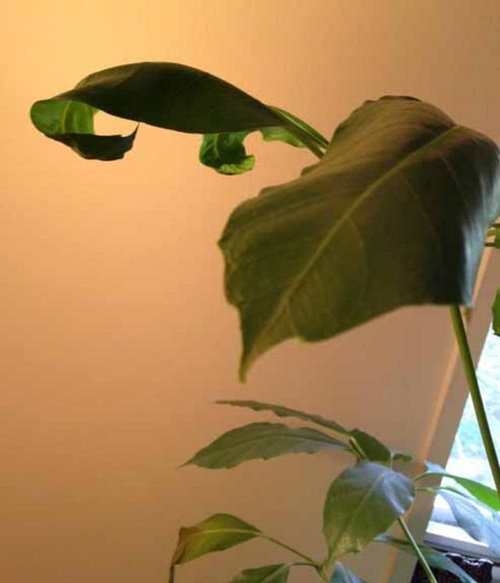
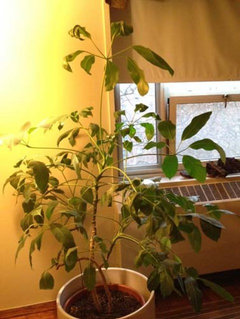
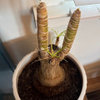
I'm hoping someone might be able to help my houseplant. I have had my plant for over 20 years without any problems. I don't know what kind of plant it is. Recently, the leaves started curling downward on new growth as well as the leaves on the lower stems rolling inward, yellowing and falling off. Lower leaves have done that in the past which I thought was normal from aging but now it has been more than usual. I thought the lower leaves could also be from overwatering - I was using water globes since I was traveling alot, and have used these for the past few years without a problem. But since it is happening at the same time as the leave curling (which has never happened before), perhaps it is something else because it is has lost a lot of leaves - mostly all the larger lower ones are gone.

I'm new to posting and realizing I can only provide one photo. I have lived in the same place and kept my plant in the same location. I've removed the watering globes and repotted. Being new, not sure what else to provide. Appreciate any help or questions immensely. My plant has lost most of the large lower leaves, and many of the new upper leaves are small and curled and I don't know what to do.
Thank you very much

Comments (9)

  • 11 years ago

    Looks like a Schefflera. How long has it been in the same soil? Do you see any spider webbing around the funky leaves? If you have more pics, you can add them in replies, 1 per reply.

  • 11 years ago

    Now that I have a plant name to search on, yes it is a Schefflera. thank you. It had been in the same soil for years and years. I did repot a few weeks ago when I didn't know why the upper leaves were curling downward or the lower leaves were rolling together, yellowing and falling off, thinking that might help.
    I do not see any spider webbing on any of the leaves.
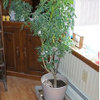
    Additional photos would be more of the same downward curling leaves - all the larger bottom leaves have fallen off. But included is a photo of it currently, looking very thin. It used to be very full with lots of large leaves.

  • 11 years ago

    If it has been in the same soil for years and years, I guess it is time to repot it. The curling of the leaves could be due to a number of issues; creepycrawlies of some sort, draft from window or heating, or simply lack of nutrients due to old soil.

  • 11 years ago

    Awww, it does look pouty. So sorry. Is being repotted the only thing that's changed? Is there hot air blowing out of that register thing? When you repotted, did the roots look like a solid pancake at the bottom of the pot? Did you go with a bigger pot, or trimming of the roots so it would fit back in the same pot? If you have anything it can sit on to stay off of the floor, that can be helpful during winter at least, keeping roots away from the coldest air in the room.

  • 11 years ago

    Spider mites don't always leave webbing, and some species are so tiny they can't really be seen by adult eyes. I searched a Crassula tetragona for pests many times and couldn't find the little @#$% - even with a magnifying glass - but they were there the whole time. I finally saw them by photographing leaves and stems with my macro lens, then enlarging those images and searching them. I wouldn't discount spider mites just because you can't see webbing.

    Hold a piece of white paper below a leaf, then flick the leaf sharply with your fingers, then use a magnifying glass to examine the paper for tiny specs. Do it to each affected leaf and to the stems. If I were a betting person, I'd bet you've picked up a little pest. I got rid of mine with homemade insecticidal soap.

  • 11 years ago

    Thank you for all the replies. In response:
    Since it had been in the same soil for years and years, I tried new soil since I had read something about a calcium deficency on the web somewhere along the way, so I thought maybe that was the problem. I bought Miracle Grow potting mix but not for any reason other than this was my soil option at the store. I can't say I know how to repot, but I changed the soil and left the soil that was around the roots. I don't recall what the roots looked like, I was more focused on not breaking any leaves since my plant is about 5 feet tall, but I do recall the roots were in a ball-ish shape and was not even close to filling the pot it was in. The new pot is slightly fuller but there is plenty of room. And just to note - the repotting happened long after it was already losing leaves and curling - repotting was a hopeful solution.
    My plant has been in that location for 20-25 years - near the register and window - I live in New York, heat/cold/on the floor hasn't been an issue before - it was always full and happy there. All I ever did was rotate it so the leaves didn't all face one way. Maybe I need to change that, but just giving the history for now.
    I looked for any indication of an insect on all leaves, on the underside and tried the white paper and flicking the leaves (apologizing to my plant) and examining with a magnifier. I didn't see anything. But if I did have a pest, would it hurt my plant to try an insecticidal soap whether I see an insect or not?

    If an insecticidal soap is worth trying, please let me know details on how and what to use. Or if it would be helpful to take it out of the pot to look at the roots (maybe root rot?) - please let me know details of what to look for and I will do so. And if I should have used something else for soil when repoting I would repot again.
    I love my plant and it has been with me a long time. It makes me smile when I come home but right now, I'm not very knowledgeable and I don't know how to help it. I appreciate your time and replies very much.

  • 11 years ago

    I can totally relate to what you were describing about the repot. Big plants are awkward!! Yes, I would repot a struggling plant in attempt to improve its' health too. (If this is done regularly, it's not as traumatic, for future reference.) I think you would have noticed if the roots were mushy, so that's good.

    From this additional info, I think your plant is having a hard time adjusting to the new conditions and disturbance. It sounds like... there was very little soil before, from the roots having filled the pot. If so, the roots around the outside of the root ball were adjusted to being dry most of the time. When this happens, the soil inside the root ball can get so hard and dry that it can't get wet anymore. It's possible your plant was getting so dry that it was suffering from lack of water, from being unable to have moisture available - just running right across roots, but not being able to soak into what little soil there was. Like a very dry sponge that doesn't get fully wet if you just pour water across the top. If still on the track of what was going on, now that the roots are surrounded with moist soil, there may be some rotting. Letting the soil dry will help combat that.

    If you packed the soil tightly around the roots, loosening that by gently pulling the plant up a bit, and/or fluffing around it with a fork, can help increase the amount of air in the soil. This would also help the portion of new soil without roots to dry more quickly, so you don't end up with a very dry ball of roots surrounded by soil that's always moist, can also cause rotting. Roots need oxygen & moisture at the same time to function. Just moisture = rotting. Just air = drying/shriveling.

    Hopefully the roots will take off into the new soil. Sending good vibes!

    It's also possible to use potting mixes that naturally have more air throughout them because they are made of larger particles (and don't contain much stuff like peat that takes a long time to dry out.) If you have an ongoing problem with rotting roots of plants, that would be something to investigate. Sounds like things were going well. Regardless of its' potential to help people overwater their plants, millions of plants are growing well in MG potting soil as we speak, so that can't automatically be blamed every time a plant gets ill. In the case of this particular plant, it may have been better to repot sooner, regardless of soil type, before the health declined. Not a chide, saying for future reference, and as possible explanation of why your plant declined at all.

    If that's a spot where this plant lived happily before, that's probably not part of the problem.

    IDK anything about insecticidal soap, so I'm not ignoring that question, just don't have any info to share.

  • 11 years ago

    Check for root rot, and if that isn't the issue, I'd bet my last nickel it has pests. I don't believe for a minute that a schefflera will start looking like that because of old potting soil. They're pretty bullet proof.

    I had a huge schefflera bite the dust last year from scale. I couldn't figure out what was wrong with it until it was too far gone. I know everyone on here is anti-pesticides, but I'd treat it with a systemic pesticide. That's your best bet if root rot isn't the issue. When you check out the roots, smell them as well to see if they have a rotten odor.

    Deanna

Sponsored
Custom Home Works
Average rating: 4.6 out of 5 stars10 Reviews
Franklin County's Award-Winning Design, Build and Remodeling Expert