Software
Houzz Logo Print
arborvitea_96

pruning apple trees!!!!!!!!!!

16 years ago

yo how is everybody?

I have this Apple tree in my front yard and I was wondering how to prune it so it will produce better fruit!!!!!! I don't knew when to prune it ether! it is surrounded by a cherry tree and a maple! but not TO close to it. it is about 9 to 10 inches in diameter at the base of the tree. I do not know how old the tree is. the tree itself appears to be healthy. ANY advise would be appreciated!!!!!!!!

I asked the people in the tree form about this, and they so willingly informed me that. the fruit tree peeps did thing that tree peeps considered a WRONG!!!!! what does this mean? I think they were making fun of you to!!!!!

thanks yo.

BTW I live in zone 5a!!!!!

Comments (23)

  • 16 years ago

    I think it's that the tree peeps do things that the fruit tree peeps consider wrong. I've seen a lot of fruit trees ruined by tree peep pruning, not the other way around.

    You're in luck, there's a pro-fruit-tree-peep from your area on here who can give you very experienced advice.
    But I'm guessing you will need to post a picture to get the best advice and if you know the variety that will help too.

  • 16 years ago

    I don't know how to tell you how to prune without pictures. For that specific tree, I'd need to see the tree and to have some way to point out specific branches to you.

    I'd prune in the spring, just before the tree wakes up.

    I suggest that the best way for you to start is to only remove branches that are crossing or rubbing on each other.

    My preference is to have branches growing as low as possible, so I can pick fruit without a ladder. If you can walk underneath a fruit tree, it makes it easier to mow, but it is a real pain to harvest the fruit.

    Also, if you want good fruit, you need to go out in the spring and thin the baby apples. The tree will set more than it needs and you will get bigger tastier apples if the tree doesn't raise all it sets.

  • 16 years ago

    "I think it's that the tree peeps do things that the fruit tree peeps consider wrong."

    Only the untrained/unenlightened ornamental-tree peeps do things that most trained/enlightened fruit-tree peeps consider wrong. The other ornamental-tree peeps may usually do things differently than the fruit-tree peeps might typically do, in order to achieve different results. The techniques used vary because the goals/objectives are different. (What's really funny is that the counterpart to your statement was just posted in the Trees Forum. All I had to do for this response is copy and paste my response and then change fruit to ornamental and ornamental to fruit.)

    "I've seen a lot of fruit trees ruined by tree peep pruning, not the other way around."

    Hmmm, and the ornamental-tree peeps say the exact same thing about fruit-tree peeps! I think there may be some ethnocentrism and a lack of understanding in both forums, at times.

  • 16 years ago

    Fruit tree pruning is a specialization not even studied by most arborists. Most arborists and even horticulturists in this country are not taught the hows and whys because places like Cornell only consider fruit trees in a commercial fruit production context.

    Europeans tend to take fruiting plants more seriously as elements of residential landscapes and public gardens. Horticulturists there have to at least be able to handle espaliers.

    For that matter, most arborists I meet are not very well trained in horticulture at all. They spend the vast majority of their time taking down dangerous or dead trees- very few of them do any kind of technical pruning around here. Thank goodness, or I'd be out of business.

  • 16 years ago

    I would think part of the difference is that 'fruit tree peeps' are interested in fruit production and quality, and 'ornamental tree peeps' are only interested in good looks and prolonging the life of the tree.

    I remember seeing an interview with an old Georgian peach farmer and his trees looked awful, like they had been tortured or something. He had a method of training that included topping at a young age and it didn't look good, but the peaches he grew were absolutely fabulous and could be picked without using ladders.

    I think many people are too quick to use the word 'Wrong' instead of the word 'Different.' Of course I can't deny that some things are just wrong ;oP

  • 16 years ago

    WHAT IS A PEEP?!?!?!?!?!?!?!?!?!?!?

    I will get pics when I can figure out how to......

    I'm ask my mom.

  • 16 years ago

    Peachymomo, you are exactly right. The typical goals of the two groups are different. I know many arborists who are as familiar with pruning fruit trees as most anyone in this forum, but it's not the type of pruning most of them typically do in their work as ornamental arborists.

    Caleb, peeps is people. I used it because the person I was responding to used it. I guess it is supposed to be a pop-culture thing from the past. LOL

  • 16 years ago

    Actually I do see a lot of old apple trees just pruned wrong by commercial arborists. They will commonly prune out the interior wood year after year until the trees become sprawling and gangly. This architecture encourages greater wind pressure on branches in wood that tends to be rotting anyway but it is a quick easy way to appear to have done something. On some of the estates I work on I see the same method used on specimen oaks and maples with the same ruinous results. A stouter tree will tend to live longer IMO. The longest lived oak trees in the world are in England where the outer branches used to be pruned annually to make tool handles.

    On some estates apples are pruned like poodles in a semi-pollard with a lollipop shape. While this is not a good way to prune for fruit it seems to suit the apple trees just fine as far as longevity. It's also a no-brainer to prune such trees once the shape is established- just cut out most of the annual growth. This is helpful because around here many of the men actually up in the trees speak very little English.

    I once converted a huge (40' tall with a 60' spread), over 100 year old Baldwin that had been poodled for decades into a huge globe (missing a continent on the north side) into a more natural and better shape for apples. Unfortunately the site was windy and probably the crop I stuck on the tree caused a scaffold that was a third of the tree to snap out so now it's missing about 3 continents.

    The tree is still growing vigorously and I've coaxed it back to a reasonably balanced shape but I almost wish I'd stuck to the pollard globe that only produced a light apple crop. Guess I should have cabled it. It produces enough apples for a neighborhood right now.

    I live in southeast NY where there are lots of very old apple trees on estates where they can afford to have their specimen apple trees pruned annually.

  • 16 years ago

    arborvitea, since you are the one who introduced the term "tree peeps" I'm surprised at your lack of understanding what you wrote. Read some books and learn the basics so your questions can be more focused. And yes, ask your mom!!!!!

  • 16 years ago

    Applefan,

    Caleb was merely repeating what he saw in another forum. He even asked, "what does this mean?" Maybe I misjudge your intent, but your comments seem especially rude to me. Since "peeps" (at least as used in this context) is not even an English word, surely you shouldn't be so surprised that someone doesn't know what the word means!

  • 16 years ago

    Brandon7

    You're right. My comment in retrospect to arborvitae does seem rude. I missed his first post and did not realize the level of understanding he brought to the subject. I actually thought the post was a joke.

  • 16 years ago

    Peeps doesn't just mean people in general. Your peeps are your people, your clan, your tribe, your group of buddies.

    So peeps would be people who stick together. I guess the fruit tree peeps and the ornamental tree peeps are in some sort of gang warfare I didn't know about. I wonder if we fruit peeps are the Hatfields or the McCoys?

  • 16 years ago

    Peeps does, most frequently, mean people in general. Here are a few Google results:

    peep - a person (The Online Slang Dictionary)
    peeps - people (The Online Slang Dictionary)
    peeps - short for people (Urban Dictionary)
    peeps - (slang) people (Encarta)
    peeps - slang: people (Merriam-Webster)

    But, you're right in that sometimes it does seem like there is a certain amount of grouping in the Trees Forum and in this forum (probably, sometimes to the detriment of each group).

  • 16 years ago

    So who are the people in the tree forum? What is their relationship with their trees? I was thinking of tree people as arborists. It's hard for me to picture people obsessing over their ornamental trees the way we do over our fruit trees if they're not being paid to care for them.

    Fruit trees require so much more care than other trees and if we didn't get this incredible fruit out of the deal there would be no obsession.

    I love my forest trees but they really don't need me much.

  • 16 years ago

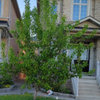
    Here are some pics of my Apple tree.

    {{gwi:125291}}

    {{gwi:125292}}

    {{gwi:125293}}

  • 16 years ago

    "Hmmm, and the ornamental-tree peeps say the exact same thing about fruit-tree peeps! I think there may be some ethnocentrism and a lack of understanding in both forums, at times."

    I mean the things like flat tops, lollypopping and extreme hack jobs with no follow up to remove all the water sprouts. On ornamentals they allow the water sprouts to die, trying to do that on fruit delays fruit and invites tree killing disease.
    My niece's dying suspected Newtown is suffering from that. My neighbor's flat topped cherries (dead a couple years later) are another. Both wrong on fruit but common on ornamentals.
    These are types of pruning I have seen from professionals and was taught in horitculture class. And when that class landscaped a house on paper the pros that came out to do our landscaping did an even worse hack job on the ornamentals than we were taught.

    I don't see (and have never seen) where thinning branches, cutting back to direct growth and dead wooding would ruin an ornamental unless it's someone who over thins and destroys the shape of the ornamental.

    Peeps is not an English word??? Since when? And Caleb was the one who first used it. If he wanted clarification on the word he should've asked those who confused him, or at least asked with a complete sentence here. It is common slang so when someone uses it I assume they know what it means.

    arborvitea_96,
    Looks can be deceiving but it looks too tall for someone with no experience to prune safely to me.
    I would see about hiring Harvestman or having him recommend someone. Unless he says otherwise.

  • 16 years ago

    What the tree peeps usually think of as "wrong" is topping trees. Topping trees is something that orchardists do regularly. Tree peeps worry about multiple uprights that follow topping but orchardists don't have to worry about this because they will be back at least annually to make sure the structure is geared to their needs.

    You need to remove a lot of wood- whole scaffold branches to bring the tree down in height and to let lots of light in throughout the tree.

    You need a really good Japanese type pruning saw but I need to know your budget to make tool recommendations. I also need to know you're level of commitment here because this is not going to be easy.

    The book "Ecological Fruit Production in the North" by Hall-Bayer has a very good chapter on renovating old apple trees.

    The fact that your tree is being badly crowded by other big trees is a major issue. To get good fruit and harvests you need a lot of direct light.

  • 16 years ago

    I think I am set on what to do now!

  • 16 years ago

    I feel pretty comfortable pruning even larger trees, and I think I'm beginning to feel fairly comfortable pruning fruit trees of various types and in various forms, but I still wouldn't want to tackle (and maintain) those large apple trees. If I was rich and really wanted to maximize production from those trees, I'd hire Harvestman to come over a couple of times per year and work magic. In real life, I'd just let them go and maybe consider planting some semi-dwarfs of various types if I wanted more fruit.

  • 16 years ago

    Thanks for the compliment, Brandon.

    I used to teach classes at NY Botanical Garden on old apple restoration. I'd teach the method explained in the Hall-Bayer book and by way of illustrations and instructions in the book, students were able to do a reasonably good job after a single 3 hour class. They probably could have done it with just the book alone (maybe better without me confusing them with too much info).

    Hall-Bayer calls it the "Swiss Method" and claims to have brought it here from Sweden but I think the method is pretty widely used as I often see it employed here by apple people who I'm sure never read this book.

    All that's really done with this method is to cut out upright wood and to train the trees to a weep. You can easily lower a really old tree by 15 feet the first season and usually get a great crop the first year as well.

    It is generally safe to remove up to (and sometimes more than) 50% of of the branches in a tree the very first season. If a tree already has a fair amount of weeping wood the tree can also look really nice after the very first pruning.

    The only danger in removing a lot of wood is if you don't leave enough leaf buds to draw adequate sap through the suddenly sun exposed wood in spring you can get some scorching on large scaffolds. The branches more or less recover and often end up being replaced by lower branches anyway as you gradually reduce a trees height.

  • 16 years ago

    "It is generally safe to remove up to (and sometimes more than) 50% of of the branches in a tree the very first season."

    Good grief! Doesn't this take some major follow up? ('Course I guess that's what I'd be paying for. LOL)

  • 16 years ago

    Of course it takes follow up. The method calls for summer pruning to remove the water sprouts so that adequate light gets to your fruiting wood. Also, the renovation usually continues for several years before the trees are really at their permanent structure.

    A vigorous, untended apple tree often grows so densely that much of the foliage is almost in total shade even though leaves that get less than 30% light are said (by unnamed experts)to function at an energy loss. The apple tree's strategy would seem to be to eliminate the establishment of any competition in the understory. Certainly such a dense canopy can't be energy efficient.

    The interesting thing is that when there's adequate fruiting wood a lot of the energy just goes into fruit production and the vegetative response isn't all that dramatic.

    The tree in the pictures would only take me an hour or 2 to do the first pruning- not much fine cutting, just lots of big wood. That doesn't count brush removal.

  • 15 years ago

    Wow, that apple looks like a Siberian elm that has been seen to by an arborist. I see this style of pruning a lot. It makes trees look very tall and graceful and they sway in the breeze in a lovely way, until on a gusty day they suffer a massive injury.

    I have been renovating an old apple. This spring I cut out a lot of the top, making all cuts at forks, and gave it just a little fertilizer. It responded by producing much better fruits and no water sprouts. It is in a sunny spot so was as wide as tall. I cut all limbs in the poke eye zone except where they hung over a fence. Limbs that are low inside the canopy don't get much sun anyway so aren't very healthy or fruitful. What remained looked pretty good in that weeping style mentioned above. I aim for a short umbrella shape: people can walk under the tree and some fruit will be in reach of small children.

    The scars show that in the past this tree repeatedly was neglected for years, then flat topped and the lower branches were cut short too, leaving a round crown shape and almost no fruiting spurs. After each one of these jobs, it grew water shoots. Of course.