

Saskatoons Juneberries ???
I received my Schlabach catalog yesterday and they have Saskatoons Juneberry potted plants. Has anyone grown or familiar this berry plant? Sounds interesting
Comments (28)
 13 years ago
Yes,another name is Serviceberries.It's one of the first ones I planted before Bluberries.
The one I planted was from a local nursery and fruited for the first time this past Summer and the fruit was okay,nothing special.
I've since planted Northline seedlings and may pick up a Theissen from Raintree. Brady- 13 years ago
Have grown a number of tissue-cultured named-variety saskatoon selections here. All were surpassed, in production and disease resistance, by some cheap ($1 each) row-run seedlings of Timm & Success.
Likewise, some inexpensive row-run type A.grandiflora seedlings have proved much more vigorous and productive than any of the Autumn Brilliance plants I've seen anywhere.
Tasty fruits - if you can beat the birds to them. Not really all that much like a blueberry, other than in size. My wife especially likes the fruits from the A.x grandiflora plants we have. Related Professionals
Savannah Landscape Architects & Landscape Designers · Tulsa Landscape Architects & Landscape Designers · Hackettstown Landscape Architects & Landscape Designers · Farmington Landscape Architects & Landscape Designers · Santa Fe Landscape Architects & Landscape Designers · Huntsville Landscape Contractors · Tuscaloosa Landscape Contractors · Chicago Landscape Contractors · Grand Junction Landscape Contractors · Eugene Landscape Contractors · Petersburg Home Additions · Alexandria Home Additions · Gallup Home Additions · Bismarck Home Additions · Kahului Home Additions- 13 years ago
I did try some berries from an Autumn Brilliance that was at a Home Depot.The flavor was like that of Apple.I think sometimes it's referred to with the common name,the Apple Serviceberry.Quite different than mine.
So,it depends on the variety as to it's flavor and most assuredly growth habit as some are trees and others shrub like.
I'm really looking forward to trying some of the Northline berries,as I've read they have excellent flavor.There are U-picks in Canada with just this variety. Brady luke_oh
Original Author13 years agoNorthline and Martin are the varieties offered by Schlabach's. Here is what they say is special about them:Easier to grow than most berries, especially raspberries and blueber ries. Tolerates a wide range of soil types and pH levels (5.0 to 8.0). Extremely high in iron, potassium, vitamins and minerals. Contains high levels of antioxidants and phenolic compounds. Will produce in 2 to 4 years. Taste is much like dark red cherries. Can be eaten fresh, frozen or processed into jams, etc. Pruning management is very basic (removing older growth). They also stated that there were some commercial plantings in NY state. Not to be confused with the serviceberries (amelanchier canadensis).
- 13 years ago
I highly recommend planting Amelanchier alnifolia 'Northline'.
At an estate I work on, we are the only commercial producers of these berries in Maine and they are a HUGE hit at the farmers market.
The berries are big and delicious!
Here is a link to our berries: http://www.oohfarms.com/index.php/aboutfarm/saskatoon-Jeremiah

luke_oh
Original Author13 years agoW?ow,your plantings look great. Is that mulch over plastic? Can you discribe the taste?
- 13 years ago
I failed at blueberries here in the alkaline soil of Denver so I bought a Regent Saskatoon. Is Northline really that superior?
- 13 years ago
>>Taste is much like dark red cherries. This is not so,...looks like another sales gimmick.
I would say it's only a OK fruit, very seedy and one has enough
after eating a couple of hands full fresh, they have a earthy taste.
I like more the haskap or honey berry. - 13 years ago
They don't give me a WOW! like a raspberry or ripe strawberry, but I find them to be very good and flavorful. Good sweetness, and the flavor reminds me of somewhere between a clove currant and a blueberry with a hint of almond. When ripe, they are nice and sweet but not overly sugary.
I think they make a much better pie than blueberries.
- 13 years ago
Maybe we're branching out a little on this thread,but I have a question.Konrad,are there any named (or unnamed)Haskap or Honeyberries in your collection,sweeter than the Amelanchier's?I'd really like to grow some,if there are.I have two bushes now and the berries are fairly tart,even when leaving them on the plant for a considerable time. Thanks,Brady
- 13 years ago
Not really, Brady, ..when it comes to sweetness, Saskatoon's are better,..I find Haskap more on the sour side,..but then I don't mind. Seeds are not noticeable in them and berries are about 2x the size over Saskatoon.
- 13 years ago
Saskatoons are a variety of amelanchier that come primarily from the Canadian prairie. Amelanchier are not like apples where breeding improvements have been going on for centuries and varieties that do well in a wide range of climates have been selected.
Saskatoons do poorly here in southeastern NY, probably because of the humidity, but we have several native amelanchiers well suited for our climate and a variety of soil conditions. In my experience, Saskatoons do not grow vigorously in southeastern NY, are very prone to fire blight and are a plum curculio magnet. I planted several named varieties on my property over twenty years ago and they've had no value as either landscape or orchard plants.
Autumn Brilliance may perform poorly in Kentucky, but here it is a common shopping mall tree because of its general toughness and lack of required maintenance. I have planted large (2" caliber) bare root trees I purchased wholesale on a project where they've established with minimal care and flourished- also reliably providing a nice crop of almond flavored fruit that is loved by birds but still possible to harvest in small quantities from semi-dwarf trees.
To my tastes it has enjoyable fruit but after a pint or so lose their attraction. They may look like blueberries but I find blueberries to be a much more appealing fruit. It's at least a very nice landscape tree whose white flowers are the harbingers of spring on our northern slopes.
Edible Landscaping sells a couple of varieties which probably would do well in Kentucky and other more southern climates.
- 13 years ago
hman,
Autumn Brilliance - and probably some of the other A.x grandiflora selections - are fairly common in newer landscape plantings - and seem to do OK; I've rarely managed to catch them in the fruiting stage, though from the bloom period, I guess I'm just not looking at the right time. I have, however seen a few in fruit - with every berry a mass of cedar-serviceberry rust fungal fruiting bodies. Have not really noticed any stem/branch lesions, like I see on quince & mayhaw, but rust certainly can take a significant portion of the fruit crop.
I've had A.obovata "Jennybelle", which is supposed to be a 'Southern' species/selection, growing here for 15 years. This single specimen is vastly inferior to row-run A.x grandiflora and A.laevis specimens I have access to.My cheap Timm & Success seedlings have been vigorous, trouble-free, and fruit well, while the tissue-cultured named varieties(including Success)- essentially planted in the same spot at the same time - have been weak, anemic things plagued by leaf spot.
I do like juneberries/serviceberries - but agree that blueberries are begger - and more productive, here. - 13 years ago
Lucky, my guess is that it all comes down to regional varieties doing best in their own regions because, as I stated, Amelanchier has not benefited from a lot of breeding effort. Apparently Jennybelle does very well for Michael at the site of his nursery in VA.
I have to admit that my observations of the fruitfulness of Autumn Brilliance was based on a single season. I don't get back to that site anymore. I have some native amelanchier on my land but never get any of the fruit- I actually don't much look for it.
- 13 years ago
>>Out of curiosity, do you have a cultivar of haskap you suggest?I have the blue belle and berry blue. These two seem to be doing good for me, also cross pollination. The Borealis,..just put a plant in this spring, supposed to be the sweetest of all.
- 13 years ago
milehigh,
'Timm' and 'Success' are named selections of A.alnifolia &/or A.stolonifera - selected, if I recall correctly, on the Canadian prairie or in the Dakotas.
The defunct Bear Creek Nursery used to offer unselected seedling saskatoons - seedlings of Timm & Success. I've had (and may still have) Success, as a tissue-cultured specimen, but the unselected seedlings I got from BCN are healthier and more productive than the parent variety. It certainly appears that these two seedlings are better suited for my growing conditions than others I've tried. - 13 years ago
lucky_p,
Have you started any seedlings from your unselected plants? If so, how are the 2nd generation?
I found a good article on Saskatoons that I will share, although it duplicates much information already on this thread.
Here is a link that might be useful: Saskatoon Cultivars
- 13 years ago
I've got some seedlings from the A.x grandiflora selections - not fruiting yet, but growing well; have dug and tranplanted some suckers from the Timm & Success plants.
My rudimentary knowledge of Amelanchier suggests that apomixis is common - so a significant percentage of seedlings would be virtually indistinguishable from the parent.
- 13 years ago
lucky_p,
From the article linked above it sounds like your Timm and Success are now rare. Do you do any trading or are you a Seedsaver member?
- 13 years ago
Hi Luke,
Sorry for the delayed reply.
Yes, it is a heavy plastic with mulch over top.
Whats so great about these plants is that there is hardly anything to eat in the garden the time these guys ripen up. It is hard to describe the taste but they are semi-sweet and taste good to me! I eat them by the handfuls.Hope this helps,
-Jeremiah
- 13 years ago
I'm surprised no-one has mentioned the saskatoon variety "Smoky" (sometimes spelled Smokey). It's the most widely planted variety in U-pick operations on the Canadian prairies, and the tastiest I have sampled. I planted 4 varieties in our backyard about 20 years ago and it is only the Smoky I bother to pick, the others are either bland or sour, whereas Smoky is sweet and flavourful. Commercially they keep them pruned to about a 4 or 5 foot bush. Mine have never been pruned so are now multi-stemmed tall bushes/small trees about 12 feet tall.
They have the advantage of being about the earliest fruit to ripen here (apart from hideously sour haskaps/honeyberries - I tore my haskaps out this past year) or strawberries (which I tend to have bad mold problems with). Saskatoons also ripen over a long season, from the start of July here in central Alberta to about mid-August or later. Downside is they are a bit dry for a berry (soft, but more like the juiciness of an apple), and I'm not a big fan of saskatoon pie.
To be honest, after 20 years of having them, I rarely pick them to bring inside anymore. I pick a handful or two to eat fresh whenever I'm in the backyard in summer (which is most every day), and the birds (robins particularly) are happy to eat the berries I leave behind.
If I moved to a new house would I plant them again?... abosolutely! But Smoky only, and only one or two bushes (where I have them now I use 7 tall bushes as a privacy screen along one side of our property line, and they work quite well for that, so I might do the same if I moved to a new house).
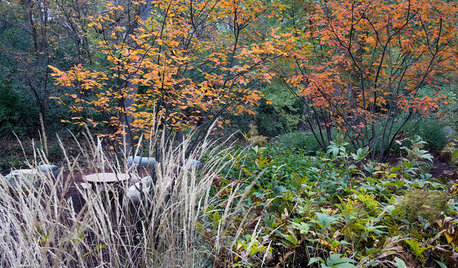
Saskatoon leaves turn wonderful orange/red/purple colours in the fall.
- 13 years ago
I have an 'Autumn Brilliance' that produces each year on neglect and almost no supplemental water... Alkaline soil, crazy weather and late freezes don't seem to faze it, the berries are small and seedy with only so-so flavor though. It seems this variety was selected primarily for a tree form and good autumn color.
BUT I have tasted MANY juneberries of varies species in the wild and in nurseries that were excellent -- nearly as good as blueberries, but different enough to stand on their own. They would seem the clear winner for regions where growing blueberries is a pain or not possible. This includes where I live, I just have not gotten around to looking for the worthwhile varieties.
- 13 years ago
Hey all, been doing a little research on both saskatoons/Juneberries and haskaps. Haskaps essentially come from three places, Siberia, Japan, and the Kuril Islands. The Siberians (early bloomers) are more tart and the Japanese later blooming) are closer to sweet. The Siberian varieties (Blue Belle, Berry Blue, etc) are hardier than the Japanese. One Green World in Oregon reported that they have varieties that actually get sweet and have much better flavor than blueberries. I would talk to them to get more details. The UofSK varieties (Tundra, Borealis, etc) are sweeter than Japanese, but bloom with the Siberian varieties. They have a bloom hardiness of 20 degrees F so they can survive a late frost if it is not too severe. For those of us in areas where late frost/rain is a problem, I've deduced that the Japanese varieties would be the most consistent producers.
As for juneberries/saskatoons, they are early bloomers. There are varieties that bloom slightly later than others (Northline and Honeywood), but they will still bloom earlier than most other fruits. These are also broken up into three general categories: grandiflora (primarily for color but have good edible fruit as well), canadensis (tend to be larger, more colorful, and are also have good flaovored fruit), and alnifolia (tend to be shorter and have higher fruit quality with better flavor). These are generalizations of course. Grandiflora and canadensis varieties do better east of the Mississippi and alnifolia varieties do better in the west. Regent is the exception to the east/west rule. I haven't read anything to indicate that they have frost hardy fruits or blooms, so my bet is that you will need to cover them in the event of a late storm. Smokey was heavily planted initially because of its sweetness, but other varieties that have better flavor have begun to replace it. Northline, Martin and Honeywood are three that I remember off the top of my head. Lee #3 and Lee #8 are newer, varieties that stay under 10 feet and show promise. Bill Mackently at St Lawrence Nursery is a good source of info on them.
Again, all of the info I have on both of these fruit types has been obtained from research. Any fruit tree/bush will respond differently to varied soil and climate conditions. I suspect that the relative bloom times (early/late) and soil likes/dislikes will remain fairly constant. Hope something in my little discourse helps.Good luck.


canadianplant