Software
Houzz Logo Print
jekeesl

Monarda Identification

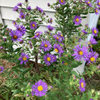
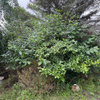
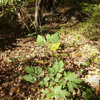
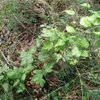
I have trouble figuring out which Monarda species we're seeing. The first photo is probably Horsemint (Monarda russeliana), since we found it in early April. We thought the next photo could be White Bergamot (M. clinopodia), since there were no pinkish dots present. The next two could be Beebalm (maybe M. fistulosa and/or M. stipitatoglandulosa); however, they are both pretty light colored for Beebalm. The last three photos were all taken yesterday, in different locations. Can any of you offer better identifications?

Thanks,

Jim

{{gwi:218664}}

{{gwi:218665}}

{{gwi:218666}}

{{gwi:218667}}

Comments (14)

  • 16 years ago

    The second one sure looks like M. clinipodia to me. The third picture has two Monardas in it, the one in the foreground looks like M. punctata. Not sure about the other ones.

  • 16 years ago

    I think your initial impressions were correct. First one is Monarda russeliana, which has sessile or nearly sessile leaves. The others all look like M. fistulosa, which has a pubescent corolla and a hairy fringe at the tip of the upper corolla lip. Monarda clinopodia intergrades with M. fistulosa so you can get intermediate forms, however M. clinopodia usually has a smooth corolla lip and no fringe.

  • 16 years ago

    Jeanne, thanks for the feedback. I hope that the Monarda with the pink bracts is M. punctata, since I've never seen that before. We do get M. punctata in this area (per USDA); however, I'm thinking that it will probably be M. fistulosa when the flowers mature. I'll know which is right in a few days.

    Lycopus, you offer good reasons for the last three being M. fistulosa. But, my Wildflowers of Arkansas book suggests that M fistulosa flowers are pinkish, lavender, or lilac. The flower in the second photo is pure white as far as I can tell. And the flowers in the 3rd photo are all whiter than I expected from M. fistulosa. I guess I'll list them as M. fistulosa, unless additional input arrives.

    Identifying wildflowers in a new area is tough! You almost need to have a botonist on hand, and provide them with specimens, to get accurate results for some families.

    Thank you both for your help!

  • 16 years ago

    Monarda punctata has longer bracts and more axillary flowers, so I don't think that is what you have. It is very easy to grow though...if you get some seeds you could have blooming plants in a year or two. Prefers sandy soil.

    While white M. fistulosa is not typical, the fringe at the tip of the upper corolla lobe does not fit M. clinopodia. However, some taxonomists have considered the latter to be a variety of M. fistulosa in the past, so there is reason to think that the two species overlap.

  • 16 years ago

    Lycopus, thank you for your expertise. I'll mark the last 3 photos as fistulosa. I also appreciate learning that taxonomy is "classification of organisms in an ordered system that indicates natural relationships". And since I was looking things up, I plugged in lycopus and found that it is a genus that includes Archangel and Gypsywort, among others. Is there a private joke in the name?

  • 16 years ago

    Not really. I had just learned the genus around the time I joined this site. It literally means "wolf foot".

  • 16 years ago

    I grow M. fistulosa, it's a coarser prairie plant that grows 5 feet tall and blooms in August. While I understand that geographical differences can affect the bloom time, your pictures don't appear to show the same plant to me.

  • 16 years ago

    Jeanne, it is probably a regional difference. Our M. fistulosa is just starting to show. The Wildflowers of Arkansas book says it blooms June-September here, and that plants are 24-48 inches tall when in bloom. Once the plants are mature, the identity will likely be more obvious.

  • 16 years ago

    Could the first one be M. bradburiana?

  • 16 years ago

    Jaynine, the reason I posted the photos is because I'm easily confused - lol. However, the only Monarda (to my knowledge) that blooms in early April in this area is Monarda russeliana (Horsemint). That said, I guess there is wide disagreement, as several sites claim that the two are either related, or the same. I think many folks believe that M. bradburiana is typically north of Arkansas.

  • 16 years ago

    There is disagreement among experts too. My sources consider M. bradburiana synonymous with M. russeliana. FWIW, I can find one somewhat confusing description from a paper published in 2002 (Prather et al.):

    "The sister group relationship between M. russeliana and the remainder of subgenus Monarda is noteworthy because M. russeliana is the only species with a revolute lower corolla lip that is constricted near its point of attachment to the tube (Scora 1967a), and it is one of the few species of the subgenus that have maculate corollas (Fig. 3). In particular, the relatively large, conspicuous spots on the lower lip are unique to this species, but M. bradburiana and M. clinopodia sometimes also have maculate lower corolla lips. In the latter two species, the spots are smaller and more irregular in size and distribution. Monarda clinopodia was sister to the remaining species of the subgenus (except M. russeliana)."

    According to the floral diagram in the paper, M. russeliana has a straight upper lip and a revolute (rolled backward) lower lip, while M. bradburiana has a arcuate (bent like a bow) upper lip and a straight lower lip. Both are depicted as having a spotted lower lip. So does the plant in your picture have a straight or revolute lower lip? Your guess is as good as mine.

    Perhaps when the Flora of North America publishes their section on the mint family we will have a better breakdown of the differences, assuming they find any.

  • 16 years ago

    Lycopus, thank you for providing such a detailed response.

  • 16 years ago

    I started Monarda punctata, M. fistulosa, and M. bradburiana from seed 2 years ago (seeds were from Prairie Moon). M. punctata blooms great the first year from seed and has acted like a short-lived perennial. The Monarda in front of the 3rd picture looks something like M. punctata to me.

    The M. bradburiana and M. fistulosa bloomed the 2nd year from seed. M. bradburiana is blooming now, about a month earlier than other Monardas here, and it is more pink than white. I love all all of them and wish I had some of that white one with the spots.

    Not sure about the botanical details, but here is what grew from the seed -

    Monarda punctata
    {{gwi:218668}}

    Monarda fistulosa -
    {{gwi:218669}}

    Monarda bradburiana -
    {{gwi:218670}}

  • 16 years ago

    Hi All,
    This may be off topic, but as lot of you seem to be familiar with Monarda, I wanted ask you about Monarda punctata habitat. I am a graduate student at Texas A&M University and coming to Arkansas to find Monarda punctata habitat, where I may likely to find my insect of interest. I will appreciate if you can provide me some locality information about this plant.

    Thanks a lot!

0