Software
Houzz Logo Print
mrs_tlc_gw

Managing garden pests organically

16 years ago

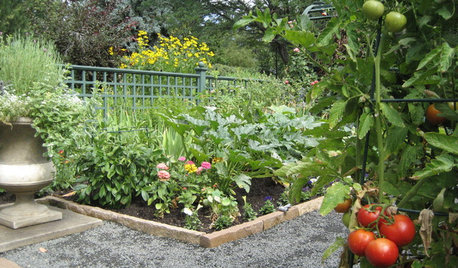
Hi everyone. The raised garden beds are constructed, filled and planted. Now I have some little sprouts peeking out of the ground and wondering what can I use to control pests organically. AND, when to start with pest management - wait till I see a problem and diagnose at the time or something preventitive ahead of time? I am using the companion planting method as I understand that should help keep pests away (nasturtiums, parsley, onion, basil). Any other suggestions???

Comments (18)

  • 16 years ago

    Integrated Pest Management is the organic pest control method of choice, but that only comes into play when there is an apparent problem. The time to start on pest, and plant diseaase, control is when you start working on the soil. Plants growing in good, healthy soil are less susceptible to insect pests and plant diseases and a good healthy soil has balanced nutrients and is well endowed with organic matter so that soil is evenly moist but well drained.
    If pests, or diseases, do show up you want to start with an assessment about is this doing more damage then I can put up with or will natural predators help keep things in control. Then properly identify the problem and if some means of control might be needed find the least toxic means of control that shouild work. Apply that means of control with care so the natural predators are not overly harmed and then review what you did. Did it work?

  • 16 years ago

    Aren't you here in FL? I couldn't tell from your page.

    If you are, you might want to sprinkle some iron phosphate snail bait around to keep you seedlings from disappearing before they're strong enough to withstand the slugs & snails. It won't harm anything but the molluscs.

    You don't say what veggies you planted, but about the only emerging seedlings snails seem to leave alone are in my garden are parsley, lettuces, arugula & papayas

  • 16 years ago

    carol - yes I am in SWFL. Would I find that iron phospate in any garden center? I also wondered if DE would work as a preventative. I have sugar snap peas, cucumbers, zucchini, tomatoes, salad mix, kale, cabbage and broccoli. I also want to plant butternut squash & spaghetti squash but am waiting a bit longer to do those.

    Kimmsr - I used a soil mix from Forestry Resources and layered along with compost from our bin here and hay. I did this based upon a kind of tutorial I saw on another gardening site. Hopefully

  • 16 years ago

    (To be nit-picky, nasturtiums don't keep pests away. They attract them.)

  • 16 years ago

    annpat - I had read in a companion planting guide that they keep pests away from other veg plants. If this is not the case then should I get them out of there and replace with something else?

    TIA :)

  • 16 years ago

    Mrs tlc, I agree with kimmsr and Carolb (I claim ignorance about the companion planting). May I also interject with a quote from one of my favorites, Malcolm Beck?
    Rules to Grow By:
    1)Use the best adapted varieties for each environment
    2)Plant in preferred season
    3)Balance the mineral content of the soil
    4)Build and maintain the soil organic content- humus
    5)Do nothing to harm the beneficial soil life
    6)Consider troublesome insects and diseases as symptoms of one of the above rules having been violated.

    He considers rule 4 to be the most important.

    All the best.

  • 16 years ago

    To know whether that soil is good and healthy still requires periodic testing to see what is available to the plants. Contact your local office of the University of Florida about having a good, reliable soil test done for that soils pH as well as nutrients, and then dig into that soil with these simple soil tests to see if there is anything else that needs be done.
    1) Structure. From that soil sample put enough of the rest to make a 4 inch level in a clear 1 quart jar, with a tight fitting lid. Fill that jar with water and replace the lid, tightly. Shake the jar vigorously and then let it stand for 24 hours. Your soil will settle out according to soil particle size and weight. For example, a good loam will have about 1-3/4 inch (about 45%) of sand on the bottom. about 1 inch (about 25%) of silt next, about 1 inch (25%) of clay above that, and about 1/4 inch (about 5%) of organic matter on the top.

    2) Drainage. Dig a hole 1 foot square and 1 foot deep and fill that with water. After that water drains away refill the hole with more water and time how long it takes that to drain away. Anything less than 2 hours and your soil drainsâ too quickly and needs more organic matter to slow that drainage down. Anything over 6 hours and the soil drains too slowly and needs lots of organic matter to speed it up.

    3) Tilth. Take a handful of your slightly damp soil and squeeze it tightly. When the pressure is released the soil should hold together in that clump, but when poked with a finger that clump should fall apart.

    4) Smell. What does your soil smell like? A pleasant, rich earthy odor? Putrid, offensive, repugnant odor? The more organic matter in your soil the more active the soil bacteria will be and the nicer your soil will smell.

    5) Life. How many earthworms per shovel full were there? 5 or more indicates a pretty healthy soil. Fewer than 5, according to the Natural Resources Conservation Service, indicates a soil that is not healthy.

    Here is a link that might be useful: UofFl CES

  • 16 years ago

    I bought Ecosense slug & snail killer @ Home Depot & am on my 2nd shaker - 1st can lasted me through 3 seasons.

    DE works better indoors, IMPE. I've used wettable sulfur for mites & I have insecticidal soap, which I hardly ever use & something called Organocide, which I think I've used twice.

    I tend to resist spraying insecticides on my plants - it may try your patience, but, when there is an insect infestation, the predators WILL show up to eat & lay eggs ( & sometimes I help things along by transferring ladybug larvae, et al. to infested plants). I find that intermingling flowering herbs & wildflowers helps attract beneficials too. & don't overlook paper wasps & the ubiquitous anoles (& other reptiles/amphibians) - they eat those pests too.

    If you provide some water for the birds they'll help as well.

    UF's IFAS has a cool insect ID/info site.

    Here is a link that might be useful: Featured Creatures

  • 16 years ago

    Pests and disease are a given with gardening. Minimizing the potential would seem the best course. Noting that the soil is the most uncontrolled environment must be appreciated. Our management enhances survival and harvest.

    I prefer to start the most prone plants from seed under lights in a prepared soil mix; the mix is your choice but I locate one approved by OMRI. Under the lights I can control the moisture and temperature suitable for germination and growth until transplanted.

    Preparing the soil for the transplants is on-going. The fall cover crop is tilled under and allow the organisms to incorporate it sufficient to avoid negative influence to future seedling transplants. Weekly (2-3) before transplants I scratch the top 1-2" of topsoil for cutworms and weeds. In the week ahead of transplant I lay out the drip lines appropriate for my planned layout; 9" and 18" emitter spacing or individual fed emitters. The week ahead of transplant is also a good time to incorporate your cured compost.

    A mention of the plan reveals that I plant in 3' wide beds. Each bed receives a mixed planting based on companion planting; 3-5 different species. Some of the direct seed species go in before or with transplants. Many of the companion plants provide the best companionship action when in bloom; like the radishes, nasturtiums and herbs.

    The brassicas are an invitation to pests. All of these get a row cover to keep out the moths. This is the cleanest option.

    Checking the soil pH each month is part of the routine. While there is little one can do for immediate correction, you can select a mulch of specific pH so not to compound the problem. Make a note for fall action with pH.

    Finely crushed eggshells surround the tender plants that attract slugs. Coffee grounds can also deter some of the crawlers. Old copper plumbing pipe cut in half can form a nice boarder and really blocks the slugs and snails. Shallow dishes of vegetable oil and soy sauce make nice traps; even for the odd cutworm. I avoid anything even moderately harmful to pets and children. The larger pest like crows and raccoons are always a challenge since they are so creative.

    Selecting variety for resistances is good but I also save seed from those plants displaying acquire horizontal improvements. It is great with heirlooms which can adapt over the years. I have gardened for over 40 years and have found heirlooms for all my plantings.

    By far the most critical is the healthy soil. Correct pH, balanced nutrients and a diverse amendment with organic matter provide the best of growing environments for your plantings. Close monitoring and management plan increase your successes.

    Good luck.

  • 16 years ago

    Monthly soil testing is usually a waste of your time and energy, and money, because it takes time for what you do to start to show results. Most all commercial farms I know of have an annual soil test done so they do not spend money on stuff not needed (lessens profits) but do not test more often because that is a waste of money (cuts into profits). For most of us soil tests more often then 3 to 5 years probably are unnecessary although periodic soil tests are necessary, and good organic practice as well as the environmentally proper thing to do.

  • 16 years ago

    Kimmsr, I have the pH kit so monthly is not a problem or expense for me. I do not fully test my compost but a measure of the pH guides my applications; and inputs to the compost to a minor level. Any fall amendment to change the pH should be confirmed; and salinity.

    Soil tests are a good indicator of progress in soil improvement. A newly broken soil plot/field can be tested for the initial three years if imbalance is significant. Any change of organic matter amendments not accurately analyzed can foul up a soil management plan. Even a well calibrated pH meter is a great tool.

    Know what your soil needs and know what you add. Have a plan. Know your amendments. It can also be said to use the same analysis lab; and know when they change testing methods. Having a like analysis permits comparison.

  • 16 years ago

    I haven't even finished reading all of the very insightful replies here and this morning I went out to the garden to find what I am hoping won't be a serious issue. There were two holes in one of the raised beds that were about the diameter of a pencil and I wondered what it was. Then I went over to the other bed and suddenly this flying insect flew down and burrowed into the soil. It looked like a BSF and it had a white egg or what looked like maybe an egg sack on it's butt.

    Could it be laying its eggs in the soil? And, if so, will the larvae eat the veggies I'm trying to grow???

  • 16 years ago

    I had posted about these flying/burrowing things on another forum and it seems as though they may be andred bees and will cause no harm.

  • 16 years ago

    If you are a newish gardener, here's what I would say: Make your garden attractive to beneficials and ignore everything else. New gardeners panic when they see a hole in a leaf and want to bring out the big guns. If you are a newish gardener, I would advise you to work on your soil and ignore petty pests. If you're a longtime gardener, ignore me, you know the difference between a slight infestation and a real problem.

  • 16 years ago

    Oh, that's not what I really meant to post. I meant to say that some plants are attractants and some are repellents. Nasturtiums attract aphids. That's great if you have aphids, but some people (me, for instance), only have aphids when they (I) grow nasturtiums.

    It's a minor point. Nasturtiums are a fun, pretty plant to grow. I grow marigolds, garlic and mint as repellents. I never plant beets and beans near one another because I heard they are mutually antagonistic. I like to grow dill and tomatoes and marigolds near one another because I once read that they are compatible. Everybody likes to grow near garlic (I read).

  • 16 years ago

    I get some leaf damage to my potato plants, and my roma tomatoes get holes (but the early girl and better boy tomatoes seem to escape major damage). The sweet corn gets some damage, depending on the variety or corn.

    I'm thinking of intermixing my plants to better foster an environment for the beneficials to live in. My thinking is that planting a block of melons together creates an environment where a pest can suddenly infest. If the melons are interplanted with other plants, the beneficials that are preying upon the pests of tomato, potato, pepper and other plants, will be in place to prey on the pests of the melon plants. I'm not sure what to do about the sweet corn.

  • 16 years ago

    It can be helpful to put a bird bath or two in the middle of or nearby the veggie garden. This attracts birds to your garden who will prey upon the bugs. Also grow some perennials that produce seed or some woody plants that produce berries nearby the vegetables, to further attract birds to your garden.

    My veggies grow in the midst of a large bird and butterfly garden that is a mix of perennials, annuals, grasses, and woody plants, along with 3 bird baths and a couple snags for perching. Sometimes the garden and yard are simply teeming with birds. I don't have much problem with pests, except for slugs, and the iron-phosphate products work very well for those.

  • 16 years ago

    I wish I could find a method of managing squash bugs. They decimated my plants this year and I would love to be able to grow both winter and summer varieties. Last year they showed up much later, after I had had a decent harvest, but this time they appeared as soon as my plants developed leaves! I intermixed and tried neem oil spray, but nothing really worked.