Software
Houzz Logo Print
formandfoliage

Cotinus x 'Grace'

I've grown Cotinus for the last dozen years or so, but most were C. coggygria varieties such as 'Royal Purple' or 'Pink Champagne'. I tend to coppice them at least every other year, as I prefer them smaller and am willing to sacrifice the flowers for larger leaves closer to eye level. I also have one C. obovatus that I got for fall color, which is stupendous. Over the last few years, when it seemed like 'Grace' was what everyone was talking about and the others could just not compare, I got a few 'Grace'. I am not happy with her growth habit; it seems whether I coppice or leave her alone, she puts on 10-15' of growth every year, in wildly arching branches that curl back on themselves and have most of their leaves at the ends. She also fasciates like crazy, which I don't mind per se but wonder why, as it is much more frequent than anything else I have in the garden. So, does anyone have any thoughts about 'Grace'? Is this branching structure just normal for her? Any thoughts on how to prune? Her fall color is very lovely, and if I could just tame her rebelliousness a bit I'd keep her where she is. Otherwise I think I'm going to relegate her to the back 40, as I generally don't like to have to try to make a plant be something that it's not. It seems like the coggygria/obovatus cross is what results in these branches...

Thanks in advance for any light you can shed on Grace and her habits.

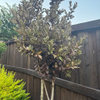
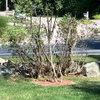
(Note: in the first picture that's Grace in the right rear of the photo)


{{gwi:242879}}

{{gwi:242881}}

{{gwi:242884}}

{{gwi:242886}}

Here is a link that might be useful: Form and Foliage

Comments (19)

  • 14 years ago

    Mine has long since returned to dust. Awful plant. It grew exactly as you say, shooting up 10' or more every year, in every direction, never looking nice. Cut it or not, made no difference. I can't remember if I killed it or if it wilted itself to death, but I shed no tears.

  • 14 years ago

    I don't like intermediately colored (coppery or bronze) forms that are neither a good deep purple nor pure green.

  • 14 years ago

    Thanks Kevin, that's what I needed to know. It is such a bizarre growth habit, and has been the rage of the designers because of the fall color and large leaves. But I think it is a case of them not knowing how the plant grows past the first year. New introductions need more experience before they can be blessed....like all of those variegated plants that revert almost before your very eyes...

    Here is a link that might be useful: Form and Foliage

  • 14 years ago

    A consultation client had been trying to grow one as a small lollipop tree in a tiny corner bed near a city sidewalk, the regrowth from the annual hard pruning was much too vigorous to fit the space. I suggested training it up into a taller tree shape that could be walked under.

    A typical green American smoke tree at the Lakewold estate was over 50' tall when measured. 'Grace' is half this species, and the European smoke tree is no small shrub either.

  • 14 years ago

    It will be interesting to see what it does. C. obovatus does, indeed, get huge. I don't mind the size per se, it's the bizarre arching branches that curl at the end, and the ones that shoot straight up 15' in one season. Keep us posted!

    Here is a link that might be useful: Form and Foliage

  • 14 years ago

    Hard pruning makes Cotinus produce snaking growths, that's why I don't care for this treatment.

    And I'd rather have flowering.

  • 14 years ago

    Here we are in a different forum!
    I have always coppiced my 'Royal Purple' and get no snaking growth whatsoever, just a nicely shaped shrub. I do 1/2 of them every year, so I get flowers on the other 1/2. I don't coppice my c. obovatus because it is in a spot where big is ok and I want as much foliage as possible due to the incredible fall color. So, I can't speak to what it does if coppiced. But that C. 'Grace' produces, exactly as you say, snaking growth whether coppiced or not. I've tried it both ways, and I'm not happy with the result either way.

  • 14 years ago

    Multiple examples of natural-form 'Grace' seen here that, although vigorous and rather open, do not produce contortions.

    Purple European smoke bush grown here at my place for many years always grew back goofy whenever and if ever cut down low, so most years it was left alone.

  • 14 years ago

    Thx - One last thought is that the C. 'Grace' here were all planted (I have about six of them) in reasonably rich soil - no fertilizer, but we amended the native soil with compost. Our native soil is adobe and adding the organic matter is necessary for drainage, workability, etc. It may be that they really went bananas due to the amped up soil. Nothing else seems to have done so, but 'Grace' may have a mind of her own! I am going to move her to a hillside we have behind a lake, where she can get as big and funky as she wants. The others, all coggygrias, were planted in spots where I did not amend, which is another variable to consider.
    Thanks for all of your insight. Say goodnight, Gracie!

  • 14 years ago

    >Our native soil is adobe and adding the organic matter is necessary for drainage, workability, etc.I wouldn't organically amend soils to be used for growing trees and shrubs or perennials that are not going to be lifted and re-planted frequently. This is a long dis-proven practice, which began to be seen to be erroneous by horticultural methods investigator and trailblazer Carl E. Whitcomb during the late 1960s. If the existing soil is too heavy for the kinds of plants to be grown use mounds, berms or raised beds of lighter soil brought onto the site instead.

    For some modern gardening information...

    Here is a link that might be useful: Linda Chalker-Scott

  • 14 years ago

    When did you guys cut them back?

    I suggest you cut them back a couple times (prior to July) during the growing season to create secondary branching.

    I have always found that cutting back just in late winter or early spring creates the more leggy shoots.

  • 14 years ago

    If doing as whaas has suggested, would this suckering growth make them a candidate for a quick espalier?

  • 14 years ago

    Thanks all - first, I know NOTHING about espaliering - this shrub doesn't strike me as a likely candidate, but I bow to the superior knowledge and experience of others.
    I'll try waiting until the growing season to do some selective pruning and see how I do before I relegate all of them to the back 40.
    And thanks, bboy for the great reference to Prof Whitcomb - his seminal work seems to have become the standard. I should have clarified; I don't amend the holes - we built entire beds and berms due to the combination of the native adobe and the fact that we are gardening on reclaimed pasture that had compaction issues, cracks, etc etc so needed a rather major re-working. My husband loves to use his backhoe so it was not as onerous a task as it might have been (and not at all onerous as far as he was concerned!) Thanks again - I spent about an hour reading all kinds of things that GooglingProf Whitcomb took me too. Nice way to spend time even though I didn't get done anything that I was supposed to be doing!

  • 14 years ago

    I knew you were talking about beds, still the same issue with decomposition and loss of amendments over time - with no ability to re-amend when it is a planting of long term plants.

    And the fact that many trees and shrubs are not adapted to highly organic soils and soils with fresh organic material in abundance, unlike annual vegetables and flowering annuals which have often been developed from wild plants that pop up on freshly disturbed soils in nature.

    If on the other hand you plant in berms, mounds or raised beds of coarser soil that is such because of a higher sand and fine rock (mineral) component then the greater level of aeration and drainage provided lasts indefinitely.

    And you don't have to dig anything except planting holes.

  • 14 years ago

    I think we are on same page...adobe is a special animal as the only way to make it workable is to add some organic material. If you add soil that is gritty, especially if it's sandy, you get cement. We also have to consider expense and expedience; we have the adobe, and we have the organic material (we run a 50-stall equine operation). So, we buy soil that is high in mineral content and low in organic material and mix all three when the adobe is workable (about three days out of the year!) WE've been doing this for years and seem to do fine. There is some minor settling but we berm and plant with that in mind. I'm part of the Farm Advisor team here in the county and soil issues are a big part of what we work on.
    Thanks again - I really appreciate your insight and I will make sure that we don't 'over compost'! Your comments are a good reminder for all of us, especially anyone starting to grow woody plants for the first time! This would make a good article for publishing on the conifer page, or maybe everyone there already knows it...
    I got myself into this by remarking that maybe 'Grace' was goofy due to 'amended' soil, which was a real stretch but I was looking for another variable that perhaps I hadn't considered.

  • 14 years ago

    Well especially if you are already buying coarser soil and bringing it in you should be berming with the imported soil instead of mixing it with the heavier stuff. A little clay goes a long way. Mixing fine material into coarse material is a great way to ruin the usefulness of the coarse material for growing plants that need it.

    You get sand to break up a fine soil by using a lot of it, if you are getting cement you aren't using enough sand. But again, I would just buy sandy soil and plant in piles of that, instead of mixing sand into what I already had. I used to have pit run berms here, everything I tried in it grew.

    I got rid of them because I decided I wanted to go back to having a flatter, more accessible entry area - not because I had not gotten excellent results from the method.

  • 14 years ago

    Ok willing to throw in the trowel...of course your points are all correct. However not the most optimal to execute due to practical limitations, mostly budget. We trucked in 100s of yards of soil as it was, could not imagine having to have done more (wouldn't have been any money left to buy plants!) if we had not used other material as well. And we had the consideration of the composted horse manure and shavings, which we would have had to have paid to truck out! Our best solution was to make the most of what we had, and believe me, you don't need to tell me that a little clay goes a long way! General Vallejo's adobe house is right around the corner...we've been here over 15 years and the plants seem to have done very well.
    So, I think that we can consider that we have beaten this thread into the ground, but whether that ground is amended, native, sandy, loamy, remains to be seen!
    Thx...

  • 14 years ago

    I have Grace pruned into a 5-foot standard and it's one of my favorite plants. I have very little room so it pops up along a white picket fence border among shrubs and perennials and provides some late afternoon shade to a hydrangea.

    I prune the branches to about 1-foot in early spring as the foliage emerges and then prune back a few branches here and there as the season progresses. The foliage is stunning all season, but the bright red foliage in early spring just can't be beat.

    Given how little space I have, Grace is one of many plants (Beech, Hydrangea pan., Crepe Myrtle, Wisteria) I simply couldn't keep unless I train them as standards.