Software
Houzz Logo Print
perennialfan273

Don't touch that roundup!!

15 years ago

Okay, as it's getting closer to spring, a lot of us are reaching for the pesticides to get rid of the weeds that are beginning to congregate. But before you do, let me ask you something. Are you willing to add more poison to the earth just to make your garden look a little bit nicer (that is, if it even works) for just one season??

Comments (39)

  • 15 years ago
    last modified: 11 years ago

    Read this for the latest info on glyphosate. Granted, this is in relation to widespread spraying on food crops, but as we learn more about it, I wonder if we want to spray it on our gardens at all. Nothing beats hand pulling weeds..

    Here is a link that might be useful: Roundup

  • 15 years ago
    last modified: 11 years ago

    Ok...so how exactly do YOU get rid of muscadine, honeysuckle and every other horrible weed in your multi acre patch?
    Forget round up, it's not strong enough, I miss Brush Be Gone!
    And I have tons of moles, voles, lizards, bees, rabbits, worms and bugs.

    I understand the general reasoning but I couldn't garden without roundup, I'm not totally on the bandwagon.

  • 15 years ago
    last modified: 11 years ago

    It could be the most benign substance on earth and I still wouldn't choose to give my money to Monsanto. Hand torch, strong vinegar, boiling hot water, heavy mulching, hand tools -- all ways I'd go before Roundup.

  • 15 years ago
    last modified: 11 years ago

    Monsanto would drench the entire earth with their poisons if it meant something in the way of short-term profit. Check them out; their disgusting record is available for all to see.

  • 15 years ago
    last modified: 11 years ago

    There does seem reason for concern. Here's another, shorter summary of some of the problems with Roundup:

    Subject: The 10 reasons, roundup.
    From: "John A. Keslick, Jr." treeman@pond.com
    Date: Tue, 29 Apr 2000 06:49:46

    Compiled by Caroline Cox, Northwest Coalition for Alternatives to Pesticides- (NCAP)

    Roundup, and related herbicides with glyphosate as an active ingredient, are advertised as products that can "eradicate weeds and unwanted grasses effectively with a high level of environmental safety." However, an independent, accurate evaluation of their health and environmental hazards can draw conclusions very different from those presented in the ads. Consider these facts:

    1. Glyphosate can be persistent. In tests conducted by Monsanto, manufacturer of glyphosate-containing herbicides, up to 140 days were required for half of the applied glyphosate to break down or disappear from agricultural soils. At harvest, residues of glyphosate were found in lettuce, carrots, and barley planted one year after glyphosate treatment.

    2. Glyphosate can drift. Test conducted by the University of California, Davis, found that glyphosate drifted up to 400 meters (1300 feet) durng ground applications and 800 meters 12600 feet) during aerial applications.

    3. Glyphosate is acutely toxic to humans. Ingesting about 3/4 of a cup can be lethal. Symptoms include eye and skin irritation, lung congestion, and erosion of the intestinal tract. Between 1984 and 1990 in California, glyphosate was the third most frequently reported cause of illness related to agricultural pesticide use.

    4. Glyphosate has shown a wide spectrum of chronic toxicity in laboratory tests. The National Toxicology Program found that chronic feeding of glyphosate caused salivary gland lesions, reduced sperm counts, and a lengthened estrous cycle (how often an individual comes into heat). Other chronic effects found in laboratory tests include an increase in the frequency of lethal mutations in fruit flies, an increase in frequency of pancreas and liver tumors in male rats along with an increase in the frequency of thyroid tumors in females, and cataracts. (ne fruit fly study used Roundup; the other studies used glyphosate.)

    5. Roundup contains toxic trade secret ingredients. These include polyethoxylated tallowamines, causing nausea and diarrhea, and isopropylamine, causing chemical pneumonia, laryngitis, headache, and bums.

    6. Roundup kills beneficial insects. Tests conducted by The International Organization for Biological Control showed that Roundup caused mortality of live beneficial species: a Thrichgramma, a predatory mite, a lacewing, a ladybug, and a predatory beetle.

    7. Glyphosate is hazardous to earthworms, Tests using New Zealand's most common earthworm showed that glyphosate, in amounts as low as 1/20 of standard application rates, reduced its growth and slowed its development.

    8. Roundup inhibits mycorrhizal fungi. Canadian studies have shown that as little as 1 part per million of Roundup can reduce the growth or colonization of mycorrhizal fungi.

    9. Glyphosate reduces nitrogen fixation. Amounts as small as 2 parts per million have had significant effects, and effects have been measured up to 120 days after treatment. Nitrogen- fixing bacteria shown to be impacted by glyphosate include a species found on soybeans and several species found on clover.

    10. Roundup can increase the spread or severity of plant diseases. Treatment with roundup increased the severity of Rhizoctonia root rot in barley, increased the amount and growth of take-all fungus, a wheat disease), and reduced the ability of bean plants to defend themselves against anthracnose.

    These facts about Roundup are taken From a two-part article about the health and environmental hazards of glyphosate published in NCAP's Journal of Pesticide Reform. Copies of the article, with complete references for all of .the information presented, are available from NCAP for $2.00. NCAP, PO Box 1391; Eugene, OR 97440; (541) 344-5044.

    _________________________________________________________

    Now, what about the stuff called 'Preen'? I've never used it, but just the basic concept scares me.

  • 15 years ago
    last modified: 11 years ago

    yes.. i am ready to use it ...

    and no .... it is not a pesticide ... where do you go with a thesis that starts by calling a herbicide a pesticide ...

    as to the list above which have no proper footnoting in science but what appears to be a copy of a GW post ...

    where do you go with a quote like this as scientific evidence:

    3. Glyphosate is acutely toxic to humans. Ingesting about 3/4 of a cup can be lethal....

    seriously.. i think i can avoid guzzling THREE QUARTERS OF A CUP ...

    i think i can avoid #4 also, by not chronically feeding it to myself : The National Toxicology Program found that chronic feeding of glyphosate

    define chronic feeding for me.. is it more than 3/4 of a cup ... or less ... seriously .. EVERYTHING.. if chronically fed .... to you is toxic.. first it was eggs... then fats.. then etc ..... are you coming for my bacon ?? i hear/read that if you eat three quarters of a ton per day.. that it WILL CAUSE DEATH .... but i cant live without bacon .. its Gods gift to mankind ... in appropriate doses, of course ....

    also MSDS sheets do not allow Roundup contains toxic trade secret ingredients.

    pshaw .... rumor mongering at best .... right up there with global warming proofs .... just keep repeating among yourselves ..... hoping to convince everyone else ...

    ken

    ps: forgive me rhiz .. i do understand that there are exceptions .. be kind to me ... lol ...

  • 15 years ago
    last modified: 11 years ago

    I was under the impression Herbicides, Insecticides and Fungicides are all classed as Pesticides, Myself I try to be as organic as I possibly can but there are times when I have clenched my teeth and used the unmentionables in order to save something, but thankfully I've not had to in the last couple of years.

    Annette

  • 15 years ago
    last modified: 11 years ago

    I manage to avoid drinking it too! And sudden rain causes earthworm death, evidenced by the hundreds all over my driveway after a downpour.

  • 15 years ago
    last modified: 11 years ago

    You are correct Annette. If you want to be more specific, than yes Roundup is technically an herbicide, but any sort of chemical spray used in the garden to eliminate a pest is considered a pesticide.

  • 15 years ago
    last modified: 11 years ago

    A flame gun is a good alternative if you are controlling weeds on a small scale.
    As it is a flame coming out of a gun it shocks the plant which usually will kill them.
    You can make this device yourself or buy it pre made.
    I have seen the guns for sale on ebay (australia).
    It is more expensive initally but will pay for itself in no time.

  • 15 years ago
    last modified: 11 years ago

    I am not comfortable with the use of herbicide for merely cosmetic reasons, nor do I use chemicals of any kind in my gardens. I would not risk poisoning the insects or birds that visit the gardens! It's not that difficult to weed them without using chemicals, for example using the scuffle hoe when the weeds are fairly small. I hate weeding, but try to do a section at a time. Over time, the weeds seem to lessen as long as you don't let them go to seed.

    However, I occasionally use a light spray of Roundup in certain short-term applications, like to control an infestation of Garlic Mustard or clear an area to prepare for seeding (lawn or meadow, for example). I also use brush killer, like Brush B Gone concentrate, and apply to the cut stumps of seriously invasive woody plants like Oriental Bittersweet, Norway maple, and Glossy Buckthorn. These are nearly impossible to control without herbicides.

  • 15 years ago
    last modified: 11 years ago

    I've lived on my property for over 30 years and never used a pesticide, herbicide or any other 'cide'. It hasn't been that hard to do. I've had my share of unwanted plant material, bugs and disease that I could have used it for, but I decided early on that I don't believe man always considers the long term effects on people, birds, insects or the earth when creating products. There are lots of examples around us to support that belief, if you are paying attention to it and considering it. I don't need a 20 year study, that 5 years from now, someone is going to disprove the validity of, anyway, to prove that to me. I don't have any faith in the government agencies that monitor these companies and their products. My trust is really in the natural world that man had nothing to do with. I have always felt the closer we can get to working with nature instead of against it, the better off we all will be.

    And supporting companies that have a social conscience, that share my respect for the natural world, are the companies I want to support with my purchases, whenever possible. Why would I want to keep buying products from a company that could care less and increase their strength and then they turn around and put the company that's trying to operate on some principles other than just profit, out of business.

    I don't have the situation that Terrene has with invasive plants. I've had a few persistent weeds but managed to free myself of them without resorting to using any product. I still have one that I haven't gotten rid of yet, but I will when I put my focus on it. I have winter moths that make a mess of my maples every year, but I would rather live with that than use chemicals. And I've noticed two years running that starlings show up in the spring and make a feast of them and the damage has been less. I have the Red Lily Beetle, but I manage to hand pick them to still enjoy my one stand of Casa Blanca and I am limiting my purchase of Lilies until and and if the beetle is less of a problem. Occasionally I've had a bug problem that I've made a garlic/hot pepper spray that worked fine. The aphids show up and the ladybugs are right behind them. If I have a disease, I rip the plant out and try again in a new location or try a different kind of plant. I don't find that a difficult way of gardening but rather it's very freeing. I don't even have to read that article on the negative effects of Roundup or worry my little head about it. [g] And I'm encouraged when I see so many more people today then when I first started to garden this way, that are doing the same thing.

  • 15 years ago
    last modified: 11 years ago

    After participating in GW forums (and other online gardening groups) for a decade or more, I find posts like this to be extremely disingenuous and designed to foster dissension and argument rather than educate or provide enlightenment. Pesticide usage - RoundUp in particular - ALWAYS encourages a lot of vocalization......most of it parrot-like repetition of something someone has read online that may or may not have any scientific basis behind it. There's a whole lot of junk science out there and a very large portion of it seems to be devoted to this topic. Like most everything else, pesticides are not wholly evil, neither are they entirely benign. Many have their place in the greater scheme of things and a great many gardeners would be in dire straights without them. It is also important to realize that many 'organic' or natural pesticides can have very serious impact on people and the environment as well.

    While I am not an advocate of RoundUp for general use, it does have valid uses. Why anyone would think it is an appropriate product to use in a perennial garden - being a broad spectrum herbicide - is a bit beyond me. But I would never condemn anyone for using this product as directed for certain applications where broad scale weed control may be required. As pesticides go, most herbicides tend to be rather short-lived, breakdown in the soil relatively rapidly and of minimal impact to humans and other mammals.

    If you are going to get on a high horse about pesticides, you might want to focus your attention on insecticides and fungicides, as these tend to be the longest lasting in the environment and of the most ecologically disruptive as well as often having long range serious health implications for humans and other mammals.

    Here is a link that might be useful: for Ken - EPA definition of 'pesticide'

  • 15 years ago
    last modified: 11 years ago

    I don't have a problem with using Roundup or other herbicide, for certain defined indications where it is highly inconvenient or impossible to get along without them.

    The focus should be on using them in a safe and limited manner, using alternatives where possible. For example, instead of Roundup I use a simple propane burner to scorch out weeds that sprout in my garden path. No residues, no druft, and cheaper than buying the quantities of Roundup I'd need to do the job.

    I've previously advised here against using Preen, a pre-emergent herbicide that to me has even less justification for its use, considering that feeding mulches do just as good a job and are much better for the garden (not to mention being a lot easier on the environment).

    "If you are going to get on a high horse about pesticides, you might want to focus your attention on insecticides and fungicides, as these tend to be the longest lasting in the environment and of the most ecologically disruptive as well as often having long range serious health implications for humans and other mammals."

    This argument takes the common tack of trying to ridicule people who having a legitimate concern, by arguing that there are more serious things they should spend time on. There's no reason that posters on this topic aren't already well aware of hazards associated with insecticide and fungicide use. It doesn't mean they shouldn't express their opinions on herbicide use as well.

  • 15 years ago
    last modified: 11 years ago

    pardon me......I wasn't trying to ridicule anyone! It is simply that RoundUp seems to be the poster child for pesticide abuse, perhaps because it is so well known and so widely used, but it is by far one of least troublesome of these substances. And it is my experience that on the whole, most folks are quite unaware of or have a faulty understanding of pesticides in general. Previous responses to this thread have made that rather obvious.

  • 15 years ago
    last modified: 11 years ago

    PM2, I tried to control the Lily Leaf beetle by hand picking, and dropping them in a container of soapy water, which does work pretty well if you're diligent. Although Lilies are beautiful, for me it just wasn't worth the aggravation, so I dug them all up last Spring! Onto the compost pile! Better that than use pesticides IMO.

    Also, many invasive plants can be hand controlled too - but not on the scale that my 1.25 acre lot was infested. I would love to eliminate all of them, but consider them "controlled" when the fruiting specimens are eliminated. I DO pull zillions of seedlings, and have a weed wrench for yanking medium sized plants, also dig out many with the shovel, but larger woody invasives have to be cut. Most will resprout from the base, so I use a squeeze bottle to carefully apply a small amount of herbicide to the cut stump.

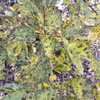
    Here's a pic that shows an example of some of the oldest Oriental bittersweet (Celastrus orbiculatus) vines that were growing up a beautiful old Choke Cherry tree in an overgrown section of the yard and had nearly strangled it to death. The pic doesn't show scale, but those vines are about 3 inches diameter, at least 30 years old, and there were numerous smaller vines in the vicinity. Also, in the lower left corner - one of 500 Norway maple seedlings!
    {{gwi:197564}}

    Here is an example of a Common Buckthorn (Rhamnus cathartica) which was cut at the base and poisoned to prevent resprouting.
    {{gwi:197565}}

  • 15 years ago
    last modified: 11 years ago

    I shared my opinion and experience on this topic because, I believed it might be of value to someone. I consider it both educational and enlightening to anyone unaware that someone can grow a garden without using chemicals, organic or otherwise. I think it's information that is hard to come by... 30 years of experience taking an organic approach. I posted without criticizing anyone else for their opinion. I'm surprised that anyone would not at the very least, find that of interest in a gardening forum, let alone decide to criticize someone for sharing it.

    Terrene, you are so right, the Red Lilly Beetle does take a lot of diligence. Some years I do and some I don't, so I planted my Casa Blanca in back of a Hydrangea bush that hides the foliage if I'm not keeping up with it as well. Last year I really put a lot of effort into it and I'm hoping I will have fewer this year. I was tempted to pull mine out, and I may still do it if it gets away from me. If it were otherwise, I would probably have a garden full of lilies. I love them.

    I don't envy you the work you've had to do to struggle with all the invasives on your property. I also have a smaller property than you do. We did have a lot of overgrown saplings along our back lot line that we dug out by hand. I've seen those weed wrenches that make quick work of small saplings and if I had a larger problem I probably would have looked for one. I have an oriental bittersweet that seeded into my shrub border without my noticing it from a neighbor's yard and it did worry me last year when I discovered it. It is one of the last areas that hasn't been renovated, so I have enough shrubs to get out of there that I'm considering a backhoe would make quick work of that small section hopefully this spring.

  • 15 years ago
    last modified: 11 years ago

    The topic is interesting and helpful but it's the black and white approach I find annoying.
    I am clearing a half acre of muscadine, smilax, wild rose, honeysuckle and privet (and a whole bunch more stuff I'm not listing) that have entrenched themselves around nearly every tree. It is a brushy viney thicket and I am doing it by hand. The muscadine vines are 3" thick in most areas.
    Possibly a flame thrower might work but frankly that scares me a whole lot more than a sprayer.
    The area is too tight with trees to use a backhoe, which I don't have, btw.
    The brush be gone, or it's equivalent, is effective, easy, cheap and what's to say it's worse than invasive vines?

    Once the area is cleared, I have cleared areas like this before, it will lay unplanted for a year at which time I will then plant camellias and azaleas.

  • 15 years ago
    last modified: 11 years ago

    Really? We're still talking about Roundup? Hasn't this subject been beaten to death? I only use Roundup on poison ivy which I'm deathly allergic to and for that I won't apologize. I feel that indiscriminate use of any pesticide or herbicide should be avoided, and I've been able to accomplish that for the most part in my little corner of the world. However, some people have pretty persistent weeds which must be addressed. As gardeners it's up to us to be stewards of the earth and try alternate "greener" solutions. But sometimes they just don't work. For me, Roundup has to be used repeatedly for it to really clear an area and I use different approaches. It's easy to be preachy on these sites, but until you have walked a mile in my shoes...

    The Red Lily Leaf Beetle has moved into my area and been a pest in my garden for 4 years now. Knocking them into a can of water is the only remedy that works for me. (It doesn't need to be soapy. All you need is a lid to contain them and the next day they've drowned.) I won't spray pesticides because for one they don't work, and two, my lilies are planted near a pond with my fish, frogs and dog who frequents the area. My solution is to consolidate all my lilies in one place so the chore isn't as laborious. I've considered ripping them out, but I can control them as long as I'm diligent. I can't avoid leaves with holes, but the flower is not lost. I get my revenge by pouring the can of water into the pond when I'm done. The fish LOVE a meaty treat and the cycle of life continues!

  • 15 years ago
    last modified: 11 years ago

    Ken, in response to a couple of your statements.

    "and no .... it is not a pesticide ... where do you go with a thesis that starts by calling a herbicide a pesticide"

    First, this isn't a thesis and second I think you misread the first few sentences. No one called Roundup a pesticide. Northwest Coalition for Alternatives to Pesticides is the name of an organization.
    ...

    "where do you go with a quote like this as scientific evidence:"

    I made no claims that this is a quote proving something as scientific evidence. It's simply another opinion addressing the claims by the manufacturer of Roundup that it is completely safe. There's lots more info out there challenging those claims. You may not want to read it, but that's up to you. I personally like to.

    In response to gardengals statement:
    "There's a whole lot of junk science out there..."

    Yes, there is a whole lot of junk science out there, but are you simply going to dismiss everything you don't like as "junk science"? Please tell us what we should dismiss as junk science? Is there an approved list somewhere? As to the statement about "high horse" , well I think your choice of those 2 words pretty well sets the tone of your statement.

    As has been said a million times before on all the GW Forums, if you don't like a particular discussion, you don't have to read it and you certainly don't have to participate.

    I found the following article rather interesting because it includes responses by Monsanto. I realize it's long, but still interesting.

    an article from The Sun (Malaysia),

    Concerns Over Glyphosate Use
    Monsanto and PAN are embroiled in a hot debate over safety of a widely-used
    herbicide. S.Puvaneswary has both sides of the story.

    A widely-used herbicide which accounts for 48% of the Malaysian market in
    pesticides may not be safe to use. A recent study which shows clear links
    between exposure to the herbicide glyphosate and non-Hodgkin's lymphoma
    (NHL), a form of cancer that afflicts the lymphatic system, has caused
    worldwide concern over the safety of the herbicide on humans. The study was
    conducted by eminent oncologists Dr Lennart Hardell and Dr Mikael Eriksson of Sweden and published in the journal Cancer by the American Cancer Society on March 15.

    It maintains that exposure to glyphosate "yielded increased risks for NHL".
    "What these scientists unearthed is indicative of the long-term chronic
    effects of pesticides", said Sarojeni V. Rengam, executive director,
    Pesticide Action Network (PAN) Asia and the Pacific. "In this case, where
    there are serious implications to human health, the precautionary principle
    must apply," she said.

    "We have to take precautions against using these dangerous chemicals." The
    widely-used herbicide glyphosate indiscriminately kills off a wide variety of
    weeds after application and is primarily used to control annual and perennial
    plants.

    PAN has called on the government to look at its regulatory standards on
    glyphosate residues because if such monitoring is not immediately done, the
    health of Malaysians would be at risk as glyphosate accounts for about 48% of
    the Malaysian market in pesticides, according to AGROW Crop Protection
    Report, 1996.

    The Hardell study is the centre of a debate between Monsanto, which refutes
    its findings, and PAN which upholds the study. The US firm manufactures
    Roundup, a glyphosate herbicide.

    The arguments and counter-arguments of both parties relating to the study
    were sent to the SUN.

    Monsanto's Argument:
    Previous evaluations conducted by the US Environmental Protection Agency
    (EPA) and the World Health Organization (WHO) suggest that glyphosate is not mutagenic or carcinogenic. WHO and the Food and Agriculture Organization (FAO) have approved the safety of glyphosate residues in
    genetically-engineered Roundup Ready soya beans.

    PAN's Counter Argument:
    The EPA and WHO evaluations were done more than five years ago and are based mainly on data submitted to them by Monsanto. These evaluations did conclude that "there is no evidence of mutagenicity or carcinogenicity" based on the available data, but they do not support definitive assertions that glyphosate "is not mutagenic or carcinogenic". (Nor did they look at the entire poison formula, contaminants and/or synergistic effects.)

    Previous EPA and WHO evaluations which made similar claims for other
    chemicals had to be revised as new evidence came to light. The establishment of the WHO's Acceptable Daily Intake (ADI) is based on limited studies using limited parameters which do not account for vulnerable groups such as children, the elderly, the sick and other groups that might have increased susceptibility to glyphosate exposure.

    Monsanto's Argument:
    Well-characterised scientific literature reviewing over 1,000 studies over
    the last 25 years demonstrates that extraordinary safety of glyphosate, the
    active ingredient of Roundup herbicide. (it is against the Federal Law to say
    even the labeled use of any economic poison is "safe" - obviously this does
    not apply to the poison producers.)

    PAN's Counter Argument:
    There are very few independent studies on glyphosate available in published
    scientific literature and no responsible reviewer of health science
    literature, health scientist, or toxicologist would claim "extraordinary
    safety" for glyphosate. Data from independent sources indicate serious
    concerns about glyphosate toxicity. In 1995, the National Poisons Centre
    reported an increase of glyphosate poisonings in Malaysia. In the UK, it was
    reported that glyphosate was the most frequent cause of complaints and
    incidents from pesticides recorded by the Health and Safety Executive.

    Monsanto's Argument:
    The epidemiology study conducted by oncologists Hardell and Eriksson did not find statistically significant associations between NHL and reported cases of fungicides and herbicides. Reported use of glyphosate, along with reported
    use of several other herbicides showed a weak, not statistically significant
    association with NHL.

    PAN's Counter Argument:
    A weak association is an association nevertheless, and could be statistically
    significant given that 211 million kg of glyphosate were used last year and
    the volume is growing at an average of 20% per year. The Hardell study
    observed a positive association between exposure to glyphosate and NHL, in
    which, chance and bias could be ruled out with reasonable confidence.

    Monsanto's Argument:
    Exposure to glyphosate is not likely to be meaningful. Exposure opportunity
    is almost exclusively through dermal contact. Glyphosate has shown very low
    skin penetrability in experimental studies.

    PAN's Counter Argument:
    Scientific principles, particularly toxicokinetics, must apply. The exposed
    person will be subjected to risks of adverse effects, known or unknown. Even
    if the chemical has low vapor pressure, appreciable inhalation exposure can
    occur since micro-droplets can form and particulates can be carried by
    movement of air. Oral intake can also occur through contaminated food or
    water. The fact that glyphosate is a systemic herbicide and persists in the
    environment for a relatively long period of time (as long as 3 years in soil)
    makes it likely to enter the body through residues (contamination) in food
    and water. Residues are unlikely to be removed from plant tissues and use of glyphosate in animal feed can result in residues in animal food products such as meat, milk and eggs. Residues are stable to up to one year in plant materials and water and up to two years in animal products in storage.

    Finally PAN upholds the right of farmers, workers and consumers to be
    informed, and to have access to all the information on poisons that they are
    using, spraying, and possibly consuming.

    In its statement to the SUN, PAN upholds the right of people to make informed
    choices on what they may be exposed to, and whether they are willing to beexposed to these chemicals.

  • 15 years ago
    last modified: 11 years ago

    One can find as many articles supporting the relatively benign qualities of RoundUp as those that dismiss the product as the root of all evil. And both can often be sourced to junk science or the reputedly scientific documentation that is produced by biased institutions without benefit of independent testing or peer review before publication. Neither is entirely correct and based on one's own bias or opinion, one can certainly find an article that will support one's own argument, either pro or con. It does take some research to cull the wheat from the chaff and not everyone is inclined to go to that much effort, nor necessarily have the scientific background to accurately evaluate the all the publications from all the various sources. I don't necessarily support either Monsanto's claims nor that of the Northwest Coalition for Alternatives to Pesticides as both are biased organizations -- one for and one against. PAN (Pesticide Action Network) and Extoxnet tend to present rather unbiased assessments, typically based on independent testing.

    This is just such a heated topic that I'm not sure it can or even should be discussed either for or against in these forums. There ARE valid reasons for using pesticides and if used properly and only according to label directions, most will present minimal environmental disruption. The long term impact to humans or other collateral organisms is in many instances a case of ongoing study, hence why many common pesticides have been removed from the marketplace in recent years. Because of its extremely widespread usage and its length of time on the market, glyphosate (RoundUp) has been rather more thoroughly studied than most. And it is still here.

    There are certainly personal factors involved when it comes to using ANY type of pesticide and they should be respected regardless of whatever one's point of view is. It is a matter of personal choice. To chastise someone because they elect to use RoundUp or some other pesticide for what they believe to be a valid and label-appropriate use or to demean them - even indirectly - for that usage is just as one-sided and unfair as saying that any registered pesticide is perfectly safe and can be used without worry.

    The truth is somewhere in between.

    Perhaps my terms "high horse" were not as well-considered as they could have been. My point was that any inferences about the dangers of specific pesticides might be more accurately and reasonably directed towards those substances that truly do create serious environmental or health issues. And RoundUp/glyphosate is not one of them.

    Here is a link that might be useful: PAN's toxicological assessment of glyphosate

  • 15 years ago
    last modified: 11 years ago

    terrene, I had some type of weed tree that kept sprouting on my back lot line and I finally ended up using a spade wood bit. Game over...I used it all the time now and nothing seems to resprout. Seems to encourage faster rot as the moisture builds up in the holes.

  • 15 years ago
    last modified: 11 years ago

    And I still say there is a difference between glyphosate and Round-Up, I'd as soon give my cash to the MexiMafia or the Hosni Mubarak retirement fund as Monsanto, a corporation that needs de-chartering as much as any in the US.

  • 15 years ago
    last modified: 11 years ago

    Roundup is the trade name for glyphosate, tho sometimes there are other ingredients in Roundup in addition to glyphosate. They are all toxic to frogs.

  • 15 years ago
    last modified: 11 years ago

    Gardengal makes a good point. There is a forum for those people who want to talk among themselves about the evils of chemistry. The organic forum....Every time these pointless dust ups occur I wonder if people are paying attention to more then their own back yard. The middle east is more unstable then ever and has nuclear capabilities. North Korea, another nuclear power, has launched missles at its neighbor and rattled its sabers at us, and there is a very distinct threat that an Islamist terrorist may use a "dirty bomb" to inflict damage on U.S. soil. And the best you can do is worry about the supposed threat of a little Round up damage? Let's move on.....

  • 15 years ago
    last modified: 11 years ago

    Jeez - with that scenario of doom and gloom, why do we bother planting gardens or even talking about them? I guess we'll all be dead soon anyway.

    "very distinct threat that an Islamist terrorist may use a dirty bomb" - and where is the proof of this?

  • 15 years ago
    last modified: 11 years ago

    I guess that criticizing Roundup means the terrorists have already won. :(

  • 15 years ago
    last modified: 11 years ago

    Hey it's winter, the Perennials forum is slow, and why not talk about pesticides? They are very much a part of gardening for a lot of people.

    Besides I don't worry about terrorists or nuclear bombs. This is because the odds of being killed or injured by either is incredibly slim. On the other hand, 40,000+ people are killed and hundreds of thousands are injured in auto accidents in the US every year. They are a much more imminent threat. Drive safely!

  • 15 years ago
    last modified: 11 years ago

    Listen, if you guys want your kids to be born with birth defects, poison your water supply, etc then more power to ya. Personally, I don't think that the side effects are worth it for a couple ears of corn, but that's just me.

  • 15 years ago
    last modified: 11 years ago

    Is it not amazing that with all these possible ways of poisoning ourselves and our children the average lifespan is continually increasing? It is bankrupting the social security system, at the same time supporting an ever larger tort lawyer population, preying on the medical profession, responsible for our living longer. As I approach my nineties I really appreciate the extra years. Al

  • 15 years ago
    last modified: 11 years ago

    In response to the above:

    This is a gardening forum the last time I checked. If you want to kill participation REALLY fast, yes - by all means turn this into a political debate. Lets start the ax swinging, pointing the fingers at who's right and who's wrong. Make your political views known to all and others will do the same or simply go away. Chances are, they will simply go somewhere else.

    There's another GW forum I use to hang out at a lot until someone took it upon themselves to do almost daily posting about why liberals were so ridiculous. I have no idea why those posting were allow since they clearly violate the basic GW rules, but remain they did and that place is now a ghost town.

    I don't want to know anyone's political views out here. I'm active in my local political scene, but I don't want to live it every second of every day. I certainly don't want it here. Am I alone on this????

    Kevin

  • 15 years ago
    last modified: 11 years ago

    I appreciate the discussion (it's a good thing), including even the "bigger picture" comments (not necessarily political IMO).

    Perhaps most of us perennial types are getting a little cabin-fever. Sow some seeds or take a cutting of one of your houseplants... here's to dirt under your nails. ;)

  • 15 years ago
    last modified: 11 years ago

    I am with you 1000% Kevin - this is a GARDENING forum, let's keep the political comments off the board. Pesticide discussion is fine on a gardening site, even if heated debate, political discussion is not. There are plenty of places on the web where one can share political views, this is NOT the place. Many an amicable relationship have been ruined over political issues - let's not let that happen here.

  • 15 years ago
    last modified: 11 years ago

    This is NOT a debate. These are all facts that have been proven. You can dispute the facts/try to change the topic all you want, but the facts will never change. Pesticides have serious consequences on the environment and our health no matter how they're used.

    There are many natural alternatives to using pesticides if you take the time to research them. In my opinion, resorting to pesticides is just the lazy way out.

  • 15 years ago
    last modified: 11 years ago

    Re: "Natural" alternatives: Natural is not a synonym for harmless. Case in point: Sulfur.

  • 15 years ago
    last modified: 11 years ago

    mxk3 I never said that natural was a synonym for harmless. I know that not all natural pesticides are safe to use, but the majority of them are. I cant think of a single regular pesticide that is safe.

  • 15 years ago
    last modified: 11 years ago

    I have not noted anything here of a political nature, and if I did would complain about it. I am perfectly willing to hear opinions with which I disagree, without complaint, regardless of whether I think them unfounded. We all have to decide for ourselves what we consider safe to use in our gardens. It is a fact that we are living longer, and remaining active in our old age, which I, for one, celebrate. Al

  • 15 years ago
    last modified: 11 years ago

    I agree totally with you, Al.

    This has been a discussion that will never end with everybody on just one side ~~ so maybe the saying *let's just agree to disagree* could be aptly applied?

  • 15 years ago
    last modified: 11 years ago

    Al,

    You don't find the following statement posted above potentially political??

    "It is bankrupting the social security system, at the same time supporting an ever larger tort lawyer population, preying on the medical profession, responsible for our living longer."

    Sorry, that has nothing to do with garden talk. No way.

    Kevin