Software
Houzz Logo Print
goodhors

Contorted Filburt

18 years ago

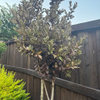
I just purchased a cntorted Filburt on sale. Haven't raised this shrub before and wondered how fast they grow? Tag said it should end up 8-10ft, does part-shade or full sun. Since the interest is winter when I can see the twisty branches, I planted it in the front yard, with sun after 10A and most of the day. Shrub is now about 3ft tall, maybe 2ft wide, lots of nice twisty branching, well shaped from the nursery.

It had a couple long, straight sprouts which the garden center person said should be trimmed off. I did trim them, removed one completely, and the other down to the last buds. Kind of hoping it might grow sideways and be twisty. Lots of leaves, good color and wonderful roots once I got them unsnarled. Very rootbound but expected at this time of the season. I figured the 75% off was worth experimenting with the plant for $10.

So kind of just asking about growing speed, pruning needs, for the future. Out in front it will be in the winter wind all the time. Need any wind protection this first year as it settles in? Do rabbits nibble on them, need a cage for protection? I am in the cage making mode now. Between winter rabbits and the new puppy, my new backyard plantings need protection. She smashed my Swan, just relocated and perking up well, chasing the cats who were teasing her. Swan looks rough. GOT to get the cages done!

Comments (5)

  • 18 years ago

    Might freeze back if not hardy there. Check zone rating. When I went to WSU in se WA state, a grassland steppe environment with few native trees as I remember it the instructor said the filberts planted there were apt to be damaged by the cold - or there was some other problem that kept them small and shrubby.

    Another problem with too much exposure could be the expanded catkins getting tossed and tangled. The vertical shoots you were told to cut out where sprouts from the rootstock, the contorted hazel being grafted onto something like Turkish hazel roots for quick and easy commercial propagation. The contorted part should mostly be left alone to form a conversation piece. You can't really cut the branches of these much without spoiling their appearance.

  • 18 years ago

    extremely hardy in Adrian MI .. and livonia ...

    if grafted.. the straight sprouts will never twist.. and should be completely removed ...

    i saw one at a nursery that was about 20 feet tall and wide ... but i have no clue how many decades old that it was ...

    i have one here.. 8 years old... maybe 5 feet round.. no care after watering the first year ...

    did you tease out.. or trim back circling roots???

    keep the demon away from it for a year or two.. and you wont be able to beat it back with a twisty stick in a year or two ....

    mine is attacked by jap. beetles every year.. i ignore it.. no impact on the plant.. and it give it a nice lacy look.. lol ...

    just keep it properly watered ... for a year or two.. and free range thereafter ....

    ken

  • 18 years ago

    Thanks for the information. Sounds like Filburt will be happy where he is.

    There is a fence between front yard and house, so the demon can't get close!! She had been so good around the new plated shrubs, while being watched closely, that I was surprised to find the Swan damaged. The kittens/cats come to sit by the small fenced pond to watch the fish and chase frogs. They seem DETERMINED to get close to the fence and sniff her back. Not sure if puppy jumped at fence or just crashed into it trying to reach the kittens, landing on the Swan. They do swipe claws at her, so she tries jumping to get them running. Sometimes they do, sometimes not. Being barn cats they go where they want. Puppy is just busy racing around so she doesn't miss anything right now, is large with big feet, so caging Swan should save it.

    Filburt sounds like a very good buy. One sprout was straight, coming off a twisty branch, while the other was from below the ground. That was the one I cut to the last bud, so sprout in spring probably will be straight as well. If so, I will cut it totally down. Interesting to find they are grafted! I have it handy to water, so it should be easy to keep going next summer. I do like the leaves and the way they flutter in breezes. Might be stiffer when roots are providing better water.

    I sat and teased out all the roots possible. Many small hairy roots, and the longer ones had circled around, back into pot center. Took a while, but laid out fluffy, the roots were about double the diameter they started out in the pot. Some length to a number of them, with a couple heavy roots in the center part. All seemed pretty flexible, just took time to work out the potting mix of chunky wood pieces with some dirt. Strange mix to me. I don't think I broke many, none fell off when I fluffed everything of root growth out from the bottom, like broken pieces will.

    I am not much for cutting roots on shrubs when setting them out. Plants I will cut the roots, open the dirt out, but not woody shrubs. You have to save those roots, spread them out for growth and food absorbtion from soil. Seems to me the shrub woody roots take much longer to regrow if broken badly or cut, so growth above ground is slowed way down. I think it worth the time to tease the roots apart before planting, rewarded with much happier shrub in spring, takes right off.

    Again, thank you very much. Nice to learn more on a bargin!

  • 18 years ago

    Yes: Roots aren't meant to be cut. But rootbound trees and shrubs are pervasive. It's the woody plants with persistent woody roots that need to have defects discovered and corrected at planting. You cut if you have to and endure a wilty or dwarfed top growth at first in order to assure a successful future for the tree or shrub.

    Herbaceous plants aren't so needful of this help as their roots are not woody. Some kinds, such as various bulbous plants even discard and replace all of their roots every year.

  • 18 years ago

    I am in zone 5, northern Indiana, where we get a lot of "lake effect" weather. My contorted filbert was planted in part sun, but in an exposed part of the front yard, where the driveway and the entry sidewalk meet. It had extreme die-back after this last winter-it was particularly cold, but the shrub had snow cover on it most of the winter, which I thought should have insulated it some. I had to prune it back quite heavily this spring, but it has recovered nicely, growing out more twisting branches which have totally hidden the pruning. The leaves also suffer from heavy japanese beetle damage in the summer. I am planning on moving it to a more favorable location this fall.

0