Software
Houzz Logo Print
purpledaisy_gw

Combining/Contrasting foliage shapes

19 years ago

Does anyone use particular rules, have special hints for combining different foliage types for good contrast.

I am beginning to think that perennial plantings especially depend alot for their success on clever groupings of foliage and heights.

I remember someone recently suggesting that a large foliage plant was needed in a certain combination. These plants with large leaves seem very valuable to the overall effect. I also think tall plants are particularly successful.

What about grasses, strappy plants. Can you have too many of these?

What does everyone think?

Regards

Susie

p.s. Can you tell I'm moving things around at the moment :-) It's autumn here and rainy and I want to see what they look like so they can settle in over winter, spring.

Comments (23)

  • 19 years ago

    Well, I don't really think there are hard and fast rules to what everyone finds aesthetically pleasing. Some adore the haphazard, randomly-reseeded prairie garden look, while others find it messy.

    I personally rely on foliage contrast so that each mass is visible in front of or behind its neighbors. In my yard, I work with masses maybe 1-3 sq feet large, and make an effort to do things like having ajuga as a groundcover in front of grasses or combining the frillier leaves of pulsatilla with the rounder ones of geraniums.

    Contrasts make each element stand out more, like a Manet painting, whereas similar elements blur together to create difficulty identifying the elements, but in a way that can create a pleasing whole, like a Monet painting.

  • 19 years ago

    Thanks Michael, that makes a lot of sense, I agree with your idea of having clear contrasts and finding the most aesthetic combinations within that. I think colours affect the way you see foliage as well as shape.

    I went out today and could see it all much more clearly. It helped to pull out some small or messy stuff too that was confusing things.

    I also think you need to echos of colours and leaf types within an area but not next to each other. Say to have a spiky grey leaf next to a round green leaf then a small round grey leaf so they all complement each other.

    I like the Manet/Monet analogy :-)

    Regards
    Susie

  • 19 years ago

    You should read the book "Consider the Leaf." I can't remember the author, as I checked it out of the library last summer (I intend to buy it). From what I recall, the author presents the following formula: a large rounded leaf, something frothy or lacy, and then something spiky.

  • 19 years ago

    I just finished reading "The Well-Planned Mixed Garden" by Tracy DiSabato-Aust. She suggests a 1/3 to 2/3 ratio. The 1/3 would be bold foliage either in form or color and the 2/3 would be lacier and/or duller colored foliage. She uses the same premise with flower color too.

  • 19 years ago

    Thank you both so much. Those books look fantastic and exactly what I am interested in. Both are available in Australia so I will head off to my local gardening bookshop (a dangerous place!) and have a look.
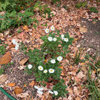
    Here's a photo from my garden where the mix of plants is starting to work. I think it looks nice even now when most of it isn't flowering.
    Regards
    Susie

    {{gwi:203181}}

  • 19 years ago

    I go more by eye. Books are helpful, and finding pictures of what you like is even more so. But reading 'rules' about how to combine can make things stiff and rule out possibilities. Good as a tool to get started, but don't get bogged down on rules. As for your combination, I think it works because you have fine, medium small and spikey. And different leaf shapes. Another thing to think about is about is how far away will you be when viewing?

    Fine Gardening has an article this month on combining variagated plants. I get more from the pictures than the actual text, but one take away from it is....rules are made to be broken, as their pictures so nicely show.

    Since I'm more of a picture person, here are some from my garden in case they help:

    {{gwi:203184}}

    {{gwi:203186}}

    IMG SRC="http://pic20.picturetrail.com/VOL1620/1763266/10125117/150909088.jpg"; border="0" alt="Image Hosting by PictureTrail.com">

    {{gwi:203188}}

    {{gwi:199455}}

    {{gwi:203190}}

  • 19 years ago

    Oops - realized one didn't post:
    {{gwi:203192}}

  • 19 years ago

    I'm not strictly a perennial gardener but I do design all my plant combinations using foliage form and color in conjunction with plant textures and shapes. Much of my early gardening efforts were in shade and part shade situations where you have to use foliage. When I finally got some sunny garden space I struggled (and still do) putting plants together in eye catching combinations that would last for more than a few weeks. Then I discovered tender and tropical plants. The majority of them aren't hardy in my zone but many of them can be easily overwintered-cannas, elephant ears, coleus, bananas, abuilons, castor beans, brugmansias...bold foliage for sun that holds up from spring til frost. When used in conjuction with hardy shrubs, trees, grasses and perennials, I find they really extend the peak season of the garden. My garden peaks in August/September. Here is a picture taken in late September last year.

    {{gwi:195074}}

    Another book I would recommend is "Gardens to Go" by Sydney Eddison. It primarily deals with ornamental container gardening but is chock filled with great photos of plant combos using bold, tropical foliage.

    Sue

  • 19 years ago

    Thanks for the photos silvergold and Sue. I just love to see the great combinations and different ideas people have.

    Silvergold I like the first and last photos especially. Is that an artemesia on the right in the last pic? Which one?
    I love your combos of red/maroon foliage with limey contrast. A favourite combination of mine. Can I ask what the maroon bushes are? Is one a berberis?

    You are right in saying you can't use a book or rules, I know that - you have to work with your own plants for a start. I do believe though that what we've been discussing about contrasts can work really well. Sometimes you find these juxtapositions by happy accident but its satisfying to try and plan them too.

    Sue your garden is lovely. I think anyone who can mix conifers with bananas is my sort of person! I love a great range of plants as you can see from my pic with banana and hellebores. You have a lot happening for so late in your season too.

    Thanks for your contributions.
    Regards
    Susie

  • 19 years ago

    I think that many of my best foliage combos come in the mixed border portions of my garden, with shrubs, trees, grasses and perennials. The grasses are especially important to give motion (and sound) to the more static and architectural trees and shrubs. Autumn Joy sedums, pennesetum & feather reed grasses, along with a curve of Evergold sedges (the pale yellow stuff around the deep green Hinoke shrub in the upper left - camera doesn't do it justice) and even some annuals dominate the late summer garden in my 3-Tree border garden where Lady's Mantle, phlox, and 2 dozen daylilies earlier held sway!

    {{gwi:203196}}

    Here the upright wide strap foliage of iris dominates all the froth of the early summer garden behind it. Notice the Autumn Joy Sedums about 8 inches high to the right of the Iris. These will eventually give some structure & neatness to the corner edge of the patio garden once the Iris leaves are past their prime.

    {{gwi:203197}}

    As others have mentioned shadier portions of the garden rely mostly on foliage contrasts. Here's some that I like a lot.

    Variegated lirope with primula, hosta Whirlwind and pennywort.

    {{gwi:203198}}


    Heuchera, Lungwort, & Japanese Painted Fern
    {{gwi:194159}}


    Hosta, Brise d'Anjou polemonium, & Anemone sylvestris, snowdrop anemone in seed (fluffy white stuff).

    {{gwi:203199}}

    And yes you can have too many strappy flowers. You'll see too many daylily fronds making their way into all my pretty foliage combos. DLs grow fast and often overtake their neighbors, so I have to constantly move them &/or split them to make them behave. I have around a hundred varieties of DLs in my small garden & that's a bit much to integrate them well into a general garden. LOL

    BTW, sedums (all sorts) currently play almost as big a role in foliage contrasts in my garden as do the mighty grasses I have. Great structure on a small scale! and for whatever reason they tolerate my wet clay quite well, while many campanulas, veronicas, & verbascums turn up their pretty noses and die for me.

    The long-leafed plant above the Early Sunrise coreopsis is Blue Danube Stoke's Aster and the large Hosta intruding on the DL space is called Fried Bananas. It is planted on the edge of the shade of a Crabapple tree, but handles a great deal of sun on the southwest side of the tree. The sedum is Sedum alboroseum 'Mediovariegatum'. I just call it yellow sedum.
    {{gwi:203200}}

  • 19 years ago

    I'll second Consider the Leaf by Judy Glattstein, though she doesn't really talk about the flowering plants very much. The formula is correct: a large bold leaf, something ferny or lacy, and then something grassy or spiky.

    Jill Billington also wrote a book called Architectural Foliage or Using Foliage Plants in the Garden (two names for the same book). It talks about both combining foliage and combining the forms of different plants, and shows several classic arrangements of forms.

    That is a nice combination that you have in your picture, PurpleDaisy. It looks like you've got a geranium and star-of-bethlehem(?) on the right, and bergenia in the middle -- with black mondo grass(?) to the upper left of the bergenia. What are the two plants in the lower lefthand corner? And is that a Japanese anemone above the bergenia?

    You've got some very nice combinations, too, Leslie.

    Here are some additional nice combos in a thread called "Shapes, textures, colors" that were in the Far North Forum. I was going to link to it, but it looks like it's dropped off into the ether. I saved a copy of it before it disappeared, though, so I might email it or manage to get it onto my server for awhile.

    Sharon

  • 19 years ago

    Leslie, some great pics. I used to have a thing about variegated plants but yours look great and I can see I need one straight away in my shady grouping. I really love lime, yellow, white and green together, its such a lovely clean bright combo. That polenomium does great foliage!

    Sharon, down on the lower left are teucrium fruticans and astrantia, white one. These are both great plants, good foliage and flowers.

    Teucrium
    {{gwi:203201}}

    Astrantia
    {{gwi:203202}}

    The darker leaves are helleborus foetidus. It hasn't flowered yet but what fantastic foliage. Next to the bergenia are rhoeo, geranium phaeum (great foliage, nothing much flowers but goes for months) and as you say double anenomes above. At the front is not star of bethlehem but zephyrantes, also known as Autumn Crocus. It is just beautiful at the moment. I like it because it bulks up well and is a nice surprise at this time of year. Good grassy foliage too.

    Another patch of Zephyrantes
    {{gwi:203203}}

    I have found all the books recommended at the local college library which I can borrow. Luxury. Thanks everyone.

    Regards
    Susie

  • 19 years ago

    Sorry, correction; Teucrium hircanicum.

  • 19 years ago

    Susie, it looks like you've got the plant combination thing down pat. But it is always fun to contunue to play with new textures and colors. I love those Zephyrantes-something tells me they aren't hardy here. When it comes to garden books, I'm more visual and prefer lots of color pictures. Are you in a part of Australia currently under water restrictions?

    Great pictures Leslie! I'm partial to shade gardening and your pictures are perfect examples of how much you can do with plant contrasts in the shade. Have you been able to keep the Polemonium 'Brise d'Anjou' around for more than a season or two? It always melts away here. I've switched to 'Stairway to Heaven', a much more vigorous variety for me.

    Interesting discussion...

    Sue

  • 19 years ago

    I didn't mention it before, but I also love the polemonium combo. I've got the hosta and the wood poppies, which look very similar to the anemone sylvestris, but not the polemonium. I tried a non-variegated one that is really not doing much (and hasn't for the past few years). Although I'm a sucker for anything variegated, I haven't tried the Brise d'Anjou polemonium (yet) because of reports that it doesn't last long here.

    That combo looks so great, though, it may be worth it to grow as an annual. Or maybe I'll try Stairway to Heaven...

    :)
    Dee

  • 19 years ago

    Thanks for the compliments on my combo pictures. I really appreciate it.

    As for the Brise d'Anjou polemoniums....I planted 3 of them in my hosta bed in April 2004. All grew well & returned in 05 & 06. I have been happy with them & they also have pretty mid-purple blue blooms that work well with the green and yellow hostas there. I had no idea that they were tempermental until I read about it too!

  • 19 years ago

    sharon, maybe you could repost the list to the far north forum? or would you post it here? thank you

  • 19 years ago

    I had several Brise d'Anjou in my last garden. When we moved, they were probably around six years old. They were healthy as can be in my dappled shade and clay soil. Until I read Sue's post above, I'd never heard anything of them being less-than-vigorous. I'd say they're definitely worth a try for anyone who likes variegated foliage.

    The only reason I haven't put any Brise d'Anjou into my current garden yet is that the conditions are drastically different from the last site, so I've been experimenting with things I could never grow before. Eventually, though, I'm sure I'll get lonely for my old friends, and start to replace everything I used to grow!

  • 19 years ago

    Sounds like you have some good thoughts Susie. It is artemesia Valarie Finnis. It can grow a little out of bounds but is easily pulled out. The other is berberis.

  • 19 years ago

    Deeje
    Can I ask what part of MN you are in? I am also in MN zone 3b.

    Jenny P

  • 19 years ago

    jenny, I'm in St. Cloud, how 'bout you?

    According to most maps I'm right on the line between 3b and 4a, but our property is mostly not conducive to zone pushing... unless this mild winter trend continues!

  • 19 years ago

    Nope I am about 5 hours north of you, north of East Grand Forks. I am in zone 3b, but right on the edge of it. Zone 4 goes up the Red River Valley, which is where I am at. And I agree about the warm winter trends! I have some zone 5 perennials that I planted as annuals 3 years ago! Each spring I wonder if it will return!

    Jenny P