Software
Houzz Logo Print
aachenelf

My favorite spring weed

12 years ago

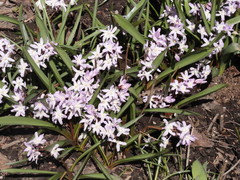
Scilla siberica

If these weren't so pretty, I'd be pulling 'em out by the hundreds, but obviously I don't. Since first planting these many years ago, they have self-sown in the lawn, in beds 20 feet away, in sun and shade. Squirrels almost always destroy any spring bulbs I plant (including crocus - they eat the flowers), but they don't touch these. Too boot, they bloom for at least 3 weeks if we don't get an early heat wave and the foliage is gone by early June.

Love 'em.

{{gwi:209064}}

{{gwi:209066}}

Kevin

Comments (18)

  • 12 years ago

    I love them too - although they don't seem to want to grow for me here for some reason.... There are quite a few older homes in our town with 'blue lawns' in spring that we greatly enjoy seeing.

  • 12 years ago

    Beautiful, but horrible.

    Am already into this season's mopping up of the (once planted) three spring nasties; namely, Scilla, Chionodoxa and Puschkinia.

    Their primary strength lies in prolific seeding, apparently combined with a toxic defence against voles.

    I am, of course, aware that some gardeners swoon at the prospect of hosting such spotty and invasive colour. I guess it's all a matter of taste (albeit toxic as far as I'm concerned!).

    On a more serious level, the issue is that these three invasives aren't satisfied with the properties of their devotees, but readily colonize adjacent properties where they are not welcome.

    Below: Chionodoxa 'Giant Pink' (April 19, 2014). It's large enough to be able to deadhead the spent flower stems to prevent seeding.

  • 12 years ago

    they spread themselves no where ..

    you have carried them around by moving plants and soil ..

    dont you think..???

    fess up man ... its not like they are sneaking around in the dead of the night.. while you are sleeping...

    ken

  • 12 years ago

    The grape hyacinths are the ones that give me fits in Colorado.

  • 12 years ago

    Ken, not sneaky, just assertive!

    it's certainly true though it's very easy to spread the seeds or bulblets of Scilla siberica, Chionodoxa forbesii/ C. luciliae and Puschkinia libanotica when moving soil.

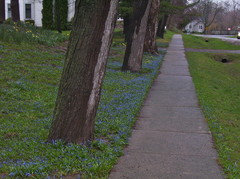
    Below: Scilla siberica perhaps stopped at the sidewalk.
    Niagara-on-the-Lake (April 20, 2011):
    (If that had been Chionodoxa forbesii/C. luciliae is would have been long over the sidewalk and down the street).

  • 12 years ago

    Invasive? I don't know about that. I guess it depends on how you define the word. I was reading a blog post about these on another site and folks were going back and forth trying unsuccessfully to reach some sort of agreement as to what should be classified as "truly invasive". They weren't having much luck. But i guess huge stands of these are becoming very common in undeveloped, wooded areas, so I guess they are spreading.

    Yes, these seed around a lot, but so do a lot of things. Bloodroot is probably my most rampant self-sower and I hoe out hundreds of seedlings every year. I realize Bloodroot is a native and Scilla isn't, so maybe that's ammo for the "invasive" camp.

    In any case, Scilla is easy to get rid of if you don't want it. Just pull or hoe it out. The bulbs are only a few inches below the soil. If you don't want it in your lawn, mow down the foliage early in the season. The bulbs can't survive for long if they don't have foliage to produce food for next year. The seedlings look like grass and are easily pulled out.

    Ken

    I'm sure mine have spread by seed. Every year I seem to see a new, single plant somewhere far removed from this original location. The seeds might be surviving my compost pile and getting spread that way or maybe I'm scattering seed while cleaning up the dried up foliage of these and carrying it to the compost pile. I certainly haven't transplanted any.

    Chionodoxa and Grape Hyacinth I've never been able to grow. I planted a whole mess of Chionodoxa again last year and so far I've only seen a couple of plants emerge.

    Kevin

  • 12 years ago

    Kevin, difference in climates maybe, but its really aggressive here in clay based soil. I fought it for years at my former home, and I mean really fought.

    I could dig a couple of feet sometimes and still not get the foliage with the bulb intact. I never let it flower, let alone go to seed. All foliage regularly removed - if you'd treated daffodils or tulips that way they'd have expired immediately and this stuff thrived. More than once, my neighbor and I corralled our DH's and we had scilla bulb digging 'parties', any clump removed with bulbs attached brought cheers. We dug up a rhododendron and laid it on its side one evening to try to get the bulbs out of the rootball and from under it.

    Garden thug. Thankfully I don't have any here in these gardens. The trade off is I have ivy (that I'm making headway on), false lily of the valley (which still has the upper hand), and deer ;)

  • 12 years ago

    Relevant point about the influence of climate/soil conditions/etc. on aggressiveness/invasiveness, Morz.

    I find that Chionodoxa comes up from the greatest depth:
    hence it's particularly difficult to dig out.

    True, Kevin, there's a free-for-all, among gardeners, as to the meaning/usage of the word "invasive".

    For gardeners, I'd suggest the following objective definition of the word: "invasive" means "spreads uninvited into ( = invades) your neighbour's property".

    Of course, I do feel we should appreciate environmentalists defining "invasive" in a broader (viz. ecological) way. Example: I heard last year of hellebores spreading into woodlands in southern Ontario.

    If hellebores are entering our woodlands, that means that no gardener should stew over environmentalists calling hellebores invasive.

  • 12 years ago

    If you don't want it in your lawn, mow down the foliage early in the season. The bulbs can't survive for long if they don't have foliage to produce food for next year.

    Uh, Kevin? Don't mean to rain on your parade but... Puschkinia & grape hyacinth have naturalized in my lawn for the past 35+ years and every year when the lawn gets mowed, the foliage gets cut along with the grass. Hasn't even slowed them down.

    My soil is sandy loam and they just thrive year-in and year-out.

  • 12 years ago

    Mow the foliage earlier when it first appears and again if more foliage reappears. I stick by my statement: A bulb needs the foliage to replenish the bulb for next year. No foliage, eventually no bulb.

    Kevin

  • 12 years ago

    I've also had Scilla make a bold increase in one area where I've let them go and I am starting to wonder about the wisdom of allowing it. Although perhaps if I enjoy them and then deadhead them before they make seed, that would work.

    That is the other point about mowing whatever is in the lawn. It might not slow down their growth to mow, but it would stop them from reseeding, wouldn't it?

  • 12 years ago

    I love the drifts of scilla - true harbingers of spring up here now that all but the deepest snow piles have disappeared. I've even been known to dig up shovels full of them to plop down in an area where little else will take hold. Pull them, dig them, mow them - they're persistent. Not to mention such a beautiful shade of blue.

  • 12 years ago

    It might, but remember these plants set seed very early - long before the grass would normally need mowing. I often pick scilla for tiny indoor bouquets and have noticed as the flowers start to fade, the seed pods are already developing. I've never seen any other cut flower do this, but these little guys certainly do.

    And to amend my previous statement about foliage, it would probably be a good idea to cut the foliage as soon as it appears if you want to get rid of the plants. The longer you wait, the more time the bulb has to store energy for next year. If you're waiting until the grass needs to be cut, that's just too long.

    Kevin

  • 12 years ago

    Nice pictures Kevin. I could think of worse weeds to have. Star of Bethlehem comes to mind and ranunculus ficaria. They either are not as attractive or overtake other plantings.
    Thug might be a good description since it will spread with a mind of its own, not according to your plans..... not invasive though since I don't see it replacing more desirable plants in my garden.... Unless you want to keep your lawn a pure green without offensive blue patches.

  • 12 years ago

    Does using a weed and feed on the lawn kill the scilla or other small bulbs?
    My small patch of scilla has not invaded my lawn yet but am finding one here and there in an adjacent bed.

    Love bloodroot which are in full bloom. Haven't noticed any seeding around though. Kevin, do you have a double blooming bloodroot? No sign of that one yet. I think it blooms a little later than the singles in my garden.

  • 12 years ago

    I had the double for a few years, but it disappeared. It just never seemed to have the vigor as the single. I've also read it's sterile, so no seedlings.

    Not sure about the weed and feed stuff.

    Kevin

  • 12 years ago

    I used to use Weed 'n Feed on the lawn, and it never killed the Chionodoxa. I don't have scilla there so I don't know about that one.