Software
Houzz Logo Print
saxophone_gw

rennovating sprinkler system

21 years ago

I need some advice on rennovating a sprinkler system.

I purchased a house back in March. I am almost finished rennovating the front yard sprinkler system. Now I'm thinking about the back yard. The

back yard is all weeds, so tearing it all up isn't a problem.

Sorry that I don't have a picture to include. I'll just have to write the thousand words in its place.

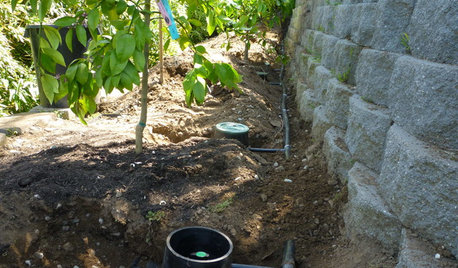
There are three sprinkler valves in the backyard, but they are not hooked

up to the water supply. The valves are the manual Lawn Genie anti-siphon valve type made of plastic. One is cracked and probably no good any more. The valves are located close to a wall of the house. The output of each valve is attached to a separate galvanized pipe. Each pipe goes down into the concrete of a walkway and lead to PVC pipe buried in the ground on the yard side of the walkway. The input side of each valve is connected to a very short galvanized nipple. Each nipple is connected to the stem of a tee, and the tees are joined with nipples. All of this appears to be glued together. I tried to unscrew it with a pair of pipe wrenches, but it wouldn't budge. The valves are connected to the pipes without the use of a union. The input tees which are all joined by nipples is not hooked up to the water supply. I'll have to get a plumber to do that.

I want to replace the valves (one is cracked anyway) and install an automated system. How can I remove the old valves while preserving the threads on the three galvanized pipes going into the concrete? Destroying the valves is not a problem. Should I just take a hacksaw to the whole thing and cut the valves up until I can remove them from the pipes?

Alternatively, I thought about hooking the water supply directly to the pipes going into the concrete. Then, on the yard side of the walkway where the PVC pipe emerges, I could install an inline ground level valve.

Comments? Advice?

Comments (5)

  • 21 years ago

    I would figure out a way to get rid of the galvanized pipe. If it is very old, it will probably be corroded inside and out and may have restricted water flow.

    Consider using pipe larger than 3/4" because it should improve the water volume.

    My pipe is 3/4" copper at the meter and I used 1" PVC for all my lines right up to the heads.

    First though, I set up a 3/4" section and then a 1" section to see if it would really help.

    The 3/4" pipe had a volume of 8 gpm. The 1" pipe has a volume of 13 gpm. I measured this with the Toro pressure and volume gauges. Needless to say, I went with the 1" pipe all the way and only reduced it right at the heads. Used 1" brass valves too.

    This system really puts out the water. Yard looks like it is flooded in some areas and I am using 7-8 heads per valve.

    As far as removing the galvanized pipes, it would probably be worth seeing if a concrete cutting company could cut around them to get them out. The resulting holes should allow enough room to connnect PVC under the walk.

    If it is just one section of the walk, the alternative might be to remove that section of the walk, install the PVC and repour the walk. Might be cheaper than a concrete cutter.

    If you don't remove them, a few years (or less) you will probably have reduced flow or leaks or ?? I would rather deal with it now.

  • 21 years ago

    Sounds like the galvanized pipe is nothing but trouble. I don't think I could get anyone to cut around them to get them out because they are less than an inch from the back wall of the house. I'm not too keen on tearing up the walkway and replacing it.

    It sounds like I should abandon what's already there. I suppose I could hire a plumber to run a new water line (copper would be nice) out to the side rear corner of the house where the concrete ends. I wonder how much that'll co$t me. I could then put in a new set of valves and use unions so that they could be replaced easily if necessary.

    Is there a zoning law or some such rule that requires that the pipe leading to the input side of a sprinkler valve be made of metal? Or could I use PVC on the input side? (Of course, I would build an enclosure to protect the PVC from the sun.)

  • 21 years ago

    I use PVC from the copper water line to the valve and then on to the various heads.

    Not aware of any code requirement but I would put a shut off valve at the junction of the copper and PVC.

    The best shut off valves I have seen are the ball type rather than those with a faucet washer or even a gate valve because the faucet washers wear out and the gate valves corrode. Never had a problem with a ball type valve yet. Home Depot sells them as do many other stores.

  • 21 years ago

    Did you install a brass ball valve or a PVC ball valve?


    If I run a new water
    line from the existing mains to the side of the house, will I need some sort of plumbing permit? Will I need some sort of plumbing inspection to make sure it is up to code?

  • 21 years ago

    I use the PVC valves on my sprinklers and in the plumbing for my house, I switched to brass ball valves for the main line, angle valves, hose bib faucets etc. The quarter turn hose bib faucets are really great. So good that I replaced all of the old style ones whether they needed it or not.

Sponsored