Software
Houzz Logo Print
pippi21

How do they do that?

16 years ago

I love browsing through people's flower garden pictures as I enjoy seeing all the beauty and creativity of them. If I like a certain flower combo, I make a handwritten note of it for future reference, or maybe I don't know the name of a flower, it is a good learning tool if the member has it named in their captions. I have noticed and always wondered how they achieve the look of having two different flowers planted together, like they were planted together. Maybe it's a bed of forget-me-nots with yellow sundrops or some other lemon colored small flower that has more height than the forget-me-nots. How can this look be accomplished? Direct sowing?

How do people know exactly how many plants of each to buy for a certain area? I never know and I get what I think will look good, then when I see I've guessed wrong, I go back to the nursery and there are no more of that plant. What's the secret? I see so many gardens that they look like they may have mapped everything down on paper first or on a computer design program and they know exactly how it will look and how many plants of each to buy, etc. My gardens always look hodgepodge to me and I hate it. I know what I like but don't know how to put it together and hubby won't allow me to hire a landscape designer.

Comments (8)

  • 16 years ago

    Secret? I over plant and plant to close. The one thing I hate is a space garden so I over plant. Plant in large groups. I son in law planted 6 sets of Shasta Daisie - looks like a polka dot pattern AAAAGH!!!!

    Also - you can ALWAYS dig up and plant somethign else - I'm constantly moving things around for better color and photo opportunities.

  • 16 years ago

    Sometimes ithink it ends up being a pleasant surprise, i had a row of catmint around the curve if my walkway.I planted clearance oriental lily bulbs in between each plant. When they bloomed this spring it was the prettiest pink peeking above the blue catmint... my fav combo in my garden so far!

  • 16 years ago

    Don't think it will be "right" in one year. I keep moving plants until I get the right combos. I divide those that are my favorites. I give away or compost those that are underperforming. After years of gardening I've got some areas I'm really happy with. But I'm still always moving and dividing.

  • 16 years ago

    Take notes when plants are flowering of things you like or don't like, colour combinations, etc., and move those plants when the time is right. Some plants can even be moved in flower without stressing them too much.

  • 16 years ago

    You'll hear the advice to "plant in odd numbers such as 3, 5, 7, etc."

    However, I've found that 4 works pretty well. You see, if you buy odd numbers, you're sure to lose one and end up with even numbers and can't get a replacement :-) I plant those even numbers in irregular diagonal patterns across the garden view.

    Polka dots happen! :-) I recently wrote ("Dotted with Daisies" on my blog) about how I stuck shasta daisies along my garden path (wherever they would fit) just to have a temporary holding place. Well, I haven't moved them. It's really not so bad since they are planted close to other perennials. It's not a disaster, it's just quirky.

    Be economical. You can buy one monarda and in the third year have more than you know what to do with. There's no reason to buy multiples of plants that grow aggressively since you can usually divide in short time.

    Plant en masse (big drifts) is another thing you'll read about.

    I've found that mass planting one variety means that when it isn't in bloom, it's a dull spot unless the perennial has pretty foliage. I mass plant a mix of perennials and annuals with the same bloom color, rather than just one variety. But, I have large areas that can handle a "meadow" look.

    Use reseeding fillers that you like. For spring, I rely upon annuals grown from seeds to fill in the gaps until the summer perennials bloom. I use nigella, cornflowers, rose campion, California poppies and perennial blue flax. In summer, I do the same with zinnias, stick verbena, ammi majus and cosmos.

    Stuff happens -- we're in the hottest month on record with triple digit days and no rain. There will be casualties from the weather and I'll have to adjust the garden.

    I play "musical plants" all the time. I move them around for better design, color combinations and growing conditions. It takes another year to see the results. Then, I tweak the design again.

    Gardening is supposed to be fun. It's a journey. It takes time. Grow what you love.

  • 16 years ago

    I agree with the use of mass plantings. But if the plant or in the case of direct sowing, you find out that it's mislabeled, then it has to be done all over again!
    It's great if the chosen area has the space & can accommodate it. Repetition of group plantings works well, also.

    Direct sowing is ok. as long as you are doing it at the correct season. Usually early spring or early autumn. Using seed trays may make better use of limited amount of seed & space & is less costly. Starting seed in trays can also be done, in shade during summer & indoors for winter. It's better than simply thinking it has to be limited to only just 'winter sowing' in plastic bottles, wasting time for the outdoors to be warm enough for germination to occur in spring. The refrigerator can be used in summer, to replace the need for outdoors winter, cold stratification.

    Mail order is a good way to go for some items, in multiples. Compare what I saw a local nursery offering the Echinacea 'Fragrant Angel' for $19.99 for one plant. So that can be rather expensive way to go, unless you have patience, or only want some plants for use as 'specimens'.

    Purchase a variety of plant cultivars from a specific Genus (Phlox, Peonies, Iris, Lilies, Coneflowers, Salvia, etc..)& then either be patient & divide it, or buy more of the selection if it does well where you want it to grow. Some are good for producing your own seed & others aren't.

    Exchanging plants & seeds can be a good way to go.

    You may need to 'trial' plants for a complete year, in a certain location & may have to move (or remove it entirely!) to get the look you want.

    Getting correct pairing isn't always easy, as bloom time can vary due to your own growing conditions, or the cultivar may actually even be early, mid, to later flowering than expected.

    It doesn't happen overnight, even with help from a 'landscape designer' plants they use can often quickly outgrow their allotted space, because they may tend to select plants that make the area look full & complete, from the get go.

    Yes, it would be nice to have a 'finished' appearance. But then what would be left to do? Turn on the sprinkler every now & then, or pull a few weeds & just add mulch every fall? Now wouldn't that be be boring!

  • 16 years ago

    One thing I do is just watch to see what I like with other gardens and then . . . . copy it! What happens is that my ineptness is so great that I end up with something different but still in the ballpark. It's like looking at a mannequin in a store - look and learn and copy!

    If you want a complete garden - get someone else to do it. If you want to be a gardener, experiment.

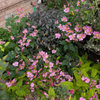
    This is my butterfly garden after 2 years - had NEVER gardened before in my life. large groups, small to big, different shapes. Behind it you see my clay garden. All Zone 4.5ish

    {{gwi:205417}}

    A friend of mine said that I really must have had a great plan with my gardens - HECK NO - I winged it. Basic concepts was all I used.

    Mass plantings, larger in the middle, different shapes and don't be afraid to dig up and place somewhere else NEXT year!

  • 16 years ago

    Great looking garden, grinder!

    I forgot to mention that if you want forget-me-nots (Myosotis) that you ought to sow them for two consecutive years. Otherwise, if they do self sow you'll probably only have them in bloom every other year.

    When I first grew Foxgloves (Digitalis) many years ago, that was one good lesson I had thought I learned about when including biennials in the border.

    Next year I'm likely going to have a similar problem with Eryngium giganteum. I think I sowed two different cultivars (Ms. Willmott's Ghost' & 'Silver Ghost') last year for germination this spring, & didn't buy any seeds of them this year(at least not yet-unless I forget!). Or, I suppose I could try to hold over some of my own seed next summer, for a whole year, but then they would likely lose viability.
    That may not be such a problem, with Myosotis seeds.