

The Great Soil Debate
Updated with best answers(7-22-14)
So while there is probably no perfect answer to this since different climates and species prefer different mixes I still see such a dizzying array of advice and growers out there doing different things and wanted to get some real world experience from everyone.
I'll start with some observations and questions:
Indian Mixes: Every video or pic I've seen from india looks like they took Grandma's ashes and mixed in sand, fine dust and pebbles. Whats up with that mix? Never looks like there is a drop of moisture in there and I have to say their adeniums look a little weird compared to Adeniums anywhere else. Thin and less vibrant in color.
Thai Mixes: They seem heavy on coco chunks/chips. From 70-100% coco chips with top layer of Coir/soil/manure. Sometimes heavy on small to medium stones mixed with coco chunks. Seems to be the best draining mixes and no one can deny the Thai get great results with their adeniums.
Western Mixes: On this side of the pond I see more of an emphasis on vermiculite and perlite. While these do the job is their a difference between these light weight fillers or just using small pebbles or grit? Then, since adeniums are to be kept on the dry side, extensive use of these very light weight mediums make it easy for plants to be blown over in strong wind.
Soil Questions:
"Never dry out seedlings" When are they old enough to start completely drying out? What defines adulthood?
If drying out between watering do we water right when it drys out or is the aim to keep dry for a full 48hrs+ to trick the plant into thinking water is scares so it fattens its caudex as drought reserves?
In the case of using full coco chunks in the bottom 50-70% of a pot like many Thai mixes do, are we trying to keep the roots lightly moist with lots of air? If Air flow is good like in Thai mixes wouldn't that allow for almost daily watering in warm sunny weather instead of waiting for long periods of dry out with more compact, smaller particles mixes?
BEST ANSWER: Yes and Yes
Any clarifications, answers, info and real world experience from you guys would be great, Thank you.
This post was edited by jasonwipf on Thu, Oct 16, 14 at 2:23
Comments (26)
 12 years agolast modified: 11 years ago
My head exploded with info overload. LOL
I go with cheap and easy if it works. I just haven't taken the time to track down all the stuff for the gritty mix that everyone raves about but at some point I will. I like it's texture and weight. Perlite does get messy unless I put river pebbles on top.
Kirk

jasonwipf
Original Author12 years agolast modified: 11 years agoHey kirk,
Overload? I thought you would be the information bank for my questions here. :-P
Have you tried wicking on your adeniums? seems as if it would be a good idea to get any lower layers that are holding moisture to release and drain water and salts.
This post was edited by jasonwipf on Sat, Jul 19, 14 at 12:39
Related Professionals
Newburyport Landscape Architects & Landscape Designers · Lewiston Landscape Architects & Landscape Designers · Syracuse Landscape Architects & Landscape Designers · Anniston Accessory Dwelling Units · Hartford Accessory Dwelling Units · Missoula Accessory Dwelling Units · Yakima Accessory Dwelling Units · Cherry Hill Architects & Building Designers · Vineland Architects & Building Designers · Fort Dodge Architects & Building Designers · Utica Architects & Building Designers · Glenwood Springs Architects & Building Designers · Billings Architects & Building Designers · Bend Architects & Building Designers · Edmonton Architects & Building Designers- 12 years agolast modified: 11 years ago
Haven't tried that but it's a good thought. The only thing I miss about growing up in the Beaumont/Orange area was having a water well. Seems all of Houston water has salt buildup issues. LOL
Kirk
jasonwipf
Original Author12 years agolast modified: 11 years agoBoy thats an understatement. We have lots of hard water here. I sometimes buy bottled or distilled water for my adeniums but wondering if I should feed captured rain water full time if I can.
- 12 years agolast modified: 11 years ago
Jason,
I'm going to take a stab at answering your questions:
Soil: The bottom of most pots are the last to dry out because potting soil retains a lot of water and gravity makes that water sit there, slowly melting the roots of plants. This is the notorious "perched water".
So what needs to happen is for the potting material to get wet, not clogged.
Layering--This idea never made sense to me. How do they keep the top part from mixing up with the bottom part that has large particles?
The layer of large-sized things at the bottom of any pot will not prevent smaller-sized particles from eventually falling into those nooks and crannies between these large-sized things. Ultimately, the pot becomes uniformly clogged with water-retentive stuff (usually peat), eliminating air spaces that roots need and the result is plant death.
Imagine putting a sponge on top of a layer of pebbles. The sponge will not absorb more than it can, but when I'm done pouring water over it, those pebbles will dry out but that sponge will still be sloshing with water. For a long long time. So I don't think layering different-sized stuff will eliminate perched water, it actually raises it, putting it even closer to plant roots and speeding up plant death.
Soil Mixes: My sister uses something very close to the Thai mix and her seedlings bloom sometimes as early as the 6th month. However, she is in the Philippines, with similar weather to Thailand, year-round temperatures between 26C to 36C, humidity at a constant 80% and higher during the monsoon season). It's like living inside a giant nostril, only sunnier. The growing season is basically twelve months long.
In those conditions, coco chunks made of coconut coir (the fibres extracted from coconut husk) are perfect for keeping adeniums (or indeed many plants) moist without drowning them. They do not compact like peat, the stay "steel-woolly" longer (thus maintaining airflow in the container) and the moisture in the air keeps them from drying out too quickly and becoming hydrophobic. Water evaporation also slows down if it is very humid since there is little space in the air for water to evaporate into, even with summer noon temperatures rising to 36C. During the monsoon, adeniums in coco fibre or coco chunks just get generous showers that wash out the roots, removing whatever salts accumulate from fertilization and what-not.
I can not speak for what they use in India---its a huge subcontinent with highly variable climate. Some places will have dry heat, others will have heavy, humid heat, others will be frigid from high elevation, etc.
I use gritty mix for my adult plants. It completely eliminates the stress of guessing when to water. I just do when it occurs to me and if it rains three days straight, my adeniums and I don't care. We drain fast!
Seedlings: After months of experimentation, I learned that the gritty mix will kill seedlings 0 to 6 months old unless you water them daily in the summer. They will suffer from chronic brown-tip syndrome (I made that up) because they are always thirsty. So what I have done is return my seedlings to a more moisture-retentive substrate consisting of 1/4 potting soil and 3/4 gritty mix. If I had more bark, I probably would have added that instead. I also have seedlings in substrates that have more pumice (holds more water than grit, but less than bark)....you know--improvise, adapt, overcome!
Growing up Adenium: Mark Dimmit's go-to article (link below) will tell you that the first three years of an adenium's life is when it grows the most and the fastest.
Personally, I have pinched, pruned, root-trimmed and spilled adenium seedlings of all ages up to 4 years (which is the oldest plant I own and I've only had it for a full year). I just learned from kiwijoe earlier here that he has grafted seedlings as young as 6 to 9 months old. So I'm actually going to try that!
Water: There are finicky plants that will tolerate only rain water or distilled water or RO water. Adeniums dont care as long as they get lots of it in summer and just sips in the winter, if at all.
Finally, this: on a scale of 1 to 7, where 1 is weed and mesembs are level 7 in terms of difficulty, I will put adeniums at 3, maybe even 2.
I hope this helps. If I got anything wrong, someone fix me at once! Adeniums are fun plants, yo.
Pagan
Here is a link that might be useful: Mark Dimmit
- 12 years agolast modified: 11 years ago
Great questions!
I'd like to throw one in as well.Given that most adeniums recommended to plant ON TOP of the soil, how deep should be the pot itself?
I see many members here have quite large pots underneath with all the fat caudexes above. Is that for stability? Or does the large layer of drainable media promote root growth?
The only one I have currently sits only on a few inches of gritty soil. It's being attached to the plastic walls with some gardening ties. I'm too cautious not to overwater but then one wonders if it's enough to stimulate further growth?
Thanks, everyone, for your insights!
LilyThis post was edited by LiliyFlower on Mon, Jul 21, 14 at 22:58
- 12 years agolast modified: 11 years ago
Hi lily,
I'm actually in the middle of packing but I'm grateful for the chance to procrastinate!
So here. Adeniums develop fat roots under the soil--often very dramatically over a single growing season, if there is enough heat and sunlight. Most growers slowly raise their plants to expose these fat roots little by little. I think it was Marie who does this every year or so, exposing about an inch at a time.
The size of the pot is, for the most part, largely a personal preference. For instance, I have all of my adult plants in wide shallow pots because I want the roots to grow that way. Also, I have not started raising my plants either because I want them to have at least two to three seasons of undisturbed growth before I start doing it.
So the adenium is not really on top of the soil per se. They're still in in the soil, just raised a little.
Other people here have more experience than I do with exposing roots though.
This is my Rik Ni Ran, planted in about 3 inches of gritty mix.
{{gwi:348362}}The downside of such a shallow, porous and wide pot is that it has to be watered more often--in this case, nearly every day, especially when in bloom. To make watering more manageable, I top-dressed with pea gravel which helps keep the moisture in. It now gets water every 2 to 3 days.
I hope this helps.
Pagan
jasonwipf
Original Author12 years agolast modified: 11 years agoThanks for the info pagan. Ay Pinoy?
I put my first batch of seedling i just repotted In Thai mix and yes it's dryiwr than its original soil. Most are starting to have their leaves move up and vertical instead of horizontal like they are supposed to be. 2-3 out if about 30 are developing brown tip. Should I water daily then?
As far as the 70% bottom coco chunk 30% top soil layering that some Thai do I "theorize" that the intent is over about a year ( untill the next repot) the top layer will slowly wash down until it is mixed with the large chunks and over all it is still a very draining type of mix. If I had thoroughly mixed them from the get go and after about a year the large chunks were at the top and the bottom was filled with small particles, that bottom 20% would now hold too much water and rot lower roots. Also that top 30% is actually a bit gritty too, my version is 1:5 each of: top soil, coir, sand, small pebble and manure.
Think the manure on young seedlings hurt them?
- 12 years agolast modified: 11 years ago
Hm. Interesting. I didn't know the Thai mix had those proportions. That's still very fast draining if they use 70 percent coconut chunks. My sister uses coconut chips as well as chunks. Chips work like tree bark (made of the hard part of the coconut shell) that is used in gritty mix.
I have zero experience using manure so I can't tell you what they will do to seedlings. You use composted and not raw manure, right? If it is composted manure then it will probably work like any organic fertilizer.
So you layered your soil? I suspect that will result in uneven moisture at different levels in the pot but I'm interested in seeing how it turns out, given your heat and humidity levels. Don't forget to update.
If I didn't have to worry about winter, I would have enjoyed trying out a variety of potting mixture.
Pagan
p.s. Yes Pinay
- 12 years agolast modified: 11 years ago
hi Pagan,
Thanks for your reply and insights. It makes sense what you said.Love your DR!
I hope packing goes well! :)
Lily
 12 years agolast modified: 11 years ago
Hi folks, an interesting thread. I have for the first season used perlite in my DR mix.... and I positively hate the stuff! I used to use vermiculite but was persuaded that it wasn't quite right for the job so swapped to perlite. I find it continually works it's way up the mix and ends up in an unsightly layer on top of the mix....just my opinion you understand! The rest of my mix is a screened mix of same size particles of equal quantities of 'reptile' bark, horticultural gravel, a very small amount of general purpose potting mix and the dreaded perlite. I have always thought that the particles need to be the same size (whatever their size) so as to prevent the smallest from working their way down to the bottom of the pot. I have never had a problem with the vermiculite holding onto too much water as suggested elsewhere so they don't ever get root rot......so, bearing in mind the conditions I can provide, next year come re-potting time I will revert back to vermiculite as it works best for me and my plants. I fully appreciate that others will argue for the virtues of using perlite as opposed to vermiculite, but I know which will get my vote next spring!
Gill UK
jasonwipf
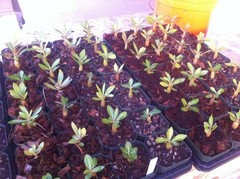
Original Author12 years agolast modified: 11 years agoOk so in the quest to answer which type of soil adeniums like I have taken 2 month old seedlings and planted my best 56 of 72 seedlings in 4 rows with the following mixes inspired by different mixes I have read about. Each of the seedlings started the first 2 months of their life from a 100% coir mix that came with Burpee seedling kits.
Four Mixes:
1. Gritty mix= soil, stone, sand, coir, chic grit equal parts.
2. Gritty mix/Coco chunks 50/50 mix
3. Coco chunks/Coir 50/50 mix
4. Coco chunk 100% mixI'll report this winter or next spring if one row outgrows the next!
- 12 years agolast modified: 11 years ago
I keep and breed Adeniums in Phoenix, Arizona and have been for about 3 years. I have experimented with many soil mixes. I like to error on the side of larger grain and more drainage because I like to water my plants a lot. It helps in the cool months too as the roots breath and tolerate watering better.
For my medium to large adeniums I use mixes that include coco husks/chunks. For me mixes with coco chunks overwhelmingly outperform soil mixes without. I mix 2 parts coco chunks, 2 parts cactus soil mix, and 1 part pumice.
For small plants and seedlings I use 1 part pumice with 1 part cactus soil. The coco chunks can float so they dont work as well in smaller pots.
I have used other items like turface and large grain diatomaceous earth (Napa floor dry) in my adenium soil mixes very successfully.
My Adeniums do enjoy acidic conditions a bit. Also, for me a big factor with adenium success is the type of pot planted in. Plastic or glazed ceramic pots require lots more drainage than clay pots. I avoid these altogether and try to use only clay pots for adeniums.
 12 years agolast modified: 11 years ago
The majority of the growers in both Taiwan and Thailand grow there Adeniums under the roof of a greenhouse or shed row. The rooves are coated with a lime based whitewash during the hot season and when the monsoons come. It washes off the coating.
They grow them indoors as they can then manage the watering.
There growing medium is very similar with coconut coir husk or peanut shells, coarse river sand and composted manures. Perlite is added some places as it has become more readily available.I prefer this method of having my plants under a clear roof structure during rainy times, so that I can manage the watering and it does not interrupt my fertilizing schedule.
What works for me in my climate is coconut husk chunks, Tuface and grit #2 in equal proportions. Some others additives also. Gritty Mix.
Rickjasonwipf
Original Author11 years agolast modified: 11 years agoGreat posts guys. I agree Tina mine seem to like the coco chunks too. There have been a few I have repotted prematurely and in each case rapid new root growth has tunneled themselves thru these coco chunks. I suspect they will win in my little test but will wait to see this spring or next summer when I do a proper repot. JJ I know exactly which walmart clay pots you are talking about, I also bought some of those 8in pots and they are great! I didn't do any drilling out but they still seem better than any glazed pots I have.
I did try 3 small sample pots of Silica balls to try a hydroponic sorta test, so far not going well as the plants can't stand up right very well and shift as the balls shrink and expand with waterings.
jasonwipf
Original Author11 years agolast modified: 11 years agoWell the Hydroponic Silica ball test was a bust. after a while the balls just didn't reabsorb water very well and kept shrinking much quicker than I thought. It looked rather pathetic and I wish I took some pictures so you could laugh. Surprisingly the seedlings I used in the experiment survived. In spite of extremes in water, lack of light where I had them indoors and being lopsided most of the time.
 11 years agolast modified: 11 years ago
I found some research suggesting that adeniums should be treated more like tropical plants, rather than the conventional wisdom that we should treat them as desert plants.
Stick with what's working for you, but I mix about 50/50 bark mix for cactus with regular potting soil for mine. I have no problems with that, and it does drain fairly well. I do keep mine growing year-round though. Every branch of my first one is currently in bloom.
Copied from that research:
--------------------------------------------------------------------------------------------------------------
"The Key to Success: They Aren't Desert Plants
A fundamental change in the prevailing perception about adeniums is necessary to grow them well. The common wisdom is that they cannot tolerate a good watering. I've seen many ten-year old plants only a few inches tall stunted by chronic water stress. The essence of this article can be summarized in two crucial rules: 1) Grow adeniums as wetland tropicals, not desert plants. 2) Reject rule #1 when the plants are dormant.
Watering
While some populations do grow in extremely arid deserts, it does not necessarily follow that they need to be wedged in a rock crevice and constantly deprived of water. Many xerophytes evolved from tropical species that adapted to aridity rather than migrated as the forest retreated due to climatic change. Adeniums are apparently among these, and most of the taxa have not lost their affinity for more mesic growing conditions.
All taxa (except possibly A.socotranum) respond to generous watering during warm weather. Treat them as if they were tropicals such as hibiscus or gingers and they will respond dramatically. This is especially true of many of the hybrids which exhibit great vigor. Keep the potting mix continuously moist during the active growth season. Root-bound plants may be watered almost daily in hot weather. Adeniums are planted as hedges in the Philippines and India, where they thrive on more than 60 inches (1500mm) of rainfall a year (Alfred B. Lau, Ashish Hansoti, pers. Comm.). The taxa that lack an obligatory dormancy (A.obesum and A.swazicum) can also be watered through the winter if they are kept warm (at least 80F, 27C days, 5OF, 10C nights), but let the medium become nearly dry between irrigations.
This is sufficiently important to justify repetition; Water them as if they were coleus or tomato plants while they're growing in hot weather, but as if they were delicate, rot-prone cacti during winter. Adeniums are extremely susceptible to rot when watered too frequently during cool weather or if chronically waterlogged at any season. Use of a well-drained potting medium prevents most rotting problems.
- 11 years ago
Hi jasonwipf,
I'm new here and found all this information very informative especially since I've killed a lot of adenium with rot. I'm especially interested in hearing more about your experiment with coco chunks.
In case you haven't run across it, Mark Dimmitt wrote an article for the Tucson Cactus and Succulent Society where he discusses coir (coco chunks) and growing adenium in coir. Apparently, he has successfully grown large adenium in anything from 2/3 coir to 100% coir.
Gives me hope for a future where I don't have to worry about rot. (My adenium are currently in a topsoil (read dirt)/perlite/lava cinder mix.)
Nora
http://www.tucsoncactus.org/html/growing_in_the_desert_column_June_2013.html
- 11 years ago
Nora, I have read Mark's article and it is wonderful. In my climate all Adeniums are in pots. I use the traditional gritty mix Turface/granite grit/Cocnut Husk Chunks. I have recently switched to a product to try that a friend uses which is Diatomite (natural product and sold as Floordry and other names).
The issue with cocnut coir, chunks, bark is that they do break down over time and repotting is necessary.
I like the gritty mix. More watering is needed than if using something with fine particles, but the roots stay healthy and do not become surrounded by a mass of fine particles over time. Creating a lack of air to roots.
You are so lucky to live in Hawaii. Assuming by avatar.
We love it there and I was fortunate to visit a nursery on Maui (Kehei) that had some and up towards Lahaina there was someone growing them, but I did not have the opportunity to visit them.
Rick
jasonwipf
Original Author11 years agoHi guys! Yes I'm still alive and sorry, no speakable results yet from the seedling coco experiment. I bearly pulled my hibernating seedlings out of the garage 2 weeks ago after this last cold spell here in houston. They are bearly waking up with new leaf sprouts. I think in a month or two I will have more tangible results. As far as winter (3month) hibernation survival I only seemed to have lost one out of 84 babies.
jasonwipf
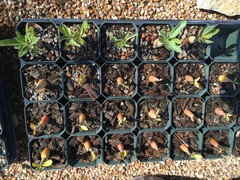
Original Author11 years agoWell the soil debate is over. Mixes with the coco chunks all failed. The only row (top) that is showing any progress is the gritty mix in two sets of planters like this. I had high hopes for the coco chunks since they are used extensively in Asia but if anything the plants in coco of any proportion have actually grown back or floundered.
 11 years ago
Jason were these mixes being watered with the same frequency? The seedlings in coco chunks look overwatered to me.
- 11 years agolast modified: 11 years ago
The nurseries in Delhi don't grow their own adeniums but source them from down south of the country, where the weather is very different from that in the northern half of the country. As a result the soil has to be changed to suit the weather conditions of the north because the same medium may hold too much water when watered in Delhi and kill them with rot .
Although coco coir seems to be the preferred media in the south of the country but when one gets them home then one has to plant them in new pots and getting them to grow after replanting is a whole new struggle.
I lost 3 grafted adeniums to rot in this replanting stuff. The others (after I began using rooting hormone on them) have taken well to the new media.
I layer the pot.bottom third broken pot pieces. Then large stone grit(average size 2-4 cms). This kindof fills up half the pot.Then I sit the plant on this base and put some manure and soil around the roots without removing the soil it came in (coco coir or whatever else) and top it up with grits till 2 inches below the top edge of the pot. The manure/soil in my plants is say only 20% or less.
I believe this makes them grow a big caudex above soil line as the media (and the plant has to store its energy somewhere )is incompressible, unlike coco coir which gives way and allows caudex formation below soil line.
This seems logical to me because in nature one sees them wedged tightly in rock crevices with little soil to speak of and a huge above ground caudex.
This medium allows very fast drainage of water through it and lots of air is trapped in it because of large gaps in between the stones. My pots are 13 inch ones and deep not shallow.
So far all grown thus have thrived (adenium grower since may 15), so that gives me some confidence that the method may be correct for growing these in a place like delhi.The ones which rotted were obesums, the arabicums seem to be more water tolerant species.
Satish on this forum lives in hyderabad and grows his adeniums in normal soil with manure because the soil there has different properties. The soil here in delhi is extremely clayey and great on water retention. Coco coir retains too much water too, even when mixed with perlite/stones etc and has caused root rot in my plants.
That is my take of these plants! :)
 11 years ago
Excellent information. it always astounds me how very much uncut manure is used. I would think that would be heavy on the N, and therefore make the plant more susceptible to burn. I run mine heavy on the grit, mostly for weight of keeping the pot stable, but then add the 8822 floor dry product for moisture control. Each plant gets planted in its own small rootball of soil in the gritty.









jjbadenium