Software
Houzz Logo Print
catsrose

Bees Declining

16 years ago

Here's a link to the latest info on the global decline of bees. It's bad news.

http://www.guardian.co.uk/environment/2010/may/02/food-fear-mystery-beehives-collapse

Comments (21)

  • 16 years ago

    link

    Here is a link that might be useful: link

  • 16 years ago

    It is distressing, mainly because of the obfuscation and unwillingness of governments to consider the implications in any terms other than the profit motives of pharmacuetical companies and intensive farming agglomerates.

  • 16 years ago

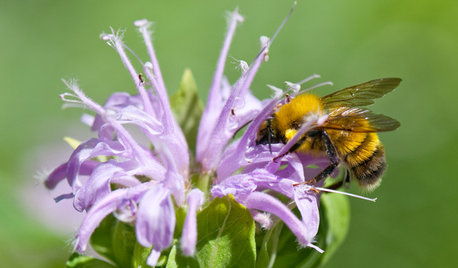
    I think we're going to need something like "Silent Spring" for bees. Until the growers quit using all the pesticides, this is probably going to keep happening. Growing more organically and having wide hedgerows of other flowers and flowering shrubs is going to have to be done, IMHO.

    As for me, I try to make sure at least half of my roses have the open stamens (the bumblebees love those) and I plant something for them all spring/summer. Lavender, sunflowers, mints, butterfly bushes, coneflowers, apple and plum trees, even the lilacs and marigolds get attention. There is also tansy that grows wild and all kinds of wildflowers out in the fields in the spring.

  • 16 years ago

    It's been a bad year for all beekeepers. Even backyard hobbyists, who typically have not had nearly the problems of the commercial bee keepers, have had problems but they have been more due to the abnormal length of winter this year. Lavender_lass you're right about growing organically and the diversity of flowers sources.

  • 16 years ago

    We also had an article recently about bee deaths in the Netherlands and apparently the reason was polluted sugar water, which bee keepers use to feed their bees in off-season (imported from Belgium). It looks like they pretty much killed most of the hives in some regions.

    Bumblebees are back as usually here at least, we always get a lot of them in the spring due to the crocus and especially due to Pulmonarias. Also I was surprised to see that they are very interested in gooseberry blooms - which bloom early, but generally are quite unattractive blossoms.

    Bumblebees also seem to love veigelas and thistles, honeysuckles are popular bee-stop as well and especially tilia trees in bloom. I think planting trees like tilias is very important to keep the bee population happy - it also is much more bee friendly plant that most of the current ornamental trees in suburban gardens.

  • 16 years ago

    well yes, elemire, we in the uk have had the 'it is the fault of beekeepers themselves' explanation. Afraid it sounds suspiciously like the Dutch Govt.get to wash their hands of any culpability - and blame another nation as well. Political genius! The true reasons, when found, will not be a nice neat solution but a horrible morass of cause and effect, lost chances and igmored warnings with truth sacrificed to greed and political expediency. True, we should, as gardeners, do whatever we can to aid the bee population but we are all, ultimately in thrall to cheap food, easy travel and a standard of living which is simply unsustainable in the long term. Gloomy sod, aren't I?

  • 16 years ago

    Unfortunately, gloomy sods are so often right. All I can do is live my life in a way I can justify, do my best to make the surroundings I can control friendly and beneficial to all living things and stay home a lot to use less gas and garden more.

    Ingrid

  • 16 years ago

    I think it is bit different over here campanula, since they banned a couple of products and law things probably will follow. The problem also is that most of this sort of chemistry industry is rather centralized and if one company has a bad shipment, consequences can be rather bad. It is also a bit different here generally culture wise, since in NL we do not have microwave food culture as much as in UK - and in the last years it turns significantly towards biologically grown products, to the point that the government does not allow anymore building of those huge farming complexes and generally wants to enforce more and more restrictions on non-eco-friendly farming.

    It also is somewhat a problem that commercial beekeepers tend to feed their bees supplements instead of actual honey the same bees produce. My uncle is a traditional beekeeper and I definitely can tell the difference between commercial honey and the one that's produced naturally, without synthetic food for the bees. Some disease explanation might be quite true though, at least to some extend, since the same uncle lives in the middle of the woods and he had also lost a few hives last years out of the blue. Since he lives in Lithuania, pesticides are not likely, they do not have money to spray forests over there.

  • 16 years ago

    Well said, elemire, with one caveat: I've read that some if not all Tilias/lime trees are toxic to bees, which is one reason I've never planted any.

    I've never used pesticides or chemical disease treatments of any sort on our land and we rejoice in lots of bugs both good and bad! We manage our property largely by default, just mowing the areas of pasture and letting the woods grow, and I hope this will suffice to allow a decent level of biodiversity develop. I'm interested in planting native plants in the rougher areas of the garden and in some cases even in the garden proper. I scout for potentially useful plants during our weekly walks.

    Melissa

  • 16 years ago

    It is strange melissa, I wonder where you read that about tilias?

    In some areas of Europe beekepers traditionally were planting tilia trees around their farms especially for the specific rich honey that bees produce then - the pale yellow kind, one of the best. I think if it was toxic to bees that would have been noticed long time back, since both bee keeping and tilias as ornamental tree go back thousands of years in especially Northern part of Europe.

  • 16 years ago

    sadly, the decline of bees is not restricted to any one region but has been observed across the globe - Brazil, Australia, Europe and so on. One of the problems is that there is a tendency to look at smaller reasons for this happening such as supplemental feeds, transporting hives and so on but, in fact, it is a reflection of a much bigger picture based on the rampant excesses of market forces and unrestricted capitalism. In fact, loss of biodiversity, loss of habitat, over reliance on pesticides in intensive monocultures are far more intractable problems and the usual response of governments and corporations has been a sorry exercise in buck passing and blame avoidance.As consumers, our choices are peculiar to say the least. For example, the middle class at least have heartily embraced the idea of organic foods in the UK while failing to consider the organic beans they are eating have been flown, at great expense from Kenya where an african population is using precious water and resources to raise crops for affluent Europeans while being unable to afford to eat these products themselves. Gardeners here have been equally culpable as I am sure you, Melissa, can attest, having seen countless ancient olives shipped to the UK for the delectation of gardeners who absolutely must have the next novel thing. Not to mention our insane reliance on peat. However, we can do many things to register our dismay. We can, if we are meat-eaters, choose to have at leat 2 meat-free days a week. We can choose to avoid peat based products and we can choose to restrict our travel, save water (which unfortunately means that roses, a water hungry plant, may have to be considered an outrageous luxury in many regions)desist from insane zonepushing and lay off the rampant buying of more and more stuff. A Chelsea show garden typically costs £250,000 while there is a show garden this year costing £10million - this is an obscenity! So, self-induced austerity, not a thrilling prospect, I know, but we must wake up to the idea that money does not rule everything and to be wealthy does not confer immunity from moral responsibility. Yet again, the southern states of the US is being punished with catastrophe: this time man-made through costcutting and profit grabbing. When there is flooding and burning in London and Washington, Paris and Sydney, rather than the beleaguered outskirts or rural holdings, there may be some seachanges in behaviour but this, I fear, is a generational change which will only be implemented when there is sufficient profit motivation to invest in truly green energy for instance but more likely, when the punishment becomes greater then the reward.

  • 16 years ago

    I'm just glad I have no-spay garden. I do not like to use chemicals in the garden and try to get roses that do well in my micro-climate. I don't know if pesticides are the only reason for it, but too many chemicals can't be good for the insect population. I do not judge those who use them, by the way. I just do my part to help the environment and keep things organic.

    Juliet

  • 16 years ago

    Many chemicals have been banned in the UK for home gardeners BUT, the chemical arsenal still available for professional and agricultural use is eye-watering. So yes, we should carry on attempting to garden more environmentally responsibly but we should also GET ANGRY with the powers that be.

  • 16 years ago

    elemire,
    That's interesting! I learn so much on the forums!
    I read that about tilia toxicity to bees in Michael Dirr's 'Manual of Woody Landscape Plants', the 1998 revision; Dirr is an internationally known authority in the field of horticulture and the book is a kind of horticultural bible. It may not be right 100% of the time, but what it says is always worth serious consideration. The reference is as follows:
    "Considerable German literature that points to honeybee and bumblebee death after sampling the nectar of T. [Tilia] tomentosa, T. petiolaris, T. dasystyla, T. x euchlora and others. One paper recommended that T. cordata, T. platyphyllos, and T. x europaea be no longer utilized in urban areas in Germany."
    So. So it's all very interesting! If you have more information on the subject, I'd appreciate your input.
    Melissa

  • 16 years ago

    I agree with campanula, it is ridiculous to hear that big food companies buy agricultural products somewhere in Afrika just because they are few cents cheaper there to maximize the profits. It also is a problem that small farms over the last decades were replaced by the huge complexes, which tend to be more specialized and often do not consider needs of the wildlife in the area.

    Melissa, I am not familiar with the mentioned German research, so I can't say much about that. But I am anthropologist by profession, so I have been collecting data in Eastern European villages/farmsteads. Tilias are really common old ornamental plant (T. cordata, T. platyphyllos) and cordata even grows as a wild plant. Traditionally the hives were usually set in the orchards, which were surrounded by tree ring (various kind, tilias among them), or in the forest. Since honey and wax were important export of Easter Europe for centuries, I would think that anything harming such important industry would have been eradicated, but there is no data about destruction of tilias because of a thread to honey production. Also, since at the period of tilia bloom bees gather immense amount of tilia nectar (hence the coloration of the honey at that period), the causal relation between bee death and plant in bloom would not have been difficult to spot.

    However, mentioned was urban area in Germany, which generally is completely different environment from the country side. There you have to consider toxins from the cars and industry, which affect tilia trees, also the lesser choice in the plants that bees can visit.

    I do have tilia cordata growing in front of our house on the public green and it is buzzing with bees and bumble bees at the time of blooming. I have never noticed a single dead bee anywhere near it, neither I have noticed a decline in bees after tilia bloom. So if the question is if the nectar of tilias is poisonous itself, I would think there should be some noticeable result in any case, not just specifically urban areas. And if the problem is in urban areas, then the cause probably is external, not the tree itself.

    Not saying that caution is a bad thing, but I am rather skeptical about this explanation of bee deaths.

  • 16 years ago

    That lindens were poisonous to bees is something I've also heard. It's not recent. My best recollection is that where I read it was in something mid-19th century.

    I found a blog post that mentions it. There is also an explanation, which would fit with a 19th century theory of tilias being poisonous to bees.

    Here is a link that might be useful: see remark 8

  • 16 years ago

    Juliet- I agree with your policy. I don't spray anything but water on my plants and I try to stay with plants that will do well in my area. However, I've never seen blackspot or rust here, so it's easier for me to grow roses and not have to spray....there are just a lot of roses that don't do well in zone 4 :)

    As for pesticides, I think we are all in as much danger as the bees. I just saw another top 12 list of bad fruits and vegetables (filled with pesticides) on Yahoo, and blueberries, strawberries, potatoes and cherries were on the list. Time to grow even more of my own food!

  • 16 years ago

    Thanks, elemire and mad gallica, for the information. I learn, I learn! Mad gallica, the link you posted revived my desire for trees, trees, and more trees; which we're planting as fast as we can, in the face of all kinds of difficulties. Right now I look outside and it's as green as can be, also because of all the rain of the last two days. The entire garden is swamped with grass and I'm going to have an infernal task pulling it while my husband cuts the paths; everything is just as messy as it can be. But, it's organic matter! The soil is alive! And the rain will help the baby trees planted the last two winters to grow before the summer drought hits. I hope in time to resolve the chaos into some kind of order, and I think we're on the right track. But I must admit my heart falters when I see what a mess we have at the moment.
    Melissa

  • 16 years ago

    Oh yeah, regarding a mess you should see my backyard. :))) I think by now I can officially re qualify our lawn and call it a meadow... :)))

    Regarding the trees, I don't know how it is over there, but here I am slightly annoyed by quite limited choice of trees in the local nurseries. I really like rowan trees (Sorbus) and I want to plant one or two of the smaller kind, which get to about 3-4 meters... and I can't find them in any nursery around here. It is so frustrating when you have to ship just a common native plant from god knows where.

  • 16 years ago

    oh elemire, i love sorbus and they are easy from seed, even some of the lovelier smaller species such as R.cashmeriana, R. hupehensis and my favourite, R.vilmorinii. Try chiltern seeds. They germinate after one winter of scarifying although they may take 2 years but they grow healthily and fast. I have been planting at the end of my allotment, 3 rowans, one a common mountain ash, the white berried cashmeriana and a hybrid, Joseph Rock. First 2 from seed although as yet, only 40cm high from a 2008 winter sowing.

  • 16 years ago

    I might just try that, although rowan berries usually do not last here till the frost, due to the healthy population of the black birds and their relatives. :)