

Fertilizing Bands
I have done a search on this subject and read many differing opinions. I have bought bands for years and have had good luck with most, but I am being really particular with this year's Vintage bands because they will be the last. I pot all of my bands in 1 gallon pots [or 2 gallon if needed] in a very good soil mix that works well for me. I put them under a shade tree and they get filtered sun all day and are growing. But not much. I have made some plant shelves and am moving them into a bit more sun, but only morning - they will have shade from the afternoon sun. I have some that are well leafed out but some with not many leaves but good green canes. I think they might do better with some feeding....but I am timid about fertilizing. I was thinking about sprinkling some alfalfa pellets or Mills Magic Rose Mix on top or half strength fish emulsion or even mild Miracle Gro. I would like to see some new growth - but I read one post from a knowledgable member who did not fertilize at all, and another from someone who said they didnt care about top growth, only roots. Am wondering what I can do to promote root growth.
Normally I would just go on and fertilize - but some of these [like Lady Roberts and Duarte de Oliveira] I would be sick if I fertilized and set them back or killed them. Would appreciate some thoughts on fertilizing these young plants. They have been in pots a couple of months........I dont even consider fertilizing the ones I have just potted up. So far, am expecting 2 more from Vintage, not counting what I am hoping to get from their July 14 sale, and 10 from the Heirloom sale. I enjoy fussing with my roses, so they are observed daily, watered if needed - just need to know anything else I can do to help them along. Thanks for any advice!
Judith
Comments (28)
 13 years agolast modified: 11 years ago
After the bands have been in their gallon pots for at least a month, I apply time-release fertilizer (Osmocote) per instructions on the container, but on the light side. That seems to work well for me. I always fear that "instant-action" inorganic fertilizers may be too harsh and can't imagine using organics in pots (except maybe fish emulsion? -- but having lots of cats around, I've been reluctant to use that).
My perspective is that the dynamics of healthy bands are sort of like suppressed understory trees in forests: with roots no longer air-pruned and set free to grow into the ample space of new medium, the plants tend to make rapid growth during warm weather, no matter what. If the band is not springing into growth, I'm not sure more fertilizer is going to push it to do so -- I would think the plant is taking time due to other factors (might just be a pokey variety, for example, or have other issues).
This post was edited by catspa on Tue, Jul 23, 13 at 0:58
- 13 years agolast modified: 11 years ago
Judith, as long as your pots are properly watered, you can safely feed inorganic, water soluble fertilizers WEAKLY. If the instructions state a tablespoon per gallon, make it half strength, or even weaker. I have great success in my arid, hot environment feeding "Weakly, weekly". Normally, something like Miracle Gro states every two weeks. Why not half strength, twice frequency?
Yes, you want roots. The plant is going to grow what it needs. You won't have foliage without roots. If the plant is pushing leaves, and it is already rooted, it has sufficient roots. If you're considering a cutting which isn't rooted, you CAN push leaves without roots, but yours ARE rooted.
I don't fertilize every cutting grown plant I propagate or grow. If they appear to be developing well, I leave them alone to do their things. But, if they're just sitting or looking peaked, I will make sure the drainage is good, the pot isn't over heating, it is watered properly and, after watering well so the plant is appropriately plump, I'll feed it "weakly, weekly". It can make a world of difference. I chose the "weak" feeding because it's more difficult to burn with a weaker solution and you can always add more. Your bands would be perfect candidates for disbudding in combination with "weakly, weekly" feeding to encourage faster maturation. Kim
Related Professionals
Montgomery Landscape Architects & Landscape Designers · Roanoke Landscape Architects & Landscape Designers · Anniston Landscape Architects & Landscape Designers · Bangor Landscape Architects & Landscape Designers · Middletown Landscape Contractors · Burlington Landscape Contractors · Cowansville Landscape Contractors · Tallahassee Home Builders · Bartlesville Home Builders · Dallas Home Builders · Aurora Home Builders · Grand Island Home Builders · Potsdam Home Builders · Hudson Home Builders · Carson City Home Builders 13 years agolast modified: 11 years ago
All my bands were potted in a mix of equal parts peat moss, Bovung dehydrated manure plus humus, and shredded hardwood mulch, mixed together in a wheelbarrow. As potting mix was added to their new pots, I sprinkled Jobe's Organics Knock Out Rose food in layers throughout the pots (1/2 cup for the 1-gallons, 1 cup for the 2-gallons).
When the pots were filled, they were soaked with a mix of 1 Tbs fish/seaweed emulsion per gallon of water (half the recommended rate per the bottle), and set out to get full-sun from about 10-11am until 5-6pm. Keep in mind this was back in April/May, in NJ, when temps were cool and rain was abundant to the point that I didn't have to water any of them again until about late June. I wouldn't put new bands in full-sun here now with all the heat and humidity we've been having, but everything else I'd do the same. And I got lots of growth from most of them. In fact, I just started planting a few this week -- I'd keep going with the rest but I still have more major bed preparation to do. My 'Orfeo' is already about 5' tall. See the link below.
:-)
~Christopher
Here is a link that might be useful: Some before and after showing growth so far
- 13 years agolast modified: 11 years ago
I plant well rooted cuttings in a potting mix with, bark/wood chip compost, peat, cowmanure and sand. Somtimes I just use a bag of organic potting mix I buy. I water with half strength liquid organic fertilizer with a good NPK ratio, mainly N and K if there is lots of phosphorous already.
I have hardly ever pruned cuttings with the thought that leaves produce all the energy for growth in the plant and it needs them. It's different with plants you dig up, replant and demage a lot of root. I have let nature take care of this part.
To promote root develompent I use only well composted stuff in the potting mix, sometimes a mychorizzae when platning. Somtimes I have mixed in a bit of crushed guano fertilizer drops as a source of phosphorous near the root. I have only had positive result with different organic liquid fertilizers, diluted to half strength at least to begin with. I don't do every thing at once or every time, but depending on what I have available when I need it. I fuzz a bit to get a reasonable NPK ratio since I try to grow organicly.
- 13 years agolast modified: 11 years ago
First of all I'm not sure they need to be put in the shade. The bands live at Vintage in full sun. They've also been given already a slow release fertilizer that's like Osmacote.
Weak fish emulsion is wonderful for the pots. For me though it has become expensive and time consuming(I have a lot of pots) This year I have had the best results ever with bands growing swiftly in gallon pots. Here's what I do: I use Black Gold potting mix. I put a little in the bottom of the pot then I put in this pelleted chicken manure product(it's like 3 3 something NPK) Then a layer of soil so the roots aren't touching that. Towards the top of the pot I mix in some feather meal(12% nitrogen) Then I mulch the top with composted steer manure. They go right out into the sun.  13 years agolast modified: 11 years ago
Hi Alameda: Check out what soluble gypsum (calcium sulfate) does to new roses in my thread "Least affected roses ... Japanese beetles".
My summer heat is intense 100 to 90's degrees so I put bands in a few hours of morning sun. Experiments in soluble fertilizers showed the best root growth is achieved with high potassium and calcium added.
I use MiracleGro Moisture Control potting soil (already has slow-released fertilizer for 3 months). The only thing I add is soluble gypsum (calcium sulfate), and a tiny bit of sulfate of potash for potassium. When we had lots of rain, I also used MiracleGro Bloom Booster NPK 10-52-10, since phosphorus got leached out of pots. Phosphorus helps with root growth.
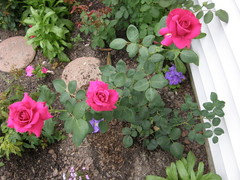
Below is Stephen Big Purple's 2-months growth, bought as a tiny band (4 " tall with 3 leaves). I also put citric acid, used for sprouting, in my tap water since I have hard well water, pH over 8.
 13 years agolast modified: 11 years ago
mendocino_rose, what is feather meal and where did you find it?
I have been testing my bands. I have a batch that is potted in organic potting mix, and I am giving them weak fish emulsion (1/4 T per gallon) every 7 days. The other bands are in Miracle Gro Potting mix - blue bag. My next batch will be in Black Gold Potting mix which you seem to have luck with, I have been curious about, so I will give it a try with the bands arriving today:).
Once I determine exactly what is in the Black Gold, I am considering adding a little alfalfa meal or using fish emulsion to the testing mix. I am concerned about the use of alfalfa meal, some folks sprinkle it on top of the soil, but you place it on the bottom of the pot. Why the bottom versus the top?
All of my bands have been received within 5 days of each other and I have two of the same plant that was received in the same batch, receiving different potting treatment, but same conditions to provide the best comparison possible.
Lynn
alameda/zone 8/East Texas
Original Author13 years agolast modified: 11 years agoStrawberry, your Stephens Big Purple is gorgeous! I just repotted a band of it I received earlier but it sure doesnt look like yours! I just called my feed store - they have a gypsum product that is in very fine granules that they say could probably be reconstituted into a liquid form. Is this what you refer to as soluable gypsum or is there a liquid form? Can I soak the granules to make a liquid? If so, how much, how often?
I have a small bag of Muriate of Potash that I cannot recall why I purchased. Would this work for the potash that you suggested?
I disbud everything - rather get the plant going first. The roses are now all going in good morning sun - they got filtered sun where they were - in Texas, full sun would be lethal this time of year. I will get photos of some of these small bands to post today.
I have some Miracle Gro Moisture Control potting mix I might try with a couple of bands. I have a really good mix made by a local company that sells in bulk - sand, bark fines, aged mushroom compost - that works great, but maybe mixing some Miracle Gro soil in with it would make it even better.
I really want to get a system down for growing out these bands and giving them a good start. Appreciate all the advice!
Judith- 13 years agolast modified: 11 years ago
I have no doubt Vintage kept bands in full sun, nor that growing them in full sun once upsized into gallons works for Pamela perfectly. This is an excellent example of determining WHERE something works before replicating it where you are. Flats full of bands could be held in full sun in my back yard as long as they are watered multiple times daily, particularly when the real heat returns. But, miss a day when it's pushing triple digits and they're toast.
If your conditions are more like a coastal, northern California area (cooler, damper, foggier with greater changes of rain), you should easily be able to grow cuttings in bands in full sun. If you are seldom likely to have "cool, damp, foggier or over cast", being more likely to expect brilliant, unrelenting sun, perhaps drying winds and temps into the nineties and above, tred lightly. It seems like stating the obvious, but it makes all the difference whether you can safely be able to follow the examples or not. Kim
- 13 years agolast modified: 11 years ago
Hi Judith and Lynn (Desertgarden):
Both University of Kentucky 1st experiment in vegetable seedlings, and University of Mass. experiment with marigolds gave THUMB-DOWN to alfalfa pellets. Both cited chlorosis, yellowing of young plants.
Both experiments gave the best result to chemical high in nitrogen and potassium (needed due to leaching out of pots.) The 2nd University of Kentucky experiment did not include alfalfa meal, but showed the best growth through applying Peter 20-10-20 three times a week. See link:
However, if the band is planted in the ground, no need for nitrogen (soil microbes help plants to utilize nitrogen from rain & atmosphere). Nitrogen is needed if plants are in pots or in sandy soil, where it leaches out. I never put nitrogen on my 26 trees, yet they are taller than 2-story building, and the deciduous ones lose leaves every winter.
Last year I had 14 bands in pots, I put alfalfa meal on top, plus mixed in with potting soil. The roses were pale, and when I planted them in the ground, the roots were small.
This year I followed the You-Tube experiment in hydroponic fertilizers, adding calcium via gypsum, and a tiny bit of potassium. I did nothing for nitrogen, since MiracleGro MC (blue bag) already have slow-released Osmocote.
After 1 month in the pot, Stephen Big Purple went from band-size to outgrowing the 2-gallon pot. Root was huge when I planted in the ground. Once in the ground, I gave Stephen Big Purple MG Bloom Booster NPK 10-52-10 to make it bloom.
The You-Tube experiment in hydroponic fertilizers showed how big the root is, versus the 2 University's measuring only top growth. Root growth is most important for my zone 5a winter survival. This year I use zero alfalfa meal, and I like the result better.
Per Judith question if Muriate of Potash can be used, all potassium fertilizer have salt, but about 1/2 salt-index of nitrogen fertilizer. (that's why I don't use nitrogen for my fertile heavy clay). One teaspoon of high-potash is sufficient. Salt index of gypsum is 8, compared to sulfate of potash at 42.
Per Judith question of granular gypsum vs. soluble? I used granular when we have non-stop week-long rain, pH of rain is 5.6, so that helped to dissolve. If you don't have rain, soluble gypsum in water is best. I bought it 5 lbs for $8.60 (with coupon) at Kelp4Less, free shipping.
I tested 5 different types of potting soil. MiracleGro Moisture Control is best when it's dry and hot. Pine-fines Organic is best when we have heavy rain, that stuff drains better.
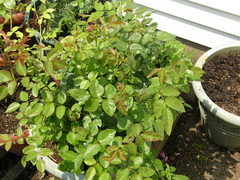
Below is a 7-months old rose I grew from a tiny seed, planted in pine-fines Organic potting soil (Jungle Juice, with slow-released fertilizer). I also added gypsum (calcium sulfate), and a tiny bit of potassium.
Here is a link that might be useful: University of Kentucky and vegetable seedlings
This post was edited by Strawberryhill on Tue, Jul 23, 13 at 13:17
- 13 years agolast modified: 11 years ago
I love to read all the different ways you guys treat your new roses. I have to read your link more carefully Strawberryhill be fore I make complete sense of it. I suppose it was alphalpha tea which first was used on roses to give an extra spur of growth, and later on some got the idea to mix dry pellets or cubes directly into the soil. Tea should have good effect in pots I think; maybe there are some scientific tests done allready?
- 13 years agolast modified: 11 years ago
I am going to play it safe and stay away from the alfalfa. I will divide the plants and replicate the organic potting soil with fish emulsion weekly for half and pot up the remainder with miracle gro moisture control potting mix only and see what happens. I am taking photos to share with all; especially those in hot climates.
stawberryhill, you seem to concur with advice provided by roseseek regarding the use of M.G. blue bag moisture control as it being a good product to use. It my hot, dry climate it seemed to be a "go to" choice. Your plants appear so healthy. I believe in my garden too, sufficient roots will be extremely necessary for them to flourish once they hit the soil !!
Lynn
This post was edited by desertgarden561 on Tue, Jul 23, 13 at 17:11
- 13 years agolast modified: 11 years ago
Hi Taoseeker: I agree with you. Alfalfa tea makes sense because NPK is 2-1-2, and phosphorus is best utilized in soluble form, plus alfalfa has calcium, best as soluble organics. I get concrete from mixing aflafa meal with my heavy clay, it choked geraniums to brown in hot weather.
People have the misconception that if municipals add lime to tap water, then tap water would provide calcium. However, hydrated lime is calcium hydroxide, very unstable, and quickly binds with phosphorus and potassium in the soil. Gypsum, or calcium sulfate, is different, provides both calcium and sulfur for plant growth.
Hi Lynn: Fish emulsion is excellent, provides better bloom color than chemical fertilizer. If you look at the below link, the marigolds with NPK 20-2-20 have the largest bloom, but dull color, versus a clean & vibrant yellow with fish emulsion. When I tested sulfate of potash NPK 0-0-60, it browned the petals of my roses, best used after a flush, rather than during a flush.
I appreciate Lynn's earlier posting of a warning: DO NOT USE GRANULAR FERTILIZER ON BANDS. Both powder gypsum and high-potassium fertilizer should be dissolved in water, rather than applied directly to tender roots. I get horse manure in cool spring and cold fall, but not during hot summer, since horse manure has salt. I get better result with soluble MiracleGro NPK 10-52-10, versus granular fertilizer as in dried chicken manure ... too much nitrogen and salt burns in hot temp, plus one tend to over-apply with dry granules.
The ARS recommended using fish emulsion when buds are small like peas for best bloom color. Fish emulsion is great, but costly. I find that soluble gypsum at $8.60 for 5 lbs. deepened my bloom color, and greened up the pale leaves. See picture below, taken in July heat of 95 degrees and very dry weather:
U. of Mass link below also shows chlorosis with alfalfa pellets, and largest blooms with NPK 20-2-20.

Here is a link that might be useful: University of Mass. experiment on marigolds
This post was edited by Strawberryhill on Tue, Jul 23, 13 at 15:46
- 13 years agolast modified: 11 years ago
Though they're great products for gardening, watch using anything "fish" if you live with raccoons and/or coyotes. Both LOVE anything "fish" and will dig up your entire area where it's applied. Been there. Kim
- 13 years agolast modified: 11 years ago
Kim, I'm glad that you pointed out the difference that temperatures can make. It can get into the 90's here and at Vintage, but triple digits are rare. I water my pots every other day , but every day if it is really hot. I'm sure they water the bands daily. I've thought about putting straw around my pots to keep the roots cooler and was also once advised to white wash the black plastic pots.
Lynn, I'm fortunate that our local nursery has such a good selection of amendments. Feather meal is just what it says, a meal made from feathers. The only thing i don't like about it is that sometimes the dogs get into it. It helps to water it in well. 12% nitrogen is fabulous. It's the same nitrogen as Fish meal but nearly half the price here. It has made quite a difference here in the growth and is easy to apply. - 13 years agolast modified: 11 years ago
I'd think feather meal would also be far less likely to attract critters than anything fish, bone/hoof, blood. Kim
alameda/zone 8/East Texas
Original Author13 years agolast modified: 11 years agoI took a photo of 3 small bands to post but Photobucket is being difficult and I cant copy my photo. Maybe later....have asked the site for help.
Firstly, I appreciate all the replies! I have a couple of specific questions.
I bought some gypsum at my feed store today [40 lbs. for $9] and was told there are instructions on the bag for diluting it. How my gypsum to how much water for rose bands do I use? I can read the bag but this might not be appropriate for rose bands. How often should I use it?
Are Muriate of Potash and Sulfate of Potash different? I would think so......would either be beneficial to these bands?
Fish emulsion is easy to get and I dont have a problem with critters digging in my pots, so this is a good option for me. Can I use it at the same time I use the gypsum?
I do have some Peters and I also have a new fertilizer with a different name that is a remake of Peters. Which fertilizer should I use first? I am thinking it would be overload to use all at the same time.
Our temperature [after a week of glorious rain and cooler temps] is heating up again, going to be 98 the next few days. My roses are now being put in full morning sun - right after noon, the spot becomes shaded from the brutal afternoon sun. I am careful about watering. I would love to see mine thrive like Strawberrys seedling!
What is best to include in the soil beneath the band when planting? I have used Mills Magic Rose Mix, but as it has some alfalfa in it, maybe this is not a good idea??
Kim, I like your theory of "weakly, weekly"..................Thanks ya'll for your help!
Judith- 13 years agolast modified: 11 years ago
A band sized rosebush can easily be killed with too much fertilizer, and if it is in good soil it doesn't need to be fertilized to survive. That being said, I do fertilize all my bands with single digit liquid fertilizer because after seeing how slowly my own root Old Garden Tea rosebushes grow from a band sized plant, I started giving them liquid fertilizer at
4-4-4 for a band sized plant c. every 10 days.
8-8-8 for a gallon sized plant, c. every 10 days
12-12-12 for a plant that has a root system that is too large to fit in a 2 gallon sized pot.
It is well worth the effort, I took notes and saw that nearly all of my Teas increased their growth rate by 25% to 33% while in pots, with that fertilizer.I use a good brand of rose potting soil mixed withc. 1/3rd home made compost and a fourth to a third of native clay soil, to help slow down the drainage rate.
gently gently wins the race,
Lux. - 13 years agolast modified: 11 years ago
Hi Judith: Muriate of Potash is potassium chloride, salt index of 116.2, very high, that's the stuff we use to de-ice in zone 5a winter. I would not use that stuff on any plants.
Sulfate of potash has salt index of 43, NPK 0-0-50, plus the sulfate part which makes it more water soluble. The safest potassium with no salt would be chop-up banana peels soaked in water. Banana peels NPK is 0-3-42.
MiracleGro Moisture Control potting soil (blue bag) already has slow-released fertilizer for 3-months, no need for additional fertilizer. What it doesn't have is calcium, essential for root-growth.
I put granular gypsum bought from Menards on top of my roses ... after 1 month of spring rain, that didn't dissolve. Gypsum is 22% calcium, and 17% sulfur, but it varies with brand .. some brand contains less sulfur, and never get dissolved.
The soluble gypsum from Kelp4Less dissolved easily in my tap water, pH 8, so I suspect there's more sulfur % in that one. The instant green-up and deepening of bloom colors most likely is from the sulfur %.
I would dissolve the gypsum you bought from the feed store at the rate of 1 tablespoon per gallon, if it doesn't dissolve, then is best used in the ground. Roses Unlimited recommends mixing in 1 cup of gypsum in the planting hole.
If the gypsum you bought from the feed store still doesn't dissolve, I would put less than 1 tablespoon of vinegar per gallon ... any more roses will wilt in the heat. Putting vinegar in the heat is risky, less is best.
So far 4 studies pointed to calcium and extra potassium as essential in best root-growth: U. of Kentucky with Peters 20-10-20, same with U. of Mass with marigolds.
Two additional studies: one with hydroponic lettuce, with the best result Masterblend 20-18-38 with added calcium nitrate and magnesium sulfate (Epsom salt). This was done hydroponic, no soil, thus the logic for Epsom salt.
Another experiment is done by Ohio Link NTD center on New Guinea impatient flowers. Here's the tested ones:
Peters-water-soluble 20- 4.4 -16
Daniels-soybean-base 10- 1.8 -2.5
Osmocote 3-month release 15-4-10
5-month slow-release 15-4-10
The best performance is Peters-water-soluble (NPK 20-4.4-16). The worst performance is organic soybean base, too little potassium. Potassium mobility is a 3, somewhat mobile, and gets leached out. Potassium is essential for root growth, that's the only extra fertilizer one needs besides calcium for best root growth.
MiracleGro potting soil has plenty of nitrogen, I get a gigantic dark-green Excellenz von Schubert from a band, I had to chop off 2 feet of growth, before planting in ground.
The safest bet: chopped up banana peels soak in water for potassium, and gypsum powder at 1 tablespoon per gallon (low salt index of 8). Plus MiracleGro Moisture Control potting soil (blue bag), which already have slow-released fertilizers. Less fertilizer is best for young bands.
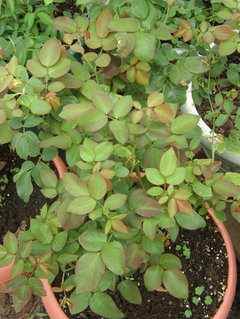
Below is Gene Boerner, bought from Roses Unlimited end of June sale, fertilized with the above approach. Picture taken few days ago, so it's 3-weeks of growth:
- 13 years agolast modified: 11 years ago
Don't forget to mention how many inches of rain also went in to generating that much growth. As was seen on the thread asking if the new growth from the poster's Red Eden, it takes WATER with all this stuff to generate that kind of growth. No matter how good the additives, nor how well and properly they are applied, you will never experience that kind of "push" unless you accompany the additives with WATER, often copious water.
Be very careful with much of what has been suggested unless you are fortunate to have regular rains during the period you use them, or are prepared to water sufficiently to make the additives available to the plants and assist them in this kind of growth. Otherwise, you are highly likely to damage them as surely as you would with traditional fertilizers with insufficient water. I'm not putting down the use of what has been suggested. I am stating without many inches of water WITH them, don't expect this kind of response, nor even healthy plants. Kim
- 13 years agolast modified: 11 years ago
Hi Kim: The 3-week growth above is in our DRY July month, temp. above 90 degrees, trees are wilted. The lush growth is from calcium and potassium role is maximizing water uptake to the plant .... only a strong root can do that.
Growing the root big is my goal, since I have to bury it 4" to 6" below ground level for zone 5a winter ... can't do that unless the root ball is at least 2-gallon size.
- 13 years agolast modified: 11 years ago
Three dry weeks....try six dry months on top of half the annual rain....it still takes water. Kim
alameda/zone 8/East Texas
Original Author13 years agolast modified: 11 years agoStrawberry, growth on your plants is gorgeous! I will just toss the Muriate of Potash - have no idea why I bought it. Its old but never been opened - might be able to take it back to the feed store.
I have a big bag of the Miracle Gro potting mix moisture control - have been afraid to use it on the young bands due to fear of burning them. With the positive report, I am going to mix it with the mix I normally use that works so well.
I have another question - do the banana peels go in with the potting mix at the bottom of the hole or put on top of the soil? I have heard about mixing the peels in a blender with water but was never sure what to do with them.
Years ago, I had to move my roses in July to their new bed - my baby was due in a couple of weeks and I knew I wouldnt be able to do it after I had him - so moved them and watered them faithfully every day. I missed a few days when I gave birth but got right back at it when I came home. These roses never missed a beat in hot summer and I have been a big believer in water ever since.
I hope I havent asked too many questions, but I really want to get my technique for raising bands perfected - I have bought alot from Vintage because of their demise and these are all precious to me because of their rarity and I really want to grow them out properly. I am loving reading all this great advice!
Judith- 13 years agolast modified: 11 years ago
Hi Judith: Solid organics requires water to break down. I chop the banana peels coarsely, and soak the bits in used water overnight, with 1/2 tablespoon vinegar per gallon. The water goes to the bands, and I put the solids on top of roses in the ground.
Banana peel NPK is 0-3-42, the water contains both soluble phosphorus and potassium. The # killer of root growth is alkaline tap water, that's the logic for putting a touch of vinegar in the "banana water". I tried sprouting broccoli seeds, no luck after 10 days, versus my Mom with neutral tap water can sprout in 3 days. I had to buy "citric acid" for sprouting at the health food store, $10 for 1 lb. ... vinegar is cheaper.
It's good to test your tap water by boiling that in red cabbage, and compare the color with distilled water boiled in red cabbage. If your water becomes blue, versus distilled water's violet color .... then root growth is slowed.
MiracleGro (blue bag) has plenty of slow-released fertilizer. If the stuff you mix in also has slow-released fertilizer, then calcium via gypsum and banana water is enough. I saw a fertilizer-result display at Cantigny rose park: one without, one with a tiny bit, one with moderate, one with excess. Here's my ranking by health: best looking to the tiny bit, then moderate, then without, and excess is last.
Thank you, Judith, for the tip of 40 lbs. of gypsum for $9 at the feed store. I'm calling my feed store to see if they sell in bulk. I paid $6 for a tiny bag at Menards (the size of 1 serving of potato chips). That's why I ordered 5 lbs. of soluble gypsum at $8 from Kelp4Less, free shipping.
alameda/zone 8/East Texas
Original Author13 years agolast modified: 11 years agoStrawberry, I just love the great information you have! Glad I could be of help about the feed store - I get all my fertilizers there and they can order what they dont have - and its cheaper than Lowes, Home Depot.
I just called my water department and found out the PH of my water is 7.0. Do I need to add anything to it for the bands? Can I use the tap water for my banana peel water?
I have a friend who is an excellent gardener [doesnt grow roses] who sprouts alot of seeds. He is a big believer in the citric acid. I sprout alot of daylily seeds - and use 1 T hydrogen peroxide to 1 C of water - this seems to speed the process along.
The soil I have been using has no fertilizer - just natural ingredients of sand, bark fines and aged mushroom compost. At another home years ago, I filled my raised beds with pure mushroom compost and let it sit awhile then planted roses and daylilies in it. They grew like gangbusters. I am going to mix the Miracle Gro with my mixed soil and see what happens. I just got my Roses Unlimited sale roses and will pot them up with this.
When I first plant up bands [or other roses], should I wait before giving the banana water, gypsum solution or fish emulsion or can I start watering in with this right away?
Judith- 13 years agolast modified: 11 years ago
Hi Judith: You are so lucky that your tap water is neutral, no need to add vinegar whatsoever.
I add a bit of vinegar since stuff doesn't dissolve in my tap water at pH 8. Phosphorus is HARDEST to dissolve in my tap water, even with soluble fertilizer. That's why I put vinegar in banana peels to get the 3% phosphorus portion. Sulfate of potash dissolved easily in my alkaline tap water. Soluble Gypsum from Kelp4Less dissolved instantly, thanks to the sulfur part.
Mushroom compost is great if one's soil is acidic, like my last house, only 1/2 hour away. In my present house of alkaline clay, pH 7.7, I tested mushroom compost from Home Depot, it's beyond pH 8, and my Japanese Maple went down hill.
Here's an excerpt on mushroom compost: "consists of wheat straw, dried blood, horse manure and ground chalk Nutrients (0.7% N, 0.3% P, 0.3% K plus trace elements). Due to its chalk content, it's alkaline, and should not be used on acid-loving plants, nor should it be applied too frequently, as it will overly raise the soil's pH levels.[1]"
Judith, your soil mix composes of "sand, bark fines and aged mushroom compost" ... My guess: would be neutral if they use acidic pine bark, which neutralizes mushroom compost's alkalinity. Best to test its pH with red cabbage juice, before mix in with MiracleGro blue bag (I tested that, it's neutral pH, clear in red cabbage juice).
Soluble fertilizer is safe to use on bands. Chamblee's Nursery in Texas advised soluble fertilizer every 2 weeks. I assume your bands will be in a few hours of weak morning sun, thus soluble fertilizer will be safe.The banana water has no salt, quite dilute, that's safe. Gypsum at 1 tablespoon per gallon, salt index of 8, is safe for once a week. Fish emulsion? Not sure how much salt it has, but I read reports of Alaska Bloom Plus fish emulsion burnt foliage from the higher phosphorus. Chamblee's guideline of once every 2 weeks is a safe bet.
Good luck to your bands! Below is the procedure I wrote for the English Roses Forum to get soil pH fast:
Here is a link that might be useful: Cheapest way to test soil pH using red cabbage
- 13 years agolast modified: 11 years ago
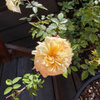
I noticed the remaining Renae cutting (wraps from late February 2013, which was stunted in the quart pot until about six weeks ago) out front is developing nicely. No rain; rather high heat and frequent watering. It was potted directly in Miracle Grow Moisture Control Soil from the wrap and now into a gallon of the same soil. No additional feeding of any kind, just high heat, brilliant sun/extreme filtered sun and copious water. This is Renae right now. Kim







User