Software
Houzz Logo Print
redwing269

Please help me idenitify this plant.

16 years ago

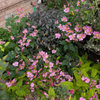
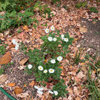
I bought it at Home Depot. They didn't know what is was, only that it was a perennial. This is a picture of two plants planted closely together. The flower looks like a light pink wild rose. Someone bought the only plant with a flower while I was standing there looking at it. Any ideas what this could be?

Here is a link that might be useful: Mystery Plant

Comments (15)

  • 16 years ago

    Japanese Anemone?

  • 16 years ago

    I agree, Japanese anemone.

  • 16 years ago

    Thanks! I think it might be 'September Charm.'

  • 16 years ago

    Probably is, I have that one. Your description of the flower is right for that variety.

  • 16 years ago

    They very rarely take when fall planted. Spring planting is recommended even in zone 6.

  • 16 years ago

    Interesting.......I have never found that to be the case nor read any cautions suggesting that. I've planted scores of Japanese or hybrid anemones in fall without any problems. In fact, in my area you would have to look very hard to find Japanese anemones (as well as most other late season perennials) available in spring in any nursery unless they were carryovers from the previous year. Perennial offerings usually are very seasonal in nature, with late season or fall blooming perennials not available until very close to or even in their bloom season. When I was buying for the nursery, even then vendors/wholesale growers would not offer the plants until quite late into the season. Unless you are looking at somewhat suspect or undeveloped bare root stock, Japanese anemones or other late season perennials are just not available - at least here - in spring.

  • 16 years ago

    Lol! I have to agree with both of you!
    Japanese anemones have a deep central root, which makes them not-so-easy to transplant, whichever season you do it.
    And it is true that, here too, you seldom find them for sale in spring. BUT!
    In regions with cold and wet winters like mine, you would have almost 100% chance to lose your japanese anemones if you planted them in fall, that's true. (Like most perennials, but more truly so for anemones). It is not so risky in well drained soils...(I never had any!)
    The solution, for me at least, is to store (or, better, bury) the pot, untouched, in a shady, protected area, until the following spring. And then to plant it. Delicately, not to disturb the central root.
    I have had very good success with transplanting young anemones from my garden (while the root is not yet too deep) in spring.
    This is also probably thanks to my heavy soil, which remains stuck around the roots, when I lift them.
    But I lost a few of those I bought in pots in my early gardening days, due (or so I think!) to the very light medium in which they were originally grown, making it difficult to plant them without disturbing the root...
    Zeph

  • 16 years ago

    Japanese anemone can form large colonies and are easily transplanted in my experience. They are rhizomateous and I've never encountered anything resembling a central taproot on them. They can have larger fleshy roots, but nothing that makes transplanting or division difficult. Also I've had no problems with fall planting them as long as the beds are well amended. If the soil is too heavy or too wet or dry, they will not do very well regardless of planting time.

    The Plant Geek
    www.confessionsofaplantgeek.blogspot.com

  • 16 years ago

    I'll send you a picture of my Honorine Jobert root system the next time I lift some (in spring), OK! ;o)

  • 16 years ago

    I always find it very interesting when folks report their experiences with various plants.......sometimes it mirrors mine but other times they are so distinctly different as to be talking about another plant entirely!

    Every Japanese anemone I have ever encountered had a shallow, fibrous and rhizomatous or suckering root system -- no tap roots. In fact, its kind of a botanical distinction that rhizomatous plants lean towards a very shallow root system. And I have never found the root systems to be very delicate. In fact, they can take an amazing amount of abuse -- in redoing a client's garden, we dug up a large colony of J. anemones to be relocated. While the reconstruction of the garden was going on (over a period of several weeks), these plants sat out, above ground and totally unprotected, in the back of the garden. They were eventually replanted - and this was also late October - in a different location and in the intervening 3 years, have re-established another, even larger, colony.

    I find them to be tough, very durable plants that do not need much coddling. In fact, if happy they can be almost problematic in the aggressiveness of their spread and growth.

  • 16 years ago

    I have had the same experience with Japanese Anemones as Gardengal48, they are as tough as old boots for me. I left a division of 'September Charm' sitting in a plastic bag for over a month before remembering I had not replanted it. It soon recovered once planted and given a drink, but then I'm in zone 8.

    Annette

  • 16 years ago

    Once you plant it, you can't get rid of them. I've had volunteers appear months later when I thought I dug up the entire plant. I do love them, but once you have them you'll never be without (literally!) They are hard to take root and I've tried in spring and fall. But don't give up. Eventually one will take.

  • 16 years ago

    I haven't had a problem transplanting them. I dug some out of my friends garden (with her permission of course) in the middle of summer and planted it in a partially sunny location and it took very well. It didn't bloom the first year but did the second.

  • 16 years ago

    I've dug up volunteers and moved them all over my garden. Never seen a taproot. Columbines sure have one though....

  • 16 years ago

    as a kind of vague rule of thumb. plants which bloom after midsummer do better planted or divided in spring whereas early season plants such as delphs can be moved or divided in autumn. I lift J.anemones at pretty much anytime of year but usually give them some time in a generous pot before putting back in the garden (no taproot noticeable here either) Once you have them, they are immortal!

Sponsored
Peabody Landscape Group
Average rating: 3.5 out of 5 stars8 Reviews
Columbus' Reliable Landscape Design & Contracting