Software
Houzz Logo Print
lizalew

RMV or something else??

13 years ago
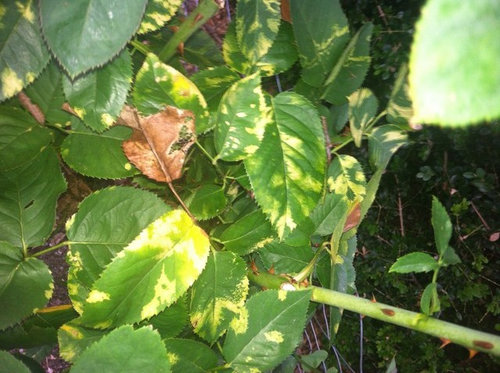
This rose is very healthy and blooms and blooms. Is this RMV or something else? I have two more pictures but don't know how to post more than one at a time.

Comments (18)

  • 13 years ago

    No it is not RRD. Your spots look like it may be weather related.
    RRD causes a witches broom look. The growth is red and misshapen. The stems have a LOT of thorns. If you want to see RRD just go to a public planting of Knockout roses. This so called easy to grow rose is getting RRD bad. I looked at some the other day and half of them had it.

  • 13 years ago

    I think the OP was wondering about RMV not RRD.

    If I saw that rose in my garden, I would suspect RMV, but would not worry about it as long as it is a happy plant.

  • 13 years ago

    I have never seen this pattern on a plant that had mosiac
    My bad I looked at it wrong.
    I have had a plant of Ivory fashion that has mosiac in it. It still is growing after all these years!

  • 13 years ago

    This is not an uncommon mosaic virus pattern.

    It doesn't make sense to talk about a typical - or atypical - mosaic virus pattern. The whole point of calling a virus or a virus complex a MOSAIC virus is that it doesn't produce a defined pattern - it is simply produces a :"mosaic". if you want to be absolutely certain of the diagnosis, bring some of the leaves to your County Ag Extension. .

    A number of other plants besides roses can be infected by mosaic viruses or mosaic virus complexes In fact, the first plant virus ever identified was a mosaic virus (tobacco mosaic virus or TMV). Tulip Breaking or Tulip Mosaic - which we now know also to be from an infection by a mosaic virus complex - was described hundreds of years ago. . So these viruses and their diseases have been known for a while..

    There is really nothing that you can do about this condition once a rose bush is infected with it. Some roses live a very long time after becoming infected, and some decline fairly rapidly. Unlike mosaic virus infections in some other plants, there is no evidence that this can be transmitted from one rose bush to another by insects or other vectors. So it's up to you if you keep the bush or not.

    .

  • 13 years ago

    Definitely one of the viruses that cause the symptoms collectively known as "RMV", although it may not specifically be PNRSV, the most ubiquitous culprit.

  • 13 years ago

    There are now about 11 viruses known to infect roses. If these symptoms are appearing now, this appears to be one of the temperature independent types. This means that it cannot be removed by the standard high heat treatment.

    This one is probably not rose spring dwarf (another rose virus not removed by heat treatment), but I will give a link to it as it is spread by aphids. I recommend not assuming that Nature formed roses with the ability to not be infected naturally while viruses have been able to figure out how to infect practically every other form of life. Nature did give roses an immune system which given enough natural exposure will result in an equilibrium with viruses.

    http://home.roadrunner.com/~kuska/rose_spring_dwarf_virus.htm

    In your area of the country possibly your rose could have a virus like Blackberry chlorotic ringspot virus (BCRV)

    http://home.roadrunner.com/~kuska/Blackberry%20chlorotic%20ringspot%20virus%20(BCRV).htm

    Since the name contains "ringspot", this is probably not it, but it gives the idea that this could be one of the newly discovered ones (or one not yet characterized).

    Hopefully, the recent University of Minnesota Ph.D. Thesis (when released), or a publication based on it for the general rose growing public, will be useful (regarding what it looks like and method of spread) to rose growers.

    Here is a link that might be useful: request for pictures of infected leaves

  • 13 years ago

    Nicki,
    That's not exactly correct about mosaic definitions. Mosaic is a symptom that is characterized by sharply defined edges of the discoloration. And that is what this rose shows.

    The alternative is Mottle. When a leaf has a mottle symptom, the gradation from discoloration to 'normal' is smooth and gradual. Ringspot viruses are so subtle on some plants that they approach mottle.

  • 13 years ago

    annin6b::

    I wasn't speaking of the pattern's edge characteristics, I was speaking of the pattern itself.

    It was in response to a previous post that said they had never seen this pattern on a rose with mosaic. I was pointing out that there is really no "typical" mosaic pattern.. Obviously, a mosaic pattern is a mosaic, and not a mottle, a ring spot, or any other type of pattern. .

    I really didn't want to get into the technical details of virology.

    The link below is an .excellent introduction to plant viruses and virology for anyone who is interested in going further into the subject.

    Here is a link that might be useful: Introduction to Plant Viruses, the Invisible Foe

  • 13 years ago

    Thanks to all for the input. Here is another picture of the same bush in another area. I will keep it going for as long as possible. Seems to be doing well and puts out tons of blooms.

  • 13 years ago

    If one or more of your other roses near it develop similar symptoms, please let us know.

    Perhaps the Minnesota group would be interested in characterizing it.

    Here is a link that might be useful: link to group characterizing new rose viruses

  • 13 years ago

    Actually, there are a couple of roses nearby that have the same look. One is the same variety. I saved 20 roses from a garden several years ago-- these we're two of them. All turned out to be pretty popular roses it seems. These two are pretty well know I'm sure- for someone that knows more roses than I.

  • 13 years ago

    I don't see anything odd or unusual about those markings -- it's just virus of one sort or another.

    Been there. Seen that.

    Jeri

  • 13 years ago

    Jeri, do you observe your viruses in the heat of summer?

  • 13 years ago

    Yep - it's RMV ... and yes, Henry - some roses will exhibit RMV in the heat of the summer. Granted, it's not as prominent as after a hard winter. I had a few roses that exhibited RMV all season long a couple of years ago after an unusual week-long period of sub-freezing ice in Atlanta. Even this season there are some roses that will exhibit a stem or two with RMV leaves.

    I have a Blaze where the RMV is bad enough on a few stems that the leaves are deformed. This happened on the other RMV roses after the hard winter mentioned above, too. ("Hard winter" is from a Hotlanta perspective. ;-) )

  • 13 years ago

    rosetom, 2 possible explanations for symptoms in the heat of summer come to mind.

    1) This is what I posted earlier in this thread: "There are now about 11 viruses known to infect roses. If these symptoms are appearing now, this appears to be one of the temperature independent types. This means that it cannot be removed by the standard high heat treatment."

    OR

    1. These may be roses with multi virus infections. It appears that the rose immune system "breaks down" when more than one virus is present.
  • 13 years ago

    The thread linked to below has a post (August 16, 2013 10:03PM) about where to send "unusual" virused infected roses for testing.

    Here is a link that might be useful: thread with post on where to send

  • 13 years ago

    Which ever RMV it is it's probably not an automatic death sentence. I have roses with RMV that are 20 or 30 years old and still going strong. And I have mighty cold winters most years. The symptoms do show up most often when the plant is stressed for some other reason like heat or drought. Otherwise you wouldn't be able to tell which ones they are. They grow and bloom with the best of them.

  • 13 years ago

    seil, I recommend that any that you have that show up with heat be sent for testing. At least send pictures of infected leaves.