Software
Houzz Logo Print
emmi331

Tree for a shady area

16 years ago

My neighbor has tall trees along a 4-foot fence along the side of my yard. Their canopy is high, so I don't have much privacy. I'd like to know of a tree that would grow under this canopy - or even a tall shrub (8+ feet high). I'd like to plant this type of thing on my side of the fence. I'd prefer a deciduous tree; the shrub could be an evergreen, though. I don't want pine or fir. Any suggestions would be appreciated. This is a very shady area! Thanks....

Comments (8)

  • 16 years ago

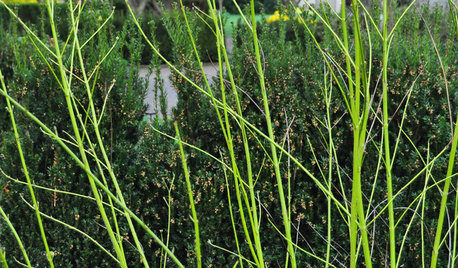
    Red Twig Dog Wood.

    Supplement the soil by adding large amounts of peat moss & fine vermiculite. Then water them all the time, keep them wet as much as you can. They grow in riprian area and tolerate standing water / flooding. In my experience dog woods that are heavily watered grow quite well even in areas that only get a little bit of light at the beginning or end of the day.

    Adding in organic matter (compost) when you plant them is great also if you can. If not, mix in a generous amount (look at the label so you don't use too much and burn them) of osmocote.

    They respond well to Miracaid for acid loving plants 20-20-20.

    Don't forget to mulch with a shredded bark mulch.

    These bushes are far more tolerant of abuse and change than most trees.

    They also respond very well to coppicing done at the proper time of year, making it very easy to manage them if they get overgrown.

    If cost ins't a issue, start with plants in about 3.5 to 5 gallon nursery pots that are already about 3' to 4' tall. In my area, these would cost around $30 each from a quality nursery. If cost is an issue, they still grow fast from small plants, but will put you a year behind.

    Good Luck
    Jamie

  • 16 years ago

    You could also consider Japanese Red Maples. They are beautiful as well.

  • 16 years ago

    I don't think japanese maples are shade-loving trees..it's a common misconception. They like sun just as much as any other maple but can withstand part sun.

    Red twig dogwoods also require at least part-sun to have a decent red trunk. They are also invasive.

    Do consider oak-leaf hydrangeas. They don't mind some shade and can get to 8' tall. I'm not sure if they would be evergreen or not in your zone. I don't think you'll be able to find a tree that would meet your requirements.

  • 16 years ago

    Don't red twig's only spread by suckering or do they readily grow from seed? I've not seen any of them growing from seed off of my 60 or so dog woods. The new growth if it would even be considered suckering has been minimal and it would be quite easy to control the spread. - Just based on my experience here in WI.

    My dogwoods have tolerated and even done well in areas that get very little light, I have a number of them that are under the canopy of my Norway maple, so they only get small amounts of light peaking through at the right time of day.

    I have a lot of trouble imagining it being very invasive in the typical residential lot. The places I have seen them grow heavily are swampy low land ditch type areas that are wet much of the year.

    Jamie

  • 16 years ago

    In my experience they have been terribly invasive...My Grandma had one on the top of a hill and it literally got to be as big as a garage.

    My Mom had one in her front yard in the city and sure enough it started suckering and spreading so she yanked it before it could take over.

    The branches that hang down come in contact with the ground and make new roots/points of growth.

  • 16 years ago

    "native from Newfoundland to Manitoba, south to the central United States. It is even found on the west coast of the United States and down into the mountains of Arizona and New Mexico"
    http://www.hort.uconn.edu/plants/c/corser/corser1.html - Cornus sericea Redosier Dogwood

    By redtwig dogwood are we talking about that species?

    I have a few planted in sun to cut down headlights from passing cars at night. They do spread by suckering very well. My mower keeps them in check though and much like the native sumac while they might spread if I'm understanding which species of plant they are they're native to the Central U.S. where I am so it isn't like a Chinese Empress tree or Honeysuckle displacing natives.

    I've put a few cuttings in shade to test their rooting. Most made it and are living as well as you could hope with no further aid from me. This fall I'll be able to check on their color.

    Of note, you need to trim these virtually to the ground to get the best winter red stem color. If you don't you get more flowers and berries and the most striking red on the new stems while the older ones with "bark" look brown with red streaks. Still not unattractive by any means.
    *****************
    MANY Japanese Maples have dainty foliage which needs protection from mid day sun. These are the Dalmatians of the tree would. Instead of being bred for a tolerance to a wide variety of conditions or the best hearing they're bred for color.

    If you order a Acer Palmatum "Purple Ghost" for $100 its a different tree than going to your state forestry web site and ordering a dozen Acer Palmatum for $25.

    "Acer palmatum includes hundreds of named cultivars with countless forms, colors, leaf types, sizes, and preferred growing conditions. Heights of mature specimens can range from 0.5 m to 25 m, depending on type. Some tolerate sun, and others like shade. Almost all are adaptable and blend well with companion plants. The trees are particularly suitable for borders and ornamental paths because the root systems are compact and not invasive. Well drained soil is preferred, and the trees grow strongest when not over-fertilized. Many varieties of Acer palmatum are successfully grown in containers.[7]"
    7. # ^ Vertrees, J.D. (1987) Japanese Maples. Timber Press, Inc. ISBN 0-88192-048-7
    http://en.wikipedia.org/wiki/Acer_palmatum
    *********************

    Personally if this is a 100 foot or less row I'd order a couple dozen different shrubs to vase shaped trees that are not prone to sucker to plant in there which tolerate shade.

    1. You'll get a great variety of happenings. Some will flower, some will have great fall color, some will get berries in July, some August, something interesting year round.
    2. When the magic Emerald Viburnum eating Chinese communist beetle or whatever is next invades it won't wipe out your whole row. Planting all of one species leaves you vulnerable.

    Oh, and post a pic Emmi!

  • 16 years ago

    Shrubs:
    Buxus ("Boxwood")
    Enkianthus
    Euonymous (any)
    Hydrangea (any)
    Ilex ("Holly")
    Rhodotypos scandens
    Symphoricarpos ("Snowberry")

    Link below has other suggestions.

    Dax

    Here is a link that might be useful: Ohio State: Rhodotypos scandens

  • 16 years ago

    I'm bumping this up from the recent past to thank everyone for your excellent suggestions. I will consider especially the red-twig dogwood and the euonymous, as they add nice color.
    Incredibly, I have a "burning bush" (can't remember formal name) that was planted years ago in light shade that has turned into deep shade - and it's thriving. I thought it would die in the darkness, but it gets bigger every year and is bumping into things around/above it. Perhaps due to its position, it is VERY late every fall to turn its signature bright red. But it makes it! - usually after plants around it have dropped their leaves.