My builder uses Houzz Pro to plan the timeline and give detailed estimates and daily updates with photos of progress, and provide invoices at pre-agreed key points in the build. This made the whole experience much more efficient and stress-free.
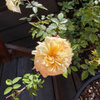
It's not a chimera -- that term gets tossed around incorrectly quite often. What this is is an example of a partial reversion or sporting -- there are pictures on HelpMeFind for 'Quatre Saisons Blanc Mousseau' showing similar partial reversions even within one flower.
My thoughts on most "sports" is that they are not actually genetic mutations, but rather changes in how the genes are expressed, which is passed on via vegetative propagation (and also breeding, if the change in genetic expression is a result of methylation or a similar epigenetic phenomenon that is maintained in germ cells). The way it would work is like this -- when you see a branch "sporting" to a different flower color, or with the addition of moss, or into a climbing version, what you're seeing is genes present in the plant as a whole which are now expressed to a greater (or lesser) degree because of the arrangement of the DNA within the cells. But the actual sequence of genes remains the same.
To give a simple explanation -- think of the genes as a list of ingredients in a recipe. The level of expression would be comparable to the quantities for each ingredient in the complete recipe. When a plant "sports" according to my idea, the ingredients don't change, but the quantities do. So if the recipe originally lists "eggs" and the quantity expressed is usually "2 eggs", a "sport" would result when, for whatever reason, the cell starts putting "4 eggs" into the recipe.
This is a normal part of cell differentiation -- all our cells (except RBCs and eggs/sperm) contain all the same genes, but vary in the degree to which particular genes are expressed. This differentiation is usually fixed in most cells, with some exceptions. In plants, there is more flexibility regarding differentiation, allowing us to induce root cells to form on branches. It's probable that this "flexibility" leaves plants more prone to "sporting" than are animals.
This change can result from proteins attached to the DNA strand, or methyl-group molecules, increasing or decreasing transcription rates of certain sections of the DNA. These changes can (but not always) be transmitted to offspring produced by sexual reproduction, but are most easily maintained in plants via asexual reproduction (i.e. taking a cutting of the "sported" branch).
You're welcome. I've read about "sports" in roses and other plants, and cases of "sports" reverting back and forth. If the change originated from a genetic mutation, the odds against going back and forth (i.e. a change in the DNA sequence at the exact same point, and then again back to normal, and then again to the "sport") are astronomical. What's more likely, in my mind, is that the undifferentiated cells in the meristem (the part of plant tissue which can be induced to form just about anything else) must undergo differentiation, which involves mechanisms regulating gene expression. These mechanisms involve how the DNA is folded, which molecules attach and where, etc. which result in some genes having "easier access" for transcription than others. And this process is more prone to both "errors" and "reversions" than actual changes in DNA sequence.
What's interesting to me is how this explains moss roses, which are claimed to have originated as "sports" among centifolias and Quatre Saisons. The ancestral species of damasks includes R. fedtschenkoana, which has similar mossy growths. Most damasks lack this phenotype, but the genes for it are still there -- perhaps genes from R. gallica and/or R. moschata interfere with this expression, but in the first mossy "sports", those interfering genes were "silenced" or otherwise reduced in expression, allowing the effects of "moss" to reappear.
Centifolias are thought to be a complex mix of roses, including damasks, and so it seems reasonable to assume that they similarly inherited genes responsible for the "mossiness" in R. fedtschenkoana as well as the "interfering" genes from the other species, and so also contained the potential for re-expression if their "interfering" genes were similarly silenced or reduced in expression. The further breeding of mosses from these sports allowed for selection of higher degrees of "mossiness" than is found in R. fedtschenkoana. It would be interesting to see if healthier moss roses could be bred by using R. fedtschenkoana with existing moss roses, since the wild species doesn't seem to be as prone to mildew as the domesticated moss roses are.
Off-topic, but if the proposed parentage of damasks is correct, perhaps breeders can "re-make" damasks by putting R. fedtschenkoana pollen onto the OGR 'Dupontii' which is claimed to be a R. gallica X R. moschata (or vice versa) cross. Or, perhaps even more interestingly, one could try using one of the purple gallicas with "Secret Garden Musk Climber" instead of pure R. moschata, and selfing the offspring, hoping to find a purple-flowered repeat-blooming plant, and then put R. fedtschenkoana pollen on that, and selfing those offspring. Maybe we could get a repeat-blooming purple-flowered damask from scratch.
I remember that that was one of his projects, but he was basically transferring the mossing trait onto a modern plant, not breeding reproductions of the old repeat-blooming mosses. Going back to the source, we might not have to "breed out" mildew attraction in mosses. I wonder how with current roses available and different selection criteria the old classes might be "remade" from the ancestral species. I don't have the resources for doing many of the things I'd like to do, so they mostly exist as thoughts in my head which I share with people who might be able to make them happen on their own.


AquaEyes 7a NJ
jerijen
Related Professionals
Little Rock Landscape Architects & Landscape Designers · Alexandria Landscape Architects & Landscape Designers · Waterbury Landscape Architects & Landscape Designers · Brainerd Landscape Architects & Landscape Designers · Carson City Landscape Architects & Landscape Designers · Bend Landscape Architects & Landscape Designers · Effingham Landscape Contractors · Toms River Landscape Contractors · Davenport Landscape Contractors · Gary Landscape Contractors · Chico Landscape Contractors · Concord Home Builders · Orangeburg Home Builders · Mansfield Home Builders · Logan Home BuildersAquaEyes 7a NJ
jerijen
AquaEyes 7a NJ