Software
Houzz Logo Print
obliviousrookie

Green Garlic

21 years ago

I'm new to garlic this year and have a few questions. Is what I see being referred to as "green garlic" only the scape and leaves of the garlic, or is it the cloves that have just not been dried out yet? What is the flavor of garlic like if it has not yet been dried out?

Comments (16)

  • 21 years ago

    Almost, but not quite. Green garlic refers to scallions that are grown from garlic instead of onions. There are seveal ways of doing this: you can, for instance, plant an entire head and harvest the greens as they appear in a bunch. Or you can plant cloves very close together (like an inch apart) and then dig the individual plants as you want.

    The flavor of garlic has a lot to do with both variety and growing conditions. Curing the garlic (which is not really drying it out---you're just drying the outer skin layers and the tops) is done for keeping purposes. Fresh garlic, which has not been cured, will taste just like the cured version of that variety except it will be a little juicier. And maybe have a "fresher" taste, whatever that actually means.

  • 21 years ago

    Most all of the greens from my hard neck garlic are flat blades right now. I also grow garlic grass and that stuff is also flat leaves, but with bump in the center that runs the full length of each leaf. Compared to scallions, which are round, there is quite a difference.

  • 21 years ago

    Ken, we use the word "scallions" here as a generic term so folks like Rookie have something to refer to; that is, a young allium including the leaves and minor bulb (if any) that is used fresh.

    Taxonomically, all garlic has flat leaves, whereas onions have round, tubular ones. Garlic leaves are solid; onions hollow. That's one of the ways you tell them apart.

  • 21 years ago

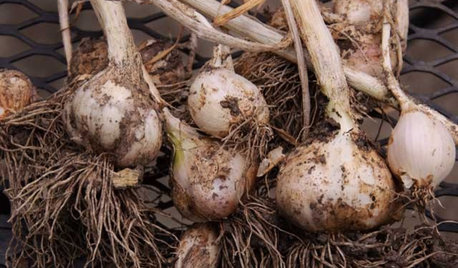
    Here's some green garlic I just dug up. I'll chop it fine and saute in oil, then freeze for summer and winter use.

    [Click picture for larger picture]
    {{gwi:363108}}

  • 21 years ago

    Gardenlad, yup, thats what I was trying to say, excpet not as non confusing as your explaination. In the photo above , the garlic near the bulbs is a purple color, so I must assume that it has some purple in the cloves later on? I always thought of the word scallion as being an onion top (green part), but I guess you could call the top of a garlic plant as a scallion too, but it does look very different.

  • 21 years ago

    Nobody likes a show-off, Earl. :>)

    Seriously, what was the growing time to reach that point? I'm thinking we might be able to give Garlic Lady a better fix (see her thread about green garlic in the fall) on how long it takes to reach that point. If you haven't seen that thread, she's trying to determine when to plant cloves to harvest green garlic in October & November.

    Ken: "Scallion" usually does refer to onions, except in those parts of the country where it refers to shallots.

    Nomanclature can be a real problem, sometimes, because we so often use the same words to mean different things. I've even heard the bulbs of spring onions referred to as scallions.

    Another, similar case, is the term "bunching onion." For most of us who grow alliums, bunching onions refers to specific varieties and how they grow. That is, perennials which grow in clumps.

    But commercial growers, particularly in the past, called scallions bunching onions because of how they were prepared for market. Although I have no idea what it is, I'm sure there is a standard for defining a "bunch."

  • 21 years ago

    Here, a scallion is the green top from a very small onion, whereas a shallot is a purple layered onion dug from the soil.

  • 21 years ago

    Around here "scallions" is not usually used we call them "spring onions" and it is the whole plant.
    If i use the term scallion some one always thinks I mean shallot(not a common thing around here).
    I often use the term "spring garlic" to oldtimers around here when talking about green garlic because they understand the term "spring onion" and then understand spring garlic as an immature garlic.
    Where you live does does make a difference in terminology- be it correct or not.

  • 21 years ago

    You're so right about geographic differences.

    Spring onions, around here, have actually bulbed out somewhat, with onions about an inch and a half in diameter. Scallions, on the other hand, have a "bulb" that's white, and just a bit thicker than the plant itself.

    Differences in nomanclature rarely matter on the local level. But, on forums like this, we often think we're communicating when where not, because somebody says X and somebody else thinks Y.

  • 21 years ago

    Scallions, on the other hand, have a "bulb" that's white, and just a bit thicker than the plant itself.
    ***********************************************
    So do spring garlic as they should be called.Compare either to Earls pic above.
    ********************************
    I'm thinking we might be able to give Garlic Lady a better fix.
    see her thread about green garlic in the fall.
    ****************
    I dont think it will be easy to mimic the spring garlic bunches in the fall.It usually takes a full garlic head after its been dried or even after the leaves turn brown and fall off if not pulled to start regrowth after a few months sometimes.But you never know.
    **********************
    Takes from first growth in early spring anywhere between 7-9 weeks to get to the stage that Earl shows above,possibly less time in other zones but thats what it takes here in my z5.I do as Earl does and miss or forget to dig a few bulbs when they are ready for this spring bunch to happen.
    Bill

  • 21 years ago

    >So do spring garlic as they should be called.Compare either to Earls pic above. You're just reinforcing the indea that there's no standardized nomenclature, Bill. If they were onions, at the stage in Earl's pix, I would call them either scallions or green onions. Spring onions, on the other hand, have fully developed bulbs, only on the small side.

    I find it curious, too, that Ken says that only the tops are eaten, no matter what they're called. Is that a New England thing, I wonder? Sure sounds like a waste to me.

  • 21 years ago

    Martin
    I think Ken says he thought tops were called scallion.I'm sure thats not what he meant to come across for our interpretation.
    New England thing-I have always called garlic clumps of undivided bulbs=spring garlic and I do enjoy eating the whole plant except the tiny root hairs stuff.Single real onion scallion from seed I cant see wasteing time on I'd rather not have to plant seed and the spring garlic clumps work just fine.I will admit the plants are ready size as in earls pic around here at the same time the Vidalia onions hit the stores and we go with a few 5 lbs of those with the spring garlic used scallion like in salad or a few clove/leave sheaths stuck into a sandwich.
    Bill

  • 21 years ago

    No comment! :-)

    Martin

  • 21 years ago

    Well we do cut down a small amount of thw white portion of the small bulbs of f the scallions, but around here, most people only cut the greens into small pieces and toss the whitish parts and any roots. Sometimes these have dirt in them and its hard to remove, so that might be why they toss them. Leeks are terrible around here as they are always loaded with dirt down at the bulb area. My garlic grass/chive has a mostly flat leaf and these are never dug up for the bulbs as there isn't much left. They do tend to grow in clumps though, even though I had a few single shoots pop up at the end of my asparagus bed where they used to reside. My shallots have tubular leaves right now, and are expanding in the soil to form clusters (I hope).

  • 21 years ago

    Ken, it's hard to not have soil between leek leaves. It's part of the very nature of how they are grown. But it's certainly worth the time it takes to clean them properly.

    As to scallions having dirt, I'm only aware of that being on the outside. If it doesn't come off easily with water and, rarely, a veggie brush, then just peel off that layer.

    You're really missing out on not eating the white part.

    Ironically, most formal recipes, discard the tops. Just think how many recipes you've read that say, "chop scallions, including a small part of the green tops, ......"

    My Mom was that way. She'd insist that the green parts weren't edible. Took me a long time to realize that the whole plant (excluding the root hairs) should be utilized.

  • 21 years ago

    With chives and scallions, I use all the greens, and most of the white on the scallions. As for leeks, the greens are a bit tough as far as I experienced. I do use most of the bulbs of leeks. But as we say, they do carry a lot of dirt in there. Alton Brown (Food network- Good Eats) had a really nice way to remove the sand. Unfortunately, now that I can't smell as well as I used to, the flavor of onions and garlic are hard for my taste buds to experience. I can peel a bushel of onions and not even shed a tear. Worked, for years, with many acids an corrosives, along with lots of chemical solvents. Thats probably why my kidneys are failing now. Many of the things I used to breath in at my job are now banned, or are considered hazardous materials. For scallions, I use all of the green tops, unless they are brown.

Sponsored
Schlabach Woodworks
Average rating: 5 out of 5 stars21 Reviews
Franklin County's Reclaimed Wood Professionals