Software
Houzz Logo Print
kdjoergensen

amaryllis - blooming again

20 years ago

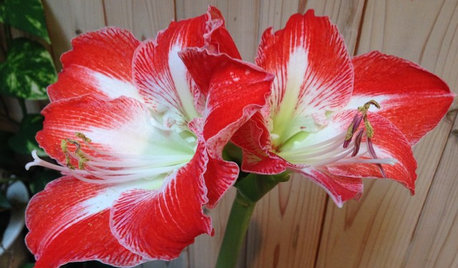
My Orange Soverign is blooming again this year:

Do you see the 3rd flower stalk coming up ? (and the offset on the side ?)

Last year, this bulb produced a nice size offset which is growing in a seperate pot.

This bulb had it's problems with insects, but it is still going strong.

{{gwi:386170}}


{{gwi:386171}}


{{gwi:386173}}

Comments (28)

  • 20 years ago
    last modified: 11 years ago

    This bulb produces 3 stalks year after year? Do you leave it in that tiny pot all year? Please post your care regimen.

    Plant_Guy

  • 20 years ago
    last modified: 11 years ago

    Yes, this is it's 4th year blooming with minimum 3 stems (one year it was 4 stems).

    I grow it in this pot through may and then plant outdoors in a planter with annuals where it gets plenty of sun and fertilizer through the summer. In fall, before first frost, I bring indoors and let leaves die back. Then rest the bulb for about 2-3 months until flower scapes and/or leaves show at the nose of the bulb. Then I replant.

    See below:

    Reblooming instructions here
    {{gwi:386174}}


    {{gwi:386175}}


    {{gwi:386176}}


    {{gwi:386177}}


    {{gwi:386178}}


    {{gwi:386179}}


    {{gwi:386180}}


    {{gwi:386182}}


    {{gwi:386184}}


    {{gwi:386186}}


    {{gwi:386189}}


    {{gwi:386191}}

  • 20 years ago
    last modified: 11 years ago

    Hello
    How much SUN (hours/day)?.
    How much fertilizer?.
    Size of the planter?.
    The growing media?.
    Please if you do not mind.
    Many of my potted plants do not bloom every year.The information will help me a lot.
    ARIF

  • 20 years ago
    last modified: 11 years ago

    Hi kdjoergensen. I knew those pictures looked familiar which really help for newbies like myself. I've bookmarked your article Fantastic Christmas Amaryllis from Suite101.

  • 20 years ago
    last modified: 11 years ago

    Very nice and informative pictures. Thanks for sharing kdjoergensen. I liked the way you planted the Amaryllis in a planter with petunias. I would definitely do that with my Amaryllises. How big was that square green pot that you used by the way?

  • 20 years ago
    last modified: 11 years ago

    Yes, it would be interesting to answer four questions:

    1) Potting medium
    2) Fertilizing regimen - fertilizer type/frequency
    3) Size of planter
    4) Do any other cultivars of yours perform routinely with 3 stalks, or just that one?

    Thanks in advance for your time and sharing.

    Plant_Guy

    Here is a link that might be useful: My Amaryllis Site

  • 20 years ago
    last modified: 11 years ago

    Ok.. everyone has their own way, but here is what I do:

    After the flower stems have died back, I cut them off at nose level and start to fertilize.

    I grow the amaryllis indoors in a pot which is about 2" larger than the widest diameter of the bulb. I do not fertilize indoors until after flowering. Then I usually use a soluble fertilizer like Miracle grow 15-30-15, or Peters 20-20-20. I fertilize with every 2nd watering after flowering (not before flowering).

    In early summer, after last chance of frost, I remove the amaryllis from it's pot and plant them where they can get full sun (in New Jersey). Full sun is 12 hours or more. If you live in Pakistan, then maybe full sun may be too much (I do not know) but I would think that atleast morning sun is fine, even if protected from hot afternoon sun. This is one plant which does really well with sun, however.

    It is also a very heavy feeder. Planted in a container planter with wave petunias, I fertilize the petunias and the amaryllis get what the petunias get. You probably know that wave petunias are very heavy gross feeders and I usually end up fertilizing monthly with 5-10-10, 10-10-10, or 10-20-20 (annual plant fertilizer) and even add occational applications of soluble 20-20-20 (liquid fertilizer mixed in water) to the pot.

    The particular planter is 18" square and hold 4 petunias and the amaryllis in the middle. The green amaryllis leaves act as a good center for the cascading petunias.

    Most amaryllis plants which I grow (Orange Sovering, Maveria, apple blossom) always give minimum 2, but often 3 flower stalks.

    I find that lack of flowers for an amaryllis plant is almost always due to: too little sun, fertilizer, and water (draught stressed) during the active growing season. If you fertilize enough and the bulb produce several leaves then flowering WILL follow. The bulb does not need a rest period (but you can give it one, if you like me have cold temperatures). However, if not, the plant will bloom on it's own eventually.

    If you fertilize sparingly, let the bulb go through excessive wet/dry cycles, or do not give enough sun then bulb will not expand in size, leaves will not be produced in abudance, and flowering will cease.

    The more leaves which are produced during an active growth season, the more flowers you will eventually get. My own back-of-the-envelope calculation says that for every 7-8 leaves, you will get one flower stalk with 4 flowers. 14-16 leaves produced during the summer and you will get 2 flower stalks. 21-24 leaves and you should have 3 stems.

    The bulb should be planted in moisture rententive soil which holds fertilizer nutrients well. However, the soil must be well drained. Potting soil is just fine, but heavy clay is not.

    Note: indoors, use a pot which is only slightly larger than the bulb itself and which keep the bulb a bit rootbound. Slightly rootbound pots means faster and more reliable flowering.

    Outdoors, I plant in deep ,well drained soil. Here it should not be restricted. The roots may grow 2-3 feet long if allowed and the deeper the roots, the more fertilizer is taken up and the bigger the bulb gets.

    e.g. indoors: keep slightly rootbound in pot.
    outdoors, give them space to grow deep roots.

    This is just my own experience. I am sure there is other ways.

  • 20 years ago
    last modified: 11 years ago

    Wow, 21-24 leaves? I have grown these bulbs for over 25 years and I've never had a bulb produce even 20 leaves. I get 8-12 leaves usually. My regimen is very much like yours. There is only one difference (maybe). When the amaryllises are indoors, the light is very dependent upon the time of year as they are in my house's atrium below two large skylights. It is always bright during the day, but not much direct sunlight. In summer, the majority of the bulbs get planted directly in the ground. I find that here in NY on Long Island, my bulbs do best when they have a little shade from around 11am to 1pm. The ones on the side of the house with filtered sunlight grow giant leaves, 3feet long, while the ones in full sunlight sometimes don't grow more than 12". They all rebloom, just not three scapes, that's all. Thanks for sharing your regimen with us.

    Plant_Guy

  • 20 years ago
    last modified: 11 years ago

    When the roots become that long over the summer in-ground, it must be difficult to repot them into small pots? Do you trim the roots a bit?

    Anna

  • 20 years ago
    last modified: 11 years ago

    ...Trim...
    This will be inevitable

    The coherence or the functional dependance between leaf count and number of initiated scapes can be somewhat precised:
    If - during the growing season - less than 6 leaves appear than that indicates a disorder, and a subsequent formation of a scape is not so very likely.
    6 Leaves are good for 1 scape;
    8 leaves two scapes
    and principally every 4 leaves more means one scape more.
    In one average growing season there emerge seldom more than 14 leaves.
    However, if the bulbs are nursed indoors at a very good windowsill place or, particularly under artificial lights, some more leaves might emerge.
    The maximum I ever observed was approx. 20 leaves of my mother bulb of "Cantate" during a prologed growing season with extra good light indoors, situated at a very big window in my former office.

    From my own experience I have none indication that a limited pot size exercises any advantageous effect on the growth and the performance of knight star lilies.

    Orange Sovereign is a cultivar which does not care so very much of the traumatization during this principally major drawback by becoming disposed of its majority of roots and then being repotted into a smaller pot (I like to assign this pot size as a "root prison".

    If I would husband a more pathetic cultivar (as regards to growth properties) like Pink Floyd under this kind of cycling the result would be a total failure.

    Hans-Werner

  • 20 years ago
    last modified: 11 years ago

    This is very helpful Hans-Werner..

    Your note on the requirement (or actually lack of requirement) to provide a rootbound environment is something I have always read/been told.

    However, my own growing experience has not been able to confirm it. In fact, I find that the amaryllis (hippeastrum) cultivars which I have grown generally do better in a larger pot. The root growth is better, and the bulbs seem to flower nevertheless. Maybe this is one of the old "tales" which are difficult to get rid of.

    I usually find that the bulbs bloom just fine in a the larger the pot, and the bulb does seem to grow bigger the more soil there is around the roots.

    Maybe time to revise the recommendation to use a smaller pot ??

  • 20 years ago
    last modified: 11 years ago

    I usually pick off some of the older, drier roots from the base of the bulb, but I generally do not trim the remaining roots back.

  • 20 years ago
    last modified: 11 years ago

    I honestly believe that this recommendation started with the growers so that cultivars purchased by customers like us would never achieve full growth potential and not produce offsets. This would ensure a constant buying cycle as people would get tired of bulbs getting smaller each year, and not flowering frequently.

    Plant_Guy

    Here is a link that might be useful: My Amaryllis Site

  • 20 years ago
    last modified: 11 years ago

    I have always been doubtful of the tight pot advice & get great results with 12 inch or larger containers. I thought the common advice of a pot 1 inch larger than the bulb was a modern construct that went along with the bulb-in-a-box death kits but not so. I found a book from 1958," The Amaryllis Manual " written by Hamilton P. Traub,Ph.D. . And in it he advises the same thing,1 inch larger than the bulb. It makes no sense to me and the only explanation offered was that tight pots kept roots from rotting. I think careful watering is more important to rot issues than pot size.
    BTW, if you can find "The Amaryllis Manual", it has some great information about breeding,ploidy issues,etc. Lora

  • 20 years ago
    last modified: 11 years ago

    Some plants can be induced to flower if you stress them mildly. E.g. plenty of growing space, water and fertilizer and you get lush green growth. Holding back on water to induce mild (!) draught stress, keeping them slightly rootbound and/or stopping fertilizing of nitrogen for a few weeks can make some plants flower better. I find this to be true about impatiens for example (as long as you do not go overboard and dry them out completely).

    With amaryllis, I have heard the same thing about 1" around the bulb and slightly rootbound. I suspected that it was similar to the above description (e.g. slightly rootbound = induced to flower) but I must admit that it has not been consistent.

    I have found something else to be true, however.
    Amaryllis will eventually flower in their own good time, but it is possible to force/program flowers earlier. If you
    dig up the bulbs, withhold water until leaves die back, and then store them dry for 6-8 weeks, this will put them into a semi dormant state.

    At the end of this period, the amaryllis will bloom as soon as re-started (some will even start to grow flower stalks in storage before being planted). As long as you have given them 7-8 months of active, healthy growth prior to placing them in dormancy, they will flower. If you have not given them long enough green growing period, they will not flower.

    If you do not dig them up/withold water, the amaryllis will eventually flower when they are ready, but the timing can vary tremendously. If you are looking for "force" (program) flowering, then the above procedure works for me.

  • 20 years ago
    last modified: 11 years ago

    Well, I really dont think stressing plants is a good way to get a decent flush of flowers. Yes, they may bloom but the quality will be much lower.
    I grow for market,between 400-500 a year.If you want blooms for the season leading up to Christmas they need to be put into dormancy the first week of August. I have a spring cooled root celler that I use for storage. If you cut off the green leaves and keep them in the pot to maintain the root system the results are better than bare bulb storage.6-8 weeks of cool is fine but they can be held longer if need be. 7-8 months of growing time before a forced dormancy is fine -but- seedlings should really be grown straight through. It can take a full year or 2 off the wait for blooming size to be achieved. Lora

  • 20 years ago
    last modified: 11 years ago

    Hi
    I agree with Lora.The plant may be stressed if recquired not otherwise.
    I grow Amaryllis for pleasure in natural environment.
    For best results I put them in ground.I use pots for display only.Big planters for clusters and minimum of 10 inch pot for a single bulb. I do not disturb them unless I have to.
    ARIF

  • 20 years ago
    last modified: 11 years ago

    In regards to the 1" bigger-then-bulb-pot rule. How does that apply to growing them in the ground? I have some blooming right now that are in the ground and have been in the ground for years. They are not constricted or stressed in any way and yet they bloom.

  • 20 years ago
    last modified: 11 years ago

    I found something out by accident once. I forgot to water one of my amaryllis pots for a few weeks (it was in a spot where I thought it would get some water, but did not). Once I discovered my error and gave the pot a good soaking, all the bulbs in the pot (7) started growing scapes within the week! All retained their leaves, and all eventually flowered. I haven't tried that since, but if anyone wants to give it a try, post your results.

    Plant_Guy

  • 20 years ago
    last modified: 11 years ago

    Plant_guy

    your explanation supports the stated theory that mild stress prompts flowering. One way is to keep the pot mildly root bound. Another is to promote light water draught stress.

    The key here is MILD stress (not so much to kill or damage the bulbs). Mild stress would force flowering. The explanation is probably that the bulb tries to flower in periods of stress to ensure its survival.

    I think we have just made full circle and are back to the point why it is recommended to pot amaryllis slightly rootbound: While the bulb may eventually flower on it's own, repotting the bulb slightly (not extreemly) rootbound will cause the bulb to flower immediately, as opposed to eventually. Not an unimportant factor if you buy a bulb for christmas.

    This then explains why this is "standard recommendation" from re-sellers. I doubt it is to save money on the pot size (irrelevant). It is to ensure that the customer is happy with their purchase. Most buyers of amaryllis bulbs are not dedicated amaryllis fanatics and don't care about the health of the bulb (most treat it like an annual anyway) -- they want it to flower after planting, and the sure fire way to do this is to keep it slightly rootbound.

  • 20 years ago
    last modified: 11 years ago

    kdjoergensen,

    I still can't see the pot thing. If an amaryllis bulb has been in storage, and if it has scapes in it, it will always bloom when repotted and watered regardless of container size. Also, if left in that pot, my experience has always been that the bulb shrinks to better fit in that pot. This is only my experience, others may have different results.

    Plant_Guy

  • 20 years ago
    last modified: 11 years ago

    Hi ALL
    Now I am thoroughly confused.
    Most plants (specialy fruit plants)Produce more flowers if mildly stressed before flowering season (instinct of survival).And go for vegitative growth given plenty of water and food.
    In Amaryllis scapes form about 18 months before flowering.
    Now, if the stress induces scape formation the flowers of next year would be effected.If it awakens the scapes, it amounts to forcing.
    If the scapes are there you will get the flowers any how.
    What induces scape formation is the question.
    I have some plants which have not flowered for two years although they have grown plenty of leaves.The ratio of three leaves for a scape does not always work.
    ARIF

  • 20 years ago
    last modified: 11 years ago

    ARIF,

    You are right, the interesting question is what prompts scape formation, and how to optimize feeding/planting/care regimens around that one goal. I have not found the "Holy Grail" of Amaryllis care. Also, the general rule of "every three leaves on each side gives one scape on that side" never held true consistently for me. As to your plants that have not flowered in a while, let them dry out for a while, they might be prodded by that treatment to bloom.

    Plant_Guy

  • 20 years ago
    last modified: 11 years ago

    I think the ratio is closer to 4 leaves for one scape.

    Exposing the plant to mild stress will prompt it to flower, but only if it has had a minimum (6-8 months) of green growth. Stressing a plant right after flowering wont make it flower.

    It is correct that flower scapes are created one season ahead. Stressing the plant does not start the formation of flower scapes but it can program a plant to flower (flower scape already developed).

    I think the proper way to explain the "programming" process is not to keep saying "stressed" but to say "interupt the existing growing pattern".

    E.g. impatiens (annual plants in our area) will flower if grown in moderate light with moderate water and frequent light fertilizer applications. Unfortunately, sometimes the plants do not flower. It is not always cut in stone. There are so many different parameters/conditions which can affect flowering (sun, water, temperatures, stress, maturity of plants, etc) that our hard and fast rules sometimes need revision.

    Therefore, I have always found that doing something different works. If you have fertilized regularily, try skipping a few applications. If you have fertilized sporadically, try fertilizing regularily. If you have watered consistently, try to let the plants dry out a bit, or give them more water if they have been kept very dry. If grown in pot, move to a sunnier (or darker) place. Just introducing some kind of interuption in the growing pattern will often result in flowering.

    This being said, the timing and conditions must be right. E.g. impatiens will not bloom earlier than 3-4 months from seed and only when soil temperatures are 65F or higher. Too much sun or too much shade and they will not flower. Here, too much stress (too strong fertilizer, too weak fertilizer, too much sun, too little sun) can prevent flowering.

    So when we say "stressing" or "doing something different" it should still be within the acceptable ranges of the particular plant species. E.g. don't stress a tropical plant with cold temperatures, or an impatiens flower with full desert sun, for example.

  • 20 years ago
    last modified: 11 years ago

    I'm just an Amaryllis newbie but I would like to share some of my experiences in this subject. My first Amaryllis, Dancing Queen, was given to me as a Christmas gift Christmas of 2003. It came with a silver metal 6 inch pot and gave me 2 scapes that time. Spring time, I brought it outside, same pot and it produced 5 leaves. I occasionally fed it with both organic and chemical fertilizer. Christmas of 2004, still in the same pot and soil, it again gave me 2 scapes and again 5 leaves in spring. Same thing happened in Christmas 2005. I didn't get to measure the circumference of the bulb so I don't know if the bulb shrunk or not. Maybe this relationship between pot size/leaf count/scape number all depends on the Amaryllis variety?

  • 20 years ago
    last modified: 11 years ago

    I've been growing amaryllis for several years and have found that for indoor growers, it's important to give the plant a sunny growing spot after blooming and thru the spring. If the plant gets sun thru the Feb-April period, it will have more leaves. As KD and others said, it's the number of leaves (and the carbos they store in the bulb) that determines the size of the bulb and the number of flowers. Some people have given me bulbs that have bloomed for them during the winter, and when I put them outside for the summer with mine, they never have as many leaves as those I have had in my sunny greenhouse. It seems that what they didn't do during the spring, they can't make up for in the summer.
    Another thing I have learned is that it helps to start with good bulbs in the beginning. My new "hobby job" gave me access to the big fat bulbs sold in our garden store, and they have rooted and grown much better than those from the chain hardware stores. I planted some 'Benfica' bulbs in late November, and they bloomed with 3-4 scapes each all thru December and January. After they finished I took the 3 pots out of their paper-lined basket and was surprised to see that 6-12" long roots had grown out of the pots into the damp paper! It was like amaryllis on steroids.

  • 18 years ago
    last modified: 11 years ago

    I experience the same. So when I finally plant my bulbs that finished flowering and seeding out to the garden, I just simply grab them by the leaves, and lift the whole thing out of the pot with its pot shaped root system that grabs onto whatever it was planted in. They are very convenient and very clean plants to handle.

  • 18 years ago
    last modified: 11 years ago

    I am very glad this thread was brought back... there is some very interesting reading here...

Sponsored
Top Choice for Reliable Tile & Stone | Franklin County, Ohio