Software
Houzz Logo Print
misssherryg

Hummingbird Clearwing

18 years ago

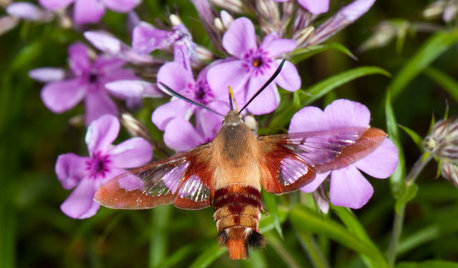
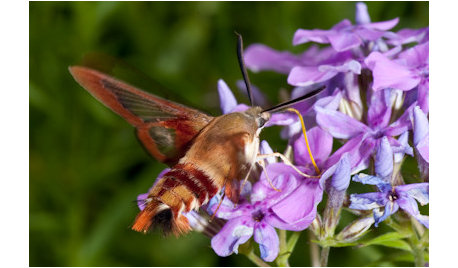
While I was outside working in my garden, a hummingbird clearwing/hemaris thysbe flew to the butterfly bush right next to me. I had my camera, so I made its picture. All the pictures I've seen of h. thysbe show a moth without a white band at the base of the olive green colored part of their back. The ones here all have it, so I e-mailed Bill Oehlke to see if maybe it was h. gracilis, which does have the band, at least the pictures I've seen of it do. He said mine was h. thysbe the usuall hummingbird clearwing - I think they're so cute!

{{gwi:477657}}
I've never found a clearwing caterpillar - wish I'd find one this year!

Sherry

Comments (23)

  • 18 years ago

    Nice photo! I've always thought they looked like a flying crawdad. :-)

    randy

  • 18 years ago

    Hehehe! I knew they looked like something "unlep", but I couldn't put my finger on it, Randy - crawdad is it!
    Sherry

  • 18 years ago

    The coloring is so beautiful. Is that a fuzzy "hair pencil" I see on the tail end? It's amazing the detail you can see in a photo, it almost looks like it's covered with feathers. A flying crawdad, huh? Sounds like a good story.

    Sandy

  • 18 years ago

    Gorgeous, MissSherry! I love the moths, you know. Bill will definitely be able to ID with certainty for you. For the majority of clearwings, the food plants are honeysuckle (loniceras) and viburnums, but you probably know that already.

    Did you check out his website to see what the cats look like?

    Susan

  • 18 years ago

    WOW! Great shot, MissSherry!

    Now that you say it, it DOES look like a Crawdad. :)

  • 18 years ago

    Thanks all!
    Bill ID'd it as hummingbird clearwing/hemaris thysbe - he said that h. gracilis doesn't occur in MS. He wants to use my picture on his website in the hemaris section to help differentiate the various types, so of course I said yes. I also gave him access to my Photobucket pictures, all 406 of them, in case he sees any more he wants to use.
    I've looked up pictures of the cats, Susan. I'll definitely be looking for them on my parsley hawthorns, honeysuckle, and prunus, which would be the ever useful prunus serotina/wild black cherry.
    Sherry

  • 18 years ago

    That's cool Sherry. Maybe some day when I grow up someone will want one of my photos. :-)

    randy

  • 18 years ago

    Yes, Bill has used some of my photos, too, especially of the early instar brown cats.

    Ah, yes, the ever popular wild cherry (P. serotina) which I hope will be useful in the near future. Last year, I only had the furcula moths and the stinging rose cat on it.

    Susan

  • 18 years ago

    Nice pic!

  • 18 years ago

    Here's the photo I took of both the brown and green form. The green cats have a noticeable brown line across the bottom length of the caterpillar.

    {{gwi:477659}}

    I find mine on my honeysuckle - an age old one that has a trunk the size of a small tree. It climbs up the outside point of my lathe which extends from my house in a triangle. The hummers love this area where I keep their feeder, as well as the butterfly feeder.

    Susan

  • 18 years ago

    Thanks, Susan!
    What type of honeysuckle is yours? Japanese honeysuckle grows invasively all over my property, and I've only got a little bit of coral honeysuckle. If they like the Japanese type, they'll have plenty of places to lay eggs.
    Sherry

  • 18 years ago

    It is one of the older yellow blooming honeysuckles, Sherry. I don't know the cultivar, just know it was here when I moved in. It's about 15' tall now. I have JH, too, but have yet to find anything on it. They prefer the yellow. I have my JH in a confined location. The thing about it is that I adore the fragrance of the blooms.

    Susan

  • 18 years ago

    I looked up yellow-flowering honeysuckle, Susan - there's the yellow form of lonicera sempervirens and there's l. flava, whose leaves look like l. sempervirens to me. I haven't been able to grow l. sempervirens well at all around here, for some reason it grows well in the spring, then dies back in the summer, not "sempervirens" at all for me!
    I looked it up again, and hummingbird clearwings also use viburnums, which are in the honeysuckle family - I've got TONS of that! So I think I'll keep an eagle eye on my v. dentatum, v. ashe, v. nudum, and v. bracteatums. Elderberry is also in that family, and it's in bloom right now - I'll keep an eye on that, too.
    I'd love to raise these little sphinx moths and help make them more common.
    Sherry

  • 18 years ago

    They are fun and very easy to raise, too, MissSherry! You may recall that I overwintered a fall crop of them in the fridge one year??? In spring, I just put them in a taller container (a pretzel jar that has to be more than a gallon), with sticks (skewers) to climb on. They all emerged (I had 5 of them) just fine. These are also the ones that I put shredded paper towels in. The pupate in the paper towels and once the bare cocoons have hardened, you can remove the paper towels. I did take them out once a month and give them a bath (I kept a container of water in the same veggie compartment of the fridge) in same temp water to prevent dessication, and put new shredded paper towel bits in with them to absorb the moisture. I didn't want to "rot" them, lol!

    I did not know that Elderberry (sambucus) was in the same family as virburnums! Thanks for sharing that. I have elderberry in my yard, too, but have yet to find anything on it. I check it all the time. I mainly grow it for the birds to have the berries.

    It's raining right now, but I'll take a photo of the foliage on the honeysuckle, but I bet its flava.

    Susan

  • 17 years ago

    Now I see what all the excitement is about. My son and I visited the Crooked Garden today and he spotted it, really wish I'd had my camera for ID. I think it was a hummingbird clearwing (Hemaris thysbe). So now we'll be watching our honeysuckle for caterpillars. Wow that thing was cool!!!
    Anyone finding any of these cats this year and if so, what host plants??
    Kelly

  • 17 years ago

    Love them! They are always a favorite of the visitors on the flowers at the arb. The snowberry clearwing uses obviously snowberry (Symphoricarpos albus), which is in the Caprifoliaceae (honeysuckle) family. Many of the following are good for all;

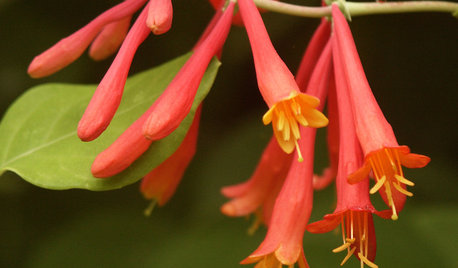
    There are a lot of native honeysuckles you could try. Lonicera flava, yellow honeysuckle, which grows in the south.

    Lonicera albiflora, western white honeysuckle, it is not native to the eastern south but it reportedly does not have the aggresiveness of the amur honeysuckle and is a bush type (which are in my opinion some of the nicest).

    Lonicera dioica, limber honeysuckle, more northern and difficult to find.

    Lonicera sempervirens, I believe this is the common vining coral honeysuckle you get at the nursery and should grow in the south for you. The trick is (and I learned this from a gardener at the arb)is to cut it back to the ground each year and then dump a bunch of old milk on it to prevent powdery mildew. Mine is in a horrible state this year because I did not cut it back. The poor hummingbird who comes to visit it! I swear it sits on the dead branches and looks in my patio window saying "Hey! Get with the program and fix this!"

    Then there is native bush honeysuckle Diervilla lonicera. Looks like the invasive amur honeysuckle but has a smaller more yellow flower. In the south there is Diervilla sessilifolia, a pretty landscaping bush.

    Viburnum nudum seems to be a favorite. Possumhaw, how could you not love a plant with a name like that? The flowers are popular with butterflies too and the drupes are pretty pink and turn purple. There are several cultivars of this plant. In the USDA map it is found as far south as Texas but I don't know how it does there.

    I love viburnums,
    Elisabeth

  • 17 years ago

    That's a moth? I always thought it was a real hummingbird. What is their host plants?

  • 17 years ago

    I have the snowberry clearwings all over my coral honeysuckle. They're the hummingbird moths that look like bumble bees (see link below). The honesuckle grows up and over my patio arbor so I've enjoyed a close-up view of the cats and egg layers this summer. :)

    Here is a link that might be useful: Snowberry Clearwing

  • 17 years ago

    I am currently rearing 8 or 9 of the Hemaris diffinis (snowberry). The caterpillars are extra cute. I try to nab the cats before the birds get them. I have a very popular honeysuckle (probably flava as mentioned earlier in this thread). It is trained like a tree up a very tall post and is so old there are a lot of dead tangled branches on the underside. The birds love to nest in it, the SCs lay their eggs on it, and I hang my hummingbird feeder underneath it and the hummers love to perch on the branches underneath near their feeder. So far, they have not used the Japanese Honeysuckle, wich altho it is a thug, it is soooo fragrant in spring.

    This will be about my 5th year raising H. diffinis. I love the moths and encourage their presence by providing both nectar and hosts for them.

    Susan

  • 17 years ago

    Okay, so my plant list keep growing. L. flava, V. nudum, P. serotina...
    -Elisabeth

  • 15 years ago

    These moths come to visit me so I apparently need to plant some honeysuckle.

  • 15 years ago

    My honeysuckle is Lonicera flava. I have two other honeysuckles in the vicinity, but have never found them on those. Also L. flava is not invasive at all.

    I had a Snowberry Clearwing visit the garden yesterday to nectar on the blooming native Monarda fistula and Verbena bonariensis. They are so cute, but I always take a step back when I first site them because at first glance they look like a huge bumblebee! Yikes! I know, I know, and unfounded fear, but I still hesitate a little when I see them.

    I hope it was a female and she left some eggs. I am currently raising two Eumorphas, an Achemon and a Pandora.

    Susan

  • 15 years ago

    Here in Illinois, we call them hummingbird moths. They are pretty cute little things! They seem to like monarda and phlox (paniculata) especially.

Sponsored
Peabody Landscape Group
Average rating: 3.5 out of 5 stars8 Reviews
Franklin County's Reliable Landscape Design & Contracting